
A US-style SAFE note is a poor fit for a UK company that wants its angels to claim SEIS or EIS relief. HMRC expects investors to hold shares, with their capital genuinely at risk. A SAFE usually promises shares later and often carries protections that cut against that. The UK tool built for the same job is the advance subscription agreement (ASA), and it only works if you keep it very plain.
This guide explains what a SAFE is, how it collides with UK venture capital tax rules, what an HMRC-friendly ASA looks like, and how to decide before a term sheet lands on your desk. It is general information for founders of UK limited companies, not legal advice on your documents.
TL;DR
- A SAFE is a US instrument. In a UK company it can look like debt or like an arrangement that protects the investor, and that can cost your investors SEIS/EIS relief.
- SEIS/EIS relief depends on shares being issued. The agreement itself earns no relief; the share issue does.
- The usual UK alternative is an ASA: no interest, no refund, no right to vary or assign, and a longstop date of no more than six months.
- Advance assurance from HMRC is optional but valuable, and it is not extended if you change the ASA terms afterwards.
- Get the structure reviewed by your accountant and a UK solicitor before any money moves, not after.
Table of Contents
- What a SAFE note is, and why UK founders keep meeting it
- How HMRC thinks about it: shares, risk and timing
- The UK answer: the advance subscription agreement
- Advance assurance: the quality stamp you cannot add later
- Worked example: one company, two paths
- Limits and eligibility you should check first
- When a SAFE can still make sense
- Our perspective
- How we can help
- FAQ
- Sources
What a SAFE note is, and why UK founders keep meeting it
A simple agreement for future equity (SAFE) is an investor’s payment now in exchange for shares at a future priced round. It usually has a valuation cap, a discount, or both. It is not a loan, it has no interest and no maturity date in its original US form, and it is quick to sign. That is why accelerators, overseas investors and US-trained lawyers keep putting one in front of UK founders.
The appeal is real. A SAFE avoids fixing a valuation when you cannot sensibly fix one. The trouble starts when the document is dropped into a UK company without adjustment. Legal commentators at Bird & Bird describe SAFEs as a US-style shortcut that sits awkwardly in the UK, where convertible loan notes and ASAs have long been the standard bridge instruments.
Three features cause most of the friction:
- Shares arrive later. Nothing is issued when the cash comes in.
- Investor protections. Some SAFEs give the investor a payout on a sale, wind-up or insolvency before conversion.
- Mixed characterisation. On a UK balance sheet, an instrument that can return cash to the investor can be treated like debt rather than equity.
How HMRC thinks about it: shares, risk and timing
UK tax relief for angels sits on top of two schemes. The Seed Enterprise Investment Scheme (SEIS) offers 50% income tax relief and the Enterprise Investment Scheme (EIS) offers 30%, according to HMRC’s guidance for investors. Investors also need to hold the shares for the qualifying period, typically three years, to keep the relief and the capital gains tax advantages.
Two points matter for any SAFE-style instrument.
Relief follows the shares, not the signature
SEIS/EIS relief is only available once shares are issued. Signing an ASA, or a SAFE, does not trigger it. After the issue, the company submits a compliance statement (SEIS1 or EIS1), and only then can HMRC authorise the investor certificates (SEIS3 or EIS3). If you are new to that step, our EIS compliance statement guide walks through it.
That has a practical consequence. If your SAFE converts 14 months after the money arrived, the investor’s relief is tied to that later conversion, with all the conditions tested at that point. A long gap makes the analysis harder, not easier.
The risk to capital condition
The condition founders most often misread is risk to capital. In HMRC’s words, the investment must carry a genuine risk of loss, and arrangements built to protect the investor’s money can sink the claim. The detail sits in HMRC’s venture capital schemes manual. The same guidance says an ASA must not behave like an investment instrument that offers extras such as investor protection.
A typical SAFE includes cash-out or liquidity-priority terms. Those are precisely the kind of provision that gives an HMRC officer pause. The investor’s downside is cushioned, so the angel’s relief is exposed.
What this means for the tax treatment of the SAFE itself
People searching for how SAFE notes are taxed in the UK are usually asking two things:
- For the investor: can they claim SEIS/EIS relief? Often not with a standard SAFE, and only with a carefully adapted instrument if at all.
- For the company: is the money equity or debt? If the SAFE can be refunded or ranks like a creditor claim, it can end up shown as a liability. That affects your balance sheet, your next-round negotiations and potentially how later investors view you.
There is no special UK tax regime named after SAFEs. They are tested against the general rules, which is why the outcome depends entirely on the wording. Anyone who tells you a SAFE is simply fine, or simply not fine, without reading it is guessing.
The UK answer: the advance subscription agreement
An ASA is a short contract where the investor pays in now and the company issues shares later, typically at the next funding round. HMRC’s manual explains that ASAs are used to raise funds quickly when share value cannot yet be set, and it lists the conditions under which it will consider them suitable.
For SEIS and EIS, HMRC’s published position is that the agreement should:
- allow no refund of the subscription payment in any circumstance;
- carry no interest;
- not be capable of being varied, cancelled or assigned; and
- have a longstop date for share issue of no more than six months from the date of the ASA.
The SEIS version of the manual sets out the same approach in its own page, which you can read in the SEIS advance subscription agreements guidance.
The six-month limit is where most real-world deals struggle. If your round is likely to take longer to close, a clean ASA may not be the right tool. We cover the trade-offs in ASA and SEIS for UK founders: why six months is not enough and the broader background in our advance subscription agreement guide.
A side-by-side view
| Feature | US-style SAFE | HMRC-friendly ASA | Convertible loan note |
|---|---|---|---|
| Nature | Right to future shares | Prepayment for shares | Debt that may convert |
| Interest | None (usually) | None | Usually yes |
| Refund rights | Often some exit or insolvency payout | None | Repayable on maturity |
| Time limit | Open-ended | Six months for SEIS/EIS purposes | Fixed maturity |
| SEIS/EIS suitability | Generally poor | Possible if every condition is met | Not suitable, debt is not eligible |
| Typical use | US and accelerator rounds | UK pre-seed and seed bridge | Bridge from lenders or non-relief investors |
The convertible loan note column is worth a pause. A CLN is a loan, and the manual treats the investment as needing to be equity from the start. If your investors want relief, a CLN is not the answer either. Law firms such as RW Blears set out the practical differences between ASAs and CLNs clearly if you want a legal angle.
Advance assurance: the quality stamp you cannot add later
HMRC advance assurance is a discretionary, non-statutory service. You do not need it for a deal to proceed, but investors treat it as reassurance that the company and the shares look eligible. With an ASA there is a sharp edge: HMRC will not give further assurance if the terms change after the first assurance has been granted.
So the order of work matters:
- Settle the commercial terms with your lead investor.
- Have the ASA drafted to meet the HMRC conditions above.
- Apply for advance assurance with the ASA attached.
- Sign only the version HMRC reviewed.
- Issue shares inside the longstop date and file the compliance statement.
If you want the application mechanics, see our guides to SEIS advance assurance and EIS advance assurance. A rushed application with the wrong ASA is the most common way founders lose weeks.
Worked example: one company, two paths
This is an illustration, not a real client case.
A London software start-up has a seed investor ready to put in £100,000 and a priced round expected within the next year. The investor sends a standard US SAFE with a valuation cap and a right to receive their money back first if the company is sold before conversion.
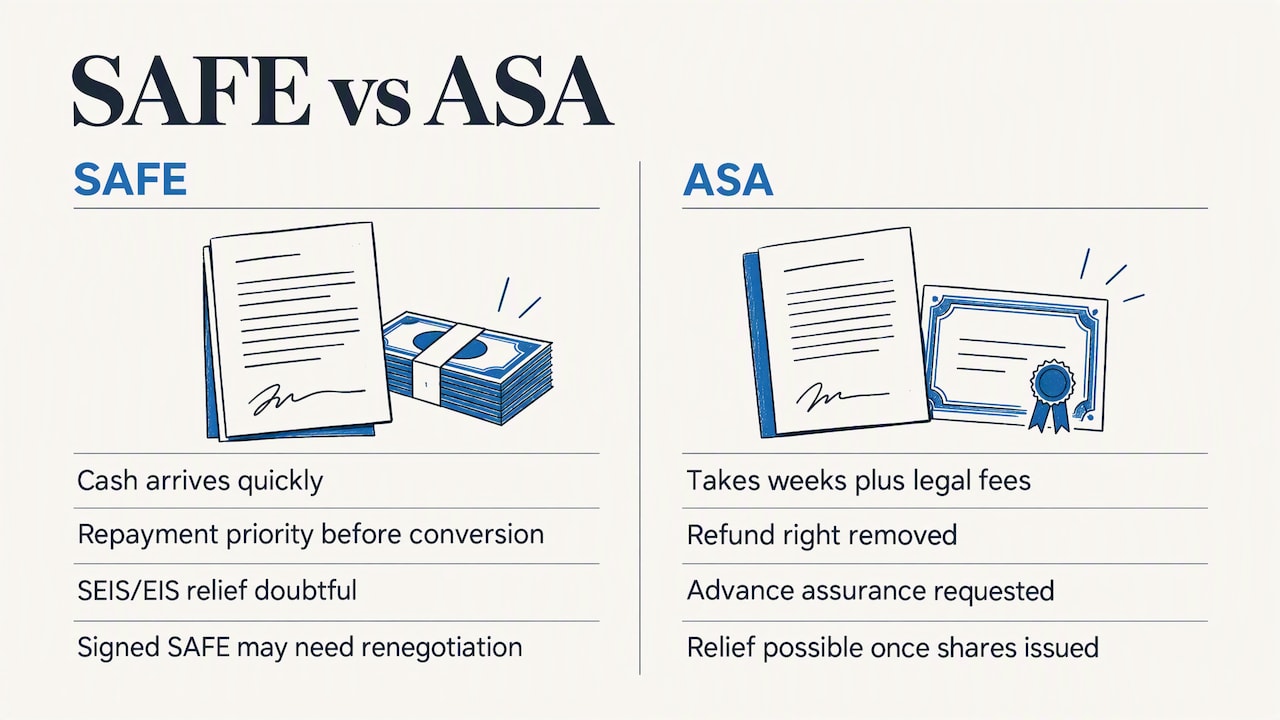
Path one: sign the SAFE as drafted. Cash arrives quickly. The investor’s repayment priority is a protection of capital. When an angel co-investing later asks about SEIS/EIS, the answer is that relief is doubtful, and the founder now has to renegotiate while the first investor holds a signed document.
Path two: convert the deal into an ASA before signing. The valuation cap and discount can still be written into the conversion mechanics. The refund right goes. A longstop date inside six months is set. Advance assurance is requested on that draft. The cost is a few weeks and some legal fees. The gain is an investor who can claim relief once shares are issued, and a cleaner equity story for the next round.
If your round might not close in six months, the better route may be to fix a modest valuation and issue shares now, which also avoids the longstop problem entirely.
Limits and eligibility you should check first
Before picking any instrument, make sure the company can use the schemes at all. Annual fundraising limits changed for shares issued on or after 6 April 2026. Per HMRC’s manual on annual limits, knowledge-intensive companies can raise up to £10 million in any 12-month period if they are specified companies, or £20 million for others, and other companies up to £5 million or £10 million respectively. Those limits count all risk finance investment, including SEIS, EIS and VCT money.
SEIS has its own, much smaller, ceilings, set out in our SEIS investment limits guide. For choosing between schemes, read SEIS vs EIS: which is right for your startup. Eligibility is wider than limits alone, and we cover the criteria in EIS eligibility criteria for UK founders.
Government statistics give a sense of scale: HMRC’s 2026 EIS and SEIS statistics report that the number of investors claiming EIS income tax relief through Self Assessment fell from 35,675 in 2023 to 2024 to 33,220 in 2024 to 2025. Angels are still active, but they check the paperwork.

When a SAFE can still make sense
We are not against SAFEs in every case. A SAFE can be reasonable when:
- your investors are overseas or institutional and are not looking for UK SEIS/EIS relief;
- you are raising from a US accelerator whose standard terms require it;
- you accept that UK relief will not be available on that money.
Even then, the document should be adapted for a UK company by a UK lawyer, and your accountant should look at how it appears in your accounts. Never mix: if some of your angels want relief and others hold a SAFE, make sure the SAFE money does not disturb the eligibility of the relief-claiming shares, for example through limits or by changing the nature of the later share issue.
Our perspective
We see the same pattern with early-stage founders: the documents get signed in a week, and the tax questions arrive three months later when a second investor asks for advance assurance. By then the cheapest fix has gone.
Our view is that the instrument matters less than the order of events. Talk to your accountant before you sign anything that promises shares later. Ask three questions: Will the shares be issued inside a window HMRC will accept? Can the investor ever get their cash back? Does anything in the document let someone vary or assign it? If any answer is uncertain, change the document first and the headline terms second.
We would also say plainly that a clean ASA is dull by design. Founders sometimes try to add helpful features, such as a repayment backstop, to keep a nervous investor comfortable. That is the single most reliable way to lose relief for everyone in the round. Where an investor needs more comfort than a clean ASA gives, the honest answer is often to price the round and issue shares now.
— Rahamut
How we can help
We are a London accountancy firm working with UK tech and fintech start-ups from pre-seed to Series A, including SEIS and EIS set-up and compliance. For founders in a fundraise we can review how your instrument will sit in your accounts, prepare for the advance assurance application with your solicitor, and handle the compliance statement once shares are issued. You can see our services and our published monthly plans on the pricing page: Core Services is 249 GBP per month, Blue Plan is 549 GBP per month, and Black Plan starts from 1999 GBP per month. If you are planning a round, our advisory and tax planning service is the place to start.
FAQ
Are SAFE notes taxed differently in the UK?
There is no separate tax category for SAFEs. HMRC tests the wording against the general rules, including whether the money is equity or debt and, for SEIS/EIS, whether capital is genuinely at risk. A SAFE with refund or priority rights can fail those tests.
Can investors claim SEIS or EIS relief on a SAFE?
Generally not on a standard US-style SAFE. Relief depends on shares being issued and on the risk to capital condition, and SAFE protections often cut against both. An ASA drafted to HMRC’s conditions is the usual route if relief matters to the investor.
How long can an ASA run for SEIS or EIS purposes?
The longstop date for issuing shares should be no more than six months from the date of the agreement. A longer period raises the risk that HMRC will not give assurance, because conditions at the time of issue may differ from those at signing.
Do I need HMRC advance assurance before signing an ASA?
No, it is not mandatory, and HMRC describes it as a discretionary service. Most investors still expect it, and once assurance is granted on an ASA, changing the terms means HMRC will not give further assurance. Apply with the final draft.
Sources
- Bird & Bird: SAFEs in the UK
- GOV.UK: Tax relief for investors using venture capital schemes
- HMRC manual VCM33025: SEIS advance subscription agreements
- HMRC manual VCM12025: EIS advance subscription agreements
- HMRC manual VCM12032: maximum amount raised annually
- GOV.UK: EIS and SEIS statistics 2026
- RW Blears: Advance subscription agreements and convertible loan note instruments