

You qualify for EIS if your company is unquoted, has a genuine UK permanent establishment, employs fewer than 250 full-time equivalent staff at the time shares are issued, is within seven years of its first commercial sale, or longer if it qualifies as knowledge-intensive, meets gross assets limits set by HMRC, which differ based on company type, and runs a qualifying trade. Miss any one of these and relief collapses for your investors, not just you. If anything below looks borderline, apply for advance assurance before you take a penny.
TL;DR:
- Companies must have fewer than 250 full-time equivalent employees at the time of share issuance, and group headcounts must be aggregated correctly to meet the requirement.
- The first commercial sale can occur with a modest transaction and must be properly documented, as the seven-year trading window starts from that date.
- Excluded activities like property development or financial services must not exceed 20% of the trade, which requires ongoing management accounts split between qualifying and excluded revenue.
- Knowledge-intensive companies benefit from longer trading periods, higher fundraising limits, and must maintain detailed R&D and IP documentation to qualify.
- Investor connection rules disqualify those with familial or business ties, and a three-year holding period is mandatory to preserve tax relief eligibility.
Table of Contents
- What is the EIS eligibility criteria checklist?
- Company tests explained: employees, assets, trading age and group rules
- Qualifying trade and excluded activities (the 20% rule)
- Knowledge-intensive companies: extended windows and higher limits
- Investor tests and holding requirements (connection, holding period, investor limits)
- HMRC processes: advance assurance, compliance statements and EIS certificates
- What does Brexit mean for EIS eligibility now?
- What tax reliefs does EIS eligibility actually unlock?
- How does the 30% connection test actually work in practice?
- What’s the realistic timeline for HMRC advance assurance?
- Common pitfalls and a short remediation checklist
- Author perspective: how Price & Accountants approaches EIS readiness
- How Price & Accountants can help with EIS eligibility and applications
- Sources
What is the EIS eligibility criteria checklist?
Before you build a pitch deck or approach a single angel investor, run your company against these tests. HMRC does not grade on effort. A company that fails one condition fails the whole scheme, and the investor’s tax relief goes with it.
Core company conditions:
- Unquoted at the time shares are issued (AIM-listed companies count as unquoted for this purpose)
- Permanent establishment in the UK, not merely a registered address
- fewer than 250 full-time equivalent employees at the time shares are issued or at the time of investment
- Gross assets below the relevant threshold, tested immediately before and after the share issue
- Trading within a set period since first commercial sale, generally up to seven years, longer if knowledge-intensive
- A qualifying trade, with excluded activities kept under 20% of the business
Funding limits worth knowing early: companies can raise money under annual and lifetime limits that vary; knowledge-intensive companies have higher thresholds. Whatever you raise has to be spent on the qualifying trade within two years of the share issue, and it has to carry genuine commercial risk, not sit in a deposit account earning interest while you decide what to do with it.
Company tests explained: employees, assets, trading age and group rules
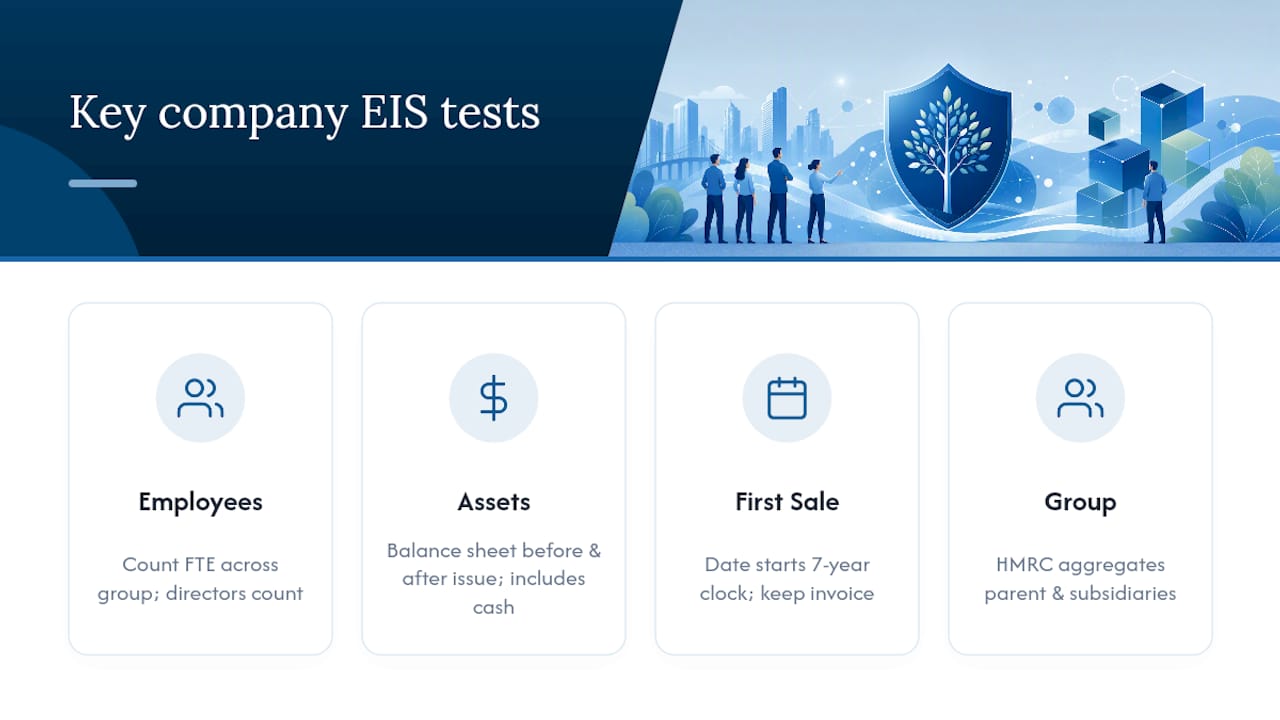
The employee test trips up more founders than any other single rule, mostly because they count wrong. Full-time equivalent means exactly that: two people working half-time count as one FTE, not two. Directors count. Apprentices and people on training contracts usually don’t. Add up the hours properly across the whole group, not just the entity raising money, because HMRC aggregates parent and subsidiary headcounts when testing group structures.
Gross assets use the balance sheet immediately before and immediately after the share issue. That includes cash sitting in your account, so a company that just closed a large grant or a previous funding round can find itself uncomfortably close to the ceiling before new investor money has even arrived. Specified companies, broadly those in higher-risk categories like energy generation, face a lower asset ceiling than non-specified companies, so check which bracket you sit in before assuming the standard limit applies.
First commercial sale is the date the seven-year clock starts, and it catches people out because HMRC doesn’t require a large transaction to trigger it. A modest pilot sale to a single customer can count, provided money genuinely changed hands for a genuine product or service. Keep the invoice, the contract, and ideally a board minute recording the date and nature of that sale, because you will need to prove it later if HMRC or an investor’s due diligence team asks.
Group aggregation matters just as much for trading history as for headcount and assets: if your company sits inside a group structure, HMRC generally looks at the group’s collective position, not just the entity issuing shares.
Qualifying trade and excluded activities (the 20% rule)
HMRC maintains a list of excluded trades that automatically disqualify a company from EIS, regardless of how compelling the investment case looks otherwise. The common culprits include:
- Property development and dealing in land
- Most banking, insurance and other financial services
- Legal and accountancy services
- Large-scale electricity, heat or gas generation
- Running hotels or nursing homes
The test HMRC actually applies is whether excluded activities make up more than 20% of the trade, measured across turnover, assets employed and management time. Hybrid businesses, particularly proptech companies that sit near the property boundary, need to document this carefully rather than assume the software layer is obviously dominant.
Pro Tip: Keep a simple management accounts split between qualifying and excluded revenue from day one. Retrofitting that evidence eighteen months into trading, right when an investor asks for it, is far harder than building it into your bookkeeping from the start.
Knowledge-intensive companies: extended windows and higher limits
Knowledge-intensive company (KIC) status rewards genuinely R&D-heavy businesses with meaningfully better terms. To qualify, you generally need to meet one of two innovation conditions (an operating costs test tied to R&D spend, or a test showing you’re creating intellectual property that will generate most of your future income) alongside one of two spending tests.
Clear this bar and the trading window extends well beyond the standard seven years, giving older, deep-tech companies room to raise EIS money that a straightforward trading business couldn’t access. KICs also unlock a higher annual fundraising ceiling and a higher individual investor limit. Keep your R&D cost breakdowns and IP ownership records tidy, because these are exactly what HMRC and advance assurance reviewers scrutinise first.
Investor tests and holding requirements (connection, holding period, investor limits)
Eligibility isn’t only about your company. It’s about who’s putting money in, and this is where founders with friends-and-family rounds most often come unstuck.
Associates include spouses, civil partners, parents, children, and business partners, so an investor who looks entirely unconnected on paper can still fail if their brother-in-law is your co-founder.
Relief also depends on a three-year holding period. Sell or dispose of the shares before that window closes and the investor typically faces clawback of the relief they already claimed, with limited exceptions. Investors receive an EIS3 certificate once your compliance statement clears, and that certificate is what they attach to their own tax return.
Standard EIS investors can claim income tax relief on up to £1 million invested per tax year, rising to £2 million where the excess goes into knowledge-intensive companies. Check every prospective investor against the connection test before you get too attached to their cheque.
HMRC processes: advance assurance, compliance statements and EIS certificates
Getting HMRC’s blessing before you fundraise is not compulsory, but it’s the difference between an investor signing quickly and an investor asking your solicitor uncomfortable questions.
- Apply for advance assurance with details of your trade, structure, financial history, and how the money will be spent. HMRC’s own guidance confirms this materially reduces investor risk, even though it isn’t a guarantee.
- Issue the shares and submit the compliance statement online once you’ve actually received the investment, not before.
- Wait for EIS2 approval and EIS3 certificates, which HMRC issues once satisfied the conditions have been met, allowing each investor to claim relief.
Don’t apply too early. HMRC wants a realistic account of how you’ll spend the money within two years of the share issue, so speculative applications with no funding round in sight tend to stall. Keep every board paper, contract, and financial record from this point on. You’ll need it if HMRC ever queries the claim retrospectively.
What does Brexit mean for EIS eligibility now?
EIS is a UK domestic tax relief scheme, not an EU state aid mechanism any more, and that distinction has quietly reshaped the rules since Britain left the EU’s single market. Before Brexit, EIS operated under EU State Aid rules that capped lifetime fundraising and imposed conditions inherited from Brussels. Since leaving, the UK government has had a freer hand to set its own limits, which is part of why the scheme now runs on domestically legislated caps like the £12 million lifetime limit and the higher knowledge-intensive thresholds, rather than limits dictated by EU state aid ceilings.
For founders, the practical implication is less about new restrictions and more about where authority now sits. Every rule in this article comes from UK primary legislation and HMRC’s own Venture Capital Schemes manual, not from a Brussels framework that could shift independently of UK policy. That also means the government can and does adjust thresholds through its own Budget process, as seen with the incoming April 2026 changes to non-specified company gross assets and fundraising caps.
One area to watch if your company has any EU dimension: a UK permanent establishment must be a genuine operational presence, not a shell address used to access UK tax relief. If your trading activity, decision-making, or staff sit predominantly outside the UK, even post-Brexit, that permanent establishment test becomes the condition most likely to catch you out. Founders relocating from an EU jurisdiction to access EIS should treat this as the first box to tick, not an afterthought.
What tax reliefs does EIS eligibility actually unlock?
Meeting every condition above is only worth the effort because of what it delivers to your investors, and understanding the reliefs helps you explain the scheme properly when you’re pitching.
This is claimed directly against the investor’s income tax liability, not against your company’s tax position.
Capital gains tax relief works in two directions. Gains on the EIS shares themselves are exempt from capital gains tax entirely, provided the investor held the shares for the full three-year period and income tax relief was given and not withdrawn. Separately, investors can defer capital gains made on other assets by reinvesting those gains into EIS shares, pushing the CGT liability into the future rather than paying it immediately.
Loss relief cushions the downside: if the company fails, an investor can offset the loss against income rather than only against capital gains, which materially changes the risk calculation for a higher-rate taxpayer weighing up an early-stage investment.
None of these reliefs exist independently of the eligibility rules covered earlier. Fail the trading age test, the gross assets test, or the qualifying trade test, and every one of these benefits disappears for the investor, retrospectively in some cases. That’s why the eligibility work happens before the fundraising conversation, not alongside it.
How does the 30% connection test actually work in practice?
The mechanics of the connection test confuse more founders than any other investor rule, so a couple of worked examples make it concrete.
Say your company issues shares to an angel who ends up holding 25% of the ordinary share capital directly.
A second common trap: a friends-and-family round where an investor is also brought on as a paid non-executive director drawing even a modest fee. Paid directorship triggers the connection test regardless of shareholding percentage, with narrow exceptions for certain “business angel” directors who weren’t connected before their first EIS investment. A director drawing no salary at all sits in a very different position from one drawing even a small monthly fee.
The safest approach is to map out every investor’s shareholding, family relationships, business partnerships, and any director or employee role, before shares are issued, not after. Associates caught by the test are a genuinely common reason otherwise well-structured rounds unravel at the compliance statement stage, usually because nobody checked the cap table for family ties until HMRC did.
What’s the realistic timeline for HMRC advance assurance?
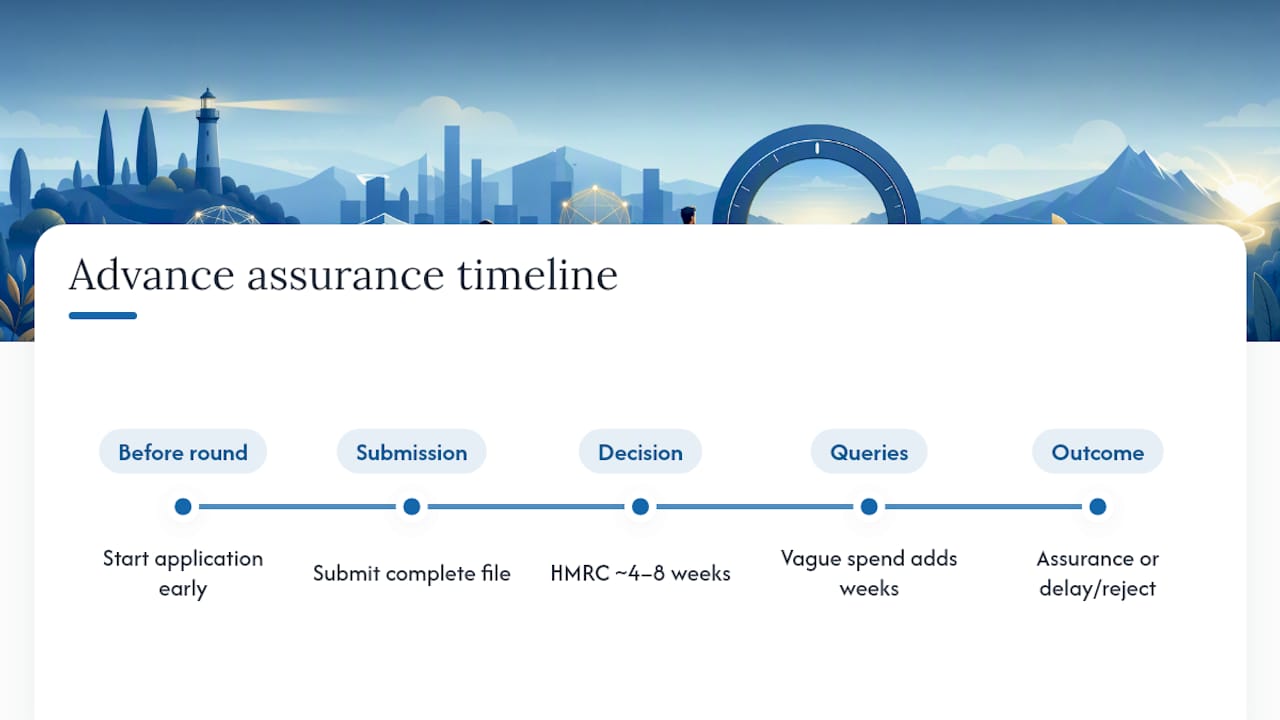
Advance assurance isn’t instant, and founders who leave it until the week before a funding round tends to regret it. HMRC doesn’t publish a guaranteed turnaround time, but practitioners generally see decisions land somewhere between four and eight weeks from a complete submission, longer if your application is incomplete or your trade sits near an excluded category.
The application itself needs your company’s trading history, a description of the trade including any activities that might look borderline against the excluded list, your latest accounts or projections, details of the shares to be issued, and crucially, a clear account of how the money will be spent within two years. HMRC reviewers spend real time on that spending narrative because it’s the primary evidence for the risk-to-capital condition, so a vague answer (“general working capital”) invites follow-up questions that add weeks to the process.
Build advance assurance into your fundraising timeline as a distinct milestone, ideally starting the application before you’ve closed your first cheque, not after. A clean, well-evidenced submission, first commercial sale documented, headcount and asset figures calculated correctly, excluded activities quantified, moves faster than one HMRC has to query. If your trade sits anywhere near a grey area (proptech, fintech, anything touching financial services or property), get a second pair of eyes on the application before it goes in. The cost of a rejected or heavily delayed assurance request, in lost investor confidence alone, dwarfs the cost of getting proper advice first.
Common pitfalls and a short remediation checklist
Most EIS failures trace back to a handful of repeat offenders: an excluded activity nobody quantified, group figures nobody aggregated, a first sale nobody documented, a connected investor nobody checked, or proceeds earmarked for something that looks like a buy-out rather than growth.
Fixes that actually work:
- Separate qualifying and excluded revenue in your management accounts now
- Write down the exact date and evidence of your first commercial sale
- Run every investor through the connection test before shares are allocated
- Draft a specific, growth-focused spending plan rather than a vague “working capital” line
Pro Tip: If more than one of these issues applies to you, stop fundraising conversations and get professional input before you go further. Restructuring a cap table after investors have already committed is far messier than fixing it beforehand.
Author perspective: how Price & Accountants approaches EIS readiness
Founders assume EIS eligibility is a legal formality their solicitor handles at completion. It isn’t. It’s an accounting exercise that starts months earlier, with headcount audits, gross assets checks, and a properly drafted risk-to-capital statement. This readiness work should start before advance assurance goes anywhere near HMRC, because the firms that get this right typically caught the problem on their own balance sheet first, not from an HMRC rejection letter. If any of the tests above feel uncertain for your company, that’s worth a proper review before you approach a single investor.
— Rahamut
How Price & Accountants can help with EIS eligibility and applications
Getting the eligibility tests right on paper is one thing. Building the accounting evidence that survives HMRC scrutiny and investor due diligence is another, and it’s where most founders actually need help. Priceandaccountants supports the whole EIS readiness process: preparing advance assurance applications, drafting the compliance statement once shares are issued, cleaning up cap tables and accounting records before investors start asking questions, and building the R&D evidence knowledge-intensive companies need to prove their spending tests.

The outcome can include fewer HMRC queries, cleaner investor packs, and a funding round that doesn’t stall on an eligibility technicality nobody spotted early enough. If you’re weighing up SEIS against EIS for your first round, or you already know EIS is the right scheme and need the accounting groundwork done properly, get in touch with our advisory and tax planning team for a review of your position before you start approaching investors.