
Meta title: Company Car Benefit Payrolling: Are You Ready for April 2027?
Meta description: From 6 April 2027, employers must payroll company cars, fuel, vans and medical benefits through RTI. Learn what Phase 1 means and how to prepare.
If your business provides company cars, vans, fuel or private medical insurance, 6 April 2027 is a payroll deadline that needs attention.
The change affects more than year-end administration. It could influence your employees’ take-home pay, PAYE deductions, payroll data, employment-cost forecasting and the way your HR and finance teams communicate benefits.
From that date, HMRC plans to introduce mandatory payrolling of benefits in kind for company cars, car fuel, vans, van fuel and employer-provided medical benefits. Instead of relying mainly on annual P11D reporting, employers will report the taxable value of these benefits through payroll and Real Time Information (RTI).
The key is to start preparing before April 2027 , whilst there is still time to review benefit records, test software and resolve data gaps.
Important: This article reflects HMRC guidance and draft legislation available on 3 September 2026. Final legislation, technical specifications and employer instructions may be updated before implementation.
HMRC is introducing mandatory benefits-in-kind reporting in phases rather than requiring every benefit to move into payroll at the same time.
Phase 1 focuses on benefits that are widely provided and represent a significant share of benefits reported by employers each year:
This phased approach is intended to support a smoother transition for businesses and payroll software providers. Phase 2 is expected to bring most other benefits into mandatory payrolling from April 2028, although employment-related loans and living accommodation remain subject to separate treatment under current plans.
The legal position is based on current HMRC guidance and draft legislation. Employers should check the final rules and technical specifications before implementation.
A benefit in kind is a non-cash benefit provided because of employment , such as a company car or private medical insurance.
Under company car benefit payrolling, your payroll process adds the taxable cash-equivalent value of the benefit to the employee’s taxable pay for PAYE purposes. The employee does not receive that value as cash. Instead, payroll uses it to calculate and collect the related Income Tax through regular pay runs.
The benefit value is then reported through payroll software using RTI, generally through the Full Payment Submission (FPS).
This means:
The employee therefore experiences the tax cost progressively through their payslips, rather than potentially receiving a later tax-code adjustment based on an annual P11D.
| Benefit | Examples | Mandatory from Phase 1? |
|---|---|---|
| Company cars | Cars available for private use, including commuting | Yes |
| Car fuel | Fuel provided for private journeys in a company car | Yes |
| Company vans | Vans available for private use or other taxable use | Yes |
| Van fuel | Fuel provided for private use in a company van | Yes |
| Medical and dental benefits | Employer-provided private medical insurance, dental insurance or treatment benefits | Yes, where within the relevant rules |
| Salary sacrifice or OpRA cars | Cars provided through salary sacrifice or an Optional Remuneration Arrangement | Included where applicable |
A company car payroll review should not be limited to vehicles recorded as traditional fleet cars. You also need to identify cars provided through salary sacrifice, flexible benefits platforms and other arrangements where the employee gives up cash or chooses a benefit instead.

Employment-related loans and living accommodation are not part of the initial mandatory Phase 1 list. Under current HMRC plans, they will remain outside the mandatory rollout for now, although employers should monitor future announcements and final guidance.
Most other benefits : such as gym memberships, non-cash vouchers and certain other employee benefits : are expected to be addressed in Phase 2 from April 2028.
That does not mean these benefits can be ignored. You may still need to report them under existing P11D arrangements, payroll them voluntarily or maintain records for other tax and National Insurance obligations.
In other words, P11D vs payrolling is not an immediate choice for every benefit. For Phase 1 benefits, mandatory payrolling is expected to apply. For other benefits, the correct process will depend on the final rules and the particular arrangement.
Accurate company car payroll depends on accurate vehicle and employee data. For each vehicle, you may need to maintain information including:
The vehicle value and tax treatment can change during the year. An employee may start or leave, change cars, stop receiving private fuel or begin making a contribution. A vehicle may also be unavailable for a period because of repairs or replacement.
These changes need to reach payroll promptly. If your payroll team receives information only at the end of the tax year, it may not be able to calculate the correct deductions in real time.
A practical control is to appoint a clear data owner : such as HR, fleet management, finance or an external benefits provider : and define when changes must be passed to payroll.
A common misconception is that a salary sacrifice car is automatically outside company car benefit payrolling.
It is not.
Where a car is provided through salary sacrifice or an Optional Remuneration Arrangement, the salary sacrifice car payrolling treatment may require a review of both:
The Optional Remuneration Arrangement rules can affect which value is used for tax purposes. The correct calculation depends on the arrangement, the vehicle and the applicable legislation.
Your payroll and benefits teams should therefore review:
Do not assume that an external salary sacrifice provider’s monthly invoice contains everything needed for compliant payroll. You may need employee-level and vehicle-level data, together with an audit trail for changes.

Car fuel is a separate benefit from the company car itself. Providing a company car does not automatically mean that private fuel is provided, and the payroll treatment may differ depending on the arrangement and private-use position.
For car fuel benefit payroll, employers should identify:
Vans also need careful review. A van may qualify for different tax treatment depending on how it is used, but employers should not assume that every van is exempt simply because it is a commercial vehicle.
The HMRC guidance on company cars and fuel explains the reporting obligations for company cars used privately and fuel provided for private journeys. HMRC also provides separate guidance on company vans and fuel.
Employer-provided medical benefits can include private medical insurance, dental insurance and certain medical or dental treatment arrangements.
For medical benefit payroll HMRC compliance, your business may need employee-level information covering:
Family cover is particularly important. The taxable value may differ between employees because one person has individual cover whilst another has family cover.
The benefit value may also change after a renewal, employee life-event change or alteration to the policy. Your payroll team needs a reliable process for receiving those updates : not just an annual provider statement.
Read the current HMRC guidance on medical or dental treatment and insurance when reviewing your arrangements.
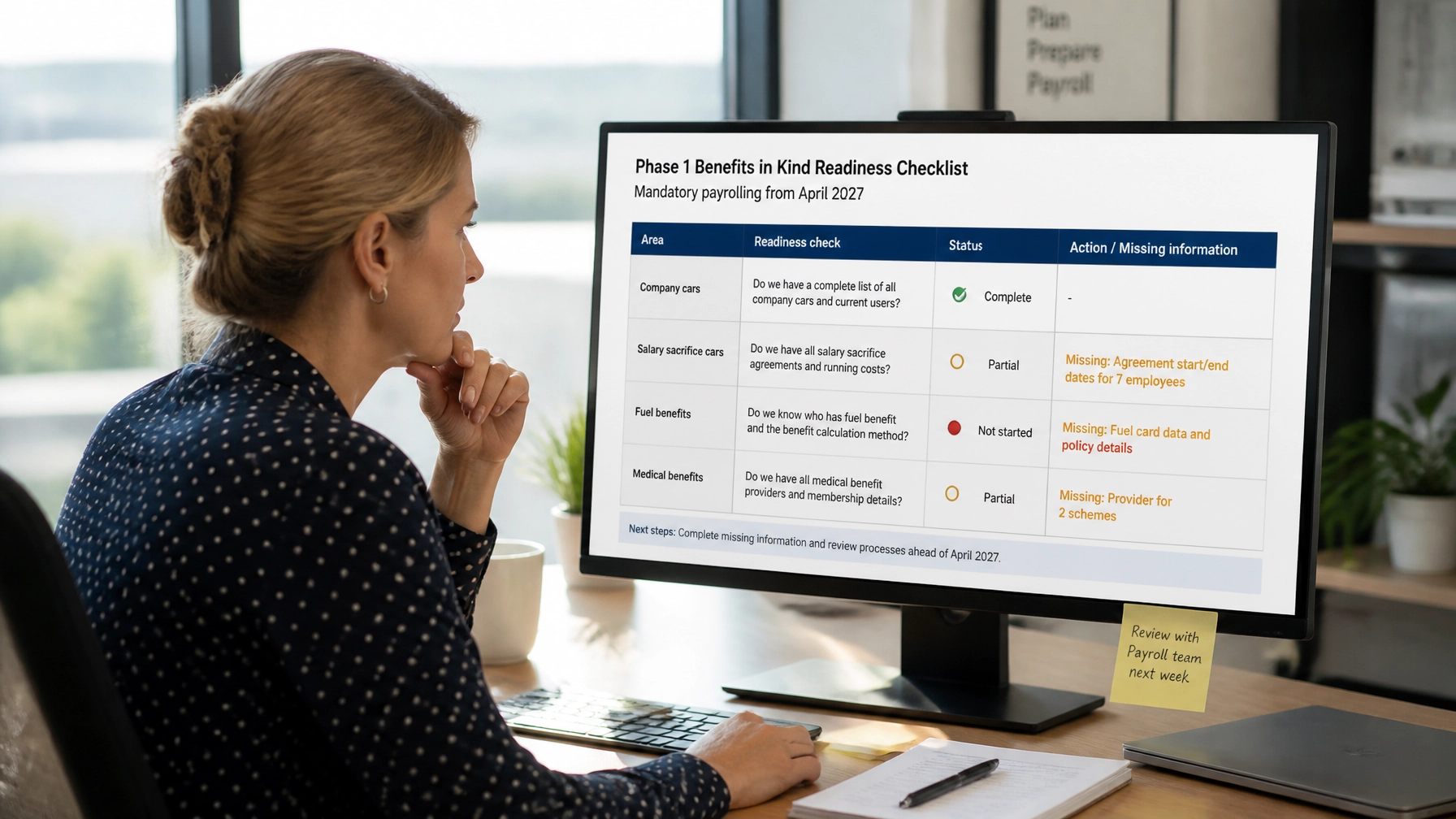
Mandatory payrolling can make the tax treatment more visible to employees because the tax is collected through regular payroll deductions.
You should prepare for questions about:
Employers will need to follow final HMRC instructions on how Phase 1 values interact with tax codes, year-end processes and employee records. The central control is consistency: the payroll record, benefit provider data and HMRC submission should tell the same story.
Class 1A National Insurance remains relevant to taxable benefits. The way employers calculate and report it will need to follow the final RTI and year-end instructions. Do not assume that moving Income Tax into payroll removes the employer’s National Insurance responsibilities.
| Area | Traditional P11D reporting | Mandatory payrolling for Phase 1 |
|---|---|---|
| Tax timing | Tax is often collected later through a tax-code adjustment | PAYE tax is collected during the tax year |
| Reporting route | Annual P11D process | Payroll software and RTI/FPS |
| Employer workflow | Year-end benefit collation and forms | Regular data updates and payroll controls |
| Employee experience | Possible later tax adjustment | More immediate effect on payslips and take-home pay |
| Class 1A NIC | Remains an employer responsibility | Remains relevant under the final reporting process |
P11Ds are not simply disappearing in every circumstance. The annual P11D deadline and reporting requirements may still apply to benefits outside mandatory payrolling, depending on the final rules and your chosen treatment.
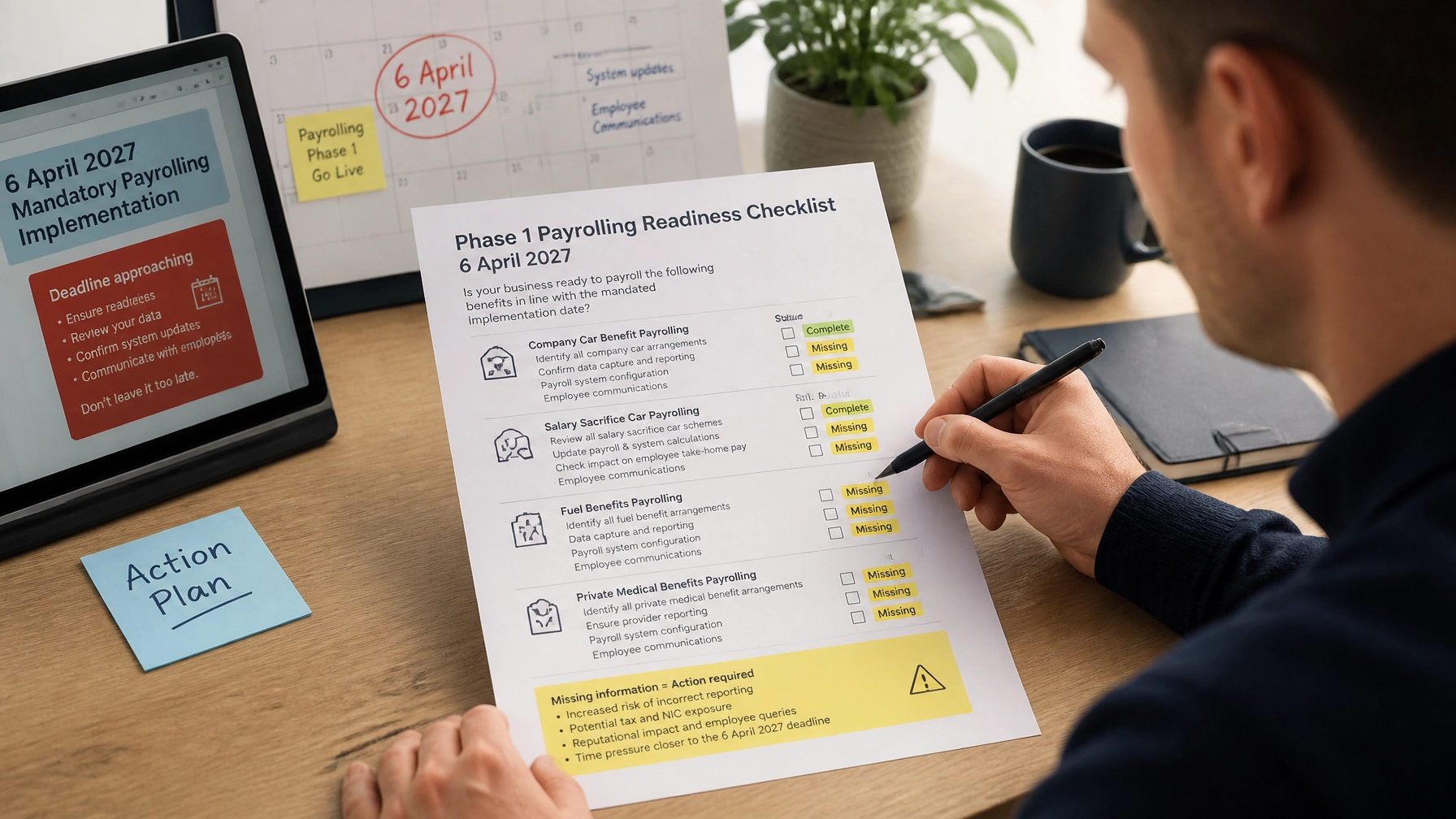
We encourage you to work through the following checklist:
| Period | Recommended employer action |
|---|---|
| September–October 2026 | Complete a benefits inventory and identify data gaps. |
| November 2026–January 2027 | Review payroll software, provider feeds, ownership and internal procedures. |
| February–March 2027 | Test calculations, RTI/FPS processes, joiner/leaver controls and employee communications. |
| 6 April 2027 | Begin Phase 1 payrolling for in-scope benefits, subject to final HMRC instructions. |
| 2027/28 tax year | Monitor deductions, reconcile benefit data and correct issues promptly. |
| 2027/28 | Review remaining benefits and prepare for Phase 2. |
| April 2028 | Prepare for the expected broader mandatory rollout. |
Employers could create unnecessary correction work by:
Start with three practical actions:
These actions will give you a clearer view of the work ahead and help you identify whether your current payroll process can support accurate company car benefit payrolling.
Price & Accountants supports UK employers with payroll and pension compliance, employment-cost reporting and practical finance processes.
We can help you review your benefits inventory, assess payroll workflows, coordinate information from vehicle and medical-benefit providers, configure processes, reconcile employment costs and prepare for the phased HMRC changes. Our wider payroll and pension services can also support your regular payroll obligations, whilst our accounting services provide broader financial clarity as your business grows.
If you provide company cars, fuel or medical benefits and want to understand how Phase 1 affects your payroll process, we would be happy to review your current arrangements.
Company car benefit payrolling is the process of adding the taxable value of a company car to an employee’s taxable pay so that PAYE tax is collected through regular payroll. From 6 April 2027, company cars are expected to be included in Phase 1 of mandatory payrolling.
Mandatory payrolling starts in phases. Phase 1 is scheduled to start on 6 April 2027 for company cars, car fuel, vans, van fuel and employer-provided medical benefits. Most other benefits are expected to follow in April 2028.
Yes. Company cars are included in Phase 1, including relevant arrangements involving salary sacrifice or Optional Remuneration Arrangements.
Where a salary sacrifice arrangement provides an in-scope company car benefit, it is expected to fall within mandatory Phase 1 payrolling. The taxable value must be reviewed under the applicable rules rather than assumed to be exempt.
Employer-provided medical and dental benefits are included in Phase 1 where they fall within the relevant HMRC rules. Employers should review individual and family cover, provider data and mid-year changes.
Yes. Private fuel provided with a company car is a separate benefit. Employers should review who receives it, when it starts or ends and whether the employee makes any reimbursement or contribution.
Yes. Company vans and van fuel are included in Phase 1. However, the tax treatment depends on the vehicle and how it is used, so employers should review each arrangement.
Not entirely. For in-scope Phase 1 benefits, mandatory payrolling is expected to replace P11D reporting as the main reporting route. P11Ds may remain relevant for other benefits and circumstances under the final rules.
Class 1A National Insurance remains relevant to taxable benefits. Employers should follow HMRC’s final instructions for calculating and reporting it under the new regime.
The traditional P11D deadline is generally 6 July following the end of the tax year for benefits that still require annual reporting. However, employers should check the final HMRC rules for benefits handled through mandatory payrolling.
It can. Because PAYE tax is collected during the tax year, employees may see changes to their regular take-home pay and payslips. Clear communication can help them understand why the deduction is changing.
This article is for general information only and does not constitute tax or legal advice. It reflects guidance available on 3 September 2026. Employers should review final HMRC guidance, legislation and technical specifications before implementing mandatory benefits-in-kind payrolling.