
Meta title: P11D vs Payrolling Benefits in Kind: What’s Changing and When | Price & Accountants
Meta description: Understand the P11D changes from 2027, mandatory payrolling of benefits in kind, key deadlines and how employers should prepare for the transition.
If you provide employees with company cars, private medical insurance, vans, fuel, loans or other benefits, the way you report and tax those benefits is changing.
For many years, employers have relied on annual P11D forms to tell HM Revenue & Customs (HMRC) about taxable benefits in kind. Employees then pay the associated tax through a tax-code adjustment or Self Assessment , often months after receiving the benefit.
HMRC is moving towards real-time reporting of benefits in kind through payroll. The change is intended to make tax deductions more immediate and reduce the administrative gap between providing a benefit and reporting it.
For employers, this is not simply a change of form. It affects payroll processes, employee communication, benefits data, software, deadlines and year-end reconciliation.
This guide explains P11D vs payrolling, what the P11D changes in 2027 and 2028 could mean for your organisation, and the steps you can take to prepare.
Under the existing process, employers generally need to:
Calculate the taxable cash-equivalent value of each benefit provided to an employee. This is the value used for tax purposes and is not necessarily the amount the employer paid.
Report the benefit on form P11D by 6 July following the end of the tax year. For example, benefits provided during 2026/27 are normally reported by 6 July 2027.
Submit form P11D(b) to declare the employer’s Class 1A National Insurance liability. Class 1A NIC is generally payable by the employer on taxable benefits in kind.
Pay Class 1A NIC by 19 July where payment is made by post, or 22 July where payment is made electronically.
The employee does not usually receive the taxable value as additional cash. Instead, HMRC may adjust their tax code so that more tax is collected from future salary payments. Employees who complete Self Assessment may report the benefit through their tax return.
This process can create a delay between the benefit being provided and the tax being collected. It can also produce unexpected changes to an employee’s take-home pay when HMRC updates their tax code.
Employers can review the current rules through HMRC’s expenses and benefits guidance and its guidance on completing forms P11D and P11D(b).
Payrolling benefits in kind means adding the taxable value of a benefit to an employee’s taxable pay in each payroll period.
The employee does not receive the benefit’s value as cash. Instead, the payroll system treats the value as taxable remuneration for PAYE purposes. The related tax is then collected gradually through the employee’s salary payments.
For example, if an employee receives a company car with an annual taxable value of £4,800 and is paid monthly, the payroll calculation may spread that value across the relevant pay periods. The employee pays the appropriate Income Tax throughout the year rather than waiting for a later tax-code adjustment.
The benefit is reported to HMRC through Real Time Information (RTI), using the Full Payment Submission (FPS). HMRC’s technical note explains that the FPS will include additional benefit and expense information so that Income Tax and Class 1A NIC can be reported in real time.
The value must still be calculated correctly. Payrolling does not remove the need to understand benefit rules, employee contributions, availability dates, private use, qualifying exemptions or changes during the year.
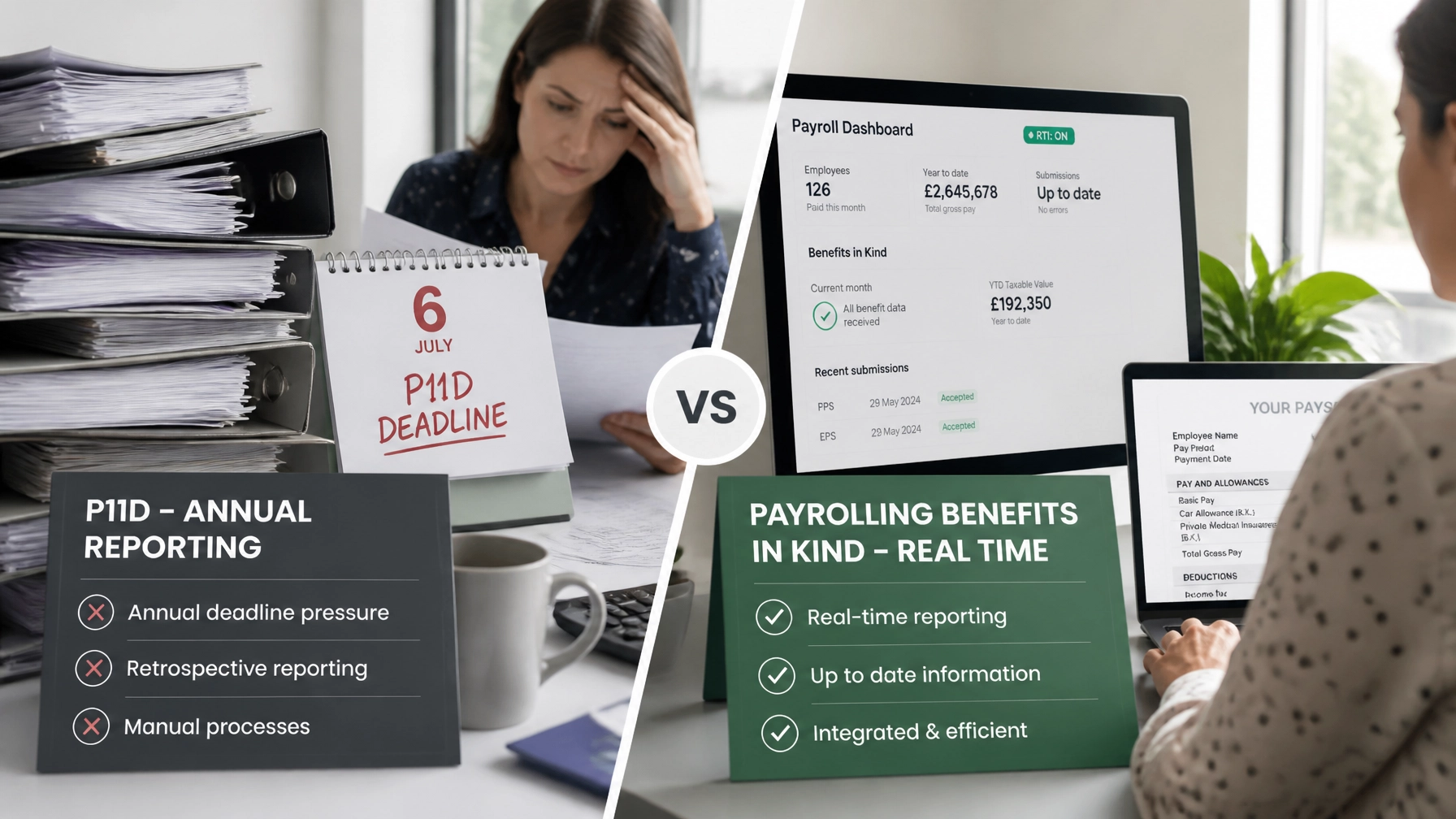
| Area | P11D reporting | Payrolling benefits in kind |
|---|---|---|
| When tax is collected | Usually after the tax year, through a tax-code adjustment or Self Assessment | During the tax year through regular payroll |
| Reporting route | Annual P11D forms and P11D(b) | RTI through the Full Payment Submission |
| Employee experience | Tax may change later when HMRC updates the employee’s code | Tax deductions are generally spread across the year |
| Employer workflow | Year-end benefit calculations and separate submissions | Benefit data must be accurate and available for each payroll run |
| Class 1A NIC | Usually calculated annually and reported through P11D(b) | Intended to be reported in real time for benefits within the new mandatory system |
| Deadlines | P11D and P11D(b) generally due by 6 July; Class 1A NIC normally paid by 19 or 22 July | Benefit information is submitted with payroll, although residual P11D deadlines remain |
| Corrections | Adjustments may be made through amended forms or HMRC tax-code changes | Payroll adjustments, updated estimates and HMRC’s proposed benefit update process may apply |
The practical difference is timing. P11D reporting is largely retrospective, whilst payrolling aims to collect and report tax as the benefit is provided.
Not immediately , and not for every benefit.
The current plan is for P11D reporting to be phased out for most benefits that fall within mandatory payrolling. However, employers should not assume that every P11D disappears from the start of April 2027.
The transition is expected to operate in stages:
Employment-related loans and employer-provided living accommodation have separate treatment under current plans. Employers are expected to retain P11D and P11D(b) reporting for these benefits for a temporary period, although voluntary payrolling is expected to be available from April 2027.
The exact rules, legislation, reporting fields and software specifications may be updated before implementation. Employers should therefore check the latest HMRC technical guidance.
From the start of the 2027/28 tax year, employers should be prepared for mandatory payrolling of the initial categories of benefits.
Company car benefits are already relatively data-intensive. Employers need accurate information about:
A company car P11D process may therefore become a payroll data process. Changes such as a new vehicle, an employee changing role or private fuel being withdrawn must reach payroll promptly.
Vans can receive different tax treatment depending on private use. A van used only for ordinary commuting and business journeys may be treated differently from one available for unrestricted private use.
Payroll teams will need reliable records showing the type of vehicle, availability and any taxable fuel benefit.
Employer-provided private medical insurance and other medical benefits may move into the initial mandatory payrolling phase. Employers should confirm the cost attributable to each employee and monitor changes when employees join or leave a scheme.
The value used for payroll must reflect the taxable benefit, rather than simply relying on a general annual policy premium where individual costs differ.
Employers will need to make benefits part of their normal payroll control environment.
Key requirements include:
Under current HMRC guidance, employers will not generally need to register for mandatory payrolling of benefits from April 2027. HMRC is expected to remove relevant benefits from employees’ tax codes so that employers do not tax the same benefit twice.
Voluntary payrolling remains relevant for benefits outside the mandatory scope. However, employers should check registration requirements carefully. HMRC has confirmed that the previous registration service for ordinary voluntary payrolling closed ahead of the new regime, whilst a separate registration process for loans and accommodation is expected to be available before the 2027/28 tax year.
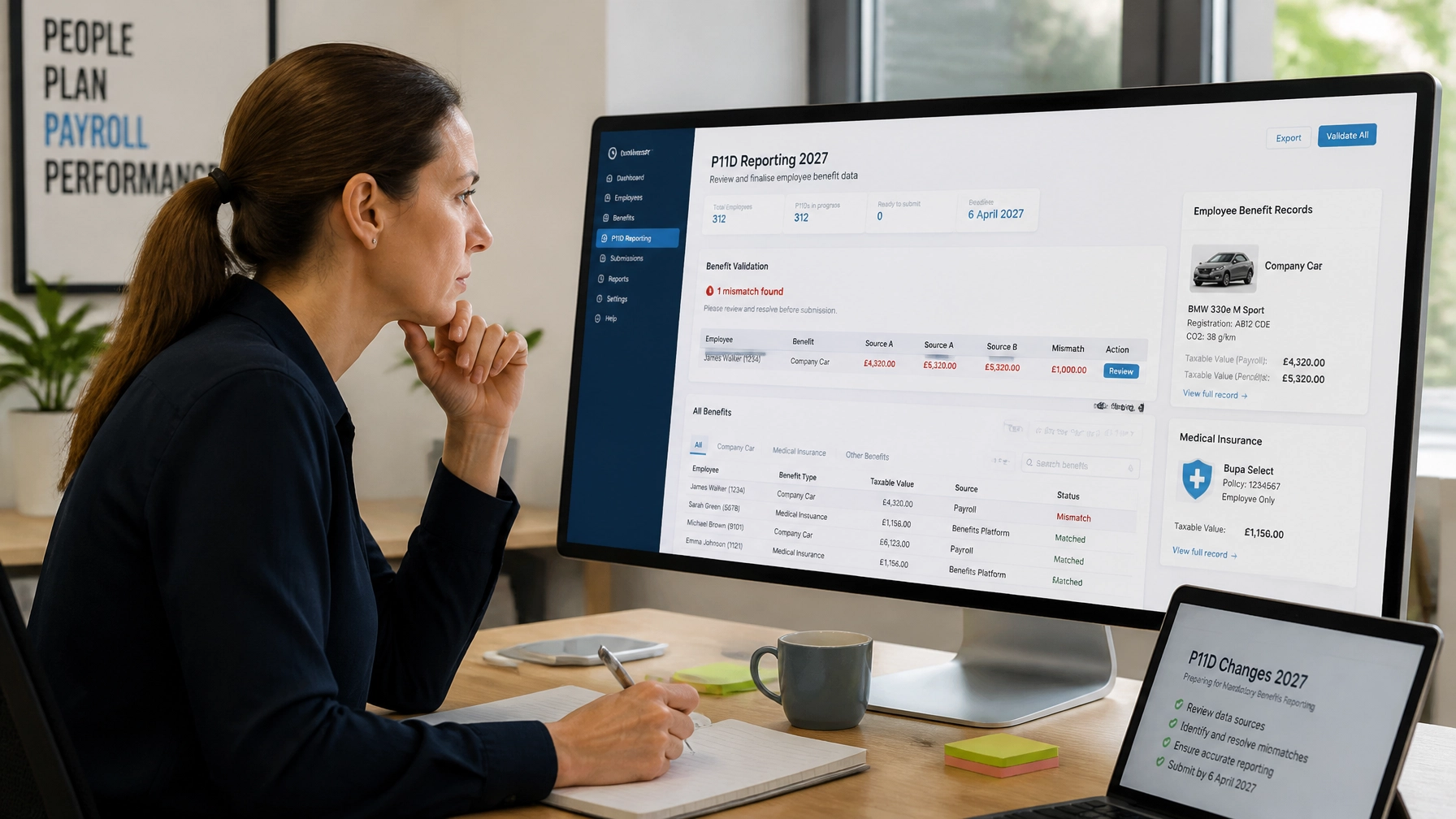
These benefits are expected to be included in the first mandatory payrolling phase from 6 April 2027. They should be processed through payroll rather than reported on P11D for the relevant tax year, subject to final legislation and guidance.
Employer-provided medical and dental benefits are expected to be included in the initial phase. Employers should ensure that providers can supply accurate employee-level information and notify them promptly of mid-year changes.
Gym memberships, non-cash vouchers, subscriptions, taxable staff entertaining and other benefits are expected to move into mandatory payrolling in the second phase from 6 April 2028.
Until the relevant mandatory date, benefits outside the scope of mandatory payrolling may continue to require P11D reporting unless the employer has validly adopted voluntary payrolling.
Interest-free and low-interest loans have complex valuation rules. The taxable amount can depend on balances outstanding, interest paid by the employee and HMRC’s official rate.
Under current plans, loans will remain a separate category for P11D and P11D(b) purposes for a temporary period. Voluntary payrolling is expected to be available, but employers should not assume it is mandatory from April 2027.
Living accommodation can involve additional considerations, including whether the accommodation is necessary for the employee’s duties and whether additional charges apply.
It is expected to remain within the transitional P11D framework unless voluntarily payrolled. Specialist advice may be appropriate where accommodation is provided to directors, internationally mobile employees or senior staff.
Payrolling can make tax deductions more predictable, but employees may initially notice a reduction in monthly take-home pay because tax is collected during the year.
Employers should explain:
HMRC has indicated that employers will need to provide employees with details of relevant benefits after the tax year, including which benefits were payrolled and their value. Employees may also view information through their Personal Tax Account.
Errors can affect employee trust quickly. A missed company car change or incorrect medical insurance value could lead to under-deductions, later adjustments and difficult conversations.
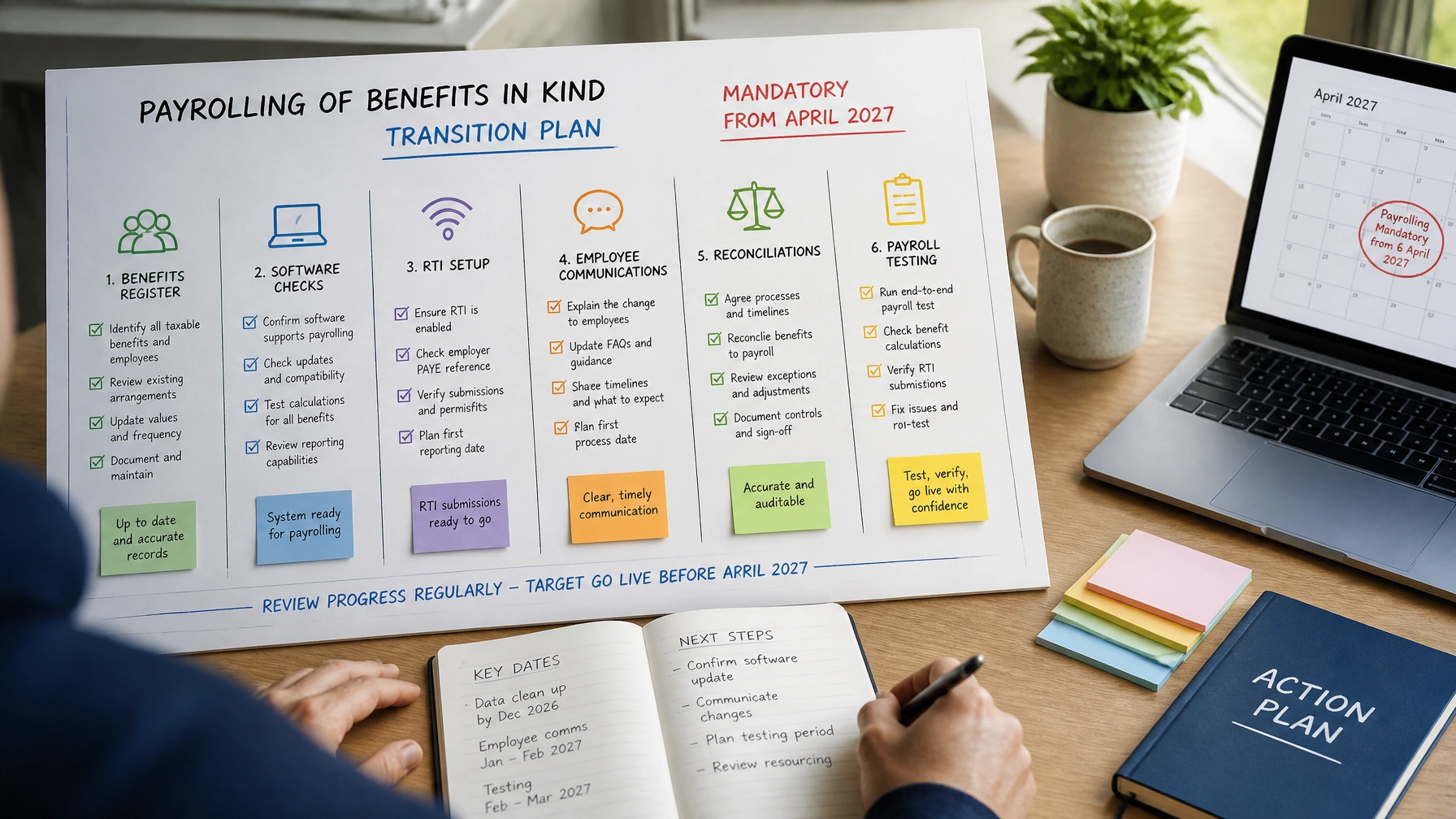
| Period | Recommended action |
|---|---|
| September–December 2026 | Review every benefit provided, identify who owns the data and separate taxable, exempt, voluntary and transitional benefits. |
| January–March 2027 | Confirm payroll software capability, review benefit valuations and test processes for cars, vans, fuel and medical benefits. |
| Before 6 April 2027 | Ensure employee tax-code records, payroll settings and benefit records are ready for the new tax year. |
| April 2027 onwards | Report mandatory benefits through RTI, monitor changes each pay period and resolve discrepancies promptly. |
| By 6 July 2027 | Submit P11D and P11D(b) for benefits from 2026/27 that still require annual reporting. |
| 2027/28 | Prepare for the broader move to payrolling, including vouchers, memberships and other taxable benefits. |
| By 6 July 2028 | Complete any remaining P11D and P11D(b) reporting for benefits that remain outside mandatory payrolling. |
Employers should avoid:
Before mandatory payrolling begins, we encourage you to:
P11D reports taxable benefits annually after the tax year has ended. Payrolling reports the taxable value through payroll so PAYE tax is collected during the year.
P11Ds are being phased out for most benefits that move into mandatory payrolling. They are not expected to disappear immediately, and loans, accommodation and certain special cases may continue to require P11D reporting.
The first stage is expected to begin on 6 April 2027, with most remaining benefits expected to follow from 6 April 2028, subject to final legislation and HMRC guidance.
The initial phase is expected to include company cars, car fuel, vans, van fuel and employer-provided medical or dental benefits.
P11D forms and P11D(b) are generally due by 6 July following the end of the tax year. Class 1A NIC is normally payable by 19 July by post or 22 July online.
Yes, where benefits remain subject to annual reporting. During the transition, employers may still need P11D(b) for benefits outside mandatory payrolling, including loans and accommodation under current plans.
Yes. Employers remain responsible for Class 1A NIC on taxable benefits. The reporting and payment mechanism is expected to move into real-time payroll for benefits within the mandatory system.
They have separate treatment under current plans. Employers are expected to retain P11D reporting for a temporary period, with voluntary payrolling available from April 2027.
It can. Tax is collected during the year, so an employee’s regular net pay may change. However, the employee is not receiving the taxable benefit as additional cash.
Voluntary payrolling may remain available for benefits outside the initial mandatory scope, subject to HMRC registration and the applicable rules. Employers should check current guidance before making a change.
The move from annual P11D reporting to benefits in kind payroll requires better coordination between your payroll, HR and finance records.
At Price & Accountants, we support UK employers with payroll and pension services, including payroll processes, employee records and ongoing compliance requirements. We can help you review your current P11D arrangements, organise benefit records, assess payroll readiness, prepare RTI processes and manage the remaining annual reporting obligations.
We can also support your wider accounting and compliance requirements, giving you clearer financial information as your business grows.
If you want to understand how the P11D changes affect your payroll process, we would be happy to review your current arrangements.
This article reflects HMRC guidance and policy information available at the publication date. The legislation, technical specifications and final guidance may change before implementation. Employers should check the latest GOV.UK and HMRC rules and obtain professional advice where appropriate.