
If you are raising your first round, SEIS is almost certainly where you start. If you have already traded for more than three years, raised over £250,000, or are planning a growth round with larger ticket sizes, EIS is the relevant scheme. The two are not interchangeable, and choosing the wrong one at the wrong stage can cost your investors their tax relief entirely.
The headline difference is straightforward:
Both schemes require investors to hold shares for at least three years to keep their reliefs. Miss that window, or breach a qualifying condition during the holding period, and HMRC can claw back the relief already claimed. Getting the compliance right from day one is not optional.
SEIS suits pre-seed companies trading under three years with gross assets below £350,000; EIS suits growth-stage companies that have outgrown SEIS or need larger raises.
| Point | Details |
|---|---|
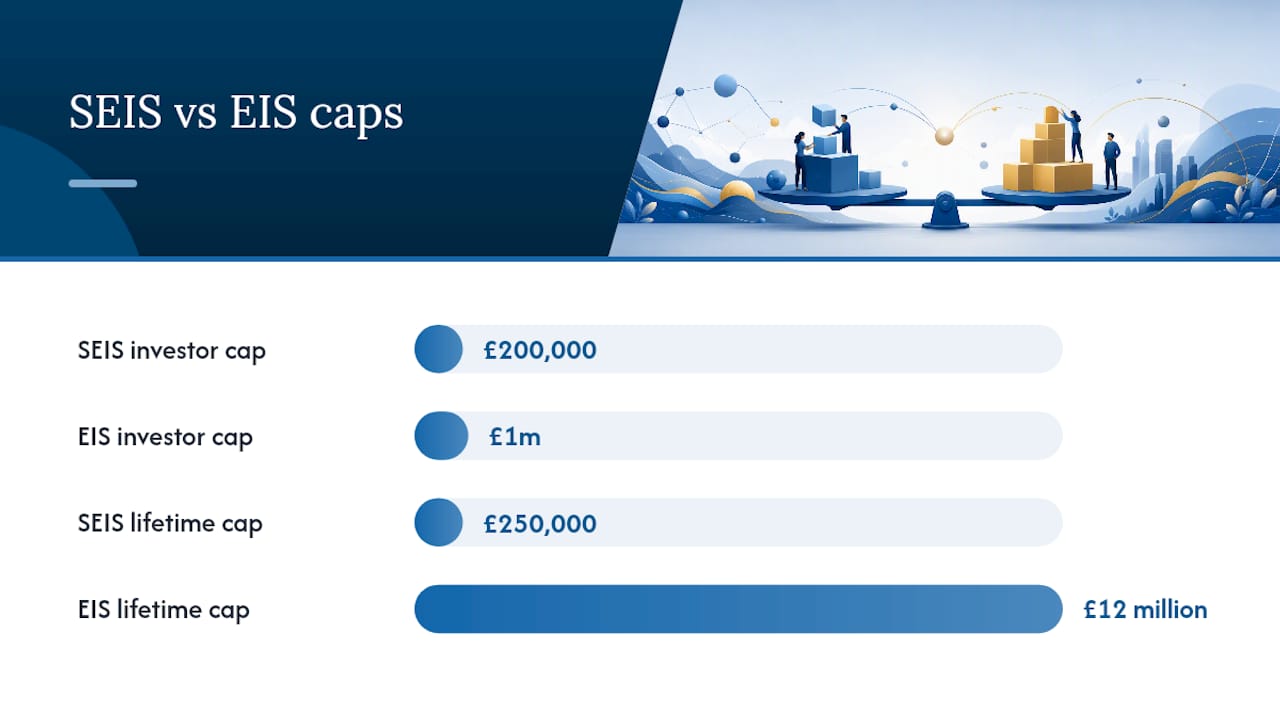
| SEIS relief rate and cap | 50% income tax relief on up to £200,000 per investor per tax year; company lifetime cap of £250,000. |
| EIS relief rate and cap | 30% income tax relief on up to £1 million per year (£2 million with KIC rules); cumulative risk finance cap of £12 million. |
| Three-year holding period | Both schemes require shares to be held for at least 3 years; early disposal or a qualifying breach triggers clawback. |
| Advance Assurance first | Apply for Advance Assurance before issuing any shares; most investors expect it and it reduces compliance risk materially. |
| Priceandaccountants | Priceandaccountants prepares Advance Assurance packs, manages compliance statements, and issues investor certificates for SEIS and EIS raises. |
The table below draws on HMRC’s venture capital scheme guidance and the LexisNexis comparative table updated following Finance Act 2026 changes.
| Dimension | SEIS | EIS |
|---|---|---|
| Best for (company stage) | Pre-seed / seed; trading under 3 years | Later seed / growth; trading under 7 years (10 for KICs) |
| Income tax relief | 50% of amount invested | 30% of amount invested |
| Investor annual cap | £200,000 | £1m (£2m if excess invested in KICs) |
| CGT treatment | Disposal relief (full CGT exemption after 3 years); reinvestment relief up to 50% of gain | CGT deferral on gains reinvested; full exemption on disposal after 3 years |
| Holding period | 3 years minimum | 3 years minimum |
| Clawback triggers | Breach of qualifying conditions; disposal within 3 years; company ceases qualifying trade | Same; also CGT deferral crystallises on disposal or disqualifying event |
| Company gross assets | Under £350,000 before share issue | Under £15 million before; under £16 million after |
| Company employees | Fewer than 25 full-time equivalents | Fewer than 250 full-time equivalents (500 for KICs) |
| Company trading age | Under 3 years from first commercial sale | Under 7 years from first commercial sale (10 for KICs) |
| Company lifetime raise cap | £250,000 | £12 million cumulative risk finance (£20m for KICs) |
| Loss relief | Against income or capital gains | Against income or capital gains |
| IHT treatment | Qualifying shares may attract Business Relief after 2 years | Same |
| Advance Assurance | Recommended; submitted to HMRC before share issue | Recommended; same process |
| Compliance certificates | SEIS1 → SEIS2 (HMRC) → SEIS3 (investor) | EIS1 → EIS2 (HMRC) → EIS3 / EIS5 (investor) |
Worked example — SEIS. An angel invests £20,000 into a qualifying SEIS company. If the shares are held for three years and the company succeeds, any gain is free of CGT. If the company fails, loss relief at their marginal income tax rate (say 45%) on the net cost of £10,000 reduces the effective loss further.
Worked example — EIS. An investor invests a sum into a qualifying EIS company and receives income tax relief amounting to about 30% of the investment, reducing the net cost accordingly. Any gain after three years is CGT-exempt. If the investor had a capital gain elsewhere, they could defer it by investing into EIS shares, postponing the CGT liability until those shares are sold.
For a fuller breakdown of how these reliefs interact with other UK startup tax schemes, the UK tax reliefs for startups guide from Priceandaccountants covers R&D credits and EMI options alongside SEIS and EIS.
The Seed Enterprise Investment Scheme is a government-backed tax relief designed to make investing in very early-stage UK companies attractive enough to offset the risk. The British Business Bank summarises the core company tests clearly: the company must have been trading for under three years, have fewer than 25 full-time equivalent employees, and hold gross assets of under £350,000 immediately before the share issue.
Investors claim 50% income tax relief on up to £200,000 invested per tax year. They must:
SEIS CGT reliefs. SEIS reinvestment relief lets an investor exempt up to 50% of a capital gain made elsewhere if they reinvest that gain into qualifying SEIS shares. On disposal of the SEIS shares after three years, any gain on those shares is fully exempt from CGT. If the investment fails, loss relief is available against income or capital gains at the investor’s marginal rate.
Numeric example. An investor puts £50,000 into a SEIS company. The 50% relief saves £25,000 in income tax, so the net cost is £25,000. The maximum effective loss after accounting for reliefs is significantly lower than the original investment.
Pro Tip: Carry-back is available for SEIS income tax relief. An investor can treat a 2025/26 investment as if made in 2024/25, which is useful when their tax liability was higher in the prior year.
The Enterprise Investment Scheme targets companies that have moved past the very earliest stage but are still too early or too risky for conventional institutional funding. EIS offers 30% income tax relief on up to £1 million invested per tax year, rising to £2 million where the excess above £1 million is invested in knowledge-intensive companies (KICs).
KICs also need to be creating intellectual property. The higher investor limit (£2 million total, with the excess above £1 million going into KICs) and the extended 10-year trading age window make EIS considerably more flexible for deep-tech and life-sciences founders.
| EIS rule | Standard company | Knowledge-intensive company (KIC) |
|---|---|---|
| Trading age limit | Under 7 years | Under 10 years |
| Employee limit | Under 250 FTEs | Under 500 FTEs |
| Lifetime risk finance cap | £12 million | £20 million |
| Investor annual limit | £1 million | £2 million (excess above £1m must go to KICs) |
For a step-by-step tax planning timeline that incorporates EIS alongside other reliefs, the 2026 startup tax planning guide from Priceandaccountants is worth bookmarking.
Use this as a starting point for your own due-diligence pack. It is not a substitute for professional advice, but it will surface obvious disqualifiers before you spend time on an Advance Assurance application.
Pro Tip: HMRC’s definition of “first commercial sale” is not always the same as the date of incorporation or the date of first revenue. Get this date confirmed in writing before submitting your Advance Assurance application.
Both schemes allow investors to claim relief against their income tax liability for the year of investment, or carry it back to the prior tax year. The relief reduces the investor’s income tax bill directly; it does not create a repayment if the investor has no liability.
Carry-back is a useful planning tool. An investor who subscribes for shares in April 2026 can elect to treat the investment as made in 2025/26, which is helpful when their income was higher in the prior year.
This is a partial exemption, not a deferral; the exempted portion is gone permanently.
EIS CGT deferral works differently. An investor can defer any capital gain (not just one from the same year) by reinvesting it into qualifying EIS shares. The deferred gain does not disappear; it crystallises when the EIS shares are sold or a disqualifying event occurs. The deferral can be indefinite if the investor holds the shares until death, at which point the deferred gain is extinguished entirely.
Disposal relief (both schemes). Shares held for at least three years that were acquired under SEIS or EIS are exempt from CGT on disposal, provided the income tax relief was not withdrawn.
If an SEIS or EIS investment fails, investors can claim loss relief on their net cost (the amount invested minus the income tax relief already received). That net loss can be set against income in the year of disposal or the prior year, or against capital gains.
Worked example. An investor invests a sum in an EIS company and if the investment fails, loss relief can recover a substantial portion of the net cost depending on their tax rate. The effective total loss is £38,500 on a £100,000 investment.
This makes them attractive to investors who are also thinking about estate planning, though the two-year clock runs from the date of acquisition and must be satisfied independently of the three-year income tax holding period.
| Relief type | SEIS | EIS |
|---|---|---|
| Income tax relief rate | 50% | 30% |
| Annual investor cap | £200,000 | £1m (£2m with KIC rules) |
| CGT on disposal after 3 years | Exempt | Exempt |
| CGT reinvestment / deferral | 50% reinvestment relief | Full deferral of any gain |
| Loss relief basis | Net cost against income or gains | Net cost against income or gains |
| IHT Business Relief | After 2 years | After 2 years |
For a detailed walkthrough of how to claim these reliefs via self-assessment, the SEIS/EIS investment benefits guide from Priceandaccountants covers the form-by-form process.
Getting the paperwork right is where most founders underestimate the effort. The process runs in a fixed sequence, and skipping steps or getting the timing wrong can invalidate investor reliefs entirely.
Before issuing shares, most founders apply to HMRC for Advance Assurance. This is not legally binding, but it tells investors that HMRC has reviewed the company’s structure and considers it likely to qualify. Most sophisticated angels expect it before committing capital. A strong Advance Assurance pack includes:
Securing Advance Assurance early and preparing a full compliance pack shortens investor due diligence and reduces the chance of HMRC requesting clarifications after share issue.
Once shares are issued, the company submits a compliance statement to HMRC: SEIS1 for SEIS raises, EIS1 for EIS raises. This confirms that the company met all qualifying conditions at the time of issue. HMRC reviews the statement and, if satisfied, issues a SEIS2 or EIS2 authorisation.
With the SEIS2 or EIS2 in hand, the company can issue SEIS3 or EIS3 certificates to each investor. These are the documents investors use to claim their income tax relief via self-assessment. For EIS, there is also an EIS5 certificate used specifically for CGT deferral claims.
HMRC’s guidance is clear that receiving a SEIS3 or EIS3 certificate means HMRC was satisfied with the company’s compliance statement at the time of assessment. Investors must still meet their own qualifying conditions independently; the certificate does not guarantee their personal relief.
HMRC’s current processing times for Advance Assurance applications and compliance statements vary, but founders should budget at least 8–12 weeks for each stage. That means starting the Advance Assurance process well before you expect to close a round.
Companies must retain:
HMRC can open a compliance check at any point during the three-year holding period. Companies that cannot produce clean documentation face certificate withdrawal and investor relief clawback.
Pro Tip: Set a calendar reminder for the three-year anniversary of each share issue. If any qualifying condition has been breached, you need to notify HMRC proactively rather than wait for a compliance check.
Yes, and many UK startups do exactly this across successive rounds. The sequencing rule is fixed: SEIS shares must be issued before EIS shares. You cannot issue EIS shares first and then go back and issue SEIS shares in the same company.
The SEIS lifetime cap is £250,000. Once a company has raised that amount under SEIS, it moves to EIS for subsequent rounds. The SEIS investment does count towards the EIS cumulative risk finance cap (£12 million for standard companies, £20 million for KICs), but in practice this is rarely a constraint at seed stage.
It is possible to issue SEIS and EIS shares in the same round, but the SEIS shares must be issued first (or simultaneously). Some founders use this when they have a mix of smaller and larger investors: smaller angels take SEIS shares up to the £250,000 cap, and larger investors take EIS shares in the same round. The share classes must be structured carefully to avoid preferential rights that would disqualify either scheme.
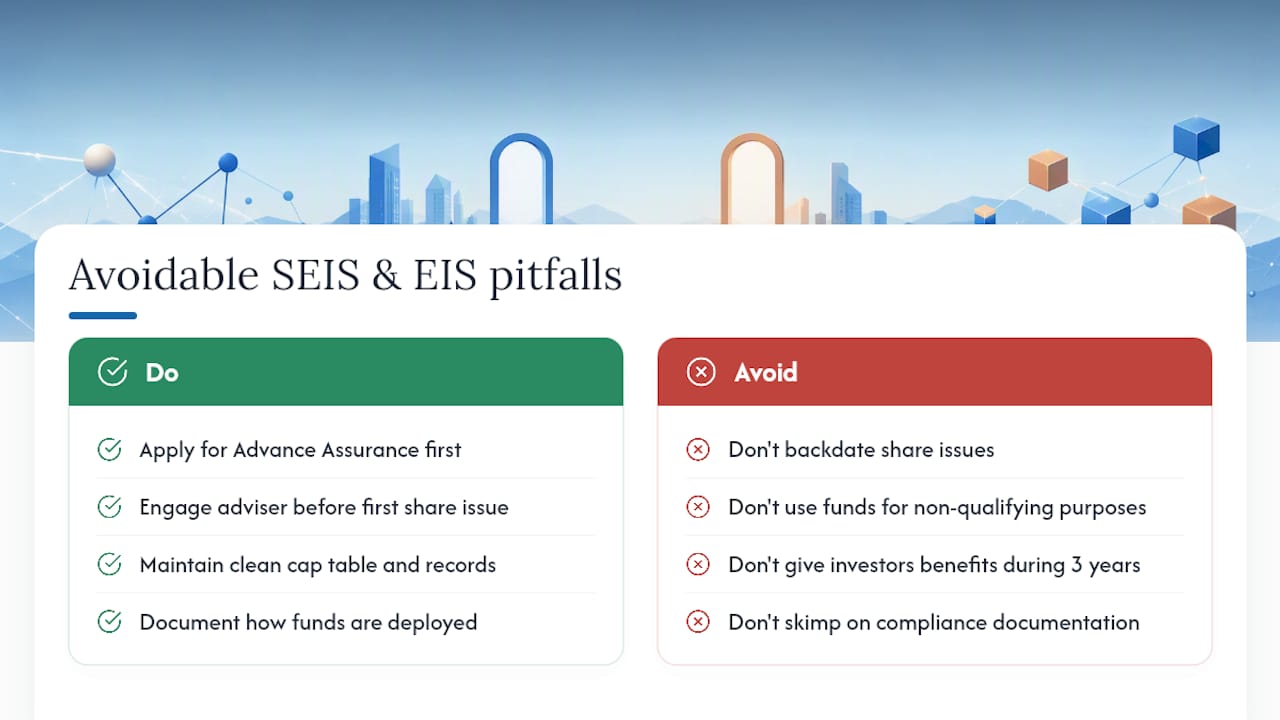
The most expensive mistakes in SEIS and EIS compliance are almost always avoidable. They tend to cluster around a handful of recurring errors.
This catches a surprising number of early-stage founders who want to invest their own money alongside external angels.
Misdated share issues. The date on the share certificate must match the date the shares were actually allotted and entered in the register of members. Backdating share issues, even by a few days, can invalidate the entire raise.
Ineligible use of funds. SEIS and EIS funds must be used for the qualifying business activity within two years of the share issue (or, if later, the commencement of trade). Paying off existing loans, acquiring other businesses, or holding cash for an extended period can all trigger disqualification.
Insufficient documentation. Founders commonly underestimate the documentation required to survive an HMRC compliance check. A clean cap table, a clear spending plan, and evidence of how funds were deployed are the minimum.
Value received by investors. If the company provides any benefit to an investor during the three-year holding period (a loan, an asset at below-market value, or excessive remuneration if the investor is also a director), HMRC treats this as value received and withdraws the relief.
Getting Advance Assurance is not just about satisfying HMRC. It is the single most effective way to reduce investor friction at the point of closing a round. Investors who have seen a clean Advance Assurance letter and a well-prepared compliance pack close faster and with fewer conditions. Founders who skip it often find themselves renegotiating terms after the fact, or losing investors who are not willing to wait for the paperwork to catch up.
Priceandaccountants works with founders from the Advance Assurance stage through to issuing investor certificates and supporting HMRC compliance checks. Having completed startup processes for over 20 clients, some now valued at well over £50 million, the firm has seen the full range of compliance scenarios. The most consistent finding: the founders who bring an adviser in before the first share issue spend far less time and money on remediation than those who try to manage it themselves.
Pro Tip: Never issue shares before your Advance Assurance application is submitted. While Advance Assurance is not legally required, issuing shares without it and then discovering a disqualifying condition is far harder to fix than getting the structure right upfront.
The decision is mostly made for you by the company’s stage and size. But there are genuine choices to make around timing, investor mix, and whether to pursue KIC status.
Founders should:
Investors should:
The schemes look straightforward on paper. In practice, the gap between “probably qualifies” and “definitely qualifies” is where most of the risk sits. A company that has been trading for two years and eleven months is in a very different position from one that is eleven months old, even though both technically pass the three-year SEIS test. The closer you are to a boundary, the more important it is to have the documentation locked down before you issue a single share.
The other thing that gets underestimated is the investor’s own position. A SEIS3 certificate tells an investor that HMRC was satisfied with the company’s compliance at the time of assessment. It does not guarantee their personal relief. If an investor turns out to be connected to the company, or if they receive value from it during the holding period, their relief is withdrawn regardless of what the certificate says. Founders who understand this tend to be more careful about who they bring in as investors and on what terms.
Priceandaccountants has supported founders through SEIS and EIS raises from the earliest pre-seed stage through to Series A, and the pattern is consistent: the raises that go smoothly are the ones where the compliance work was done before the first investor conversation, not after.
Priceandaccountants gives founders a done-for-you compliance pathway from the first investor conversation to the final certificate. The firm prepares Advance Assurance packs, manages the SEIS1/EIS1 compliance statements, and issues SEIS3/EIS3/EIS5 certificates to investors once HMRC authorisation is received. For founders who are also planning R&D tax credit claims, the two workstreams are coordinated so neither delays the other.

The practical difference is speed and certainty. Investors who receive a clean Advance Assurance letter and a well-prepared compliance pack close faster. Founders who have a specialist managing the certificate workflow spend less time chasing HMRC and more time building the business. Priceandaccountants also provides ongoing accounting services to maintain the recordkeeping that HMRC expects during the three-year holding period, so compliance checks do not become a crisis.
To request a specialist review of your SEIS or EIS eligibility, visit Priceandaccountants or get in touch directly. Bring your trading start date, current gross assets, employee headcount, and a summary of your proposed raise structure. That is enough to give you a clear picture of which scheme applies and what the compliance roadmap looks like.
The following sources were used in preparing this article and are worth bookmarking for ongoing reference:
This article provides general information about SEIS and EIS and is not a substitute for professional tax or legal advice. Rules change and individual circumstances vary; confirm current eligibility conditions with HMRC or a qualified adviser before issuing shares or making an investment.