
Start with a 10% fully diluted pool at seed and expect 10–15% by Series A, but the number itself matters less than how it’s created. The single highest-value move is defending pre-money versus post-money treatment (the option pool shuffle), because a badly structured pool can quietly cost founders 3–5 percentage points of ownership on one round.
TL;DR:
- Creating a smaller, well-structured option pool before funding rounds helps preserve founder ownership and aligns dilution costs with actual hiring needs.
- A bottoms-up approach to sizing the pool based on detailed hiring plans is more credible and negotiable than relying solely on industry benchmarks.
- Using post-money creation of the option pool shifts dilution from founders to investors, potentially saving founders 3–5 percentage points of ownership per round.
- Regularly updating the hiring and pool worksheet every 18 to 24 months ensures accurate planning and avoids unnecessary future dilution.
- The decision between pre-money and post-money pool treatment has a larger impact on ownership percentage than the exact size of the pool itself.
An option pool is a block of shares set aside, unissued, for future employees, advisors, and sometimes contractors. It sits inside your fully diluted cap table, meaning every share, option, and convertible instrument that could ever become equity, whether exercised yet or not.
Founders create pools for one practical reason: hiring. You cannot offer a senior engineer or commercial lead a stake in the business without shares already reserved for that purpose. Investors expect to see this reserve before they commit, because it protects their own future dilution too.
The pool typically benefits:
There’s a UK-specific wrinkle worth flagging early: how you structure the pool can affect SEIS and EIS eligibility for your investors. Get the share structure wrong, and you risk disqualifying the very tax reliefs that made your round attractive in the first place.
Every percentage point allocated to the pool comes from somewhere, usually from founders and existing shareholders rather than new investors. A larger pool means investors buy in at a lower effective price, because their percentage stake is calculated after the pool is carved out. That’s precisely why pool size sits at the centre of nearly every term sheet negotiation.
The knock-on effects go beyond simple maths:
Here’s the part most founders miss: vesting schedules and clean documentation usually matter more to investors than shaving half a percentage point off the pool. Precision on paperwork beats precision on percentages.
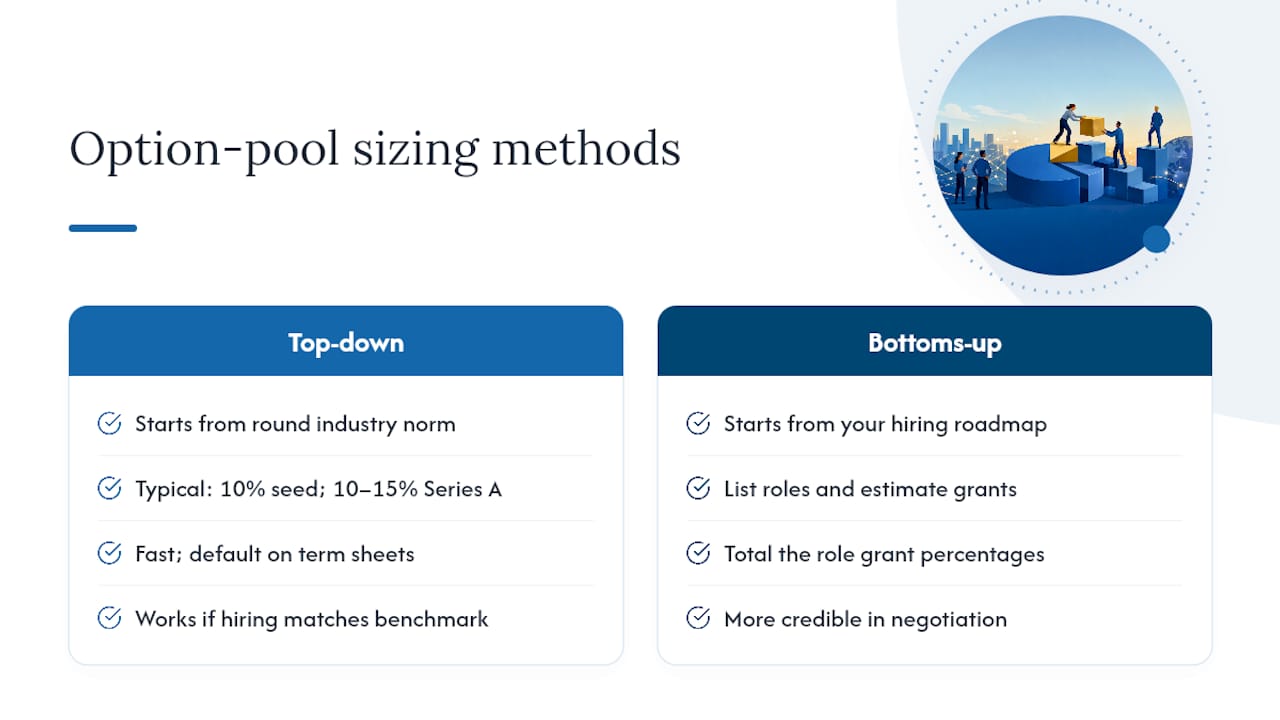
Two accepted methods exist, and you’ll need to be fluent in both because investors often open with one and expect you to counter with the other.
The top-down approach starts with a round number, typically 10% at seed or 10–15% at Series A, based purely on what’s normal for the stage. It’s fast, it’s what most term sheets propose by default, and it works fine when your hiring plan genuinely matches the benchmark.
The bottoms-up approach starts from your actual hiring roadmap. You list every role you expect to fill over the next 12 to 18 months, estimate a grant percentage for each, and total the result. This method is far more credible in negotiation because it’s built from your specific business, not an industry average.
The practical play: when an investor proposes a large round-number pool, don’t argue the percentage in the abstract. Build the bottoms-up worksheet, show your actual hiring need, and let the numbers do the negotiating. Investors respect a founder who arrives with a plan rather than a protest.
Building a defensible bottoms-up figure takes four steps, and doing this properly before your next raise gives you real ammunition at the term sheet stage.
If you already have outstanding grants from a previous round, subtract those from the total pool before calculating what fresh percentage you actually need. That incremental figure, not the gross number, is what you should be negotiating.
Role-based equity benchmarks from VP down to junior hire give you a sanity check against UK market norms, though London tech salaries and equity expectations can run slightly differently to US benchmarks.
Pro Tip: Keep the worksheet as a live spreadsheet, not a one-off exercise. Update it every time you make an offer, and you’ll walk into your next funding conversation with real data instead of a guess.
Term sheets tend to lean on round numbers because they’re quick to agree and familiar to both sides. The most common figures cited in UK term-sheet guidance run as follows:
Investors propose round numbers partly for speed and partly because it’s the industry default they’ve used across dozens of other deals. That doesn’t make the number wrong for your business, but it does mean it’s a starting position, not a fact. If your bottoms-up worksheet lands close to the suggested range, accept the shortcut and move on. If it doesn’t, that’s your negotiating opening.
The “option pool shuffle” refers to whether the pool gets created before or after the investor’s money values the company, and it changes who actually pays for it.
Pre-money creation means the pool is added to the cap table before the new investment is priced, so the entire cost of the pool comes out of existing shareholders, meaning founders. Post-money creation means the pool is calculated after the round closes, sharing the dilution cost between founders and the incoming investor.
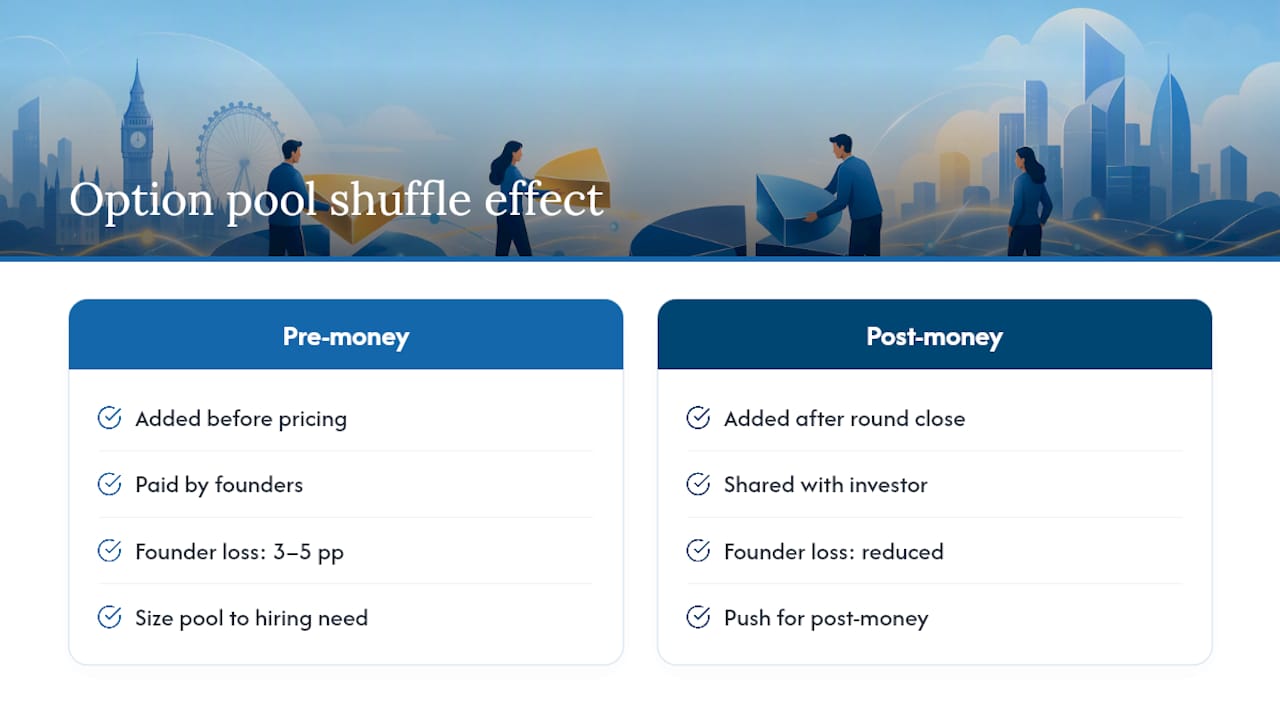
The difference is not trivial in percentage terms. HSBC’s term sheet guidance notes that pre-money pool expansion can shift founder ownership by 3 to 5 percentage points on a single round, purely through where the pool sits on the calculation timeline. On a company raising at a meaningful valuation, that’s real money and real control.
Your negotiation options here are limited but effective. Push for post-money treatment so the investor shares the dilution cost. If that’s rejected, come back with your bottoms-up hiring schedule and argue for a smaller pre-money pool sized to actual need rather than a round number. Whichever way it lands, document the assumptions in the term sheet itself, not just in a side email, so there’s no dispute when the lawyers draft the definitive agreements.
Take a simple case. A company has 8,000,000 founder shares outstanding before the round.
Under pre-money creation, the pool is added before the new shares are issued, so the entire 10% comes out of the founders’ existing stake, and the investor’s price per share is calculated after that dilution. Under post-money creation, the pool is layered in after the investment is priced, spreading the cost between founders and the investor.
The gap, roughly 4 percentage points here, lands squarely inside the 3 to 5 point range practitioners commonly see. Fully diluted, for this calculation, should include all outstanding options, convertible notes, and SAFEs already on the table, not just issued shares. Miss one of those instruments and your worked numbers will be wrong before you even start the negotiation.
Most practitioner guidance points to refreshing the pool every 18 to 24 months, timed to land just before or alongside your next fundraise so the top-up gets baked into the round rather than negotiated separately later.
Pro Tip: Unvested shares from departed employees usually return to the pool. Treat that as a recyclable source before assuming you need a fresh allocation from the next round.
This article is written by Rahamut, drawing on experience helping UK startups navigate SEIS/EIS structuring and cap table modelling from pre-seed through Series A. Price & Accountants has completed start-up processes for over 20 clients, some now valued well over £50m, with particular depth in R&D tax credits, Xero-based cloud accounting, and outsourced finance director support.
When founders need hands-on modelling of pool scenarios, drafting of EMI schemes, or investor-ready documentation, that’s exactly where a specialist team earns its fee rather than a generalist accountant guessing at startup norms.
Most guidance obsesses over the “right” percentage, 10% here, 15% there, as though the number itself is the prize. It isn’t. The research on this consistently points the same direction: the treatment (pre-money or post-money) and the quality of your hiring plan matter more than the digit you agree to.
Founders who arrive with a role-by-role worksheet, a defensible 12 to 18 month hiring horizon, and a clear ask on post-money treatment tend to keep more of their company, even if the headline percentage ends up looking similar on paper.
If you take one thing from this, make it this: spend your negotiating energy on the shuffle, not the size. Precision theatre over a single point rarely pays off; structural clarity almost always does.
— Rahamut
Most UK seed rounds settle around 10% of fully diluted equity, rising to 10–15% at Series A. The right figure for your company should come from a bottoms-up hiring plan covering the next 12 to 18 months, not just the market average.
It depends entirely on stage, role, and dilution to date.
Tax treatment depends heavily on the scheme used. Options granted under an approved EMI scheme typically benefit from more favourable Capital Gains Tax treatment on sale than unapproved options, which can trigger Income Tax and National Insurance on exercise; specific eligibility and interaction with SEIS/EIS structuring is worth checking with an adviser before granting.
Employee Share Purchase Plans are far more common in listed US companies than in UK private startups, where EMI option schemes are the standard route for equity incentives instead. Most early-stage UK companies are better served comparing an option pool against EMI grants rather than an ESPP structure.