
If your business receives services from a supplier who belongs outside the UK, or you operate in specified domestic sectors like construction, you almost certainly need to apply reverse charge accounting rather than pay VAT to the supplier. The action is simple: enter the VAT as both output tax and, where recoverable, input tax on the same VAT return, which is usually cash-neutral. Exceptions exist for end users and exempt supplies, so invoice wording and VAT-number checks still matter.
TL;DR:
- The reverse charge applies when purchasing cross-border services from an overseas supplier or in certain domestic sectors like construction, requiring careful invoice wording and VAT number verification.
- For international services, convert the invoice to sterling on supply date, calculate 20% VAT, and record equal amounts as output and input VAT, usually resulting in no net cash flow.
- In construction, the customer accounts for VAT instead of the supplier, with end-user notifications allowing some transactions to bypass reverse charge rules; proper documentation is essential.
- Common errors include treating B2C supplies as B2B, omitting the reverse charge statement, and failing to verify VAT numbers, risking penalties, interest, and disallowed VAT claims.
- Regular reconciliation, supplier verification, and recordkeeping, plus seeking expert support if needed, help ensure compliance and avoid costly HMRC investigations.
Before wading into ledgers, run the transaction through a fast test. The general B2B rule asks four questions, and if you answer yes to all of them, the reverse charge applies.
Domestic reverse charge sectors, chiefly construction, follow a separate rulebook covered later. Watch for two carve-outs: B2C purchases and exempt supplies never attract reverse charge, and you need documentary evidence, VAT registration numbers, and, in construction, written end-user notifications, to prove your position if HMRC asks.
The mechanics are mechanical by design. HMRC’s guidance on services from abroad sets out a four-step process:
Pro Tip: Keep a simple spreadsheet log of the exchange rate source and date for every reverse-charge invoice. HMRC can ask you to justify the rate used months after the transaction, and “I don’t remember” is not an answer they accept.
For a fully taxable business, steps three and four cancel out. The reverse charge technical guide confirms the net financial effect is typically zero because output VAT is simultaneously reclaimed as input VAT. That neutrality breaks down the moment partial exemption enters the picture, which we cover in a later section. In Xero or similar cloud software, most reverse-charge transactions map to a dedicated tax rate that posts both sides automatically, but always check the return preview before submission, particularly Box 1 and Box 4 figures.
The domestic reverse charge exists to close a VAT fraud gap in construction supply chains, where subcontractors historically charged VAT, collected it, and disappeared before paying it to HMRC. Under the rules described in VAT Notice 735, the supplier stops charging VAT altogether, and the customer accounts for it instead.
Two roles change how this plays out:
This detail sits in VAT Notice 735 itself, so check the current wording before relying on it for a live contract. For complex, multi-tier subcontracting chains, HMRC’s own flowcharts remain the fastest way to work out where the reverse charge starts and stops.
Get the invoice wrong and you hand HMRC an easy target. The supplier must not add VAT to the invoice total under reverse charge rules; instead, the invoice needs to state plainly that reverse charge applies, along with both parties’ VAT registration numbers where relevant.
Missing invoice wording is one of the most common triggers for HMRC to disallow an input VAT claim on review, according to internal guidance on reverse-charge invoicing for specified goods.
Beyond the invoice itself, verify your supplier’s VAT number through the VIES system where the transaction is cross-border, and keep correspondence proving the customer’s business status. Electronic invoices carry the same evidential weight as paper, but only if you retain them accessibly for the standard six-year record period.
Three errors show up repeatedly in HMRC reviews. Treating a B2C supply as B2B is the most damaging, because it means the reverse charge never should have applied in the first place. Omitting the reverse charge statement from an invoice is the second, and accepting a VAT number without checking it is the third.
The consequences bite. Disallowed input VAT means you owe the money back plus interest, and if HMRC decides the error pattern looks careless rather than accidental, penalties follow on top. Backdated liabilities can stretch across several VAT periods if the error went unnoticed for a while.
Fix errors properly rather than quietly. Depending on the size and age of the mistake, you’ll either adjust it on your next VAT return or file a voluntary disclosure to HMRC directly.
Example 1: digital consultancy from a non-UK supplier. A UK fintech firm buys £8,000 (converted from US dollars at the invoice date’s exchange rate) of software consultancy from a US-based provider. The bookkeeper enters £1,600 as output tax and £1,600 as input tax on the same return, following the four-step process HMRC sets out for services bought from abroad. Net cash effect: nil, because the business is fully taxable.
Example 2: domestic construction subcontractor. A subcontractor invoices £15,000 net for groundworks with no VAT charged and the reverse charge statement included. The contractor, not registered as an end user for this job, accounts for £3,000 output VAT and reclaims £3,000 input VAT, again cash-neutral.
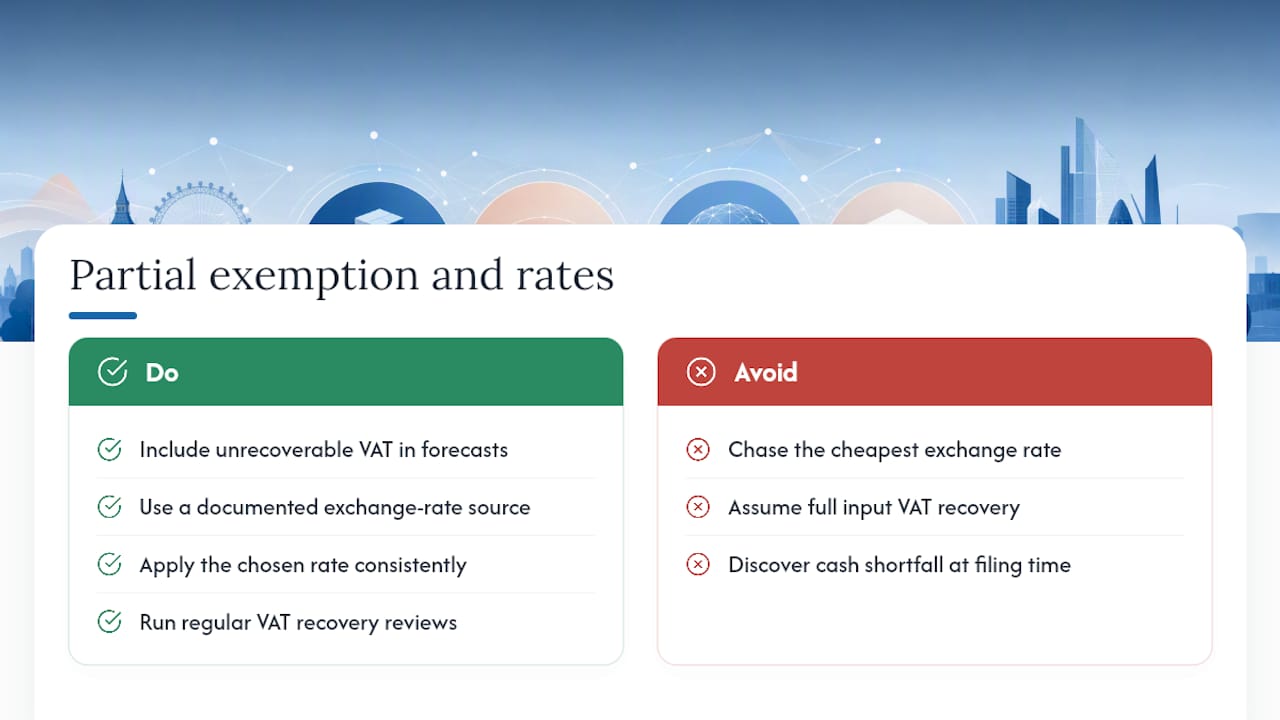
Partial exemption is where the “neutral” reputation of reverse charge quietly falls apart. If your business makes exempt supplies alongside taxable ones, only the taxable proportion of input VAT is recoverable. That means a chunk of the reverse-charge VAT you post as output tax stays as a genuine cost rather than cancelling out, and fintech firms with exempt lending or insurance-adjacent income run into this more often than most.
On exchange rates, HMRC expects the rate in force on the date of supply, and consistency matters more than chasing the cheapest conversion. Pick a documented source, such as HMRC’s own published exchange rates, and apply it uniformly.
If reverse charge is creating a real cash cost through partial exemption, build that percentage into your quarterly forecasting rather than discovering it at return-filing time. A VAT compliance review that models your recovery rate against typical purchase volumes catches this early.
The clients who get caught out rarely have one big error. It’s usually three small habits stacked together: no VAT-number verification process, invoice templates missing the reverse-charge statement, and nobody reconciling output against input entries before the return goes in.
A workable monthly routine covers four things: verify every new supplier’s VAT status before the first invoice, confirm end-user notifications are filed and dated for construction contracts, reconcile reverse-charge output and input entries against the general ledger before submission, and recalculate your partial exemption percentage if it’s been more than a quarter since the last check. None of this takes long once it’s a habit. It’s the businesses that treat reverse charge as a one-off setup task, rather than a recurring control, that end up explaining themselves to HMRC eighteen months later.
— Rahamut
Specialist accounting firms provide essential support for complex issues like cross-border reverse charge and construction sector rules, especially for tech and fintech clients scaling internationally.

Our VAT & business compliance service covers VAT return preparation, reverse-charge classification checks, and ongoing bookkeeping through Xero, so errors get caught before they reach HMRC rather than after. If you’d rather not second-guess every cross-border invoice, a compliance review is the practical starting point. Pricing runs from the Core Services plan at £249 per month, scaling up to the Blue Plan and Black Plan for businesses with heavier compliance loads. Book a conversation through our pricing page to find out which level fits your transaction volume.
Exempt supplies, such as certain financial and insurance services, never attract reverse charge because there’s no VAT to shift in the first place. B2C services also fall outside the mechanism, since it only applies between VAT-registered businesses acting in a business capacity.
Cross-border professional and digital services, including consultancy, software licensing, and telecommunications bought from suppliers who belong outside the UK, typically fall under the general B2B reverse charge. Domestically, specified building and construction services carry their own reverse charge regime with separate end-user rules.
Yes, where the conditions are met, reverse charge accounting is a legal requirement rather than a choice, as confirmed in HMRC’s reverse charge technical guide. A supplier who wrongly charges VAT on a transaction that should have been reverse-charged creates a compliance problem for both parties.
In construction contracts under VAT Notice 735, if the reverse-charge element of a mixed supply is small, the whole supply can be treated under normal VAT rules instead of being split. It’s a simplification measure, not a general exemption, so check the current notice wording against your specific contract before applying it.