
Since 1 April 2024, the default route for claiming R&D tax relief is the merged RDEC-style scheme, replacing the old separate SME and RDEC schemes. The only carve-out is Enhanced R&D Intensive Support (ERIS), reserved for loss-making SMEs that spend at least 30% of total expenditure on qualifying R&D. If your company falls outside that band, you’re in the merged scheme whether you like it or not.
TL;DR:
- Loss-making, R&D-intensive SMEs spending at least 30% of their expenditure can claim ERIS, which provides a cash credit worth up to 27p for each pound spent.
- Profitable SMEs and loss-making companies below the 30% threshold generally claim through the merged scheme, receiving a taxable income credit that is less advantageous for cash flow.
- The 2024 reform removes automatic restrictions on subsidy-funded R&D spend, but proper documentation of grant terms remains essential.
- Companies should recalculate their size and R&D intensity annually, especially if growth or funding rounds shift their thresholds during an accounting period.
- Choosing between schemes impacts financial reporting, with ERIS improving cash flow and the merged scheme highlighting R&D expenditure in income statements.
The old fork in the road (SME scheme or RDEC, depending on company size) has narrowed to a single question: are you a loss-making, R&D-intensive SME, or not?
For accounting periods beginning on or after 1 April 2024, the separate SME and RDEC schemes have been replaced by a single merged RDEC-style scheme. Most profitable SMEs, large companies, and loss-making SMEs below the intensity threshold now claim under this one framework. It works as an above-the-line credit, calculated on qualifying R&D costs and shown as taxable income.
ERIS sits alongside it as the exception, not the rule:
The gap between the two matters most when cash, not tax deduction, is what keeps a business running. ERIS was built precisely for that scenario.
Before choosing a route, check the basics. SME status under the R&D rules follows the standard test: fewer than 500 staff, and either turnover under €100 million or a balance sheet under €86 million. Linked and partner enterprises count towards those thresholds, which catches out founders who assume a subsidiary or a heavily-invested associate company doesn’t count. It usually does.
Three checks decide your route:
Subcontracted R&D also needs care. Work contracted out to another business, or costs shared with connected parties, follows specific attribution rules that determine which company can actually claim, as detailed in GOV.UK’s SME R&D guidance.
The numbers are where the two routes genuinely diverge.
ERIS pays a 14.5% payable credit on enhanced qualifying expenditure, worth up to 27p for every £1 spent on R&D for a loss-making, intensive SME. That’s a direct cash payment, not a deferred tax saving, which is exactly why it matters for pre-revenue and early-revenue tech companies burning cash on development.
The merged scheme works differently. It delivers a taxable expenditure credit, currently set well below ERIS’s effective rate once corporation tax is applied, and the credit counts as income above the line in the accounts before tax is deducted. For a profitable company already paying corporation tax, that’s often simpler to process and reasonably competitive. For a loss-maker outside the intensity band, it’s a smaller cash benefit than ERIS would have delivered, paid later and taxed on the way through.
A quick illustration: two companies each spend substantial amounts on qualifying R&D. One is loss-making and R&D-intensive, claiming ERIS, and receives a payable credit worth significantly more cash. The other is loss-making but below the 30% intensity threshold, claims under the merged scheme, and receives a taxable credit with a materially lower net cash benefit. The same spend, same loss position, very different runway impact.
One of the quieter but more useful changes in the 2024 reform: the merged scheme removed the automatic reduction in relief that previously applied when R&D spend was subsidised by a grant. Under the old SME scheme, grant funding often pushed companies into the less generous RDEC route by default. That penalty has largely gone.
Pro Tip: Even though the grant penalty has eased, document the terms of any subsidy anyway. State-aid compatibility questions still surface in enquiries, and a paper trail saves weeks of back-and-forth.
Getting the mechanics right matters as much as picking the correct scheme.
Pro Tip: Keep a running log of R&D activity throughout the year rather than reconstructing it at claim time. Retrospective narratives are the single biggest reason claims get challenged.
This guide draws on how R&D claims actually play out for UK tech and fintech companies navigating scheme choice, not just the theory of it.
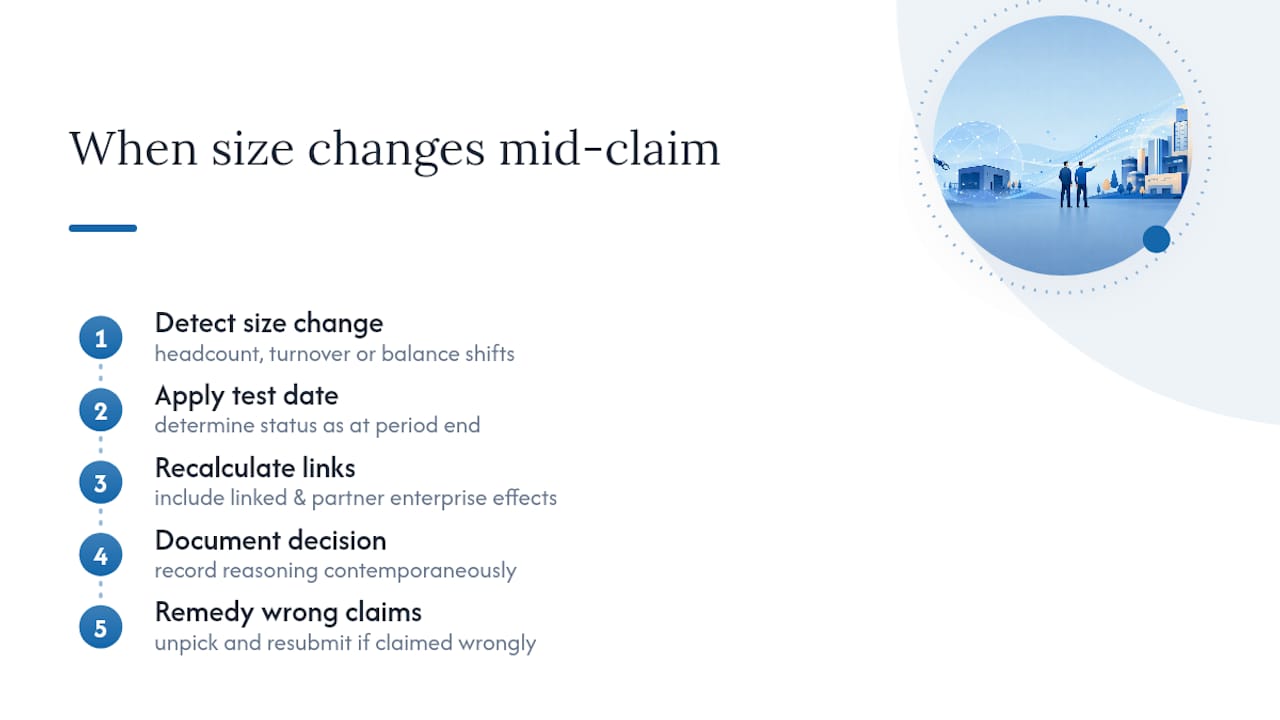
Company size isn’t fixed, and R&D claims often span a period where headcount, turnover or balance sheet totals shift enough to change eligibility.
A company that starts an accounting period as a qualifying SME but grows past the thresholds during the year, through a funding round, an acquisition, or simply strong trading, needs to check its status at the relevant test date rather than assuming last year’s classification still holds. Linked and partner enterprise calculations can also shift suddenly: bringing on a new majority investor, or being acquired by a larger group, can pull a previously independent SME over the 500-staff or turnover limits without anything changing in the day-to-day business.
The practical risk is claiming under the wrong route entirely, then having to unpick and resubmit. This happens more often than founders expect in fast-growing fintech companies, where a single funding round can double headcount within months. If a size change happens partway through an accounting period, the safest approach is to test eligibility as at the period end and document the reasoning at the time, not months later when HMRC asks. Groups with several related entities should map out linked and partner enterprise relationships annually, not just when a claim is due, since the answer can change year to year even without a formal acquisition.
The scheme you claim under doesn’t just affect cash received. It changes how R&D relief appears in the financial statements themselves.
Under the merged RDEC-style scheme, the credit is recognised above the line, as taxable income within operating profit, before corporation tax is applied. That means R&D activity visibly boosts revenue-adjacent metrics in the accounts, which some finance directors actually prefer when presenting figures to investors, since it makes the R&D investment and its return more visible in the profit and loss account rather than buried in the tax line.
ERIS, by contrast, delivers a payable credit that behaves more like a below-the-line cash receipt, offsetting or refunding tax rather than inflating reported operating income. For companies still raising funding rounds, that distinction affects how investors read the numbers: an ERIS credit doesn’t dress up top-line performance, but it does materially improve the cash position, which matters more to a pre-revenue business than optics on an income statement.
Either way, the credit’s tax treatment needs to be handled correctly under UK GAAP or IFRS, particularly around whether it’s presented as a reduction in R&D expense or as separate income. Get this wrong and your statutory accounts and your R&D claim can tell two different stories, which is exactly the kind of inconsistency that invites HMRC questions.
Strip away the marketing language and the differences between the merged scheme and ERIS come down to four practical factors.
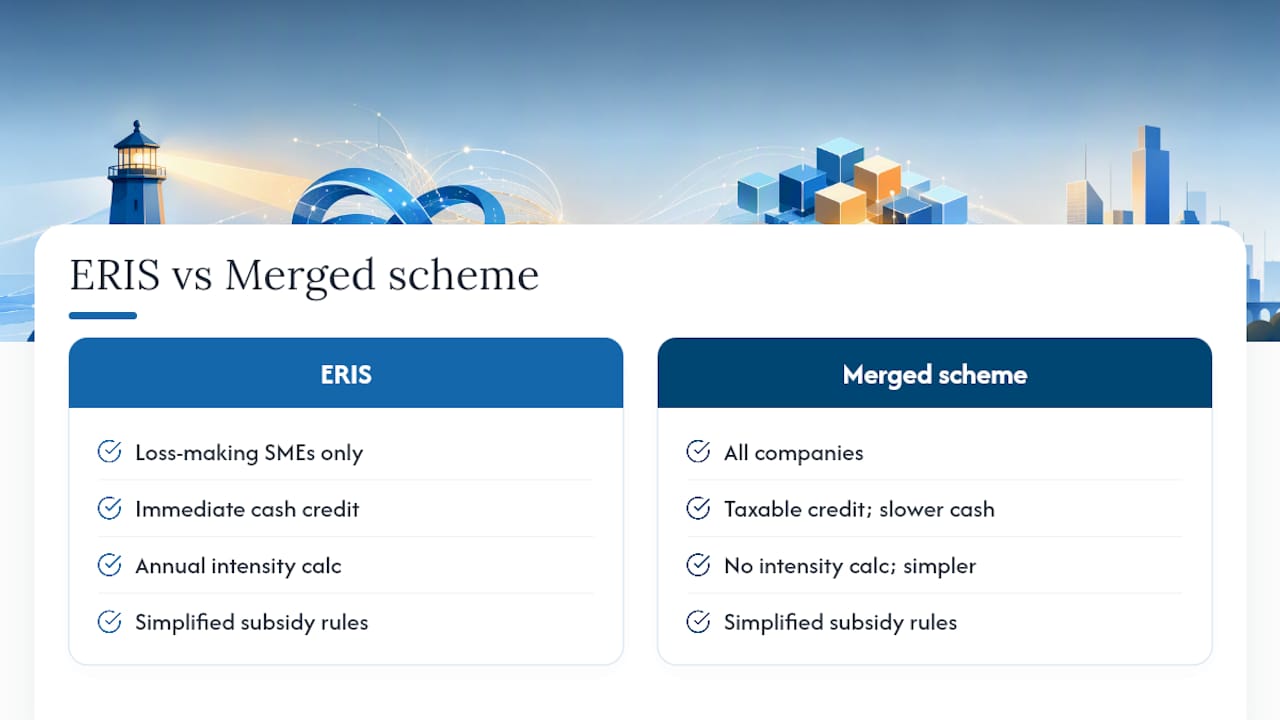
Eligibility population. The merged scheme covers everyone: profitable SMEs, large companies, and loss-making SMEs that don’t hit the 30% intensity bar. ERIS is deliberately narrow, available only to loss-making SMEs that clear that intensity threshold, as confirmed in GOV.UK’s enhanced support guidance.
Cash timing. ERIS pays a genuine cash credit that supports runway directly. The merged scheme’s credit is taxable and, for loss-makers outside ERIS, converts to cash more slowly and at a lower effective rate.
Administrative complexity. Profit-making companies generally find the merged scheme more straightforward, since there’s no intensity calculation to perform each year. ERIS claimants must recalculate intensity annually and track the grace period carefully.
Subsidy treatment. Both routes now benefit from the simplified treatment of subsidised expenditure introduced in 2024, removing a longstanding SME-scheme pitfall.
The nuance most guides skip: a company can move between the two routes year on year as its profit position and intensity ratio shift, which means scheme choice isn’t a one-off decision but an annual recalculation.
Two scenarios make the choice concrete.
A profitable SaaS company spending £150,000 annually on product development, with steady revenue and modest headcount growth, simply claims under the merged scheme. There’s no intensity test to pass because the company isn’t loss-making, and the taxable credit integrates cleanly with its existing corporation tax position.
A pre-revenue fintech startup, 18 months from its first paying customer, spending 60% of its total costs on engineering and compliance-tech development, is a textbook ERIS candidate. It’s loss-making, comfortably over the 30% intensity threshold, and the enhanced payable credit puts real cash back into the business at a point when every month of runway counts.
Companies in that position should model both outcomes each year rather than assuming last year’s answer holds.
The claims that go wrong rarely fail on eligibility. They fail on weak recordkeeping and subcontractor costs allocated to the wrong entity months after the work happened. The commercial trade-off is rarely discussed honestly: immediate ERIS cash versus a larger deferred benefit under the merged scheme. Treat R&D claims as part of ongoing finance planning, not an annual afterthought.
— Rahamut
Working out whether your company sits in ERIS or the merged scheme is only half the job. The harder part is building a claim that survives an HMRC enquiry, which is where founders juggling product development and fundraising tend to run out of time. We focus on R&D claims for high-growth UK tech and fintech companies that require specialized expertise beyond general accounting services.

The firm’s R&D tax credit service covers scoping, cost schedule preparation, and technical narrative drafting, alongside broader advisory and tax planning support for companies managing grants, group structures, or cross-border R&D activity where the rules get genuinely complicated. Book a scoping call and bring your last two years of R&D cost breakdowns; the firm’s pricing page sets out engagement options, including the Core Services plan at £249 per month for ongoing compliance support.
The separate schemes no longer exist for periods starting on or after 1 April 2024. Almost all companies now claim under the merged RDEC-style scheme, except qualifying loss-making, R&D-intensive SMEs, which use ERIS instead.
Check your accounting period start date first.
The threshold is 30% of total expenditure spent on qualifying R&D, and it must be calculated for each accounting period, with a one-year grace period if you dip below it after previously qualifying.
ERIS offers a 14.5% payable credit on enhanced qualifying expenditure, worth up to 27p per £1 spent for eligible loss-making, R&D-intensive SMEs.
The 2024 reform removed the automatic reduction that previously applied when R&D spend was grant-funded, though you should still document subsidy terms for compliance purposes.
Yes. Price & Accountants’ R&D tax credit service works specifically with UK tech and fintech companies to determine scheme eligibility and prepare compliant claims.