
Your first job this quarter is simple: check your intensity ratio, confirm who in your contract chain actually holds the right to claim, and get your evidence pack ready for the Additional Information Form.
TL;DR:
- Companies must carefully determine claim rights in supply chains and ensure contracts explicitly reference R&D activities before claiming.
- Overseas costs are increasingly restricted and require clear justification based on necessity rather than cost savings, with thorough documentation maintained.
- The 30% R&D expenditure intensity test must be monitored regularly, as minor cost reclassifications can alter eligibility from one period to another.
- The merged RDEC scheme requires timely notification to HMRC within six months and submission of a detailed Additional Information Form alongside the tax return.
- Building a comprehensive, contemporaneous evidence pack, including time logs and contract specifics, is essential to avoid HMRC disputes during claims.
The government folded the old SME scheme and RDEC into one mechanism to simplify a system that had grown genuinely confusing, with different rates, different rules on subcontracting, and two separate sets of forms depending on company size. Under the merged RDEC scheme, the credit sits above the line in your accounts, taxable as trading income rather than buried as a below-the-line deduction. That matters for how it reads on your P&L, not just your tax bill.
Most companies that previously claimed under the SME scheme or RDEC now fall under this single regime. The exception is loss-making, R&D-intensive SMEs, who remain eligible for ERIS. The rules apply to accounting periods starting on or after 1 April 2024, so a company with a June year-end will still file its prior period under the old rules and its next return under the merged scheme. Public R&D spending continues to climb under DSIT’s funding allocations, and the merger is part of a wider push to keep the UK’s innovation incentive competitive while tightening compliance.
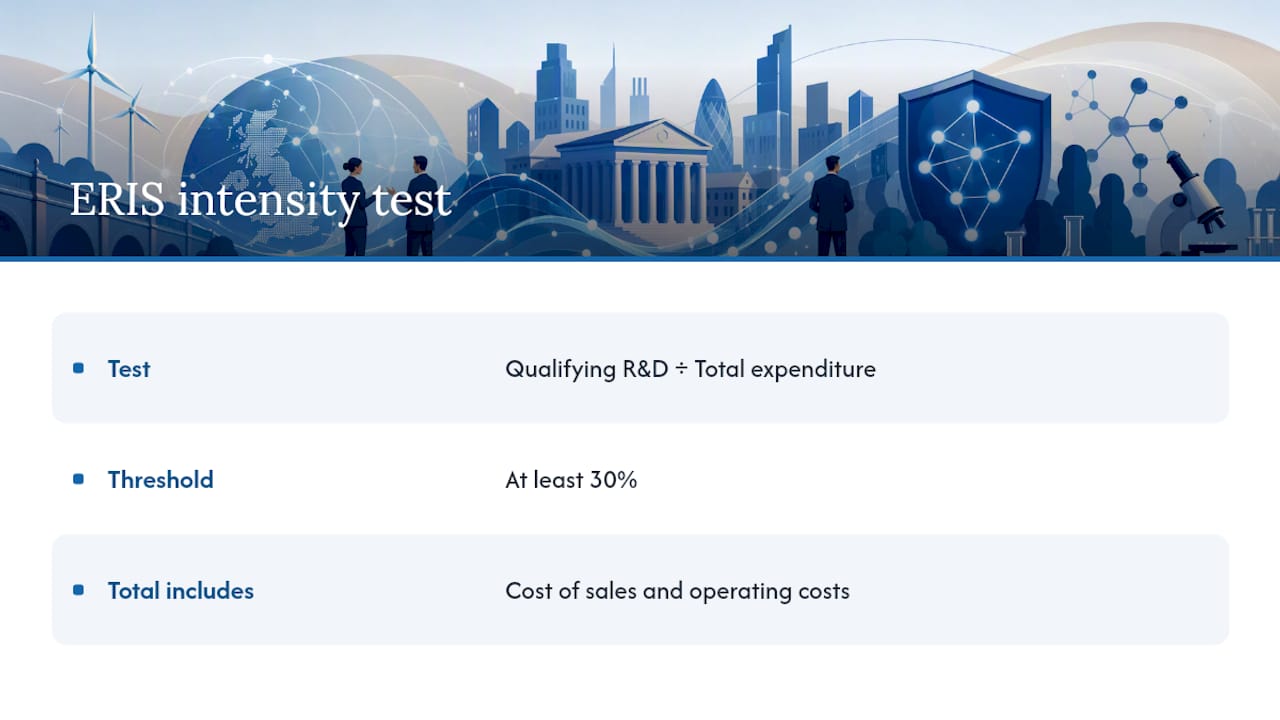
Any company subject to UK Corporation Tax that carries out qualifying R&D can claim under merged RDEC, regardless of size, provided it isn’t better placed under ERIS. The ERIS intensity test asks a specific question: does qualifying R&D expenditure make up at least 30% of total expenditure for the period? Total expenditure includes cost of sales and operating costs, not just R&D-adjacent spend.
Work it out as relevant R&D spend divided by total expenditure.
Sitting close to the line is risky. Our worked examples on the intensity rule show how a single reclassified cost can flip eligibility between periods, so model this before you file, not after.
Qualifying cost categories haven’t shifted dramatically under the merger, but the overseas rules have tightened considerably, and this is where most avoidable errors now happen.
Overseas subcontractors and EPWs are now largely excluded unless “necessary conditions” exist abroad, such as geographical, environmental, or regulatory factors that make UK-based work genuinely impossible, not merely cheaper. Keep dated correspondence and technical justifications on file, since cost alone won’t satisfy HMRC. Our guide to qualifying costs and evidence covers documentation templates in more depth.
The default position under merged RDEC has flipped in a way many finance teams haven’t fully absorbed: the customer commissioning R&D generally claims, not the contractor doing the work. That’s a reversal from parts of the old SME regime, and it puts contract wording under far more scrutiny than before.
Deloitte’s analysis of the merged regime points to the “contemplated and intended” test as the practical hinge. HMRC asks whether the R&D was contemplated and intended by the customer at the point the contract was agreed, or whether the contractor undertook it on its own initiative and merely delivered a result. A software agency solving an unforeseen technical problem mid-project, one the client never specified or anticipated, may retain the claim itself even though it was technically contracted.
The exceptions matter more than the default rule in practice. Check whether your contracts explicitly reference R&D activity, whether payment terms are tied to deliverables or to effort, and whether risk sits with you or your supplier. Reviewing subcontractor cost treatment before you sign the next master services agreement is far cheaper than untangling a disputed claim after HMRC opens an enquiry. Industry advisers including BDO recommend documenting, in writing, exactly which party in the supply chain intends to claim before the accounting period closes.
Net benefit depends on your tax position:
Companies with significant intellectual property under their own management, rather than acquired or subcontracted from a connected party, may qualify for an exemption from the cap, so check connected-party arrangements carefully before assuming the cap applies. Our breakdown of PAYE/NIC cap mechanics walks through the formula against real payroll figures.
New claimants, or companies that haven’t claimed in the previous three years, must notify HMRC within six months of the end of the accounting period the claim relates to. Miss that window and the claim simply cannot be made, regardless of how strong the underlying R&D case is.
Every claim submitted on or after 1 August 2023 requires an Additional Information Form, filed before or alongside the Corporation Tax return. The AIF asks for a breakdown of qualifying costs by category, details of the competent professional who oversaw the R&D, and a technical narrative describing the advance sought and the uncertainties addressed. HMRC checks the AIF against the return automatically, and a mismatch between the two is one of the fastest routes to an enquiry.
Before submission, cross-check that your technical narrative describes the same projects your cost schedule claims for, that job titles in your evidence match payroll records, and that subcontractor invoices reference the same work described in the AIF. Weak documentary evidence on overseas work or ambiguous contract drafting is exactly what ForrestBrown flags as the pattern HMRC now prioritises for review.
Building an evidence pack before your accounting period even closes saves weeks of scrambling later. Work through this sequence:
Pro Tip: Keep a running R&D time log by project, updated monthly rather than reconstructed at year end. HMRC’s enquiry teams consistently flag time allocations that appear estimated retrospectively, and a contemporaneous log is the single cheapest defence you can build.
The most common pitfall isn’t a missing receipt. It’s a technical narrative describing ambitious innovation work that doesn’t match a cost schedule dominated by routine maintenance, or a claim filed by the contractor when the customer’s contract clearly shows they commissioned and specified the R&D themselves.
The firms getting this right treat the merger as a contract-review exercise first and a tax calculation second. Spend the next 90 days auditing who has claim rights in your supply chain and building your evidence pack, before you touch the numbers. If contracts are ambiguous, bring in specialist advice rather than guessing.
— Rahamut
Getting the merged RDEC calculation right is one problem. Getting the contract review, the AIF narrative, and the PAYE/NIC cap modelling right at the same time, without missing the six-month notification window, is a different exercise entirely, and it’s the one where most in-house finance teams run out of hours. Specialist firms support UK tech and fintech companies with the combination of claim management, contract review to establish who holds claim rights, AIF preparation, and outsourced finance director support when a claim touches wider funding or valuation decisions.

If your accounting period has already moved into the merged scheme, or you’re weighing ERIS eligibility for the first time, a compliance review now is considerably cheaper than an HMRC enquiry later. Get in touch through our R&D tax credits service page to arrange an initial consultation before your next filing deadline.
Yes.
The customer commissioning the work generally claims under merged RDEC, unless the contractor undertook the R&D on its own initiative rather than at the customer’s specification, per the “contemplated and intended” test.
Only where “necessary conditions”, such as regulatory, environmental, or geographical factors, make UK-based work genuinely impossible; cost savings alone don’t satisfy the test.
Every claim submitted on or after 1 August 2023 needs an AIF filed alongside or before the Corporation Tax return, detailing costs, projects, and the competent professional involved.
Priceandaccountants reviews R&D contracts to establish claim rights, prepares AIF documentation, and models PAYE/NIC cap exposure as part of its R&D tax credit service for UK tech and fintech companies.