

Yes, a non-resident can incorporate and wholly own a UK limited company. You don’t need to live in Britain, hold a UK visa, or even visit the country. What you cannot skip are three fixed requirements: a UK registered office address, a correctly filed application at Companies House, and identity verification for every director and person with significant control. Once incorporated, you’ll also need to register for Corporation Tax and watch the VAT threshold from day one.
TL;DR:
- Non-residents can incorporate a UK limited company without living in Britain, but must provide a UK registered office and undergo identity verification.
- An authorised formation agent simplifies registration, handles address and ID requirements, and processes applications within 24 hours, avoiding common delays.
- A UK registered office must be a physical address capable of receiving mail, with privacy options available by using service addresses instead of home addresses.
- Fintech accounts like Wise, Revolut, and Tide offer remote onboarding for banking, enabling quick setup for non-residents, while traditional banks often require in-person visits.
- Registering for Corporation Tax within three months of trading start and managing VAT compliance are crucial, with penalties for late filings and statutory deadlines.
Table of Contents
- Quick checklist: what you must arrange before you apply
- Step-by-step: how to form a UK limited company from abroad
- Identity verification and the Economic Crime / Corporate Transparency changes
- Registered office and service address: options and privacy considerations
- Banking and payment options for non-resident directors
- Tax and ongoing compliance: corporation tax, VAT and statutory filings
- Do non-resident directors pay UK tax personally? (residency and source rules)
- When to hire a UK accountant or formation partner (how Price & Accountants helps)
- Author perspective: common founder pitfalls and fast wins
- How Price & Accountants can help set up and manage your UK company
- Sources
Quick checklist: what you must arrange before you apply
Before you touch the incorporation form, get these decisions and documents lined up. Rushing this stage is where most overseas founders lose a week to avoidable back-and-forth with Companies House.
- Company name and structure: pick a compliant name, decide on a private limited company by shares (the standard choice for most non-resident founders), and settle on your SIC code and initial share split.
- Officers and shareholders: you need at least one director aged 16 or over and at least one shareholder. If anyone holds more than 25% of shares or voting rights, they count as a Person with Significant Control (PSC) and must be declared.
- Registered office address: this has to be a physical UK address on public record. A director’s separate service address can keep home addresses private if that matters to you.
- Identity documents: a valid passport and proof of address for every director and PSC, plus working contact details, since Companies House and any formation agent will need to reach people directly.
- A post-incorporation plan: know roughly when you’ll start trading, because that date triggers your Corporation Tax registration deadline, and think ahead about VAT and who’ll handle your bookkeeping from month one.
Getting this list sorted first turns incorporation into a same-day task rather than a drawn-out one.
Step-by-step: how to form a UK limited company from abroad
1. Choose your route. You can file directly through Companies House’s own web incorporation service, or use an authorised formation agent. For most non-residents, an agent is worth the fee: they handle identity verification, know how registered office and service address rules interact, and won’t let a technicality bounce your application back.
2. Check the name and settle your structure. Confirm the name isn’t already taken or too similar to an existing one, decide whether to adopt the standard model articles of association or draft bespoke ones, assign a SIC code that matches your actual business activity, and fix your initial shareholding.
3. Line up your registered office and officer details. You’ll need the UK address confirmed and full details, including nationality and occupation, for every director and shareholder before you submit anything.
4. Complete identity verification. This is where non-resident applications most often stall. You’ll either upload certified documents yourself or, more commonly, go through an agent-assisted check that verifies your passport and a selfie or video call. Get this done before submission, not after.
5. Submit and wait. Correctly completed online applications are often processed within 24 hours by Companies House, though incomplete ID checks or name queries can push this to several days.
6. Handle what arrives next. You’ll receive a Certificate of Incorporation electronically, and a Unique Taxpayer Reference (UTR) by post to your registered office, which can take a couple of weeks to reach an overseas founder if mail isn’t being forwarded promptly. From the date you actually start trading, you have three months to register for Corporation Tax with HMRC.
Miss that three-month window and you risk a penalty for late registration, so mark the trading start date the moment you decide it, not the moment the paperwork lands.
Identity verification and the Economic Crime / Corporate Transparency changes
Companies House now requires identity verification for directors and PSCs as part of a wider push against shell companies and fraudulent filings, tightening what used to be a fairly light-touch registration process. For non-residents, this usually means one of two routes: certified copies of your passport and proof of address sent to an agent, or a remote biometric check where you photograph your passport and complete a live selfie or video verification.
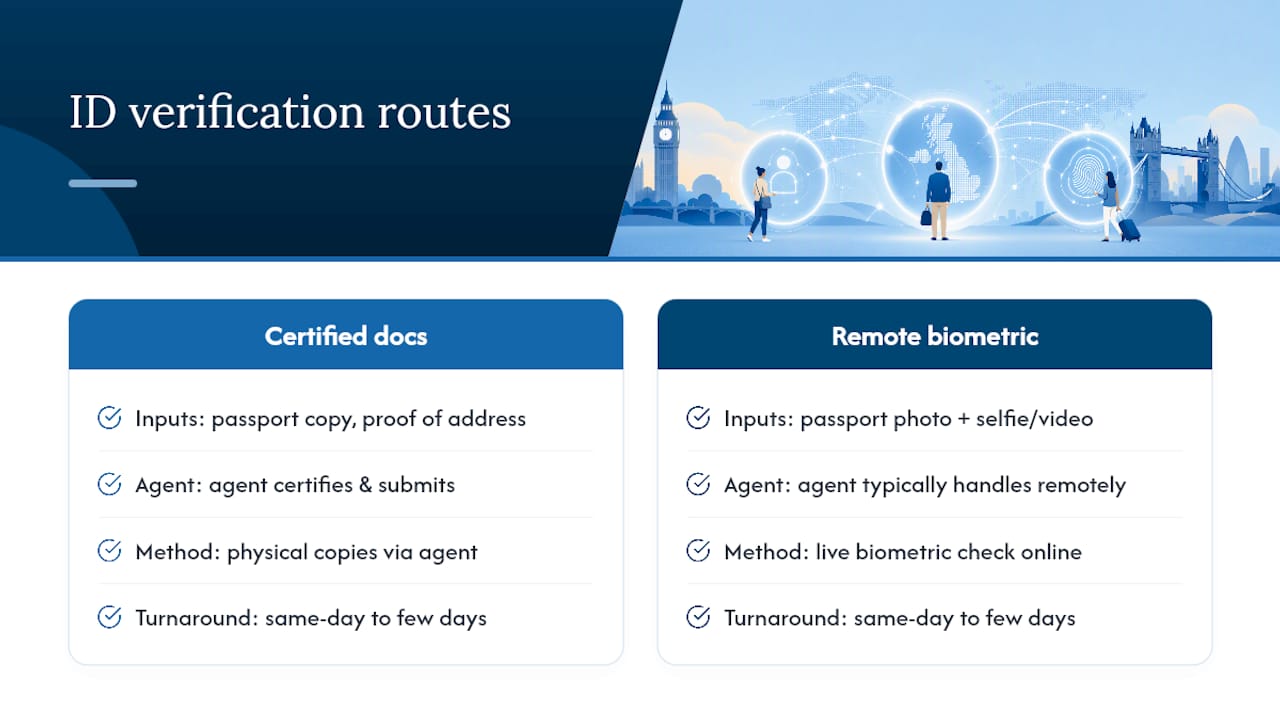
Get this sorted before or right at incorporation. Filing without completed verification is the single most common cause of delayed or rejected non-resident applications, and it’s entirely avoidable with a bit of forward planning.
The practical route for most founders is working through an Authorised Corporate Service Provider (ACSP) or formation agent that’s already set up to handle verification remotely. Typical turnaround runs from same-day to a few days, depending on document quality. The most common pitfall is submitting a blurry passport scan or an address document that doesn’t match the name exactly, which sends you back to square one.
Registered office and service address: options and privacy considerations
Every UK company needs a registered office, a physical UK address where official post and legal notices are sent. A PO box on its own doesn’t satisfy this requirement; it has to be a genuine address capable of receiving mail.
Your options here trade off cost against convenience:
- Formation agent addresses: bundled with incorporation packages, usually the cheapest way to tick this box.
- Virtual office providers: dedicated registered office services with mail scanning included, often priced separately from formation.
- Accountant or solicitor addresses: some firms offer this as part of a wider service relationship rather than a standalone product.
- Your own UK premises: viable if you already have a physical base, but rare for a first-time non-resident founder.
The registered office address appears permanently on the public register, visible to anyone who looks the company up. A director’s home address does not need to appear there if you use a separate service address, which most non-residents choose for exactly that privacy reason. Costs for a basic registered office with mail scanning typically sit in the range of a modest monthly or annual fee, depending on how much forwarding and scanning you need.
Banking and payment options for non-resident directors
High-street UK banks still often expect an in-branch visit, UK residential address history, or both, which makes them a poor first option for a founder incorporating from abroad. That’s not a rule written into law; it’s simply how most traditional banks have built their onboarding.
Fintech providers have largely filled that gap:
- Wise Business and Revolut Business both offer UK account details (sort code and account number) with fully remote onboarding.
- Tide is popular among UK small businesses and accepts many non-resident director applications.
- Monzo and Starling lean more towards UK-resident personal and small business banking, so check eligibility carefully before applying as a non-resident.
- Protection differs by provider: traditional banks carry FSCS deposit protection up to the standard limit, whereas some fintech accounts operate as e-money institutions without the same coverage.
If you need a full banking relationship for lending or larger cash management, you may still need a traditional UK bank eventually. For invoicing, receiving payments, and paying UK suppliers early on, a multi-currency fintech account is usually enough to get trading.
Pro Tip: Apply for your business bank account or fintech account the same week you incorporate, using your Certificate of Incorporation as proof. The company record needs to exist and be searchable before most providers will even start your application, so delaying this step by even a fortnight can push your first invoice back further than you’d expect.
Tax and ongoing compliance: corporation tax, VAT and statutory filings

You must register for Corporation Tax with HMRC within three months of starting to trade, done online using your company’s registration details from Companies House. Missing this deadline triggers a penalty, and HMRC treats “starting to trade” broadly, covering the first sale, the first advertising spend, or even buying stock.
VAT works differently: registration becomes compulsory once your taxable turnover crosses the statutory threshold, though many non-resident-owned companies choose to register for VAT voluntarily before hitting it, mainly to reclaim VAT on UK expenses and to look more established to UK-based customers and suppliers.
| Obligation | Trigger | Typical deadline |
|---|---|---|
| Corporation Tax registration | Company starts trading | Within 3 months of trading start |
| VAT registration | Taxable turnover exceeds the statutory threshold | Within 30 days of exceeding it |
| Annual accounts | Company’s accounting reference date | 9 months after year end |
| Confirmation statement | Anniversary of incorporation | Within 14 days after the review period ends |
| PAYE/NIC registration | First UK employee is paid | Before or on the first payday |
Late annual accounts or confirmation statements trigger automatic penalties from Companies House that scale with how late the filing runs, and persistent failure can lead to the company being struck off the register. If you take on UK-based staff, PAYE and National Insurance obligations begin immediately, and HMRC’s national insurance enquiries service for non-UK residents is worth bookmarking if you’re coordinating payroll from overseas. A compliance checklist built around your specific accounting reference date makes these deadlines far easier to track than trying to remember them manually.
Do non-resident directors pay UK tax personally? (residency and source rules)
The company itself pays Corporation Tax on its UK-sourced profits regardless of where the directors live. Whether you, personally, owe UK tax is a separate question that depends on where duties are actually performed and whether income counts as UK-sourced, a distinction HMRC’s guidance for non-residents sets out in more detail.
Double taxation treaties between the UK and your home country can shift this outcome considerably, sometimes eliminating a UK personal tax liability, sometimes not. This is genuinely case-by-case territory. Before drawing a salary or a meaningful dividend, get advice from someone who understands both your home jurisdiction and UK rules, and keep clean records of where and when work was actually carried out.
When to hire a UK accountant or formation partner (how Price & Accountants helps)
Some tasks are worth outsourcing from day one: registered office and mail handling, managing identity verification with Companies House, Corporation Tax registration, and the annual accounts and confirmation statement cycle. Trying to run these yourself from another time zone eats hours you’d rather spend on the business.
Professional support becomes especially valuable if you’re raising investment through SEIS or EIS, since share structures for these schemes need to be right from the first allotment, or if you’re planning to hire UK staff and need payroll set up correctly the first time. Some accounting firms have guided over 20 start-up clients through this process, some now valued well beyond £50m, drawing on substantial combined accounting and tax experience.
When you first speak to a prospective accountant, ask directly: do you handle non-resident director ID verification, what’s your typical Corporation Tax registration turnaround, and can you support Xero from the outset? Have your incorporation documents and a rough trading start date ready for that call.
Author perspective: common founder pitfalls and fast wins
The mistake I see most often isn’t the incorporation itself, it’s what happens in the six weeks after. Founders treat identity verification as a formality to sort out later, then wonder why their application is stuck. They underestimate how much friction UK banks add for anyone without a UK address history. And they treat the registered office as a box-ticking afterthought, right up until a legal notice or HMRC letter goes to an address nobody’s checking.
The fast wins mirror those mistakes almost exactly: lock in a proper registered office before you file, get identity verification done in the same sitting as your application, and bring an accountant in before you take your first payment, not after your first VAT deadline.
Three things to do today: confirm your registered office provider, gather passport and address documents for every director and PSC, and book a call with an accountant who’s actually done this for non-resident founders before.
— Rahamut
How Price & Accountants can help set up and manage your UK company
Handling incorporation, registered office, tax registration, and ongoing filings from a different time zone is exactly the kind of coordination problem that eats a founder’s first month. Specialised service providers can manage UK entity setup, registered office and mail handling, Corporation Tax registration, VAT returns, and outsourced finance director support, helping ensure compliance with UK government deadlines without gaps.

A typical engagement starts with a short scoping call to map your structure, trading date, and whether SEIS/EIS or R&D claims are relevant, followed by incorporation and registration usually completed within days rather than weeks. From there, ongoing accounting and statutory filing support keeps your Corporation Tax, VAT, and Companies House deadlines on track without you having to track a UK calendar from abroad. If you’re ready to get your UK company properly set up, get in touch with Price & Accountants to book an initial consultation.
Sources
Consult Companies House for incorporation, HMRC’s Corporation Tax guidance for tax registration, and the Companies Act 2006 for the underlying legal framework.
- Gov