

A modest salary set to secure your Personal Allowance and National Insurance credits, topped up with dividends from remaining profits, still works best for most directors in 2026/27. The gap has narrowed, though. Higher dividend tax rates and steeper employer National Insurance mean the maths favours dividends less than it did, so run the numbers yourself before assuming last year’s split still holds. Exceptions apply if you need mortgage evidence, lack distributable profits, or rely on statutory pay.
TL;DR:
- The benefit of dividends over salary has decreased due to higher dividend tax rates and increased employer National Insurance costs in 2026/27.
- Most directors still prefer a low salary within National Insurance thresholds combined with dividends, but this approach may hurt mortgage prospects if not properly modeled.
- Legally, it is crucial to confirm distributable profits before declaring dividends and to comply with PAYE and dividend voucher regulations to avoid penalties.
- For company profits of around £50,000 to £100,000, a modest salary plus dividends generally yields a better after-tax income, though this margin has shrunk this year.
- Lenders tend to consider a higher salary more favorably than dividends when assessing mortgage affordability, making tax optimization secondary to borrowing needs.
Table of Contents
- Salary vs dividends UK: quick comparison
- How salary and dividends are taxed: mechanics and interactions
- How to choose the right salary/dividend split
- Worked examples: salary vs dividends UK take-home pay
- Legal and admin steps for paying salary or dividends
- Price & Accountants’ practical rules for directors
- Why the standard advice on this split is starting to age badly
- How Price & Accountants can help with your salary and dividend split
- Sources
Salary vs dividends UK: quick comparison
Before you model anything, it helps to see the two routes side by side. Salary and dividends are taxed through entirely different mechanisms, and that difference drives almost every decision in this article.
- Salary: deductible against Corporation Tax, taxed through PAYE, and subject to both employee and employer National Insurance contributions.
- Dividends: paid only from profits left after Corporation Tax, immune from National Insurance, and taxed at 10.75% (basic rate), 35.75% (higher rate), or 39.35% (additional rate) above the annual dividend allowance.
- Hybrid approach: the common practice among directors is a low salary within National Insurance thresholds, then dividends for the rest. This applies where the company has the profits to support it.
The dividend allowance has shrunk considerably over recent years and now sits at just £500, which is an important factor for those managing significant trading income as explained in Crypto Bot Tax Considerations That single figure explains why even directors taking modest dividend income now pay some tax on it, something that wasn’t true when the allowance stood at £5,000.
How salary and dividends are taxed: mechanics and interactions
Salary works its way through the company’s books before it ever reaches your bank account. It reduces taxable profit, which cuts the Corporation Tax bill, but it also triggers PAYE income tax plus National Insurance on both sides. For 2026/27, employer National Insurance kicks in above the secondary threshold of £5,000, while your own employee contributions start at the £12,570 primary threshold. Keep salary below the lower earnings limit, and you stop earning qualifying years towards the state pension entirely, so that figure matters more than it looks.
Dividends follow a different path. There’s no NIC on dividend income at all, but the 2026/27 dividend rates of 10.75%, 35.75% and 39.35% now apply above the £500 allowance.
- Corporation Tax comes first, salary or no salary.
- Dividends are entirely NIC free, which is their core advantage.
- Legislation enacted for 2026/27 raised both the ordinary and upper dividend rates, narrowing that advantage year on year.
If you’re in Scotland, remember salary uses the Scottish income tax bands, which differ from the rest of the UK, while dividend rates stay UK-wide regardless of where you live. Student loan repayments, other employment income and pension contributions all interact with whichever route you choose, so a single-year snapshot rarely tells the full story.
How to choose the right salary/dividend split
There’s no universal number here, only a checklist that forces you to weigh tax against everything else the money needs to do for you.
- Check mortgage and borrowing needs first. Many lenders still weight salary more heavily than dividends when assessing affordability, even for well-established companies.
- Decide whether you need NI credits. A salary above £6,708 secures a qualifying year for the state pension without pushing you into paying employee NI.
- Confirm distributable profits exist. No profit, no legal dividend, whatever your spreadsheet says is tax-optimal.
- Check Employment Allowance eligibility. If you qualify, you can offset up to a set amount of employer NIC, which changes the salary maths meaningfully.
- Factor in student loans and other income. A second job, rental income or a spouse’s earnings can shift which band you actually sit in.
Salary bands worth knowing: £6,708 to £12,570 protects your NI credit without triggering employee contributions; £12,570 uses your full Personal Allowance; anything higher usually only makes sense for mortgage evidence or statutory pay eligibility.
Pro Tip: Reserve your Corporation Tax and PAYE liabilities the moment profit lands in the account, before you even think about a dividend voucher. Directors who skip this step are the ones who end up drawing an unlawful dividend by accident.
Worked examples: salary vs dividends UK take-home pay
Numbers make this concrete faster than any explanation. Assume a 19% Corporation Tax rate, the 2026/27 NI thresholds, and the £500 dividend allowance throughout. These are illustrative, not a substitute for running your own scenario through a proper calculator or a director-focused tool.
Company profit: £50,000 before director pay
- All salary: triggers employer and employee NIC across most of the amount, plus income tax above the Personal Allowance, leaving the least in your pocket of the three options.
- Low salary (£12,570) plus dividends: salary uses the Personal Allowance tax free, remaining profit is taxed at 19% Corporation Tax, then dividends above £500 attract the basic or higher dividend rate.
- All dividends: no NI credit earned at all, and you lose the Corporation Tax deduction salary would have given you.
Company profit: £100,000 before director pay
- The low-salary-plus-dividends route still tends to come out ahead here, but by a slimmer margin than in previous tax years thanks to the higher dividend rates.
- Pushing more into dividends at this level increasingly tips you into the higher dividend rate at 35.75%, which changes the calculus fast.
The direction of travel is consistent across both scenarios: modest salary plus dividends usually wins on pure tax terms, but the margin has compressed enough that it’s worth checking annually rather than assuming.
Legal and admin steps for paying salary or dividends
Getting the tax split right means nothing if the paperwork behind it falls apart.
- Register as an employer with HMRC and run PAYE with Real Time Information reporting for any salary you pay yourself, even a small one.
- Confirm distributable profits before declaring a dividend, and hold a board minute recording the decision.
- Issue a dividend voucher for every payment and treat all shareholders of the same class equally.
- Watch for directors’ loans. Draw more than the company can legally distribute and it’s reclassified as a loan, which can trigger a Section 455 tax charge.
- Get professional advice if you hold multiple companies, have complex shareholder arrangements, or operate across borders.
Price & Accountants’ practical rules for directors
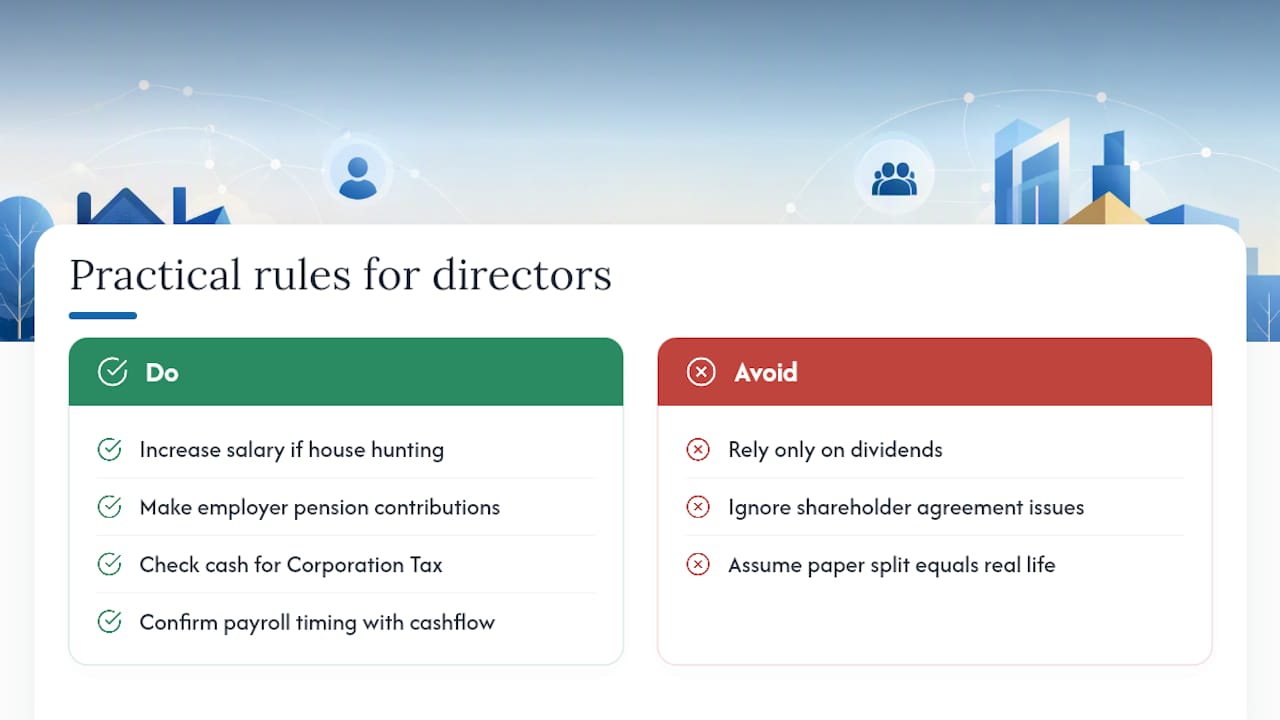
Most directors we work with start from the same base: a salary calibrated to the exact National Insurance or benefit outcome they need, with dividends handling everything else. That starting point shifts, though, the moment mortgage applications, pension planning or statutory pay enter the picture.
We often recommend a higher salary, or a larger employer pension contribution instead of dividends, when a director is house hunting within the next twelve months or wants to shelter profit from Corporation Tax through pension input rather than extraction. Before finalising any split, we check available cash against the upcoming Corporation Tax bill, confirm payroll timing lines up with cashflow, review shareholder agreements for dividend equality issues, and gather the paperwork lenders actually want to see. Our tax planning work with tech founders shows the same pattern repeatedly: the optimal split on paper and the optimal split for a director’s actual life rarely match without adjustment.
Why the standard advice on this split is starting to age badly
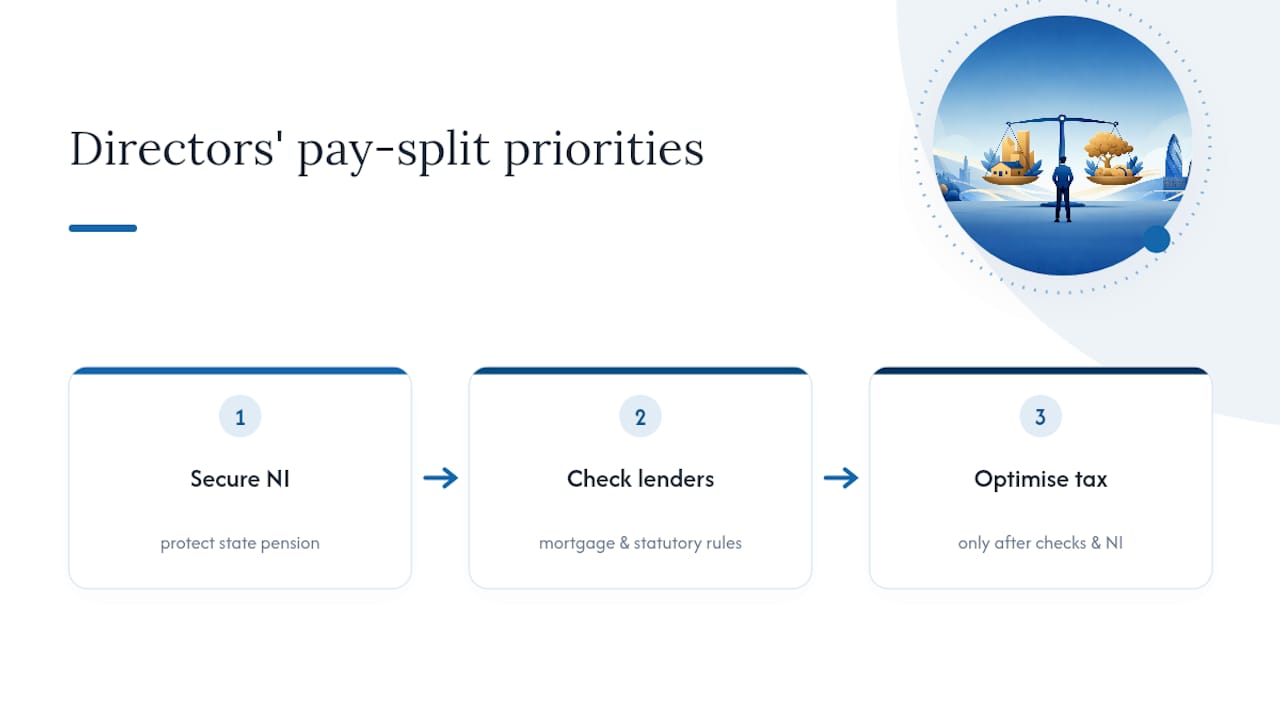
The received wisdom, salary to the Personal Allowance and dividends for the rest, was built for a tax environment where dividends carried a much lighter rate. That environment no longer exists. With the ordinary dividend rate now at 10.75% and employer NIC costs climbing, the advantage of dividends has shrunk enough that some directors would do just as well, after accounting for mortgage and pension consequences, taking a somewhat higher salary than a generic guide would suggest.
What gets underweighted in most commentary is the lender problem. A director drawing minimum salary and maximising dividends can look financially weaker on paper to a mortgage underwriter than someone earning the same total income mostly as salary, even when the tax bill is higher. If a mortgage application sits anywhere on your horizon, model that scenario before you optimise for tax alone. The right priority order is: secure the NI credit, check what lenders and statutory schemes actually require, then optimise the remainder for tax. Do it in the reverse order and you’ll save a few hundred pounds in tax while costing yourself a mortgage offer.
— Rahamut
How Price & Accountants can help with your salary and dividend split
Every scenario above assumes clean, generic numbers. Your company profit, your mortgage timeline, and your pension goals are not generic, and that’s exactly where a spreadsheet template stops being useful. We build bespoke salary and dividend models for founders and growing SMEs, factoring in Corporation Tax reserves, payroll timing, Employment Allowance eligibility and pension input alongside the pure tax comparison.

Our strategic advisory and tax planning service covers exactly this kind of director-level modelling, alongside payroll set-up and RTI compliance through our bookkeeping service so your PAYE and dividend paperwork stays audit-ready. If share structure or investor terms complicate your position, our guide to share capital is a useful starting point. Book a modelling call with us and get a split built around your actual numbers, not a generic assumption.
Sources
- Gov
- Gov
- Legislation
- Salary or dividends: What’s the best way for SME owners to pay themselves in 2026? | The Independent