

You qualify for SEIS if your company passes four core tests at the date of share issue: gross assets of £350,000 or less, fewer than 25 full-time equivalent employees, a qualifying trade that started no more than three years ago, and no prior EIS or VCT investment. Miss any one of these and advance assurance will flag it before investors do.
TL;DR:
- Companies must have gross assets of no more than £350,000 before share issuance and fewer than 25 full-time employees, including directors.
- The qualifying trade must be less than three years old and cannot involve excluded activities such as property development or financial services.
- Shares need to be fully paid in cash, non-redeemable, and held by investors with no more than 30% ownership including their associates.
- Funds raised under SEIS must be spent within three years on the qualifying trade, with detailed records of expenditure essential for compliance.
- A company that received prior EIS or VCT funding cannot raise under SEIS, requiring careful sequencing of investment rounds.
Table of Contents
- What are the core SEIS eligibility thresholds for companies?
- Which trades qualify for SEIS, and how does the 20% rule work?
- What share and investor rules apply under SEIS?
- How does SEIS advance assurance and the SEIS1/SEIS3 process work?
- How should founders prepare for an SEIS advance assurance application?
- Ready to move from likely eligible to investor-ready?
- What ongoing compliance is required to keep SEIS eligibility after approval?
- What happens if your business circumstances change after SEIS approval?
- Who counts for ownership and control under SEIS rules?
- Can you claim SEIS and EIS or VCT relief on the same company?
- Practitioner perspective: what founders underestimate about SEIS eligibility
- Price & Accountants: SEIS readiness that gets you investor-ready faster
- Where to check the official SEIS eligibility rules
- Sources
What are the core SEIS eligibility thresholds for companies?
Every threshold is tested at the date the shares are issued, not at the point you started planning the round. That timing catches out more founders than any single rule on the list.
Gross assets: £350,000 or less. This means every asset on the balance sheet immediately before the share issue, including cash sitting in the business account, equipment, and any intangible IP you have capitalised. Founders often undervalue software or patents on the books, then get caught out when a proper valuation pushes the balance sheet over the line. If you are close to the ceiling, get the valuation checked before you file anything with HMRC.
Employee headcount: fewer than 25 full-time equivalents. Directors count towards this figure. Part-time staff are counted pro rata against a standard working week, and apprentices or students on recognised vocational training are typically excluded from the calculation. Someone on parental leave still counts as employed. Keep a dated headcount snapshot alongside your advance assurance paperwork.
Trading time: the qualifying trade must be less than three years old. This is about the trade itself, not the company’s incorporation date. A business that quietly ran a different trade before pivoting can lose its “new trade” status entirely.
Prior investment: a company that has previously received EIS or VCT money cannot then raise under SEIS, and the lifetime SEIS limit sits at £250,000 per company group.
- Gross assets ≤ £350,000 before the share issue
- Fewer than 25 FTE employees, directors included
- Qualifying trade under three years old
- No previous EIS or VCT investment
- Lifetime SEIS raise capped at £250,000
Which trades qualify for SEIS, and how does the 20% rule work?
Most ordinary trading companies qualify, but HMRC excludes a specific list of activities regardless of how promising the business otherwise looks. A company fails the test the moment more than 20% of its trade falls into an excluded category.
Common exclusions include:
- Banking, insurance and money-lending
- Property development and most land dealing
- Legal and accountancy services
- Farming, market gardening and forestry
- Energy generation, including most renewables projects
- Providing services to a connected company that itself carries out an excluded activity
Founders should calculate it against turnover, cost base, or asset use, whichever measure genuinely reflects the balance of the trade, and keep that working alongside the advance assurance application. A software company that also rents out a small property portfolio needs to check that rental income does not creep past the threshold. Subsidiaries complicate things further: if a subsidiary carries out an excluded activity, that can taint the parent’s qualifying trade status even when the parent’s own activity is clean.
What share and investor rules apply under SEIS?
Shares issued under SEIS have to be full-risk, and the rules leave little room for creative structuring.
- Shares must be ordinary, fully paid in cash, and not redeemable. Preferential rights that protect an investor’s capital, or arrangements involving linked loans or guarantees, will disqualify the entire issue. Limited, non-cumulative preferential dividend rights are sometimes acceptable, but they cannot vary an investor’s capital protection, so get any dividend clause checked before you circulate documents.
- No single investor, combined with their associates, can hold more than 30% of the company’s ordinary share capital, loan capital, or voting rights. Associates include spouses, civil partners, parents, children, and business partners, so a founder’s spouse investing personally can breach this without anyone realising until the audit.
- Directors may invest and still claim relief; employees generally cannot, unless they also hold a director role. Founders raising their own round need to think carefully about how much personal shareholding they retain if they intend to invest further themselves later.
How does SEIS advance assurance and the SEIS1/SEIS3 process work?
Advance assurance is not a legal requirement, but it has become the market standard. Most angel networks and syndicates will not sign a term sheet without an HMRC assurance letter in hand, because it shifts risk away from the investor and onto the company’s own preparation.
Once shares are issued, the compliance statement, SEIS1, can be submitted after the company has carried out its qualifying trade for at least four months, or once it has spent at least 70% of the money raised. Filing early against either test, before HMRC’s conditions are actually met, is a common reason applications get bounced back. Once HMRC accepts the statement, it issues SEIS3 certificates, and investors cannot claim their income tax relief without one.
- Advance assurance: voluntary, but expected by most serious investors
- SEIS1: filed after 4 months of trading OR 70% of funds spent
- SEIS3: issued by HMRC to each investor for their tax return
- Funds must be spent within three years of the share issue, on the qualifying trade
Pro Tip: Keep a running log of exactly how the raised funds are spent from day one. A vague or retrospective breakdown at the four-month mark is one of the fastest ways to trigger a follow-up query from HMRC.
How should founders prepare for an SEIS advance assurance application?
Preparation beats correction every time. Review your share structure before you draft anything: strip out any linked loans, confirm every share is fully paid in cash, and check that no class carries hidden preferential rights.
Next, pull together documented evidence for your asset and employee figures. A signed balance sheet snapshot and a dated headcount spreadsheet, with FTE calculations shown for part-time staff, is usually enough to satisfy a reviewer. When you submit your advance assurance application, include your business plan, financial projections, the proposed share structure, and details of the investors you expect to approach.
- Check for linked loans or capital-protection clauses in share terms
- Confirm asset valuations include intangible IP and cash correctly
- Recalculate headcount if any staff changed hours recently
- Flag any connected-party arrangements before HMRC finds them
Pro Tip: If your company has a subsidiary or shares directors with another business, disclose the connection upfront. HMRC almost always finds it during review, and a voluntary disclosure reads far better than a discovered one.
Ready to move from likely eligible to investor-ready?
Confirm your thresholds, draft compliant share documents, and file for advance assurance now rather than after term sheets arrive. Most founders secure their assurance letter within two to six weeks, so build that into your fundraising timeline and bring in an adviser early if your structure includes subsidiaries or prior investment.
What ongoing compliance is required to keep SEIS eligibility after approval?
Advance assurance and SEIS1 approval are not the end of the compliance story. HMRC can review a company’s SEIS status retrospectively, sometimes years after the certificates were issued, if something later suggests the original conditions were not genuinely met.
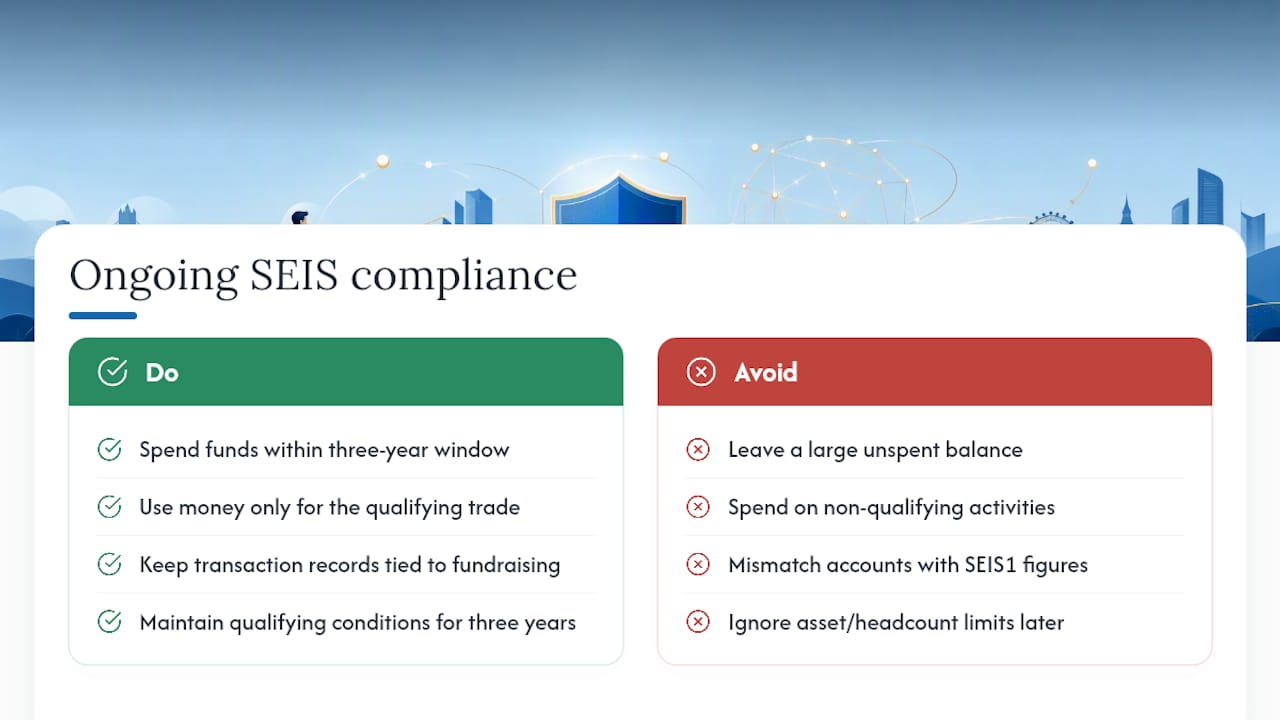
The three-year spending window is the main ongoing obligation. Funds raised must be spent on the qualifying trade, or on preparing to carry it out, within three years of the share issue. Spending on anything outside that scope, or leaving a large unspent balance with no clear plan, invites scrutiny. Keep records of every purchase and payment tied back to the original fundraising, because that trail is what an adviser or HMRC reviewer will ask for first.
Companies also need to maintain the qualifying conditions throughout the three-year period, not just at the point of issue. If gross assets creep past £350,000 during a later funding round, or headcount grows past 25 FTE because of rapid hiring, that alone does not retrospectively disqualify shares already issued correctly, but it does close the door on issuing further SEIS shares. Annual accounts and any correspondence with HMRC should be kept consistent with the figures declared at the time of the SEIS1 submission, because discrepancies between what was claimed and what later accounts show are one of the most common triggers for a compliance query.
What happens if your business circumstances change after SEIS approval?
Growth is the goal, but growth can quietly undermine SEIS status if it is not managed with the scheme in mind. A company that lands a large new contract, brings on a wave of new hires, or restructures its share capital needs to check each change against the original qualifying conditions.
The most common triggers are headcount growth past 25 FTE, a change of trade that drifts into excluded territory, and the addition of a subsidiary that itself carries out excluded activity. None of these automatically undo shares already issued and held for the required period, but each one can affect the company’s ability to raise further SEIS or EIS funds, and each needs documenting clearly in board records.
Changes to share capital deserve particular care. Issuing new share classes, buying back shares from an investor, or restructuring ahead of a later funding round can all interact with SEIS conditions in ways that are not obvious from the surface. A share buyback within three years of the SEIS issue, for example, can put an investor’s relief at risk even where the company’s own eligibility is untouched. Before any restructuring, cap table change, or major pivot, it is worth running the change past whoever manages your SEIS compliance, because the fix is far easier before the event than after.
Who counts for ownership and control under SEIS rules?
SEIS eligibility depends heavily on who controls the company and who is connected to whom, and this is where the associate and 30% holding rules bite hardest. No individual investor, combined with their associates, can hold more than 30% of the ordinary share capital, loan capital, or voting power of the company.
Associates are defined broadly: spouses, civil partners, parents, grandparents, children, grandchildren, and business partners all count. Control also extends to connected companies. A subsidiary or a company under common control with the issuing company can affect whether the issuing company’s trade genuinely qualifies as independent, and the technical detail on subsidiary control sits in HMRC’s own conditions for relief.
The test is about the investor claiming relief and their associates, not about the founder’s own stake, so every individual investor’s position needs checking separately before shares are allotted.
Can you claim SEIS and EIS or VCT relief on the same company?
SEIS and EIS sit on the same spectrum of UK venture capital schemes, but they are not interchangeable, and the rules around combining them are strict. A company that has already received EIS or VCT investment cannot subsequently raise money under SEIS. The sequencing only works one way: SEIS first, then EIS or VCT once the SEIS allowance is used up.
This makes fundraising order a genuine strategic decision, not an afterthought. Founders who raise EIS money first close off the SEIS route entirely, even if their company would otherwise have qualified. Given that the SEIS lifetime limit is £250,000, most early-stage companies use it for a pre-seed or seed round, then move to EIS for a larger Series A-style raise once the qualifying trade has matured past three years or the company has outgrown SEIS’s asset and headcount limits.
Investors also cannot claim SEIS and EIS relief on the same specific shares, though a single investor can hold SEIS shares in one company and EIS shares in another without conflict. The two reliefs use separate certificates (SEIS3 versus EIS3), and mixing them up on a tax return is a common error advisers see at filing time. Getting the sequencing right at the outset avoids a scenario where a company inadvertently forfeits SEIS eligibility by taking the wrong type of investment too early.
Practitioner perspective: what founders underestimate about SEIS eligibility
Founders treat SEIS eligibility as a filing exercise. It is a structuring exercise. Get share terms and cap tables right on day one, because advance assurance nearly always surfaces fixable problems that simply take longer to unwind under pressure. The smart sequencing is SEIS now, EIS later, once your trade has matured past the thresholds.
— Rahamut
Price & Accountants: SEIS readiness that gets you investor-ready faster
Beyond the checklist, getting SEIS right in practice means someone reviewing your share structure, drafting the advance assurance submission, and catching the connected-party issue before HMRC does. Priceandaccountants runs SEIS healthchecks for tech and fintech founders across pre-seed and seed rounds, covering share-structure review, advance assurance drafting, and full SEIS1/SEIS3 compliance once shares are issued.

Working with a specialist matters here because HMRC queries on borderline cases, subsidiary structures, or asset valuations move faster with someone who has navigated them before, and investors read a properly handled assurance letter as a signal the company is fundraising-ready. Priceandaccountants pairs SEIS work with ongoing accounting support so your compliance does not lapse after the certificates land.
If you are planning a raise in the next few months, get your share structure and advance assurance reviewed before you approach investors. Speak to Priceandaccountants’ strategic advisory and tax planning team to start your SEIS healthcheck.
Where to check the official SEIS eligibility rules
- HMRC: apply to use SEIS to raise money
- HMRC: apply for advance assurance
- BDO: companies guide to raising SEIS finance
- LexisNexis: SEIS conditions for relief practice note
Sources
- Apply to use the Seed Enterprise Investment Scheme to raise money for your company
- Apply for advance assurance on a venture capital scheme
- Companies guide to raising finance through SEIS (BDO)