

If you’ve bought, sold, swapped, staked or earned cryptoassets in the UK, you almost certainly have a reporting duty to HMRC, whether that’s Capital Gains Tax on disposals or Income Tax on receipts. Start by pulling together your wallet and exchange records now, and if your trading history spans multiple platforms or several tax years, book a proper tax health check with a specialist rather than guessing.
TL;DR:
- HMRC treats crypto trading activity as disposals for capital gains purposes unless it qualifies as a trade, which triggers different tax and reporting obligations.
- Crypto-to-crypto swaps count as disposals, creating multiple taxable events that are often overlooked in DIY calculations, risking unexpected tax bills.
- Income from staking, mining, or airdrops is taxed at receipt based on market value, and proper recordkeeping of these events is crucial to avoid double taxation.
- Maintaining detailed records, including transaction date, GBP value, and wallet details for every activity, is essential for accurate HMRC reporting and audits.
- Using a specialist crypto accountant helps accurately reconcile activity across all wallets and platforms, especially for complex DeFi and NFT transactions, and reduces audit risks.
Table of Contents
- What crypto accounting covers for UK taxpayers and companies
- How UK tax treats crypto: capital gains versus income
- Calculating gains: Section 104 pooling, same-day and 30-day rules
- Income events and special cases: staking, mining, airdrops and vesting
- Recordkeeping checklist HMRC expects and how to prepare exports
- How a specialist crypto accountant helps: Price & Accountants’ approach
- Costs and timings: what influences fees and how long reconciliations take
- A specialist’s view on getting crypto tax right before CARF changes everything
- Get your crypto tax position sorted before CARF reporting expands
- Where to check the rules yourself
- Sources
What crypto accounting covers for UK taxpayers and companies
Crypto accounting isn’t one job. It changes shape depending on who you are: a casual investor who bought Bitcoin in 2021 and finally sold some in 2026, an active trader running dozens of transactions a week, an employee whose salary includes token grants, or a company holding digital assets on its balance sheet. Each of these faces a different mix of HMRC obligations, and a competent accountant tailors the work accordingly.
For most individuals, the deliverables look like this:
- A fully reconciled transaction history across every wallet and exchange used, with duplicates and internal transfers stripped out.
- Capital Gains Tax calculations using HMRC’s pooling method, applied per token type.
- Income Tax calculations for staking, mining, airdrops or salary paid in crypto, valued at the point of receipt.
- A completed Self Assessment return, including the dedicated cryptoassets pages introduced for the 2024/25 tax year.
For companies, the picture shifts towards corporation tax treatment of token holdings, disclosure in the statutory accounts, and deciding whether crypto activity sits on capital or trading account, a distinction that changes the tax rate and the way losses can be used.
What makes this harder than ordinary bookkeeping is the sheer variety of modern crypto activity. DeFi lending, liquidity pool deposits, NFT minting and staking rewards don’t map neatly onto a simple buy-sell ledger. A single liquidity pool exit can trigger several implicit disposals in one transaction, and most off-the-shelf accounting software simply isn’t built to spot that.
How UK tax treats crypto: capital gains versus income
HMRC treats cryptoassets as property, not currency, and that single classification decides almost everything else. Sell it, swap it, spend it, or give it away, and you’ve usually made a disposal for Capital Gains Tax purposes. Receive it through mining, staking rewards, certain airdrops, or as payment for work, and it’s normally taxed as income at the market value on the day you received it.
The line between the two regimes matters enormously, because the tax rates, allowances and reporting routes differ:
- Disposals (usually CGT): selling for GBP, swapping one token for another, spending crypto on goods or services, gifting to anyone other than a spouse or civil partner.
- Receipts (usually Income Tax): mining rewards, staking rewards, airdrops received in exchange for a service or promotional action, salary or freelance payment settled in crypto.
Statistic Callout: HMRC’s own Cryptoassets Manual sets out detailed tests for whether crypto activity amounts to trading rather than investment, and the manual is the primary reference tax professionals use when a case sits close to the line.
That trading question deserves its own moment of attention, because it changes everything. If HMRC decides your activity is a trade, self-employment rules kick in: profits are taxed as trading income, National Insurance Contributions apply, but you can also deduct genuine business expenses. Most individual investors, even frequent ones, stay on the capital account. Trading status tends to apply only where someone runs the activity with real organisation, frequency and commercial intent, closer to a day trader than a holder who occasionally rebalances.
A few concrete mappings help make this real:
- You bought Ethereum in 2022 and sold half in 2026 for a profit. That’s a disposal, CGT applies.
- You staked Cardano and received rewards monthly. Each reward is income at the GBP value on the day it landed in your wallet.
- You swapped Bitcoin for a stablecoin to “lock in” gains without cashing out to sterling. HMRC still treats that as a disposal, the swap itself is the taxable event, not the eventual cash withdrawal.
- Your employer pays part of your salary in a token. That’s employment income, taxed and reported through PAYE or Self Assessment depending on how it’s structured.
Calculating gains: Section 104 pooling, same-day and 30-day rules
This is where most DIY crypto tax calculations fall apart, because HMRC doesn’t let you pick which coins you’re selling to minimise your bill. Instead, you follow a strict order of matching rules to work out the cost basis of every disposal, and the sequence is fixed.
- Same-day rule. If you buy and sell the same token on the same day, those transactions are matched first.
- 30-day rule (the “bed and breakfast” rule). Any tokens sold are then matched against tokens of the same type bought within the following 30 days, a rule designed to stop people selling to crystallise a loss and immediately buying back in.
- Section 104 pooling. Anything left over is matched against the “pool”, a running average cost of every unit of that token you’ve ever held, adjusted each time you buy or sell.
Here’s where it gets genuinely tricky: crypto-to-crypto swaps count as disposals, so swapping Bitcoin for Ethereum means you dispose of the Bitcoin (calculate the gain using its pooled cost) and simultaneously acquire Ethereum at its market value, which becomes the start of a new pool. Someone who swaps between five tokens a dozen times might have generated sixty taxable events without ever touching a bank account.
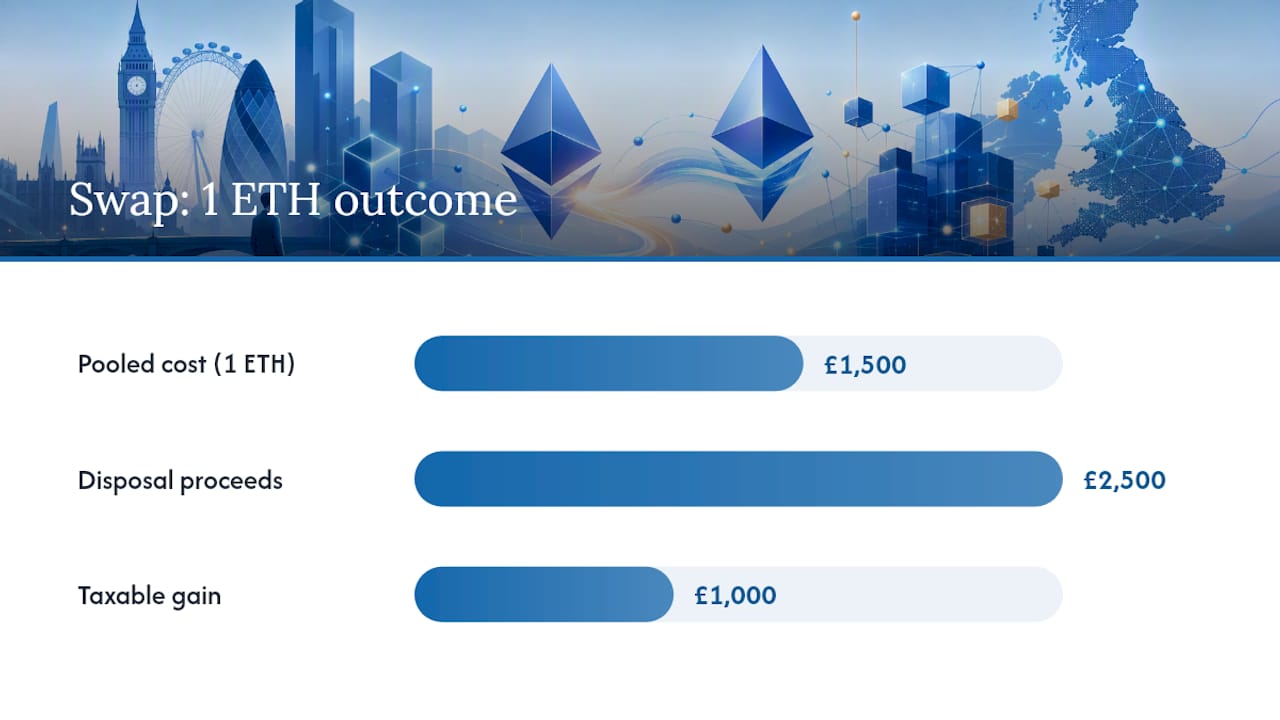
Say you hold a Section 104 pool of 2 ETH with a pooled cost of £3,000. You swap 1 ETH for a stablecoin when ETH is trading at £2,500. Your disposal proceeds are £2,500, your pooled cost for that 1 ETH is £1,500 (half the pool), giving a gain of £1,000, even though no sterling ever hit your bank account.
Pro Tip: Never assume a swap between two coins is a “non-event” just because you never cashed out to GBP. That single misconception is behind more unexpected tax bills than any other crypto accounting mistake we see.
The most common errors that inflate tax bills unnecessarily are failing to maintain a running pooled cost per token, treating every disposal as a fresh purchase price calculation, and forgetting that DeFi actions like adding liquidity can themselves be disposals in HMRC’s eyes.
Income events and special cases: staking, mining, airdrops and vesting
Income-style receipts follow a different rule to disposals: the tax point is the day you receive the asset, and the tax base is its market value in GBP on that date, not what it’s worth later when you eventually sell it.
- Staking and mining rewards are normally taxed as income the moment they land in your wallet or account, valued at that day’s GBP price. That value then becomes your cost basis for CGT purposes if you dispose of the tokens later, so recording the exact receipt date and price matters twice over.
- Airdrops sit in a genuinely grey area. LITRG’s guidance explains that airdrops received without doing anything in return, and with no expectation of a service, are often not taxable as income on receipt. Airdrops given in exchange for a promotional action, referral, or existing service relationship generally are taxable income.
- Forks typically don’t create an income tax charge on the new tokens themselves, though the situation depends on the specifics of how the fork happened and what you do with the resulting assets afterwards.
- Employee token grants and vesting schedules create employer reporting obligations. If your company issues tokens as part of remuneration, that’s employment income, potentially subject to PAYE, and the employer carries reporting duties alongside your own.
The double-taxation trap catches people surprisingly often: recording a staking reward as income, then later disposing of the same tokens and forgetting to use that receipt-date value as the cost basis, effectively taxing the same value twice.
Recordkeeping checklist HMRC expects and how to prepare exports
HMRC doesn’t prescribe a single software format, but it does expect detailed records for every disposal, and the burden of proof sits with you, not your exchange.
| Record needed | Why it matters |
|---|---|
| Date and time of each transaction | Determines which pooling rule applies and the correct tax year |
| Type and quantity of asset | Needed to maintain separate pools per token type |
| GBP value at the time of the transaction | Sets both the disposal proceeds and the acquisition cost |
| Transaction hash or reference | Lets you verify the transaction independently if HMRC queries it |
| Counterparty or platform details | Shows where the transaction occurred, relevant for cross-referencing exchange data |
| Fees paid in GBP or crypto | Allowable as a deduction against gains in most cases |
Exchange-generated tax reports are a useful starting point, but they won’t calculate your pooled cost for you, particularly if you’ve moved assets between platforms or wallets, which most exchanges have no visibility of. A CSV export from Coinbase only tells half the story if you then moved those tokens to a hardware wallet and traded them on a decentralised exchange six months later.
If you’ve got historical gaps, missing years, forgotten wallets, or simply never reported anything, HMRC’s Cryptoasset Disclosure Service exists specifically for voluntary disclosure. Coming forward proactively is treated far more favourably than waiting to be caught, particularly with exchange reporting about to expand significantly.
How a specialist crypto accountant helps: Price & Accountants’ approach
A specialist accountant does more than run your transactions through software, because software doesn’t know when a DeFi action is a disposal in disguise, and it certainly doesn’t argue your case if HMRC opens an enquiry.
A specialist accountant’s work on a typical crypto engagement covers:
- Full reconciliation of every wallet and exchange, cross-checked against blockchain data where records are incomplete.
- Capital Gains Tax and income calculations applied correctly under the same-day, 30-day and Section 104 pooling rules.
- Self Assessment filing, including the dedicated cryptoassets section, and corporation tax treatment for companies holding tokens.
- Support with voluntary disclosures where historical reporting has gaps.
- Ongoing advisory as your holdings or trading activity grow more complex.
The process typically runs in four stages: data intake from every platform you’ve used, reconciliation and pooled-cost computation, a draft tax position for your review, then sign-off and filing. With extensive accounting expertise and experience supporting tech and fintech startups through funding rounds and R&D claims, the same rigour that gets applied to SEIS structuring or corporation tax planning gets applied to crypto reconciliation.
Pro Tip: If your company holds crypto on its balance sheet, ask your accountant how it will be disclosed in your statutory accounts, not just how it’s taxed. Getting the accounting treatment wrong can distort your numbers when you’re raising a funding round.
Costs and timings: what influences fees and how long reconciliations take
Fees for crypto tax work vary far more than for a standard tax return, because the effort scales with complexity rather than income—understanding the right Oil Sector Tax Forms can similarly impact investor reporting and tax accuracy.
The main cost drivers are transaction volume, the number of separate wallets and exchanges involved, how much DeFi or NFT activity needs unpicking, and whether the work includes forensic reconciliation of earlier, unreported years. A straightforward annual report for someone with two exchange accounts and modest activity can be turned around quickly. A multi-year historical reconciliation across a dozen wallets, several DeFi protocols, and gaps stretching back to 2019, is a different scale of project entirely, and priced accordingly.
Before engaging anyone, ask:
- Do you have hands-on experience with pooled-cost calculations, not just general tax returns?
- Can you handle DeFi, NFTs and staking, or only straightforward buy-sell histories?
- What happens if HMRC opens an enquiry, is that included or billed separately?
- Can you quote a fee range before seeing my full transaction history, and what would change that estimate?
Red flags include a flat quote given before anyone has looked at your data, or an accountant who can’t explain how same-day and 30-day rules interact with Section 104 pooling.
A specialist’s view on getting crypto tax right before CARF changes everything
The single biggest mistake I see is treating crypto tax as something to sort out once a year, in a rush, from memory. Records built after the fact are always weaker than records built as you go, and HMRC’s ability to cross-check your figures against exchange data is only going to improve as CARF reporting rolls out from 2026 onwards.

The shortcut I’d warn against most is treating swaps as “internal” moves that don’t need recording. They do. Every one of them.
Get a proper reconciliation done now, while you still have time to fix gaps quietly, rather than scrambling once exchanges start reporting your activity to HMRC directly.
— Rahamut
Get your crypto tax position sorted before CARF reporting expands
Most crypto investors try to reconcile years of exchange and wallet activity themselves, then discover halfway through that a spreadsheet can’t apply pooling rules correctly. Specialist accountants provide what a spreadsheet or a generic accountant can’t: expertise to handle complex financial reporting for fast-growing tech companies, applied directly to your crypto transactions, wallets and disposals.

We handle the full picture, transaction reconciliation across every exchange and wallet you’ve used, Capital Gains Tax and income calculations, Self Assessment filing including the cryptoassets pages, corporation tax treatment if you hold tokens through a company, and support with HMRC voluntary disclosures if you’ve got historical gaps to close.
Before your first session, gather your exchange statements, wallet addresses, and any records of staking or airdrop income you can find, even partial records help. From there, we build a full reconciliation and give you a clear tax position before anything gets filed.
If you’re ready to stop guessing at your crypto tax position, book a tax health check through our accounting services page and get a straight answer on where you stand.
Where to check the rules yourself
For anyone who wants to verify the underlying rules directly rather than take an accountant’s word for it, these are the primary sources worth bookmarking:
- HMRC’s Cryptoassets collection on GOV.UK, the umbrella guidance covering CGT and Income Tax treatment.
- The Cryptoassets Manual, HMRC’s internal reference used by tax professionals for detailed and borderline cases.
- LITRG’s cryptoassets guidance, particularly useful for the airdrop and receipt distinctions covered above.
- Background on the CARF reporting timeline and what expanded exchange reporting will mean for existing taxpayers from 2026 onwards.
This article is general information, not a substitute for advice from a qualified financial advisor. Consult a qualified financial professional about your own circumstances before acting on anything here.