

A person with significant control (PSC) is someone who holds a substantial proportion of a company’s shares or voting rights, can appoint or remove a majority of directors, exercises significant influence or control, or controls a trust or firm that meets any of those tests. Companies House has run the central PSC register since 18 November 2025, replacing internal company registers, and PSCs must now verify their identity to comply. The rest of this guide covers how to identify them, what to file, and what happens when someone won’t cooperate.
TL;DR:
- Companies must identify PSCs based on five criteria, including holding over 25% of voting rights or having board appointment rights, to ensure compliance.
- Confirming PSCs involves reviewing shareholder registers, agreements, and voting records, with special attention to nominee shareholders and shadow directors.
- Companies are required to report PSC details within 14 days of confirmation, including personal information and the specific condition met, via online forms.
- PSCs must verify their identity using a personal verification code within 14 days, with proper documentation to prevent delays or non-cooperation issues.
- Complex ownership structures, especially involving trusts, firms, or layered entities, demand careful tracing and often legal support to accurately determine PSC status.
Table of Contents
- What are the five statutory conditions for being a PSC?
- How do you identify PSCs at your company?
- What must you file at Companies House, and by when?
- How does PSC identity verification and the personal code work?
- What if you can’t identify a PSC or they refuse to cooperate?
- How do trusts, firms and legal entities complicate PSC reporting?
- Your practical PSC compliance checklist
- Why PSC compliance deserves more attention than directors give it
- Get PSC compliance sorted before it becomes a problem
- Sources
What are the five statutory conditions for being a PSC?
The Companies Act 2006, extended by the Register of People with Significant Control Regulations 2016, sets out five conditions. Meeting any one of them makes someone a PSC.
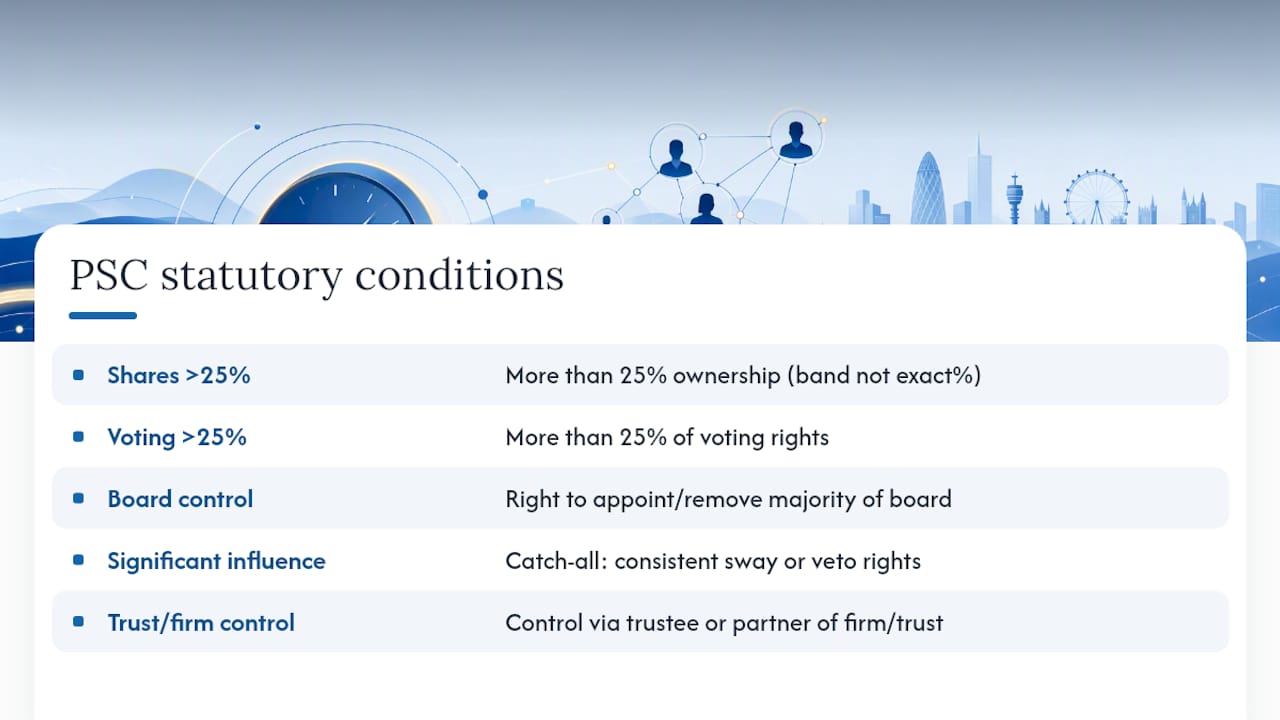
Companies House wants the band, not a precise percentage, which spares you disclosing exact commercial terms.
Condition (ii): more than 25% of voting rights. Shareholding and voting rights usually track together, but not always. A shareholder with below the threshold of shares but sufficient voting rights (through a special share class, for instance) still qualifies under this condition.
Condition (iii): the right to appoint or remove a majority of the board. This catches investors or founders who hold minority equity but negotiated board control as part of a funding round, a common structure in early-stage tech deals.
Condition (iv): significant influence or control. This is the catch-all condition, and it’s where most disputes arise. Statutory guidance points to indicators such as a person whose recommendations are consistently followed by the board, or who holds veto rights over key decisions despite owning no shares at all.
Condition (v): control through a trust or firm. If a trustee or partner controls a trust or unincorporated firm that itself would meet any of the first four conditions were it an individual, the person behind that trust or firm becomes the PSC.
How do you identify PSCs at your company?
Start with documents you already hold, not guesswork. A structured review beats trying to remember who negotiated what during a funding round two years ago.
- Pull the register of members and confirm who legally holds shares as of today, not at incorporation.
- Check the statement of capital for share classes with unusual voting weight attached.
- Read the articles of association for any appointment or veto rights buried in the small print.
- Review shareholder or investor agreements for board appointment rights, drag-along clauses, or consent requirements over budgets and hiring.
- Cross-check voting records at recent general meetings against what the paperwork says should happen.
Nominee shareholders need particular care. If someone holds shares “for” another person, the beneficial owner is the PSC, not the nominee. Where you suspect a shareholder is a nominee but they won’t confirm it, you can issue a notice under section 790DA of the Companies Act 2006 compelling disclosure.
Watch for shadow directors who never sit on the board but whose instructions the real directors habitually follow, and lenders whose loan covenants give them a veto over dividends or new share issues. Both can trigger Condition (iv) even without a shareholding.
Pro Tip: Keep a dated log of every step you take, board minutes, emails to shareholders, notices issued, because contemporaneous records are what protect you if Companies House later questions whether your “reasonable steps” were genuine.
What must you file at Companies House, and by when?
Once you’ve confirmed a PSC, you need their full particulars before reporting anything. Companies House requires:
- Full name and any former name relevant to identification
- Date of birth and nationality
- Country, state, or part of the UK where they usually live
- Service address (a residential address is kept private on the public register)
- The date they became a PSC
- Which of the five conditions they meet, and the relevant share/voting band where applicable
Directors are responsible for confirming these details and filing within 14 days of confirmation, whether the PSC is new or their details have changed. That 14 day clock is unforgiving. It starts running the moment you have confirmed particulars, not when you get around to filing.
The biggest procedural shift for many directors is that local PSC registers no longer exist. Since 18 November 2025, Companies House itself is the single, central record. Some directors still keep an internal paper register out of habit, which is harmless but no longer a legal requirement, and it doesn’t substitute for filing with the registrar.
You file using form PSC01 (adding a new PSC), PSC03 (a PSC’s details have changed), or the equivalent notices for legal entities, all submitted through the Companies House online filing service rather than by post.
How does PSC identity verification and the personal code work?
Identity verification is the part catching most directors off guard, because it puts an obligation on the PSC personally, not just on the company.
- Each PSC must verify their identity with Companies House, either directly or through an authorised corporate service provider.
- Once verified, Companies House issues a personal verification code unique to that individual.
- The PSC supplies this code to the company, which the company then reports as part of its filing.
- New PSCs have a 14 day window from becoming a PSC to provide their code.
The most common holdup is a mismatch between the identity documents used for verification and the name or address already on file with the company, such as a maiden name on a passport against a married name in the shareholder register. Sort these out before the clock starts, not after.
What if you can’t identify a PSC or they refuse to cooperate?
If you suspect someone is a PSC but they won’t confirm it, issue a formal notice requesting the information. Ignoring that notice, or supplying false particulars, exposes both the PSC and the company to sanctions, and criminal penalties can include fines or up to two years’ imprisonment.
Persistent refusal lets you escalate to restricting the relevant shares, freezing dividends, voting rights, and transfer rights until the person complies. Where you genuinely cannot identify anyone meeting the five conditions, you can file a statement to that effect rather than leaving the record blank.
Document every notice sent and every response, or lack of one. If a case turns hostile or you suspect deliberate concealment, bring in a solicitor or your accountant before things escalate further.
How do trusts, firms and legal entities complicate PSC reporting?
Condition (v) exists because ownership doesn’t always sit with a named individual. When shares are held through a trust, the trustee isn’t automatically the PSC. The person who actually controls the trust, often a settlor with the power to remove trustees or direct distributions, is who you need to identify.
- An individual PSC is a natural person and is reported with their personal details as above.
- A registrable relevant legal entity (RLE) is a company or other legal entity that itself meets a PSC condition and keeps its own PSC register, so it’s reported by its corporate details rather than a person’s.
- Layered structures, an overseas holding company owned by a limited partnership owned by a family trust, are where most errors happen, because each layer needs tracing back to the natural person ultimately in control.
Red flags worth escalating include multiple shell entities registered in low-transparency jurisdictions, control exercised through side letters not reflected in the articles, and structures set up specifically before a funding round without commercial justification. Cross-border ownership adds its own wrinkle, particularly for founders establishing UK entities from overseas. If your structure involves more than one layer of trust or entity, get a solicitor or specialist accountant to trace it before you file.
Your practical PSC compliance checklist
- Within 14 days: confirm particulars for any new or changed PSC and file PSC01 or PSC03 with Companies House.
- Immediately: ask each PSC to complete identity verification and pass you their personal code.
- Quarterly: re-check the register of members, articles, and any new shareholder agreements for changes that alter someone’s PSC status.
- Before due diligence: gather share certificates, the statement of capital, board minutes, and any investor agreements in one folder, investors and their lawyers will ask for exactly this.
Expert accounting firms support founders through company set-up, share structure reviews, and ongoing filing to help manage PSC compliance during funding rounds, including understanding the invoice requirements UK to remain compliant.
Pro Tip: If you’re raising a seed or Series A round, sort your PSC filings before due diligence starts. Investors’ lawyers check this early, and a messy PSC register is an easy, avoidable red flag.
Why PSC compliance deserves more attention than directors give it
Most directors treat the PSC register as a box-ticking formality bolted onto incorporation. That’s a mistake. The regime exists because ownership transparency underpins anti-money laundering enforcement, and investors increasingly treat a clean PSC record as a proxy for how seriously a company takes governance generally.
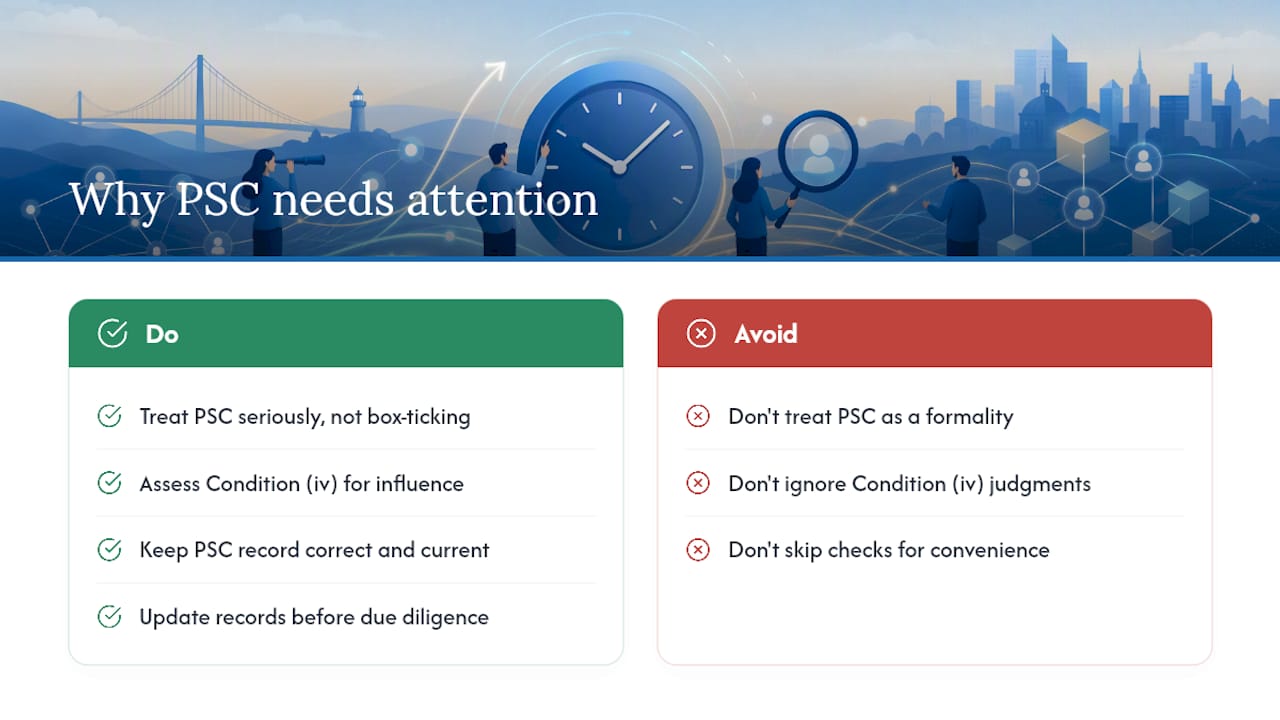
The uncomfortable truth is that Condition (iv), significant influence or control, gets ignored far more often than it should, because it requires judgement rather than a simple percentage check. A founder who never took shares but still controls every material decision is a PSC. Skipping that call because it’s inconvenient is the single most common failure I see in growing companies.
Get the record right once, keep it current, and it stops being a liability at the exact moment it matters most: due diligence.
— Rahamut
Get PSC compliance sorted before it becomes a problem
Price & Accountants is the practical alternative to piecing PSC rules together from government PDFs at midnight before a filing deadline. We work daily with tech and fintech founders on company set-up, share structure reviews, and the wider accounting work that PSC compliance sits alongside, so identifying and filing PSC details becomes one item on a list we’re already handling, not a separate fire drill.

If your ownership structure involves investors, option pools, or overseas entities, a first call with us usually starts by mapping who actually meets each of the five conditions, then checking that against what’s currently filed. Where trusts or multi-jurisdiction holding structures are involved, we’ll flag when you also need a solicitor, we’re accountants, not a substitute for legal advice on complex trust law. Get in touch through Price & Accountants to book that first conversation.
Sources
- Understanding identity verification for people with significant control (PSCs) — Companies House blog
- Statutory guidance on the meaning of significant influence or control