
Xero does not consolidate across organisations, so the honest answer is that you need a workaround. Your three realistic routes are Excel, a dedicated consolidation add-on, or a BI/data warehouse layer. Whichever you pick, start by standardising your chart of accounts and exporting locked trial balances from every entity, because that groundwork determines whether the rest goes smoothly or turns into a spreadsheet nightmare.
TL;DR:
- Standardizing account codes across entities before connecting a consolidation tool significantly reduces mapping errors and speeds up the first close.
- Using Excel for consolidations works only for small, simple groups with infrequent updates, but becomes unmanageable as complexity grows.
- Automation tools like consolidation add-ons or data warehouses are better suited for larger groups with multiple currencies and extensive intercompany activity.
- Proper preparation includes locking reporting periods, documenting eliminations, and confirming currency policies to ensure a credible and traceable consolidation process.
- Regular governance practices such as period locking, detailed reconciliation trails, and clear ownership are essential for trustworthy consolidated financial reports.
Table of Contents
- Why Xero can’t produce consolidated group statements on its own
- Excel, consolidation add-ons, or BI: which route fits your group?
- What to prepare inside each Xero organisation before connecting a consolidation layer
- Eliminations, currency translation, and ownership adjustments explained
- How long setup takes and what happens after go-live
- Building an audit trail finance teams can actually trust
- What guiding clients through Xero consolidations has taught us
- When to bring in a specialist versus keeping it in-house
- How Price & Accountants gets your group reporting off the ground
- Sources
Why Xero can’t produce consolidated group statements on its own
Xero was built to run one organisation’s ledger, not a group. Every entity you set up lives in its own walled-off database, and the report templates you customise for formatting only ever pull from that single organisation. They’re presentation tools, not aggregation engines. Xero’s own multi-entity guide makes the same distinction: Xero HQ lets accounting practices standardise how reports look across client files, but it stops well short of merging figures into one set of group accounts.
The trial balance is what fills that gap. It’s the one output every Xero organisation produces in a consistent, exportable shape, which makes it the correct input for any consolidation exercise, whether that’s a manual Excel model or an automated tool. Skip it and go straight from Xero’s dashboards into a spreadsheet, and you lose the audit trail connecting each consolidated line back to a real transaction. That’s when reconciliation differences start appearing at month nine that nobody can explain, because nobody kept a record of which trial balance version fed which report.
Excel, consolidation add-ons, or BI: which route fits your group?
The right method depends less on preference and more on how many entities you’re running and how messy the intercompany activity gets.
Excel works fine for a two or three-entity group with simple, infrequent consolidations, maybe a year-end exercise for a small holding structure. The catch is that every mapping rule, every elimination, and every currency adjustment lives in formulas that only the person who built them fully understands. Version control becomes a real problem the moment two people touch the file in the same week.
Consolidation and reporting add-ons connect via Xero’s API and automate the parts that break spreadsheets: account mapping, intercompany eliminations, FX conversion, and scheduled report packs. The Xero app marketplace lists tools such as Konsolidator that handle exactly this, pulling trial balances from each connected organisation and running the consolidation logic centrally.
BI and data warehouse setups, often built on Power BI or a cloud SQL database, suit larger groups that need bespoke dashboards, cross-system data (not just Xero), or heavy transformation logic that a packaged add-on won’t stretch to.
Decision drivers worth weighing before you commit:
- Number of entities and how often new ones get added
- Volume and complexity of intercompany trading
- Number of currencies and how often exchange rates move materially
- Whether external auditors will need to trace consolidated figures back to source
What to prepare inside each Xero organisation before connecting a consolidation layer
Most consolidation problems trace back to skipped preparation, not the tool itself. Before connecting anything, work through this sequence:
- Close and lock each entity’s reporting period, then export a final trial balance rather than an interim one.
- Agree a group chart of accounts and either standardise codes across entities or write explicit mapping rules for each one.
- Document intercompany account codes and the recurring eliminations they trigger, loan balances, management charges, dividend flows.
- Confirm each entity’s functional currency and the FX policy the consolidation will apply.
- Set the reporting cadence and distribution list so the process has an owner and a deadline, not just a spreadsheet sitting on someone’s desktop.
Pro Tip: Standardise the first three digits of account codes across every entity, so “office expenses” is always 601, say, regardless of which Xero organisation it sits in. This single change cuts mapping time dramatically because the group chart of accounts practically maps itself.
Eliminations, currency translation, and ownership adjustments explained
This is the accounting engine room, and it’s where most consolidation projects either earn their keep or fall apart quietly in the background.
Eliminations can run at account level or transaction level. Account-level eliminations, netting off the intercompany loan account against its mirror entry in the other entity, are cheaper and faster to set up. Transaction-level eliminations match individual invoices and payments, giving you far better accuracy but costing considerably more in setup and maintenance. Where full transaction matching isn’t practical, a dedicated top-side elimination entity or adjustment account keeps the process traceable without requiring line-by-line matching.
Currency translation follows IAS 21: profit and loss items typically translate at average rates for the period, balance sheet items at the closing rate on the reporting date. The gap between those two rate sets creates a currency translation adjustment (CTA), which posts to a separate reserve within equity rather than through the income statement. If your group spans several currencies, this single mechanic is usually where most reconciliation queries originate.
Ownership adjustments, minority interests and investment eliminations, need the same discipline. Every adjustment should be traceable back to the specific Xero transactions behind it, because an auditor who can’t follow that chain will simply reject the consolidated figure.

How long setup takes and what happens after go-live
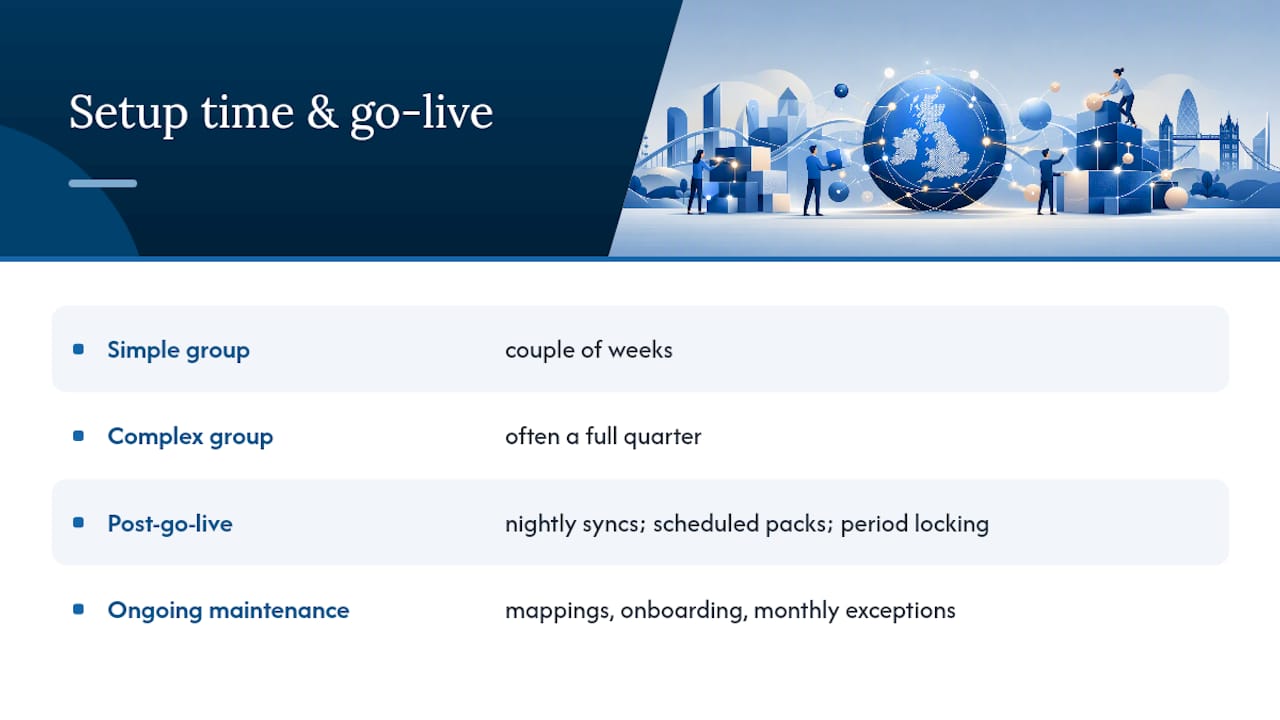
A simple two-entity group with a common currency and low intercompany volume can realistically be mapped and tested within a couple of weeks. A complex group spanning several currencies, frequent acquisitions, and heavy intercompany trading tends to take considerably longer, often stretching across a full quarter before the first clean close.
Once live, nightly syncs pull fresh trial balances automatically, scheduled report packs distribute consolidated figures to the right people without manual chasing, and period locking stops anyone editing a closed entity’s books after the fact. The work doesn’t stop there, though. Mapping tables need updating whenever a chart of accounts changes, new entities need onboarding into the group structure, and someone needs to own the exception queue every single month.
Building an audit trail finance teams can actually trust
Consolidated numbers are only as credible as the controls behind them. A workable governance framework rests on a few non-negotiables:
- Close and lock source periods before pulling any figure into the consolidation, never consolidate from an interim trial balance.
- Keep a documented reconciliation trail from every consolidated line back to the entity-level transaction that created it.
- Name a specific owner and a separate approver for consolidation adjustments and period locks, never the same person doing both unchecked.
- Run exception reports at each close so validation effort goes where the numbers have actually moved, not everywhere at once.
These practices sit alongside the wider financial reporting standards that UK finance teams are already expected to follow, consolidation just adds another layer that needs the same rigour.
What guiding clients through Xero consolidations has taught us
The single biggest time-saver we’ve seen is standardising account numbering before a client ever connects a consolidation tool. Groups that map codes consistently from day one cut their first-close time dramatically compared with those trying to reconcile mismatched charts after the fact.
Running a pilot consolidation for one period, before committing to full roll-out, reliably surfaces the mapping errors and elimination gaps that would otherwise appear mid-close under pressure. It’s a small step that saves a lot of firefighting later.
For groups moving off spreadsheets into automated tooling, an outsourced finance function or virtual FD engagement tends to shorten that first full consolidated close by handling the scoping and validation work that in-house teams rarely have spare capacity for.
When to bring in a specialist versus keeping it in-house
Bring in outside help when audit requirements are tightening, when you’ve just completed an acquisition, or when intercompany activity has grown complex enough that manual eliminations are becoming unreliable. Keep consolidation in-house when your group is small, stable, and intercompany volume is genuinely low, there’s little value paying for machinery you don’t need yet.
If you do decide to hire, don’t sign up for a full build straight away. Run a short scoping exercise first, then a pilot period covering one consolidation cycle, before committing to the full setup. That single pilot will tell you more about where the real complexity sits than any amount of upfront planning.
— Rahamut
How Price & Accountants gets your group reporting off the ground
Getting from separate Xero files to a trustworthy consolidated number usually takes a chart of accounts that actually maps cleanly, and someone who’s done the eliminations before. Priceandaccountants works with growing UK groups on exactly this: designing a group chart of accounts that maps without guesswork, scoping the consolidation approach that fits your entity count and currencies, and stepping in as your outsourced finance director to run governance and prepare figures for audit.

Rather than guessing which route suits your group, book a short discovery call. We’ll scope a pilot consolidation for one period, agree a fixed-fee proposal, and show you exactly where your current setup will slow you down. Start with our strategic advisory and virtual FD services and get a clear view of what your group’s first proper close should look like.
Sources
- About report templates — Xero Central
- Konsolidator — Financial Consolidation & Reporting — Xero app store