
A UK branch is a registered extension of your overseas company; a UK subsidiary is a separate limited company you incorporate at Companies House. The trade-off is straightforward: a branch keeps setup fast and cheap but leaves the parent company liable for everything it does, while a subsidiary costs more to run but ring-fences liability and reads far better to investors and UK customers. Most international founders raising money or hiring staff choose a subsidiary; a branch suits short-term market testing only.
TL;DR:
- A UK branch exposes the parent company to full liability for contracts, debts, and claims, while a subsidiary limits liability to its own assets.
- Only a subsidiary can hold UK assets, property, and intellectual property independently from the overseas parent, affecting tax and capital planning.
- Investors typically prefer UK subsidiaries for SEIS and EIS relief, as branches often fail to meet eligibility criteria easily.
- Registering a branch is faster and cheaper upfront but can lead to longer delays in bank and VAT setup, while subsidiaries involve more initial work but offer clearer long-term benefits.
- For testing UK demand for less than a year, a branch is practical, but for long-term operations or fundraising, a subsidiary is generally the safer and more credible choice.
Table of Contents
- UK branch vs subsidiary: how each structure actually works
- Legal liability, governance, and who answers for what
- Tax and reporting: what corporation tax and VAT look like for each
- Setting up a branch or subsidiary: the practical steps
- Branch or subsidiary: weighing the trade-offs
- A decision checklist before you commit to a structure
- Timelines and costs founders actually budget for
- How Priceandaccountants supports founders choosing a structure
- Employment law and staff rights under each structure
- Exit strategies: closing or selling a branch versus a subsidiary
- Why the branch route gets undersold too often
- Get your UK structure right before you incorporate
- Sources
UK branch vs subsidiary: how each structure actually works
A branch is not a company in its own right. It is your overseas company trading under a UK-registered name, which means every contract it signs, every debt it takes on, sits legally with the parent. A subsidiary is different in kind, not just in paperwork: it is a distinct UK limited company that happens to be owned by your overseas parent, and it typically files its own UK accounts and limits liability to the company itself.
The registration route reflects that split:
- Branches register under the Overseas Companies Regulations, filing prescribed particulars about the parent rather than incorporating a new entity.
- Subsidiaries incorporate fresh at Companies House, with their own certificate of incorporation, articles, and company number.
- Branches open UK bank accounts and sign local leases in the parent’s name; subsidiaries do so in their own name.
- Only a subsidiary can hold UK assets, IP, or property entirely separately from the parent’s balance sheet.
That distinction shapes almost everything downstream, from who a UK client is actually contracting with to how HMRC treats your profits.
Legal liability, governance, and who answers for what
Liability is the sharpest difference between the two structures. Run a branch, and the parent company is on the hook for its debts, its contracts, and any tort claims arising from its UK activity, because a branch is legally an extension of the parent, not a separate entity. A subsidiary absorbs that exposure itself, insulating the parent unless there’s evidence of fraud or improper trading.
Where parent exposure tends to bite hardest:
- A UK client sues over a contract signed by the branch, and the claim can reach the parent’s global assets.
- An employee brings a tribunal claim against a branch with thin local assets.
- Insolvency practitioners look straight through the branch structure to the parent.
A UK subsidiary brings its own governance obligations. Directors owe statutory duties under the Companies Act 2006, including acting in the company’s independent interest, not simply the parent’s. This gets tested when the same people sit on both boards.
Pro Tip: If your subsidiary and parent share directors, keep board minutes that show the subsidiary’s decisions were made in its own interest. Regulators and HMRC both look for that separation when disputes or intercompany reviews arise.
Tax and reporting: what corporation tax and VAT look like for each
Tax treatment tracks the legal split closely. A UK subsidiary pays UK corporation tax on its worldwide profits (subject to double-tax relief) and files its own set of statutory accounts. A branch pays UK corporation tax only on the profits attributable to its UK trading activity, and the overseas parent normally files certain parent-company accounts at Companies House rather than a fully separate UK filing.
VAT and payroll create their own friction points:
- Branches frequently face closer scrutiny when registering for VAT, and refunds can be slower without clear evidence of genuine UK trading.
- PAYE and workplace pension duties apply the same way to branch employees as to subsidiary employees, so payroll setup can’t be skipped either way.
- Intercompany charges between parent and subsidiary, such as management fees or secondment costs, need documentation that satisfies HMRC’s tests on allowable expenditure, detailed in its Business Income Manual.
Fundraising is where the structure choice bites hardest for tech founders. SEIS and EIS reliefs are among the most valuable tools for early-stage UK fundraising, but eligibility is structure-sensitive. An overseas company with only a branch may struggle to meet the tests; HMRC’s own SEIS guidance sets out strict conditions that most investor-facing founders find easier to satisfy through a UK subsidiary with genuine UK trading activity.
Setting up a branch or subsidiary: the practical steps
Registering a branch means working through the Overseas Companies Regulations rather than a standard incorporation:
- Gather your parent company’s constitutional documents and recent accounts.
- Have non-English documents certified and translated, a requirement BDO flags as a common bottleneck for overseas founders.
- File prescribed particulars with Companies House, including a nominated UK representative.
- Register for VAT and PAYE once the branch starts trading.
Incorporating a subsidiary is more standardised:
- File Form IN01 with Companies House, naming directors, a registered office, and initial shareholders.
- Draft articles of association and allocate share capital, using the correct SIC code for your activity.
- Appoint directors, who immediately take on Companies Act duties.
- Open a UK bank account, register for VAT and PAYE, and file your first confirmation statement inside the statutory window.
Both routes still need a UK bank account and HMRC registrations before you can actually trade, which is often the slowest part of either process.
Branch or subsidiary: weighing the trade-offs
Neither structure wins outright. A branch is cheaper and faster to stand up, and keeps decision-making centralised with the parent board, which suits a company still testing UK demand. A subsidiary costs more to run year on year but gives you limited liability, a UK company number that reads as credible to customers and suppliers, and a cleaner story for investors.
- Cost and speed: branches usually win on both, at least initially.
- Liability protection: subsidiaries win decisively, since the parent’s balance sheet stays out of reach.
- Investor and customer perception: UK-based investors and enterprise clients generally prefer contracting with a UK subsidiary over an overseas branch, particularly once SEIS or EIS money is involved.
- Compliance burden: subsidiaries carry heavier statutory obligations, from director duties to standalone accounts.
If you’re hiring UK staff, signing UK contracts at scale, or courting UK investors, that combination usually points one way.
A decision checklist before you commit to a structure
Answer these before instructing anyone to register anything:
- Will you raise money from UK investors who expect SEIS or EIS eligibility?
- How much liability is the parent board genuinely willing to carry for UK activity?
- Will you employ UK staff, sign UK leases, or hold UK-registered IP?
- Is this a genuine market test, or a permanent base for the next five years?
As a rule of thumb: if investors, UK assets, or permanence are in the picture, a subsidiary tends to be the safer long-term choice. If you’re simply testing demand with minimal footprint, a branch can hold you over.
Pro Tip: Watch for red flags that override cost preferences: a UK enterprise client demanding to contract with a UK entity, a regulatory licence that only a UK company can hold, or UK-based IP and staff you don’t want tangled up with the parent’s balance sheet.
Timelines and costs founders actually budget for
Subsidiary incorporation at Companies House can complete within days once documents are ready, but opening a UK bank account and completing VAT registration routinely takes several weeks longer. Branch registration under the Overseas Companies Regulations often takes longer upfront because of certified translation requirements, and VAT registration for branches faces heavier scrutiny, which can delay refunds.
Expect one-off costs for legal drafting, and incorporation fees, plus recurring costs for bookkeeping, payroll, and annual Companies House filings. The gap most founders underestimate isn’t the incorporation fee. It’s the weeks lost waiting on a bank account or a VAT number while payroll and supplier contracts sit unresolved. Budget cashflow for that gap, not just the paperwork.
How Priceandaccountants supports founders choosing a structure
Specialist accounting firms work with international founders at exactly this decision point, having supported entity setup for early-stage clients across various sectors. That includes US tech founders weighing a branch against a subsidiary before their first UK hire, and fintech scale-ups structuring for SEIS or EIS ahead of a funding round.
The practical support spans entity setup, SEIS/EIS eligibility planning, payroll and pension registration, and outsourced finance director input on cashflow through the first year of trading. Founders typically arrive uncertain about which structure protects them commercially; the more useful conversation is usually about what investors and customers will expect twelve months from now, not just what’s cheapest to register today.
Employment law and staff rights under each structure
UK employment law applies to employees the moment they work in the UK, regardless of whether their employer is a branch or a subsidiary. Statutory rights, including minimum wage, holiday entitlement, unfair dismissal protection after two years’ service, and workplace pension auto-enrolment, attach to the individual’s employment relationship, not to the corporate structure sitting above it.
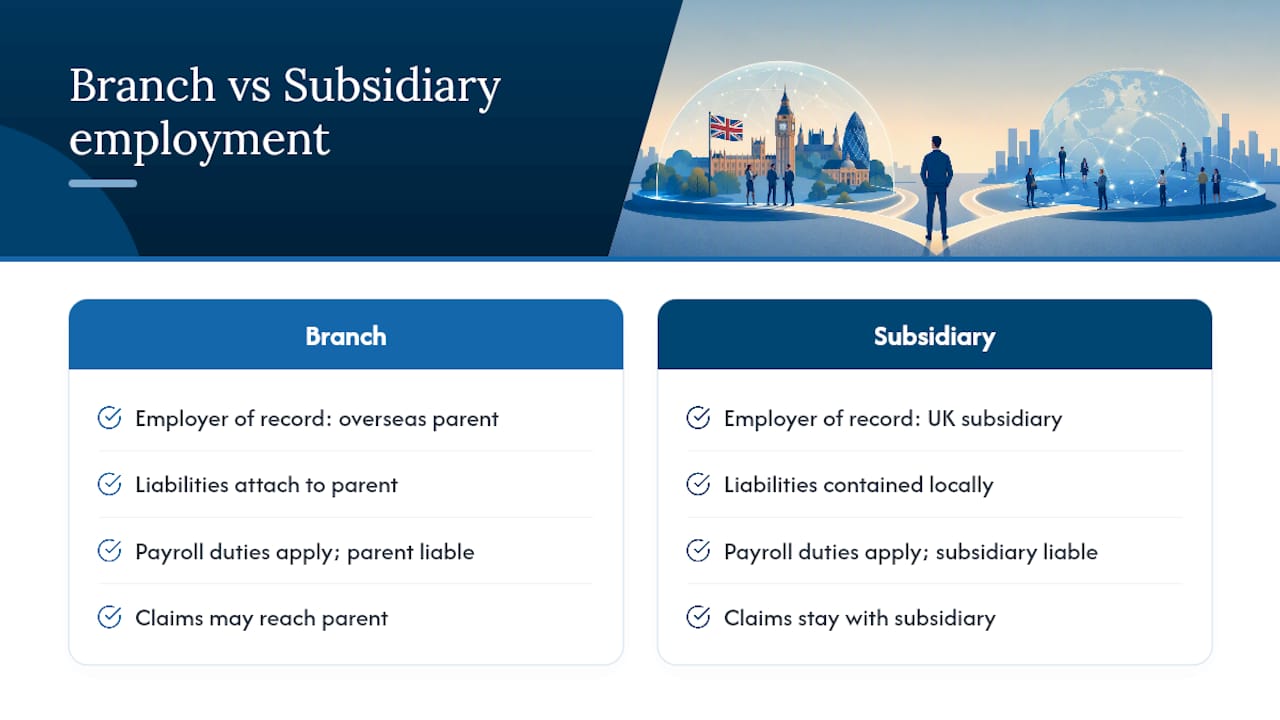
The practical difference shows up in who carries the obligation. Employ someone through a branch, and the overseas parent is the employer of record, meaning tribunal claims and employment liabilities trace straight back to it. Employ someone through a subsidiary, and the UK company itself is the employer, keeping that exposure contained within the subsidiary’s own balance sheet, in line with the same liability logic that applies to commercial contracts.
This matters more than most founders expect when hiring senior UK staff. Enterprise clients and experienced hires alike often ask, directly or indirectly, who they’re actually contracting with. A UK subsidiary offering a UK employment contract, UK pension scheme, and UK-registered payroll tends to read as a firmer commitment than a branch offering employment terms drafted by an overseas parent.
Payroll administration itself doesn’t differ much between the two. PAYE registration, National Insurance contributions, and pension auto-enrolment duties apply whether staff sit on a branch or subsidiary payroll. The difference is accountability, not process: get payroll wrong on a subsidiary, and the fallout stays local; get it wrong on a branch, and it can follow the parent home.
Exit strategies: closing or selling a branch versus a subsidiary
Winding down a branch is comparatively simple because there’s no separate legal entity to dissolve. You deregister with Companies House under the Overseas Companies Regulations, settle any outstanding UK tax and VAT positions, and the parent company’s UK presence ends. There’s no company to sell, because a buyer would be acquiring the parent’s UK trading activity directly, which rarely appeals to acquirers wanting a clean, ring-fenced target.
Closing or selling a subsidiary is a different exercise entirely. A UK subsidiary can be sold as a going concern, with a buyer acquiring shares in a distinct legal entity that carries its own contracts, employees, and liabilities. That’s precisely why investors and acquirers prefer subsidiaries: due diligence has something concrete to examine, and the transaction structure (share sale versus asset sale) offers tax and liability options that a branch simply can’t provide.
Where a subsidiary is failing rather than being sold, formal insolvency processes such as administration or liquidation apply to the subsidiary itself, generally protecting the parent from creditor claims unless there’s evidence of wrongful trading or the parent gave guarantees. A branch offers no such protection: if the UK operation fails, creditors can pursue the overseas parent directly, because there was never a separate entity standing between them.
Founders planning an eventual UK exit, whether through acquisition, investment buyout, or wind-down, generally find the subsidiary route gives cleaner options at every stage.

Why the branch route gets undersold too often
Most advice on this topic defaults to “just incorporate a subsidiary,” and for founders chasing SEIS/EIS money or UK enterprise contracts, that’s usually right. But the blanket recommendation undersells branches for a narrower, real use case: founders who need to test UK demand for six to twelve months before committing capital to a full incorporation.
The conventional advice also underweights how much the SEIS/EIS conversation should shape the decision before incorporation, not after. Too many founders pick a structure on cost grounds, then discover months later that their branch status complicates investor relief eligibility just as a funding round is closing. That’s an expensive sequencing error, not a structural flaw.
What should come first: decide whether UK investors, UK contracts, or UK hires are on your roadmap within the next year. If any of those is a firm yes, incorporate a subsidiary from day one and build SEIS/EIS planning into the share structure immediately, rather than retrofitting it later. If none of those apply yet, a branch buys time without locking you into unnecessary compliance overhead. The mistake isn’t choosing a branch. It’s choosing one without a clear trigger for when you’ll convert to a subsidiary.
— Rahamut
Get your UK structure right before you incorporate
Choosing between a branch and a subsidiary is a decision that shapes your tax position, your investor readiness, and your liability exposure for years, not just your first filing fee. Priceandaccountants works specifically with international founders navigating this choice, combining UK entity setup with SEIS/EIS readiness so your share structure doesn’t create problems just as a funding round opens.

If you’re weighing a branch against a subsidiary for a UK tech or fintech launch, the practical next step is a conversation before you file anything with Companies House. Priceandaccountants’s advisory and tax planning service covers entity choice, investor-relief structuring, and the compliance calendar that follows incorporation, and once you’re trading, bookkeeping support keeps your accounts audit-ready from month one. Book a consultation to map out which structure actually fits your fundraising timeline.
Sources
- Setting up a UK subsidiary or registering a UK permanent establishment - BDO
- Branch vs subsidiary: what are the differences? - Saffery
- HMRC Business Income Manual — BIM38250