
To appoint a UK director, you need to confirm the person is eligible, get their written consent, complete Companies House identity verification, formally record the decision, and file form AP01 within 14 days of the appointment date. Companies House and the Companies Act 2006 govern every step. Since November 2025, identity verification has been mandatory, and you cannot complete the filing without a Companies House personal code.
TL;DR:
- Identity verification has become mandatory since November 2025 and must be completed before filing AP01, requiring a personal code from Companies House or an authorised provider.
- The appointment process must follow an exact sequence including verifying eligibility, obtaining written consent, recording the decision, and filing within 14 days of the appointment date.
- Common filing errors include mismatched details, missing personal codes, appointing disqualified persons, or mistakenly publishing residential addresses instead of service addresses.
- Using a professional adviser can streamline verification, ensure compliance, and handle filings correctly, especially for overseas directors or multiple appointments.
- Directors who work from home should use a professional service address for privacy, as residential addresses are kept confidential but must be updated properly.
Get the order wrong and you risk a rejected filing or a missed deadline. Follow these steps in sequence.
Once filed, tidy up the loose ends:
Any natural person aged 16 or over can be appointed, provided they are not disqualified or an undischarged bankrupt. Directors do not need to be UK residents, but the company itself must keep a UK registered office address for official correspondence. That single rule is why so many overseas founders end up appointing a UK-resident director or arranging a professional registered office, rather than trying to run everything from abroad.
A company can also appoint a corporate director (another company, rather than an individual) in some circumstances, though this is now restricted and every corporate director must itself have at least one natural-person director standing behind it. Most small companies stick with individual appointments simply because it is administratively cleaner.
Before appointing anyone, check for disqualification via the Insolvency Service’s register. Appointing a disqualified person is a criminal offence, not a paperwork slip.
Once appointed, a director takes on seven general duties under the Companies Act 2006, including acting within their powers, promoting the company’s success, exercising independent judgement, and avoiding conflicts of interest. The Director information hub sets these out in full.
Pro Tip: Hiring an accountant or company secretary to handle filings doesn’t transfer legal responsibility. The director whose name is on the register carries the liability, even when someone else pushes the paperwork through.
Companies House now requires every new director to complete identity verification before an AP01 filing will be accepted, and the filing must carry the resulting personal code. Skip this step and the form simply will not go through.
There are two routes to get verified:
Both routes produce the same thing: a personal code that Companies House checks against the AP01 submission.
Practitioners report that this step often adds extra time to appointments that used to be same-day affairs, particularly where a director is overseas or unfamiliar with the online verification process. Build that buffer into your planning rather than assuming the filing itself is the bottleneck.
If verification stalls, the sensible move is to pause, not to file anyway hoping it clears later. A rejected AP01 wastes more time than a short delay while verification completes. Communicate internally that the appointment “goes live” only once both the board decision and the verification are locked in.
Pro Tip: If you’re appointing a director from overseas, start the identity verification conversation the moment you know the appointment is coming, not once the paperwork is drafted.
Filing AP01 sounds simple until Companies House bounces it back for a detail you missed. Here’s what the form actually needs and where people trip up.
The full field list and formatting requirements sit in the official AP01 form and guidance published by Companies House.
Paper filing still exists, but it is now the exception rather than the norm, generally reserved for situations where online filing isn’t accessible. Appointing a corporate director instead of an individual uses a different form, AP02, and comes with its own restrictions.
Common validation errors include:
Notice of appointment must reach the registrar within 14 days of the appointment date, under section 167G of the Companies Act 2006, and the filing must state that exact date. Miss it, and the company itself, not just the director, is technically in breach.
The appointment date and the filing date are two different things, and confusing them is a recurring error. The appointment date is when the board or members actually approved the decision. The 14-day countdown starts there, regardless of when you get around to filing.
To stay on the right side of the deadline:
If you do file late, there’s no formal penalty tariff published for a first minor breach, but persistent or wilful non-compliance can attract enforcement action. Keeping paper evidence of when the decision was actually taken matters more than people expect.
Companies House publishes a director’s service address on the public register, but the usual residential address stays on a private register with restricted access, as confirmed in Companies House’s own guidance on personal information.
Many directors use their accountant’s office, a company’s registered office, or a professional service address instead of their home address, precisely to keep that detail off the public record. It’s a small administrative choice with a real privacy payoff, particularly for directors who work from home or who are uneasy about their address being searchable by anyone.
Pro Tip: If you’re appointing directors who work from home, set up a service address before the appointment, not after. Changing it retrospectively means an extra filing.
Most companies use the model articles, which typically allow either the existing directors or the members to appoint a new director, but bespoke articles or a shareholders’ agreement can impose extra conditions, such as requiring unanimous shareholder consent. Check the company’s specific articles before assuming the default route applies.
Consent to act needs to be documented in writing and kept on file. Companies House doesn’t ask to see it upfront, but it forms part of the company’s statutory records and matters if the appointment is ever challenged.
Getting this internal governance step right before you touch AP01 saves a great deal of retrospective tidying later.
The same handful of errors account for most problems. Recognising them in advance is cheaper than fixing them after the fact.
Consequences range from a simply rejected filing to, in serious or wilful cases, disqualification or prosecution. Most breaches are administrative rather than criminal, but persistent non-compliance escalates quickly.
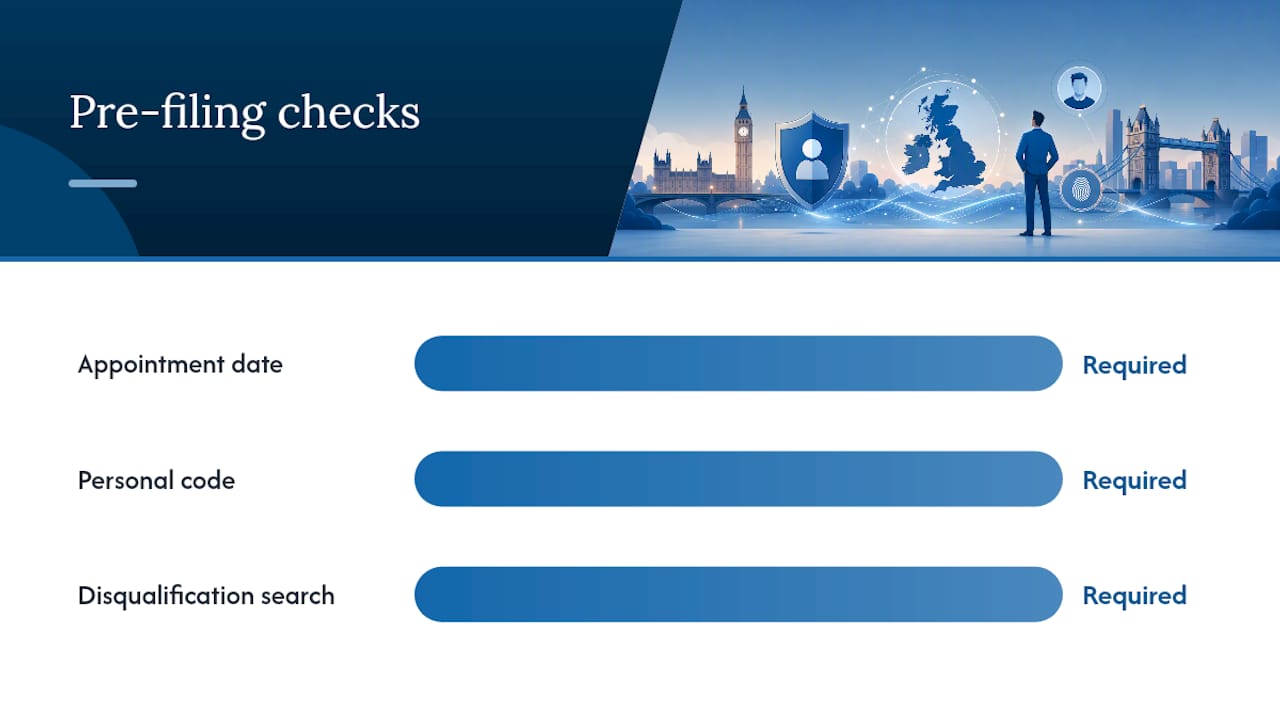
Pro Tip: Build a short pre-filing checklist covering the date, the personal code, and a disqualification search. Five minutes of checking beats weeks of correcting a bounced form.
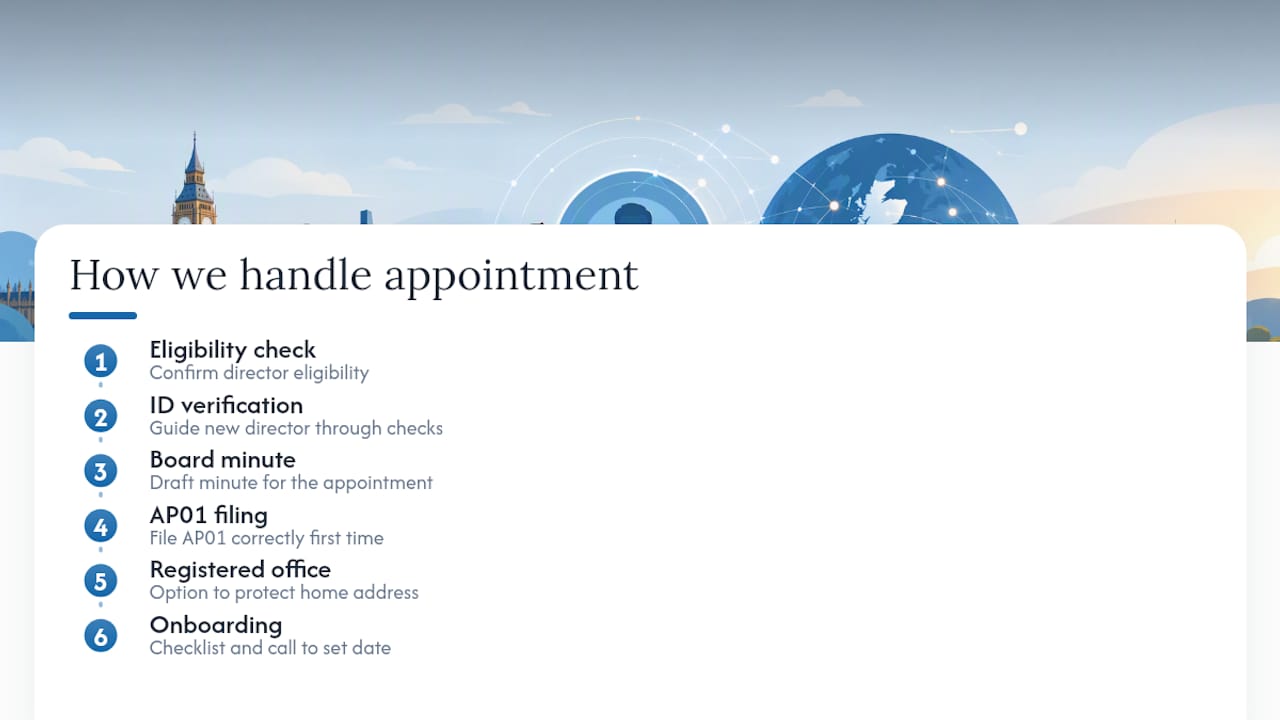
A firm that handles company secretarial work day in, day out spots the errors that trip up a first-time founder. Typical support includes running the eligibility and disqualification checks, guiding the director through identity verification, drafting the board minute or resolution, completing and filing AP01, and offering a registered office or service address to keep home addresses off the public register.
Outsourcing this work makes the most sense when timelines are tight, the company’s articles are non-standard, or the appointment involves an overseas director unfamiliar with UK filing conventions. It also helps where a company is appointing several directors at once and wants a consistent audit trail across every appointment.
Firms with experience supporting UK company formations for non-residents and outsourced finance director work tend to have this workflow well established, since founders setting up from abroad hit the identity verification and address questions most often.
The three things that actually matter here are eligibility, identity verification, and the 14-day AP01 deadline. Everything else, the minute wording, the address choice, the articles, supports those three but doesn’t replace them.
If you’re appointing a director soon, check the company’s articles today, get written consent moving, and start identity verification immediately rather than waiting for the paperwork to be “ready.” Book a filing slot with an adviser once verification is in progress, not after.
— Rahamut
A professional firm is a practical alternative to juggling AP01, identity verification, and board paperwork yourself while running a growing business. For founders appointing their first UK director, or an overseas director unfamiliar with Companies House procedure, having someone who files these forms every week removes the guesswork around dates, personal codes, and validation errors.

The team handles the eligibility check, guides the new director through identity verification, drafts the board minute, and files AP01 correctly the first time, with a registered office and service address option to keep residential details off the public register. This sits alongside the firm’s wider company accounts and compliance services, so the appointment isn’t a one-off task but part of an ongoing compliance relationship. Onboarding typically starts with a short document checklist and a call to confirm the appointment date and timeline.
If you want a fixed monthly cost rather than ad-hoc fees, the Core Services plan starts at £249 per month and covers this kind of statutory administration alongside core accounting. Get in touch to check availability for your filing date.
Before you file anything, it’s worth reading the primary sources directly rather than relying on a summary, since Companies House updates its guidance as verification rules evolve.
This article is general information, not a substitute for advice from a qualified lawyer. Consult a qualified legal professional about your own circumstances before acting on anything here.
No. Directors do not need to be UK residents, but the company must maintain a UK registered office address for official correspondence, which is why many non-resident founders arrange a UK-based service address.
Yes, appointments are recorded internally through a board minute or resolution, then filed with Companies House online using form AP01, provided the director has completed identity verification and holds a personal code.
Yes, a non-resident director UK company can appoint someone living abroad, since UK director eligibility rules focus on age and disqualification status, not residency. Many non-resident directors use a professional UK service address to handle official post reliably.
Filing itself is quick once identity verification is complete, but you must notify Companies House within 14 days of the appointment date. Identity verification, particularly for overseas directors, often takes the most time, so start it as early as possible.