You are liable to UK corporation tax if your company has a permanent establishment here, deals in or develops UK land, runs a UK property business, or is actually controlled from the UK at board level. If any of that applies, notify HMRC within three months of starting the activity and request a Unique Taxpayer Reference straightaway. When you are unsure which test catches you, get advice before your first UK invoice goes out, not after HMRC writes to you.
TL;DR:
- Most overseas companies become liable for UK tax if they establish a permanent establishment, transact land, or have central management in the UK, requiring early notification to HMRC.
- From January 2026, UK law aligns with OECD standards, affecting how dependent agents and fragmented activities are treated concerning permanent establishment rules.
- Companies involved in UK land dealings or property rental must report profits separately, as property income and trading profits are taxed and calculated differently, regardless of PE existence.
- Registration with HMRC and submission deadlines are strict, with specific filing procedures for companies without a UK permanent establishment, making early compliance essential.
- Treaty protections and anti-avoidance rules prevent abuse, requiring clear documentation and arm’s length transfer pricing to avoid disputes and penalties from HMRC.
Two legal routes catch most overseas companies out. The first is a permanent establishment (PE): a fixed place of business in the UK, or an agent here who habitually concludes contracts on your behalf. The second is central management and control (CMC): if the real decisions about your company happen at board meetings in London rather than wherever you are incorporated, HMRC can treat you as UK tax resident regardless of where the certificate of incorporation was issued.
The domestic PE test excludes purely preparatory or auxiliary activities, such as a warehouse used only for storage. But HMRC will look past artificial splitting: several small UK sites that together perform a core business function can be combined and treated as one PE, even if each site alone would qualify for the exemption.
Common PE triggers in practice:
For accounting periods from 1 January 2026, UK law is interpreted in line with OECD Commentary wherever the domestic wording mirrors the OECD Model Convention, which pulls UK practice closer to international norms on dependent agents and fragmentation.
Pro Tip: If your only UK “presence” is a freelance contractor working from home, check their contract terms carefully. An independent agent acting in the ordinary course of their own business usually will not create a PE, but a contractor who effectively works exclusively for you and has authority to bind you on price or delivery terms often will.
Since 6 April 2020, non-resident companies pay Corporation Tax rather than Income Tax on profits from UK property. This applies whether or not you have a PE, because UK land and property carry their own charging rules under domestic legislation.
Two distinct activities fall in scope:
The distinction matters because property profits and PE-attributable profits are computed and reported differently, and a company can owe tax under the property rules while having no PE at all. A Jersey-incorporated company that buys a London office block, refurbishes it, and lets it to tenants owes UK corporation tax on the rental profit under the property business rules, separate from any PE analysis on its wider trading activity.
Keep property income and expenditure in a distinct set of accounts from the outset. Mixing UK rental transactions into a group’s general ledger without a clear UK-only extract makes the year-end return far harder to prepare and increases the risk of an HMRC query.
Notify HMRC within three months of starting to trade in the UK or establishing a PE here. Miss that window and you risk a penalty before you have even filed a return.
Miss either date and interest starts running immediately, with late-filing penalties layered on top of late-payment interest. For a company that has never dealt with HMRC before, that combination can turn a modest oversight into a genuinely expensive one.
Once a PE exists, CTA 2009 section 19 sets out which profits are actually chargeable: trading income, property income, and chargeable gains that can fairly be attributed to the PE, as if it were a distinct and separate enterprise dealing with the rest of your company at arm’s length.
In practice this means:
Get this apportionment wrong and you either overpay (rarely challenged, but costly) or underpay (which invites an enquiry). Once the chargeable profit figure is settled, the standard corporation tax rate and small profits marginal relief apply in the same way they would to a UK-incorporated company.
A tax treaty can override or narrow the domestic PE test, and it always takes priority where the two conflict. Some treaties set a longer minimum duration before a construction site becomes a PE, or exclude specific activities the domestic test would otherwise catch. Post-2026 treaty interpretation increasingly follows OECD Commentary, so the treaty text and the domestic wording are converging rather than diverging.
Two reliefs matter most in practice:
Where a company appears resident in two states, treaty tie-breaker rules (usually turning on where effective management genuinely sits) decide the outcome, not a simple vote between jurisdictions.
Gather your certificate of tax residence, board minutes, and treaty documentation before you need them. If a Mutual Agreement Procedure (MAP) claim becomes necessary because two tax authorities disagree, the process moves faster when the paperwork already exists.
Pro Tip: Run this checklist before you sign a UK lease or hire a UK-based sales agent, not after. Retrofitting compliant records for a year you have already traded through is always slower and costlier than setting them up from day one.
Rahamut and the team at Price & Accountants regularly work with overseas founders and finance directors through exactly this process: UTR registration, CT600 or SA750 preparation, and defensible profit attribution when a PE has crystallised. Typical outcomes are straightforward: registration completed inside HMRC’s window, returns filed on time, and a documented apportionment methodology that survives scrutiny. Contact a specialist with your corporate structure, UK activity dates, and board minutes ready to hand.
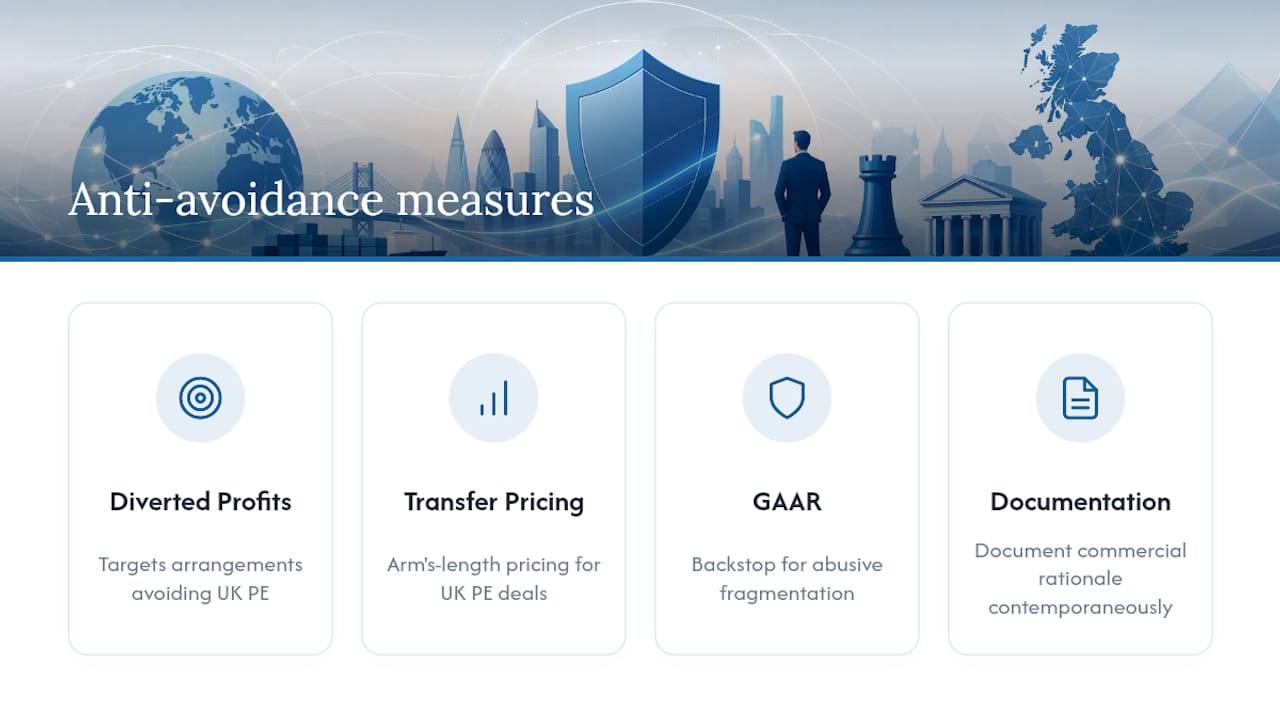
HMRC does not treat “no PE” as the end of the conversation. The Diverted Profits Tax targets arrangements designed to avoid a UK taxable presence or to shift UK-generated profit offshore through transactions lacking genuine economic substance. Where a non-resident company structures its UK activity specifically to stay under the PE threshold, HMRC can still assert a taxable diversion of profit and charge tax on it directly.
Transfer pricing rules apply in parallel. Transactions between a UK PE and the rest of the overseas company must be priced as if they were dealing with each other at arm’s length, mirroring the OECD’s separate enterprise principle already built into profit attribution under CTA 2009. Artificially loading costs onto the UK side, or routing revenue away from it, invites adjustment and potential penalties.
The General Anti-Abuse Rule (GAAR) sits above all of this as a backstop. It targets arrangements that cannot reasonably be regarded as a reasonable course of action, even where each individual step is technically lawful. A group that fragments a single UK construction project across three related entities purely to keep each one under the PE duration threshold is a textbook target, and the 2026 alignment with OECD Commentary makes that kind of anti-fragmentation testing more consistent, not less.
None of this means legitimate cross-border structuring is off the table. It means the commercial rationale needs to exist independently of the tax outcome, and needs to be documented at the time, not reconstructed after an HMRC letter arrives.
If you realise a PE existed, or CMC shifted to the UK, before HMRC finds out, voluntary disclosure is almost always the better path. HMRC’s disclosure facilities generally result in lower penalties than an enquiry HMRC opens off its own initiative, because the legislation rewards unprompted correction over discovered non-compliance.
The practical process starts with quantifying the exposure: which years, which profits, and what tax was actually due. From there, you notify HMRC of the intention to disclose, prepare the calculations and supporting evidence, and submit the disclosure with payment or a proposed payment plan attached. Interest runs from the original due date regardless of when you disclose, so earlier action always costs less than later action.
Where HMRC opens an enquiry directly, respond within the stated deadlines and resist the temptation to guess at figures you cannot yet support. An enquiry into non-resident PE status typically focuses on where contracts were actually negotiated and signed, where senior staff spent their time, and what the board minutes say about who decided what. Keep every relevant email, contract, and diary entry, because these enquiries are won or lost on contemporaneous evidence, not on retrospective argument.
If a dispute cannot be resolved through ordinary correspondence, HMRC’s Alternative Dispute Resolution service offers a mediated route before matters escalate to the tax tribunal. Specialist advice at the enquiry stage, rather than the tribunal stage, is almost always the cheaper intervention.
Corporation tax and VAT run on entirely separate rules, and a company with no UK PE for corporation tax purposes can still have a full UK VAT registration obligation. There is no VAT registration threshold for non-established taxable persons: if you make any taxable supply of goods or services in the UK, registration is required from the first pound of turnover, unlike the £90,000 threshold that applies to UK-established businesses.
This catches overseas companies selling goods stored in a UK warehouse, providing certain UK-based services, or importing goods for onward UK sale. Digital services sold to UK consumers carry their own place-of-supply rules, and getting the customer location evidence wrong is a common and costly error for software and subscription businesses selling into the UK market.
Beyond VAT, non-resident companies with UK employees or UK-based directors on the payroll need to register for PAYE and operate payroll correctly, including employer’s National Insurance contributions. Stamp Duty Land Tax applies to UK property purchases regardless of the buyer’s residence or incorporation status. None of these obligations depend on whether you have crossed the corporation tax PE threshold, which is precisely why treating “no PE” as “no UK tax obligations” is the single most common and expensive assumption overseas founders make.

Brexit changed very little about the double tax treaties themselves, because UK tax treaties are bilateral agreements with individual countries, not instruments of EU membership. A treaty with Germany or France continues to operate exactly as it did before, unaffected by the UK’s departure from the EU.
What did change is the loss of EU directives that used to sit alongside those treaties for companies operating within the EU. The Parent-Subsidiary Directive and the Interest and Royalties Directive, which allowed certain intra-EU payments to move without withholding tax, no longer apply to UK companies receiving or making payments to EU entities. Groups that relied on those directives now need to check the relevant bilateral treaty’s withholding provisions directly, and in some cases a treaty rate is less favourable than the directive exemption it replaced.
For non-resident companies with UK PEs, the more relevant shift is procedural rather than legal: UK interpretation of PE and profit attribution is moving toward OECD Commentary from 2026 onwards, independent of Brexit, as HMRC and the legislation continue that international alignment. Any group that restructured around Brexit specifically for tax reasons should revisit that structure now, since the OECD-aligned interpretation may treat old arrangements differently than the analysis performed at the time they were set up.
The traps that actually bite are dull ones: an overseas agent with informal authority to agree prices, directors dialling into board calls from a London flat, and property income buried inside general ledgers. None of these need expensive fixes. Written authority limits, properly minuted meetings held outside the UK, and a separate UK ledger cost almost nothing and remove most of the ambiguity HMRC would otherwise probe. Review structures before HMRC does; remediation after the fact is always the more expensive route.
— Rahamut
Price & Accountants is the alternative to piecing this together yourself across HMRC guidance, treaty text, and internal manuals: one team handles the registration, the return, and the ongoing filings, so nothing falls through the gap between “we think we’re compliant” and actually being compliant. That gap is where penalties and interest accumulate quietly, often for months before anyone notices.

For non-resident companies, that means HMRC registration and UTR requests handled correctly the first time, CT600 or SA750 preparation built around a defensible profit attribution methodology, and outsourced finance director support once you need ongoing strategic tax input rather than a once-a-year filing. Core Services starts at a monthly fee, with higher-tier plans available for growing operations and active management of treaty positions, PE risk, and cross-border structuring.
If you already suspect a permanent establishment or a central management and control issue, the next step is a conversation, not another guidance page. Get in touch through the services overview and bring your UK activity dates, board minutes, and current structure to that first call.
This article is general information, not a substitute for advice from a qualified financial advisor. Consult a qualified financial professional about your own circumstances before acting on anything here.
A non-resident company is taxed on UK profits only where a specific charging provision applies: a UK permanent establishment, dealing in or developing UK land, a UK property business, or central management and control actually exercised from the UK. Outside those triggers, HMRC’s domestic charging rules generally do not bring foreign profits into the UK tax net.
You cannot legally avoid corporation tax by ignoring a genuine liability, but the rate charged depends on your taxable profit level, with marginal relief reducing the effective rate for profits between the small profits threshold and the main rate threshold. Proper profit attribution under CTA 2009 section 19, combined with legitimate treaty relief, ensures you pay tax only on profit genuinely attributable to UK activity, not on your entire global income.
Yes. Non-residents can incorporate a UK company through Companies House with no residency requirement for shareholders or, in most cases, directors, though you will still need to register separately with HMRC for corporation tax once the company starts trading.
This depends on your personal tax residence rather than the company’s, and is governed by separate rules from corporate tax residence. Living abroad while working for a UK employer typically shifts your personal income tax liability toward your country of residence under that country’s tax treaty with the UK, but the UK company itself remains separately liable for corporation tax on any UK-attributable profit regardless of where its staff live.