
A budget is the committed plan you set once and defend all year: fixed targets for revenue, cost and headcount, locked in for governance and accountability. A forecast is the estimate you keep rewriting as new information lands, using actuals and market signals to show where you will actually finish. Budgets hold you accountable to a promise; forecasts help you steer around the obstacles that promise didn’t anticipate.
TL;DR:
- Businesses should update rolling forecasts monthly for volatile sectors and quarterly for stable industries, matching real-time changes in underlying conditions.
- Forecasts should focus on driver-based, granular assumptions such as sales conversion, churn, and team utilization, rather than top-line totals.
- Actuals should be compared to both budgets and forecasts separately to diagnose performance issues versus modeling inaccuracies.
- Maintaining discipline in updating forecasts and clearly separating them from budgets helps avoid confusion and supports timely decision-making.
- Tying bonuses to budget performance rather than forecast accuracy prevents manipulative drift and preserves forecasting integrity.
A budget is a static, committed financial plan, usually built for a 12-month fiscal period, that sets the targets everyone gets measured against. It’s the anchor for accountability across the organisation, which is exactly why finance teams resist changing it mid-year.
A typical budget includes:
Budgets get built during a defined “budget season”, usually in the final quarter before the new fiscal year, and go through formal sign-off from leadership or the board. Once approved, they become the fixed reference point for performance reviews, bonus structures, and board reporting. That rigidity is deliberate. If you reopen the budget every time the market shifts, you lose the one document everyone agreed to be judged against.
A forecast is a dynamic estimate, rebuilt regularly using actuals, current trends and external conditions rather than last year’s assumptions. Where a budget answers “what did we commit to?”, a forecast answers “where are we actually heading?” It typically operates across several horizons at once.
Common forecast types include:
The inputs come from the business itself: sales pipeline conversion, customer churn, team utilisation, and pricing assumptions. Forecasts get updated monthly or quarterly depending on how fast the business moves, and unlike a budget, nobody signs off on a forecast as a fixed promise. It exists to inform decisions, not to be defended in a board meeting.
The confusion usually isn’t budget versus forecast, it’s that people throw a third word, “projection,” into the mix without defining it. A projection tests a specific scenario, like the cash impact of losing your biggest client or opening a second office, rather than predicting the most likely outcome. Think of the budget as the promise, the forecast as the likely outcome, and the projection as the “what if” stress test.
| Dimension | Budget | Forecast |
|---|---|---|
| Purpose | Sets targets and allocates resources | Estimates the likely outcome given current data |
| Timeframe | Fixed period, usually 12 months | Rolling: weekly, monthly, or multi-year |
| Flexibility | Locked after approval | Updated regularly as conditions change |
| Typical use cases | Performance reviews, board sign-off, incentive targets | Cash management, hiring decisions, investor updates |
| Level of detail | Broad line items by department | Driver-based, granular, tied to specific assumptions |
Say your budget set annual revenue at £4m. By month six, your forecast might show you landing at £3.6m, based on a slower sales cycle than assumed. The budget doesn’t move. The forecast tells you what to do about the gap, whether that’s cutting discretionary spend or renegotiating a runway assumption with investors.
Comparing actuals against both budget and forecast gives you two different diagnoses, and mixing them up is where most finance teams go wrong. Actual versus budget measures performance: did the business deliver what it promised? Actual versus forecast measures something else entirely: how good is your modelling? A forecast miss doesn’t mean the business failed, it means your assumptions need work.
The monthly rhythm that keeps this useful usually runs in three steps:
Rolling forecasts earn their place here because they catch drift early, long before the annual budget review would surface it. A rolling, driver-based forecast run alongside the fixed budget lets you stay agile operationally while the budget still does its governance job undisturbed. Neither tool replaces the other. They’re solving different problems on the same numbers.
Fast-moving businesses, particularly early-stage tech companies with volatile pipelines, should update their rolling forecast monthly. Stable, low-volatility sectors can usually stretch that to quarterly without losing much accuracy. The cadence should match how quickly the business’s underlying reality actually changes, not an arbitrary calendar habit.
Ownership matters more than most teams admit:
Five drivers tend to matter most in a driver-based forecast, and building the model around these rather than editing top-line totals is what makes the numbers trustworthy: sales pipeline conversion, customer churn, pricing assumptions, team utilisation, and headcount timing.
Pro Tip: Keep forecast numbers out of incentive plans entirely. Tie bonuses to budget performance and disciplined governance instead. The moment a forecaster’s pay depends on the forecast, the estimate quietly starts drifting towards whatever number looks best, not whatever number is true.
Some businesses use the gap between budget and forecast to decide whether a funding round lands on schedule. The pattern that separates the businesses that stay ahead of cash problems from the ones that get surprised by them usually comes down to discipline in the first 90 days after a budget is set.
The checklist worth running:
One client, a fast-scaling software business, used exactly this rhythm to spot a pipeline slowdown two months before it would have shown up in a quarterly budget review. The rolling forecast triggered a hiring pause on two open roles, preserving cash runway without touching the original budget or the targets tied to it. If you want the underlying templates for building this kind of rolling model, our guide to financial forecasting for UK SMEs walks through the mechanics in more depth.
The confusion between budget and forecast rarely comes from a lack of definitions. Most finance teams can recite the difference perfectly well. It comes from treating them as competing versions of the truth instead of two tools built for different jobs, which is how you end up in a monthly meeting arguing about which number is “right” when both are correct for what they’re measuring.
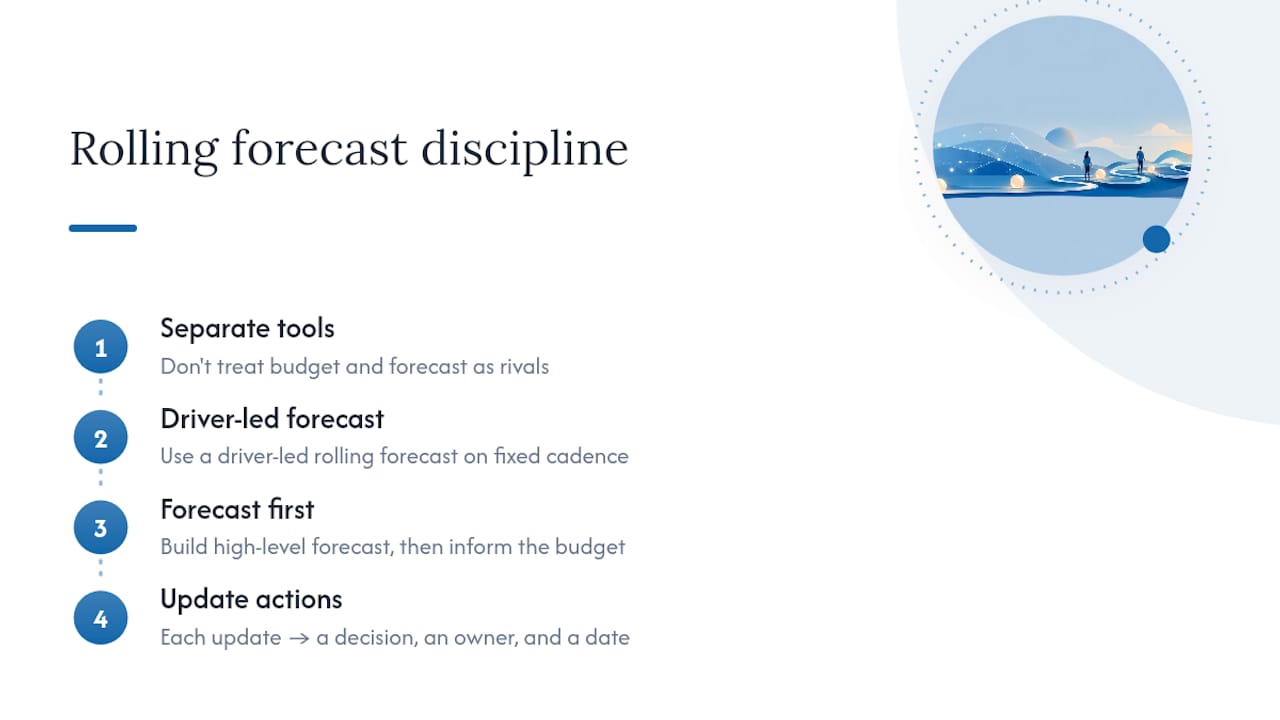
The single habit worth adopting is a driver-led rolling forecast, rebuilt on a fixed cadence, that never gets confused with the budget it sits alongside. Practitioners increasingly build a high-level forecast first, then let it inform a more grounded, realistic budget rather than the other way round. Whichever order you choose, the forecast only earns its keep when every update ends in a decision, an owner, and a date. A forecast nobody acts on is just a spreadsheet with better formatting.
— Rahamut
A budget is the fixed target set and approved before the period begins; actuals are the real, recorded results once the period has run. A forecast sits between the two, estimating where actuals will likely land before the period closes, which is why comparing actuals against both budget and forecast gives you two separate diagnoses rather than one.
Budgeting sets a static, committed plan for accountability and governance, usually fixed for the year. Forecasting produces a dynamic estimate updated regularly based on actuals, trends and current conditions, feeding operational decisions rather than formal sign-off.
No. A budget is a target you commit to and get measured against, while a forecast is your best current estimate of the outcome. Corporate Finance Institute treats them as distinct tools alongside projections, which test the impact of a specific scenario rather than predicting the most likely result.
Financial forecasts most commonly split into short-term cash forecasts, 12-month rolling forecasts, multi-year strategic forecasts, and scenario-based projections for stress-testing specific events. Each serves a different decision, from weekly liquidity checks to multi-year investment planning, and businesses typically run more than one type at once.