Runway is the number of months your cash will last at current net burn: cash on hand divided by monthly net burn. If that number is under six months and you haven’t started fundraising, that’s your action point today. Everything else in a runway forecasting model exists to make that single figure more accurate and less likely to surprise you.
TL;DR:
- A six-month runway or less without fundraising should trigger immediate action to extend cash reserves.
- Accurate forecasting requires clear separation of gross burn and net burn, with cash on hand excluding invoiced revenue or pending funds.
- Running both a monthly scenario model and a 13-week forecast helps detect tight payroll weeks and informs fundraising timing.
- Building a simple spreadsheet with real-time inputs, automated hire timing, and scenario comparisons supports better cash management.
- External finance support offers live Xero integration and investor-ready models for startups approaching investor scrutiny.
Cash runway is simply how many months a company can keep operating before its bank balance hits zero, and the reason investors and CFOs obsess over it is that it converts an abstract bank balance into a countdown. Get the inputs wrong and the countdown lies to you.
Cash on hand means money actually sitting in your business accounts, not invoiced revenue, not a pending grant, not funds ring-fenced for a client escrow. Two figures matter for burn:
Say you hold a significant cash balance and have monthly expenses and revenue such that your net burn is meaningfully less than your gross burn, resulting in more runway than gross burn alone would indicate. Confusing the two is one of the most common calculation errors founders make.
Not every business needs the same level of forecasting detail, and building a twelve-tab scenario model when you just need a gut check wastes time. The right choice depends on how close you are to running out and how much precision the decision in front of you demands.
Most startups need two of these running in parallel: a monthly model for strategic decisions and a 13-week model for operational payroll safety. Running only the monthly view means you can miss a genuinely tight fortnight buried inside an otherwise healthy quarter.
You don’t need financial modelling software to build something reliable. A clean spreadsheet, built in the right order, beats a complicated template you don’t fully understand.
Pro Tip: Build hire costs off a start-date cell using a simple IF or SUMIFS formula rather than hardcoding numbers into monthly columns. When a hire slips, you change one date, not fourteen cells, and you avoid circular references that quietly corrupt the whole sheet.
For a walk-through of the full build with downloadable structure, our guide on cashflow forecasting models covers the workbook layout in more depth.
A single-point runway figure tells you almost nothing about risk. Modelling three scenarios side by side, best, base and worst, turns one brittle number into a usable range.
Set your assumptions deliberately rather than guessing:
Present these as parallel columns in the same sheet or as a simple fan chart, so a board member can see the spread at a glance rather than hunting through three separate files.
Three drivers typically swing runway more than anything else: sales cycle length (a delayed close pushes revenue into the next quarter), headcount timing (a hire that slips three months changes burn materially), and churn on existing revenue ramp assumptions. Our scenario planning guide walks through setting these assumptions properly.
A month-by-month scenario model is the tool for fundraising and hiring calls; a 13-week direct forecast is the one that catches a tight payroll week before it becomes an emergency.
When the worst case shows zero-cash within a few months, that’s your signal to freeze hiring, cut discretionary spend, or open fundraising conversations immediately, not once the base case also turns ugly.

A runway of about a year is survivable but tight, leaving little room for a slow raise. More runway gives you breathing room to fundraise without desperation showing in every investor meeting. Longer runway suits companies extending toward profitability rather than a near-term raise, although holding too much idle cash has its own opportunity cost.
Runway alone can mislead you if burn is accelerating rather than flat, since a trailing average understates what’s coming. Pair it with the Burn Multiple to judge whether your spend is buying proportionate growth, and treat one-time inflows (a grant, an R&D tax credit payment) as separate from operating runway rather than folding them into the headline number.
A workable template needs four components: a dashboard showing current runway at a glance, a closing-cash row, scenario columns for best/base/worst, and an editable hire scheduler tied to start dates rather than fixed months. Most well-built Excel or Google Sheets templates already include these.
Understanding what belongs in your cash figures also depends on getting the underlying accounting right, worth checking against a clear accounting period definition if your fiscal calendar doesn’t run neatly month to month.
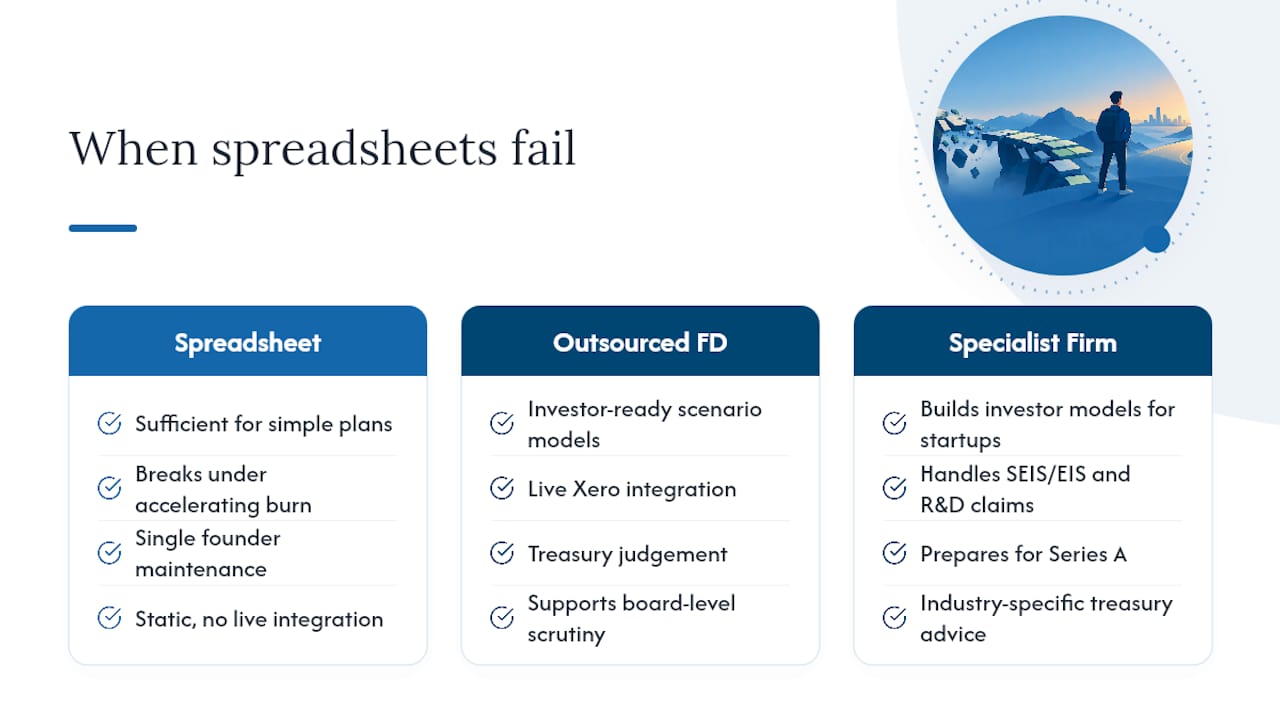
A template stops being sufficient once your model needs to survive investor scrutiny, once burn starts accelerating unpredictably, or once a single tight week could disrupt payroll. That’s usually the point complexity outpaces what one founder can maintain reliably between board meetings.
An outsourced finance director brings investor-ready scenario models, live Xero integration, and treasury judgement that a static spreadsheet can’t replicate on its own. Specialist accounting and advisory firms build these models for tech and fintech startups navigating SEIS/EIS rounds, R&D claims, and Series A preparation, where the runway number quietly sits behind every funding conversation.
— Rahamut
If you’re patching together spreadsheets at midnight before a board meeting, the more direct route is having someone build and maintain the model with you. Outsourced finance director support can pair monthly runway modelling with live Xero integration, so your closing-cash figure updates from actual bank data rather than manual entry.

The firm’s finance directorship services sit alongside R&D tax credit claims and SEIS/EIS advisory, which matters if a chunk of your runway extension depends on a tax credit payment landing on schedule. Plans start with the Core Services package at £249 per month, scaling to the Blue Plan at £549 per month or the Black Plan from £1,999 per month for full finance directorship support. Browse the full service list or book a call to talk through your current model before your next fundraising conversation.
A runway model is a spreadsheet or tool that projects how many months a company’s cash will last, built by dividing cash on hand by monthly net burn. It’s separate from “Runway ML,” which is unrelated AI video software, a common source of confusion in search results.
Use a monthly scenario model for fundraising and hiring decisions, and a 13-week rolling direct forecast for spotting tight payroll weeks. Most CFOs run both simultaneously rather than choosing one.
In VC conversations, runway signals how much time a company has before it needs new capital or hits zero cash. Investors generally view 18 to 24 months as comfortable, while under six months without an active raise is treated as a red flag.
Price & Accountants’ relevant services are priced through its plans, starting with Core Services at £249 per month and rising to the Black Plan from £1,999 per month for full finance directorship work, both detailed on the pricing page. Bespoke advisory work such as R&D claims or SEIS/EIS setup is quoted on request.
Using invoiced revenue instead of cash actually collected, and dividing by gross burn instead of net burn, both of which overstate how much time you have. The fix is reconciling your model to real bank statements every month, not just trusting the formula.