
An ASA can qualify for SEIS, but only if it meets HMRC’s strict conditions: no refund, no interest, no assignment or variation, and a longstop date that HMRC expects to be no more than six months. The point most founders miss is timing. SEIS relief arises when the shares are issued, not when the ASA is signed.
TL;DR:
- At share issue, the company must be under three years old, have fewer than 25 employees, and hold gross assets of no more than £350,000.
- Check age, headcount, and gross assets monthly, and convert before a planned funding round pushes the company beyond any SEIS limit.
- Investors claim through SEIS3 after share issue and company approval; when payment and conversion cross tax years, relief belongs to the issue year.
- Apply for discretionary advance assurance before signing if time allows; it can take weeks and never guarantees relief, so keep eligibility and spending records.
Table of Contents
- What does an ASA need to say to stay SEIS-eligible?
- When does HMRC test SEIS eligibility, and what must still be true then?
- How should you draft the clauses?
- Should you apply for advance assurance, and when?
- What tax position do investors take when they sign an ASA?
- How do ASAs work across SEIS and EIS together?
- How should share classes be structured alongside an ASA?
- Where do ASAs most often go wrong with HMRC?
- What does a SEIS-friendly ASA look like in practice?
- Our view: speed against precision
- How we help with ASA drafting and SEIS compliance
- FAQ
- Sources
What does an ASA need to say to stay SEIS-eligible?
Treat this as the checklist you hand to your solicitor before anyone signs. Each line below reflects the position HMRC sets out in its manual, where an ASA is treated as a pure equity instrument and anything resembling debt puts relief at risk.
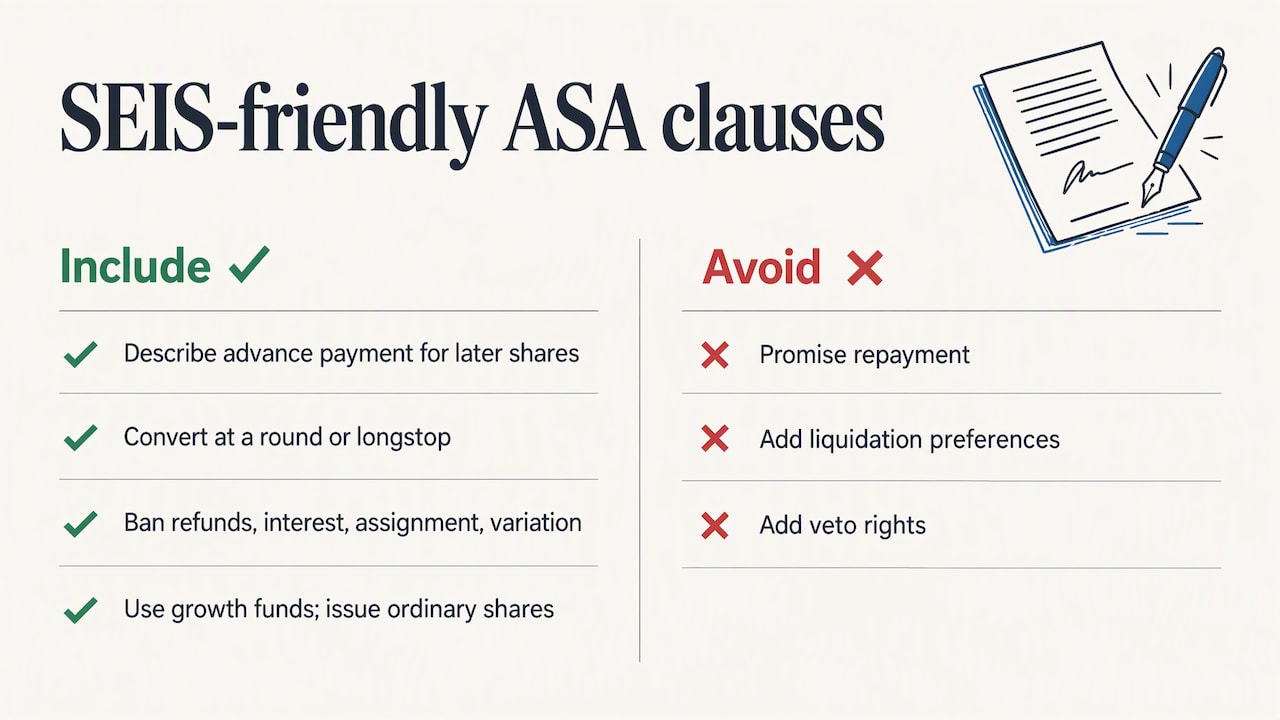
- The ASA must prohibit any refund of the subscription payment, whatever happens to the company.
- It must carry no interest, and it should avoid repayment language of any kind.
- It must be non-assignable and incapable of variation once signed.
- It must set a longstop date for conversion, which HMRC expects to be no more than six months from the date of payment.
- It must convert into ordinary, fully paid, non-redeemable shares.
- It must state that the funds are for the growth of the trade and not for repaying existing creditors.
Pro Tip: Read your draft aloud and ask whether any sentence could be read as a promise to give the money back. If it can, rewrite it before the investor sees it.
The same logic applies under HMRC’s EIS guidance on ASAs, which accepts these agreements only where refunds, variation, assignment and interest are all excluded and the longstop is short. Longer or more complex agreements raise the chance that the rules are not met. If you want a broader grounding in the instrument itself, our piece on advance subscription agreements for UK founders and investors covers the basics.
When does HMRC test SEIS eligibility, and what must still be true then?
HMRC does not judge your company on the day the ASA is signed. Relief arises when the shares are issued, so the company must meet the SEIS conditions on that later date. According to the government’s SEIS application guidance, the company must be under three years old, have fewer than 25 employees and hold gross assets of no more than £350,000 at the date of issue. It must also not have been funded in a way that disqualifies it.
This creates a gap risk. Between signing and conversion, a company can hire its way past the employee limit, build up assets, or reach a point where the trade is older than the scheme allows. Industry commentators such as Guinness Ventures make the same point: relief depends on the issue date, so you need to keep the company qualifying throughout the ASA period.
In practice we suggest a short monthly check covering three items: gross assets against the £350,000 ceiling, headcount, and the date the trade began. If a larger funding round is likely to push you past a limit, convert the ASA shares before it lands.

The paperwork follows the issue. Investors then claim through the SEIS3 certificate, as the gov.uk investor guidance sets out. For a walkthrough of the form, see our guide to the SEIS1 compliance statement, and for the company tests in detail, our note on SEIS eligibility criteria.
How should you draft the clauses?
Clause wording is where most ASAs succeed or fail. The aim is to say plainly what the investor receives, shares, and to remove every hint of a debt.
- Refund prohibition. State that the subscription money is not repayable in any circumstances, including failure to complete a funding round.
- No interest. Say expressly that no interest or return accrues on the subscription amount.
- Non-assignment and no variation. Prevent the investor transferring the agreement and prevent either side amending its core terms.
- Conversion wording. Provide for conversion into ordinary, fully paid, non-redeemable shares, with no preferential rights that act as downside protection.
- A short longstop. Fix a date no more than six months out, and say what happens at that date.
Be careful with fallback pricing. If no priced round occurs, the ASA still needs a mechanism to convert at the longstop, for example at a pre-agreed valuation or a formula. Keep it a conversion mechanism, never a repayment alternative.
Avoid investor-protective terms such as liquidation preferences, guaranteed returns or heavy veto rights. The practitioner commentary from Humphreys Law notes that HMRC’s refusals typically trace back to repayment rights, interest, investor protection or an excessive longstop.
Pro Tip: Minute the board decision to enter the ASA and keep evidence of how the funds were used. Both support the SEIS1 submission later.
Should you apply for advance assurance, and when?
Advance assurance is discretionary and non-statutory, but many investors expect it. If you want that comfort, apply before you sign the ASA. Our founder’s guide to SEIS advance assurance covers the process in more depth.
HMRC reviews the ASA terms alongside the rest of your application. It is unlikely to give assurance where the longstop exceeds six months or where the agreement looks loan-like. The steps usually run like this:
- Prepare the draft ASA, a business plan and details of the company’s share capital and shareholders.
- Submit these to HMRC with a covering description of the intended use of funds.
- Respond to any follow-up questions, which often concern the longstop or any protective clauses.
- Receive HMRC’s opinion, which is not a guarantee of relief.
- Sign the ASA only once you are comfortable with the position, adjusting terms if HMRC raises concerns.
Expect the opinion to take a matter of weeks rather than days, so build that into your fundraising calendar and tell investors early. If the round is too urgent to wait, you can proceed without assurance, but then document the transaction carefully: keep the signed ASA, your eligibility checks and the evidence of how funds are spent, so the later SEIS1 claim stands on firm records.
What tax position do investors take when they sign an ASA?
For the investor, the tax benefit does not start when the money leaves their account. It starts when the shares exist. As HMRC’s manual states, SEIS relief arises when the shares are issued, so the ASA payment sits in limbo until conversion. The investor claims income tax relief through the certificate process, using the SEIS3 form once the company has received its compliance statement approval, as gov.uk’s investor guidance describes.
That timing has a practical effect on which tax year the relief falls into. Because the claim is tied to the issue date, a payment made in one tax year but converted in the next belongs to the year of issue. Investors who want relief against a particular year’s income should therefore press for conversion before that year ends.
The flip side is risk. If the ASA fails HMRC’s tests, or the company stops qualifying before conversion, the investor can lose the relief they expected. For this reason, sophisticated investors often ask to see advance assurance or the company’s eligibility evidence before they commit. We recommend that investors take their own tax advice on their personal position, since reliefs depend on individual circumstances.
How do ASAs work across SEIS and EIS together?
SEIS and EIS often sit in the same funding journey. A company might raise its first small round under SEIS and a larger one later under EIS, and an ASA can serve either, provided the same core conditions are met. HMRC’s guidance on EIS advance subscription agreements mirrors the SEIS position: no refund, no variation or assignment, no interest and a short longstop.
The practical consequence is that one well-drafted ASA template can be reused, but you should confirm which scheme the shares will qualify under at the moment of issue. SEIS has tighter company limits than EIS, so a company that starts SEIS-eligible may cross a threshold before conversion and find only EIS available. Plan for that by identifying early which relief each investor is targeting.
Where SEIS and EIS money arrives in the same period, keep each investor’s ASA, payment and share issue clearly separated in your records. That makes the later compliance statements and certificates straightforward, and it avoids confusion over which shares carry which relief. Our overview of SEIS and EIS accounting for UK tech startups shows how this record-keeping fits into your wider books.
How should share classes be structured alongside an ASA?
The ASA should convert into ordinary, fully paid, non-redeemable shares, and your share structure needs to be ready to receive them. If your articles do not yet provide for the class of share the investor will take, amend them before the longstop so conversion is not delayed.
Where you want to give investors different economic rights, proceed with care. HMRC looks at whether any rights amount to downside protection or a guaranteed return, and preferential terms on the shares themselves can undermine the equity character the scheme requires. Keep rights simple: the same class as existing ordinary shares, or a separate class that differs only in ways that do not shield the investor from loss.
A sensible sequence is to confirm your authorised share capital, check that the articles allow issue of the intended class, and reserve the shares in your cap table so the numbers are ready at conversion. Do this early and conversion becomes an administrative step rather than a scramble against the longstop. If the structure is more than trivial, ask your solicitor and your accountant to review it together before signing.
Where do ASAs most often go wrong with HMRC?
Most objections come from a small number of repeating mistakes, and Humphreys Law’s summary of HMRC’s guidance lists the usual suspects.
- Loan-like drafting. Any wording that suggests the money could be repaid, or that it accrues a return, invites refusal.
- Investor protection. Clauses that cushion the investor from loss, such as repayment triggers or guaranteed outcomes, are treated as incompatible with the scheme.
- An excessive longstop. A date beyond six months weakens the case and is a frequent reason advance assurance is declined.
- Loss of qualifying status. The company outgrows the SEIS limits between signing and issue, so relief fails on the day it matters.
- Premature or incomplete claims. Submitting the SEIS1 before shares are issued, or before the trading or spending condition is met, leads to rejection.
- Weak records. Missing board minutes or no evidence of how funds were spent leaves you exposed if HMRC asks questions.
Guinness Ventures cautions that the speed of an ASA can mask these strict requirements, and that treating it as a simple contract is a common error. The remedy is dull but effective: draft tightly, monitor eligibility, and keep records throughout the process.
What does a SEIS-friendly ASA look like in practice?
Rather than reproduce a full template, here is the shape of one, so you can compare it with what your solicitor produces. A SEIS-friendly ASA typically contains these elements in plain terms.
The parties and subscription amount come first, followed by a statement that the investor pays the amount in advance in exchange for shares to be issued later. A conversion clause then fixes how and when the shares are issued, either on a priced funding round or, failing that, at the longstop date on a stated basis. A short longstop sits alongside it, no more than six months from payment.
The protective clauses are the ones to get right. An express no-refund clause, a no-interest clause and a bar on assignment and variation belong in every version. A use-of-funds statement confirms the money is for the growth of the trade. The agreement ends with the confirmation that the shares will be ordinary, fully paid and non-redeemable.
Notice what is missing: no repayment mechanism, no liquidation preference, no veto package. If your draft contains any of those, treat it as a signal to revisit the terms. You can find a broader walkthrough in our advance subscription agreement guide, and we are happy to review a draft against HMRC’s published position before you send it to an investor.
Our view: speed against precision
In our experience, ASAs are chosen for speed, and speed is exactly what tempts founders to skip the careful drafting HMRC expects. The trade-off is real. A loosely written agreement may be quick to sign, but careful drafting can help protect an investor’s relief. We would rather take extra care than leave a seed investor holding a claim that HMRC later refuses.
A specialist adviser earns their fee between signing and issue, as explained in this founder’s guide to Innovator Founder visa requirements. That is when companies drift past the SEIS limits, when advance assurance submissions need to be accurate, and when clause wording either holds or fails. We prepare advance assurance applications, draft or review ASA clauses to HMRC’s standard, and keep the company’s eligibility under watch until the shares are issued. That support raises the odds that your investors keep the relief they were promised, and it spares you the awkward conversation if they do not.
— Rahamut
How we help with ASA drafting and SEIS compliance
We handle SEIS and EIS setup and compliance for UK tech startups, from reviewing your ASA wording to supporting your advance assurance application, preparing the SEIS1 paperwork once shares are issued, and keeping the records HMRC may ask for later. A typical engagement starts with a document review, moves to tailored clause drafting, then to the HMRC submission and finally the compliance statement at issue.

Book a consultation through our services page, or see our plans and pricing to choose how we work with you.
This article is general information, not a substitute for advice from a qualified financial advisor. Consult a qualified financial professional about your own circumstances before acting on anything here.
FAQ
Who qualifies for SEIS?
The company must meet the SEIS tests at the date shares are issued. Gov.uk guidance sets the limits at under three years old, fewer than 25 employees and no more than £350,000 in gross assets. Investors then claim relief on shares they hold in a qualifying company.
What does “ASA investment” mean?
An ASA investment is money paid to a company in advance in return for shares to be issued later, usually at a future funding round. It is treated as equity rather than a loan, which is why it must contain no refund or interest.
What are the best SEIS funds in the UK?
We do not rank funds, because suitability depends on an investor’s own goals and tax position. Investors should compare fund track records, fees and the quality of each fund’s compliance process, and take independent financial and tax advice before committing.
What is the maximum investment limit for SEIS in 2026?
This article does not state an investor limit, because we have no up-to-date source in front of us. Check the current figure in HMRC’s investor guidance before you commit funds.