

An advance subscription agreement (ASA) is a contract where an investor pays money to a company now, and the company issues shares later — typically when a priced funding round completes. No interest accrues, nothing is repayable, and the investor is not a creditor. If you are a UK founder raising early-stage capital, or an angel considering a pre-seed cheque, the ASA is probably the instrument you will encounter first. The single most important immediate action: apply for HMRC SEIS/EIS advance assurance before you sign and receive funds.
Three things to do before the ink dries:
- Confirm HMRC advance assurance is in place (or applied for) if investors expect SEIS or EIS relief.
- Set a longstop date that is genuinely short. Practitioners commonly use a relatively short period for SEIS/EIS comfort.
- Record the incoming funds as an advance subscription in your accounts, not as a loan or deferred income.
The single biggest ASA mistake is drafting language that looks like debt. Any clause that creates a right to repayment or charges interest will likely cause HMRC to deny SEIS/EIS relief — and that denial can come years after the investment, leaving investors with an unexpected tax bill.
Pro Tip: Before circulating an ASA to investors, have a specialist accountant or solicitor confirm that no clause — however innocuously worded — creates an effective right to repayment or a return of capital, as advised in Mortgages for Lawyers & Legal Professionals | Haven Mark Adv.
Key takeaways
An advance subscription agreement lets a UK startup take investment now and issue shares later, but SEIS/EIS eligibility depends entirely on keeping the instrument free of debt-like features, maintaining a short longstop date, and completing corporate actions promptly.
PointDetailsNon-repayable by designAn ASA carries no interest and no repayment right; any clause suggesting otherwise risks SEIS/EIS denial.Six-month longstop benchmarkPractitioners commonly target a relatively short longstop date to support SEIS/EIS eligibility with HMRC.Advance assurance firstApply for HMRC advance assurance before funds are received, not after the ASA is signed.Standardise terms across investorsVaried caps or discounts across a funding phase create cap-table complexity and contentious later rounds.Priceandaccountants next stepPriceandaccountants provides ASA review, advance assurance support, and cap-table modelling for UK tech startups.
Table of Contents
- What is an advance subscription agreement and how does it work?
- How does an ASA convert from cash to shares?
- What are the key contractual terms to negotiate in an ASA?
- Does an ASA qualify for SEIS and EIS tax relief?
- When should you use an ASA, and when should you avoid one?
- Operational checklist: from drafting to share issuance
- Common mistakes that create legal, tax, and fundraising problems
- How Priceandaccountants supports ASA structuring and SEIS/EIS compliance
- What practitioners have learned from working with UK startups
- Tax-aware ASA support for UK tech startups
- Sources
What is an advance subscription agreement and how does it work?
An ASA sits between a handshake and a full equity round. The investor wires funds today; the company promises to issue shares at a future date, at a price determined by the next qualifying financing round (or a pre-agreed formula if no round occurs). It is not a loan. ASAs carry no interest and are not repayable — they are equity-like in substance from the moment the money lands.
Founders use ASAs for two practical reasons: speed and valuation deferral. Agreeing a share price requires a full valuation exercise, which takes time and negotiation. An ASA lets a company close an investor in days rather than weeks, with the valuation question deferred to the next round. Investors accept this because they typically receive a discount or valuation cap as compensation for the uncertainty and early risk.
A short worked scenario. A seed-stage SaaS company needs £150,000 to reach its next product milestone. Three angels want to invest now, but the founders are not ready to set a company valuation. Each angel signs an ASA. Six months later, a lead investor prices the round at a £3m pre-money valuation. The angels get more shares per pound than the new investors — their reward for backing the company earlier.
Key reasons founders and investors choose ASAs:
- Speed: A well-drafted ASA can be signed and funded quickly after first contact.
- Valuation deferral: No need to agree a company valuation upfront.
- SEIS/EIS compatibility: Structured correctly, ASAs can qualify for generous UK tax reliefs.
- Early access: Investors secure a position before the priced round fills.
Pro Tip: Check your articles of association and any existing shareholder agreement before issuing an ASA. Some articles require a shareholder resolution before new shares can be allotted, and some investor agreements contain pre-emption rights that must be waived. Missing either step can block conversion later.
How does an ASA convert from cash to shares?
The mechanics follow a clear sequence, though the details of each step matter enormously for tax and legal purposes.
- Subscription payment. The investor transfers funds to the company’s bank account. The company records this as an advance subscription (a liability on the balance sheet until shares are issued).
- Holding period. The company uses the funds commercially. No interest accrues. The investor holds no shares yet but may have limited information rights under the ASA.
- Trigger event occurs. The most common trigger is a qualifying financing round — a new equity raise above a minimum threshold. Other triggers include a sale of the company, an IPO, the longstop date, or (in a worst case) insolvency. Standard ASA templates set out all five triggers explicitly and confirm the advance is not repayable under any of them.
- Conversion calculation. The number of shares issued depends on which trigger fires and what protections the investor negotiated. See the worked example below.
- Share allotment. The board passes a resolution to allot shares, updates the statutory register, and files an SH01 return at Companies House within one month.
- Cap table update. The company’s cap table is updated to reflect the new shareholders before the next funding round closes.
Sample conversion calculation
The investor paid £50,000 and receives 62,500 shares rather than the 50,000 a new investor at the same round would receive. That 12,500-share difference is the economic reward for investing early.
Where a valuation cap applies instead of (or alongside) a discount, the conversion uses whichever formula produces more shares for the investor. Valuation caps and discounts are standard ASA mechanisms designed to protect early investors against a high-valuation round that would otherwise dilute their return.
If no qualifying round occurs before the longstop date, the ASA should include a pre-agreed longstop valuation formula so shares can still be issued without last-minute negotiation under pressure.
What are the key contractual terms to negotiate in an ASA?
The clauses below determine whether an ASA protects both parties or creates problems at conversion. Each one is worth negotiating carefully.
- Longstop date. The deadline by which shares must be issued if no qualifying round has occurred. Too long a period raises SEIS/EIS risk; too short may not give the company enough runway. A relatively short longstop period is commonly used as a benchmark for SEIS/EIS-sensitive deals.
- Qualifying financing definition. Specifies the minimum raise amount that triggers conversion. Set it too low and a small top-up round triggers conversion prematurely; too high and the trigger may never fire.
- Valuation cap. The maximum valuation at which the ASA converts. Protects the investor if the company raises at a very high valuation.
- Discount rate. A percentage reduction applied to the qualifying round price. Typically a moderate discount percentage.
- Longstop valuation. The pre-agreed formula or fixed valuation used to price shares if the longstop date arrives with no qualifying round. Including this avoids a stressful renegotiation.
- Conversion methodology. Whether the discount and cap apply independently or together, and which produces the better outcome for the investor.
- Investor rights pre-conversion. Information rights (management accounts, material event notices) are common. Voting rights or board observer seats are less standard and can complicate SEIS/EIS eligibility.
- Aggregate ASA limits. A cap on the total amount raised under ASAs in a single phase, to prevent cap-table fragmentation.
A sample longstop clause might read: “If no Qualifying Financing has occurred on or before the Longstop Date, the Company shall, within five Business Days of the Longstop Date, allot and issue to the Investor such number of Ordinary Shares as is equal to the Subscription Amount divided by the Longstop Price.” Lawyers will recognise this structure from the Seedcamp and Seedsummit templates — it is the language that makes the advance unambiguously non-repayable.
Practical drafting guidance consistently warns against using a template without adapting it to the company’s articles and existing shareholder arrangements. A clause that works perfectly in the template may conflict with pre-emption rights or drag-along provisions already in place.
Does an ASA qualify for SEIS and EIS tax relief?
This is where most ASA mistakes happen, and the consequences can be severe. HMRC’s position is clear: an ASA can qualify for SEIS or EIS relief, but only if it is structured so that no repayment right, no interest, and no debt-like protection exists. Any clause that gives an investor an effective right to get their money back — even indirectly — risks denial of relief.
The steps to protect SEIS/EIS eligibility:
- Apply for advance assurance before issuing the ASA. HMRC’s advance assurance process confirms (in principle) that the company and the proposed investment structure qualify. It is not legally binding, but it gives investors confidence before they commit.
- Structure the ASA with no repayment and no interest. The advance must be applied commercially and must convert only into ordinary, non-redeemable shares.
- Keep the longstop date short. Practitioners commonly target a six-month longstop to support SEIS/EIS eligibility. A 12-month or longer period increases the risk that HMRC treats the instrument as quasi-loan.
- Pass the necessary shareholder consents. A resolution authorising the allotment of shares is typically required before or at the point of conversion. Prepare this in advance.
- Update the articles if needed. Confirm the articles permit the allotment of shares on ASA conversion terms without further conditions.
- File the SH01 promptly on conversion. Delays in allotment paperwork can delay investors’ ability to claim their tax relief.
Pro Tip: Check whether your investors are claiming SEIS or EIS — the qualifying conditions differ. SEIS applies to very early-stage companies and carries higher income tax relief rates; EIS covers a broader range of companies. The SEIS HS393 helpsheet sets out the qualifying conditions investors must meet. Getting this wrong costs investors real money.
Tax-risk callout: Common traps include exit clauses that trigger repayment before conversion, investor control rights that resemble creditor protections, and longstop dates that are so distant they suggest the instrument is really a loan. For SEIS/EIS accounting and compliance, consult a specialist accountant before the ASA is signed — not after.
When should you use an ASA, and when should you avoid one?
Advantages:
- Fast to execute — legal costs are lower than a full equity round.
- Compatible with SEIS/EIS when structured correctly.
- Defers the valuation conversation to a point when the company has more data.
- Well understood by UK angels and seed funds.
Disadvantages:
- Adds complexity to the cap table before a priced round.
- Investors hold no shares during the holding period, which can create tension.
- A poorly drafted longstop clause can leave both parties in an awkward position.
- Multiple ASAs with different caps and discounts make later modelling painful.
ASA vs convertible loan note vs SAFE
The UK market uses three main pre-equity instruments. A convertible loan note (CLN) is a loan that converts to equity — it carries interest and is technically repayable, which makes it incompatible with SEIS/EIS unless structured very carefully. A SAFE (Simple Agreement for Future Equity) originated in the US and is not widely used in the UK; it has no established HMRC treatment and creates uncertainty for tax-sensitive investors. The ASA is the UK-native instrument: no interest, not repayable, and with a clear HMRC framework when structured correctly.
Use an ASA when:
- You are bridging to a priced round within six months.
- Investors are writing angel-sized cheques (typically £10,000–£150,000) and want SEIS/EIS relief.
- Speed matters more than a fully negotiated term sheet.
Avoid an ASA when:
- You have no realistic prospect of a qualifying round within the longstop period.
- Investors require board seats or voting rights before conversion (these can jeopardise SEIS/EIS).
- The aggregate ASA amount is large enough that a priced round would be more appropriate.
Operational checklist: from drafting to share issuance
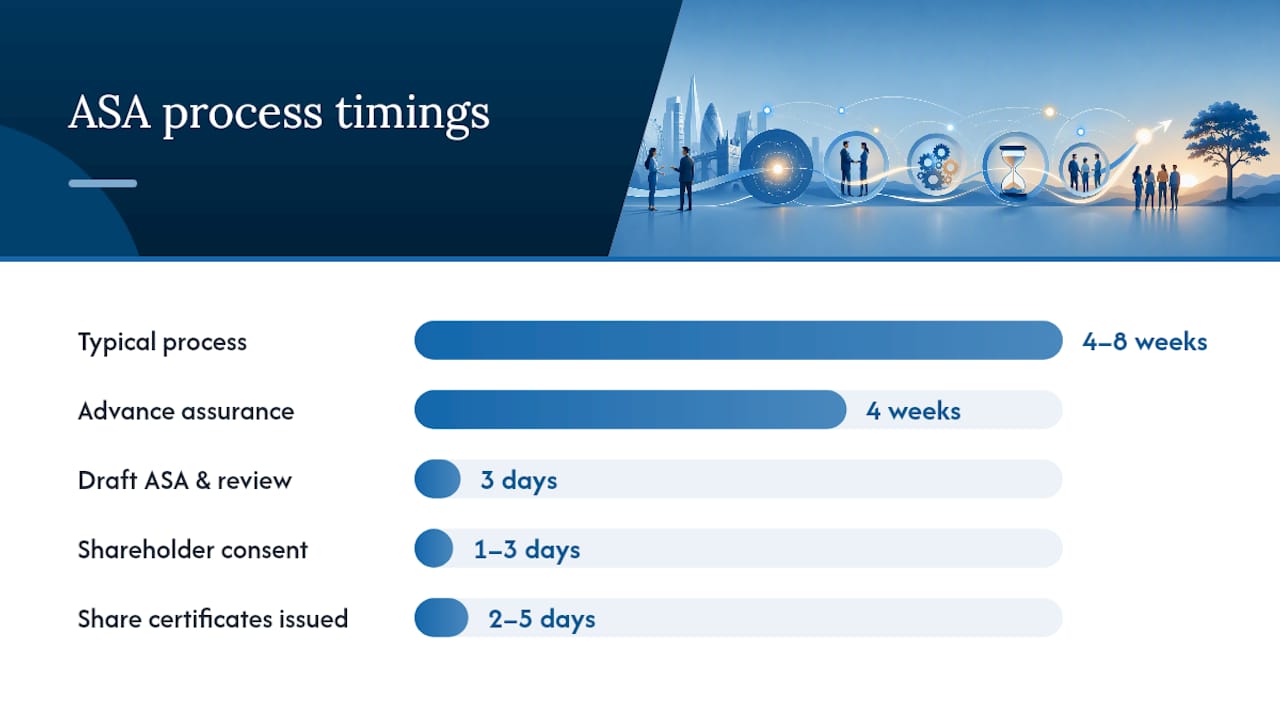
The process from first draft to allotted shares typically runs four to eight weeks for a straightforward deal, though the holding period before conversion can extend to the longstop date.
MilestoneTypical durationWho actsDraft ASA and review against articles3 daysSolicitor, founderShareholder consent / board resolution1–3 daysBoard, existing shareholdersInvestor signs ASA1–2 daysInvestorFunds received in company bank account1–3 daysInvestor, founderAdvance assurance confirmation (if pending)4 weeksHMRC, accountantQualifying round closes (trigger event)VariableLead investor, founderBoard resolution to allot shares1–2 daysBoardSH01 filed at Companies HouseWithin 1 month of allotmentCompany secretary, accountantShare certificates issued2–5 daysCompany secretaryCap table updatedSame day as allotmentFounder, accountant
Documents needed alongside the ASA:
- Board minutes authorising the ASA and the receipt of funds.
- Shareholder resolution waiving pre-emption rights (if required by the articles).
- HMRC advance assurance application and confirmation letter.
- Updated cap table showing the ASA as a contingent instrument.
- SH01 form for Companies House on conversion.
- Share certificates for new shareholders.
Typical costs for a straightforward ASA: legal drafting and review £500–£2,000; accountancy support for advance assurance and cap-table modelling £500–£1,500; Companies House filing fees are modest. Budget for cap-table modelling help if you are running multiple ASAs with different terms — the complexity compounds quickly.
Common mistakes that create legal, tax, and fundraising problems
Treating the ASA as a loan. The most damaging error. If the company’s accounts, board minutes, or any correspondence describe the advance as a loan or refer to repayment, HMRC may treat it as one. The HMRC Venture Capital Schemes Manual is explicit: debt-like features disqualify the investment from SEIS/EIS relief.
Inconsistent terms across investors. Running multiple ASAs in the same phase with different caps, discounts, or longstop dates creates a modelling nightmare at the next round. Investors with better terms will receive more shares; those with worse terms may feel misled. Practitioners recommend harmonising terms across a funding phase to avoid complexity and contention in cap-table modelling and later rounds.
Missing shareholder consents. If the articles require a shareholder resolution before new shares can be allotted, and that resolution was never passed, conversion is legally blocked. This is fixable, but it delays investors’ tax relief claims and creates friction at the worst possible moment.
A longstop date that is too distant. A two-year longstop may feel founder-friendly, but it signals to HMRC that the instrument is quasi-debt. It also leaves investors in limbo for longer than is commercially sensible.
Failing to seek advance assurance. Some founders skip advance assurance to save time. If HMRC later rejects the SEIS/EIS claim, the investor loses their tax relief — and the founder loses their reputation with that investor and their network.

A brief illustrative scenario. A founder issued four ASAs over eight months, each with slightly different discount rates and longstop dates. When the Series A closed, the cap-table calculation produced four different per-share prices. The lead investor’s lawyers flagged the inconsistency, the round was delayed by three weeks while the ASA investors renegotiated, and one investor’s SEIS claim was queried by HMRC because the longstop date had already passed without a formal conversion resolution being passed. The fix cost more in legal fees than the original ASA drafting.
Pro Tip: Use a single, standardised ASA template for all investors in a given funding phase. Agree the cap, discount and longstop date once, then issue the same document to each investor with only the name and amount changed. It saves hours of modelling and prevents exactly the scenario above.
How Priceandaccountants supports ASA structuring and SEIS/EIS compliance
Getting an ASA right requires more than a downloaded template. The tax and legal interactions — advance assurance, share allotment timing, cap-table modelling, corporate actions — are where founders most often need specialist support. Priceandaccountants works with UK tech and fintech startups from pre-seed through Series A, and ASA-related services sit at the core of what we do.
Services available:
- ASA drafting review and alignment with your articles of association.
- SEIS/EIS advance assurance application preparation and HMRC liaison.
- Cap-table modelling across multiple ASA tranches and conversion scenarios.
- Corporate actions support: board resolutions, SH01 filings, share certificates.
- Virtual FD and ongoing tax compliance, including SEIS vs EIS scheme selection and EIS compliance statements.
Priceandaccountants has supported over 20 startups through the early-stage funding process, with several now valued at well over £50m. The onboarding process starts with an initial review of your cap table and funding documents, followed by fixed-fee workstreams for advance assurance and corporate actions. For founders who need ongoing support, a monthly advisory retainer covers tax planning, management accounts, and Companies House compliance throughout the fundraising cycle.
What practitioners have learned from working with UK startups
The advice that matters most is rarely in the template. After working through ASA processes with founders at different stages, a few patterns stand out.
First, the founders who move fastest are not the ones who skip legal review — they are the ones who have their articles, cap table, and advance assurance in order before they start talking to investors. An investor who asks “have you got advance assurance?” and hears “yes, here it is” closes faster than one who hears “we’ll sort that after you sign.”
Second, the temptation to offer slightly better terms to a particularly enthusiastic investor is almost always a mistake.
Third, the longstop date is not a formality. Founders often set it at 12 or 18 months because it feels safe. The better question is: what is the realistic timeline to a qualifying round? If the honest answer is six months, set the longstop at six months, apply for advance assurance immediately, and treat the ASA as the bridge it is meant to be. If the honest answer is “we don’t know,” that is a signal to reconsider whether an ASA is the right instrument at all.
A practical priority list for any founder issuing ASAs:
- Secure advance assurance before funds are received, not after.
- Standardise all ASA terms within a single funding phase.
- Pass board resolutions and update statutory records on the same day funds arrive.
Tax-aware ASA support for UK tech startups

Getting an ASA right is a tax problem as much as a legal one. Priceandaccountants works exclusively with UK tech and fintech startups, and SEIS/EIS advance assurance and ASA structuring are among the most common engagements we handle. We review your ASA against your articles, prepare and submit the advance assurance application to HMRC, model your cap table across conversion scenarios, and handle the SH01 filing and share allotment paperwork when the trigger event fires.
For founders who need accounting and compliance services beyond the ASA itself — management accounts, year-end filings, R&D tax credits — we offer monthly retainer packages that cover the full financial lifecycle from pre-seed to Series A. The first step is a short review of your current cap table and funding documents. See how we work with startups and get in touch to arrange an initial conversation.
This article provides general information about advance subscription agreements and UK tax schemes. It is not a substitute for professional legal or tax advice. Confirm current HMRC rules and your specific eligibility with a qualified adviser before issuing or accepting an ASA.
Sources
Official guidance and templates worth bookmarking:
- What is an “ASA” (Advance Subscription Agreement)? | Ashfords
- Gov
- Advanced Subscription Agreements (ASA) explained - Wise