

Companies can raise a maximum of £250,000 lifetime through SEIS, provided their gross assets do not exceed £350,000 at the point of share issue and they have fewer than 25 full-time equivalent employees. Both the investor and company limits were increased by the Finance (No. 2) Act 2023 and apply to shares issued on or after 6 April 2023.
Key headline figures at a glance:
- A maximum annual investor subscription qualifies for income tax relief
- Income tax relief is available on qualifying SEIS investments
- £250,000 — company lifetime SEIS raise limit (including de minimis State aid in the prior three years)
- A maximum gross asset value applies to companies at the point of share issue
- Company employee headcount is limited
- Qualifying trades must not exceed a certain age at share issue
Key takeaways
The single most important number in SEIS is £250,000: the company lifetime raise limit that, once exceeded including prior State aid, ends SEIS eligibility entirely.
PointDetailsInvestor annual limit£200,000 per tax year; 50% income tax relief gives a maximum £100,000 reduction in your tax bill.Company lifetime cap£250,000 including de minimis State aid received in the prior three years; gross assets must be below £350,000 at share issue.Effective date of 2023 changesNew limits apply to shares issued on or after 6 April 2023 under the Finance (No. 2) Act 2023.Three-year holding ruleInvestors must hold shares for at least three years or face withdrawal of income tax and CGT relief.PriceandaccountantsProvides end-to-end SEIS support: Advance Assurance prep, compliance statements, de minimis audits, and cap table advice for UK tech founders.
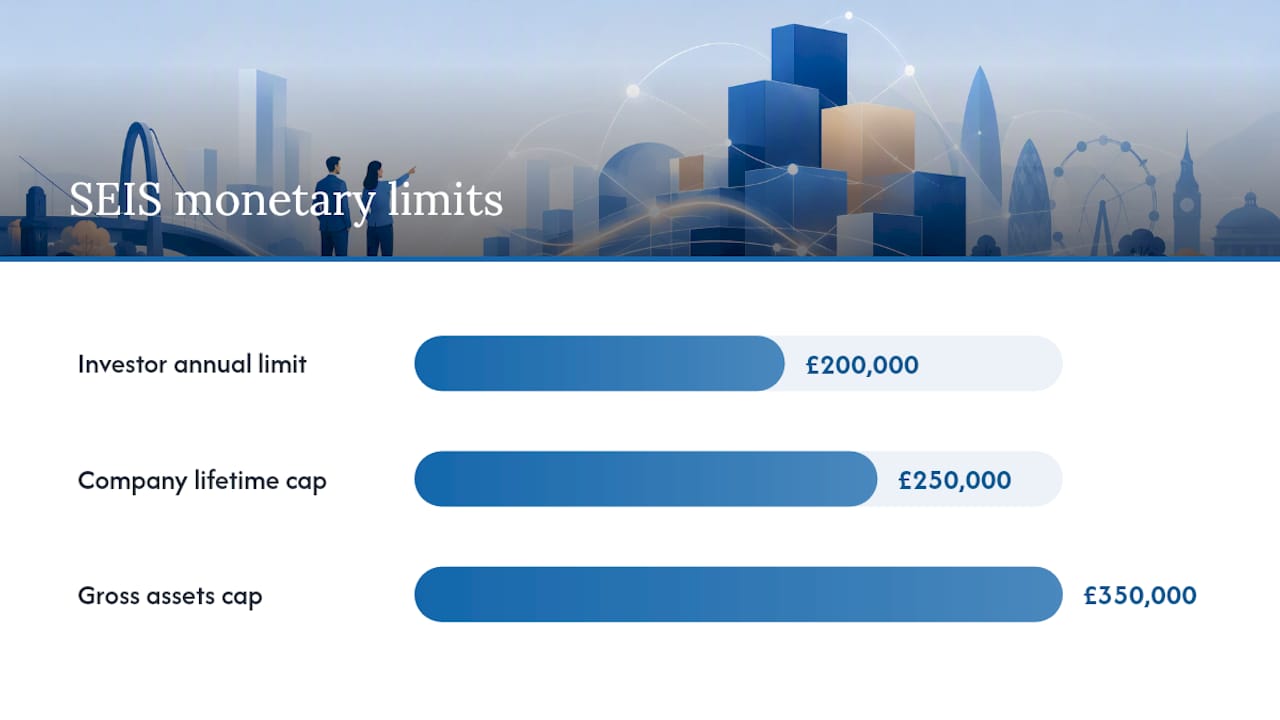
Table of Contents
- What are the SEIS investment limits for individual investors?
- What company conditions must founders meet before issuing SEIS shares?
- What changed in April 2023 and when do the new limits apply?
- How does SEIS interact with EIS and VCT?
- How do you apply for SEIS and claim the relief?
- Worked examples: calculating SEIS relief and apportionment
- Common mistakes founders and investors make with SEIS
- How Priceandaccountants supports SEIS rounds
- A practitioner’s view on SEIS planning
- SEIS compliance handled by specialists who know the scheme
- Sources
What are the SEIS investment limits for individual investors?
The investor-side rules govern how much you can put in each year and what you get back in tax relief. Getting these numbers right before you commit capital matters, because relief is capped per tax year and unused allowance cannot be carried forward.
Income tax relief: the £200,000 annual cap
You can invest up to a specified annual amount in SEIS-qualifying shares and claim income tax relief at a stated rate on the amount invested, up to your tax liability for the year. That relief reduces your income tax bill pound for pound, so it is only useful if you have sufficient UK income tax liability to absorb it. Relief cannot exceed the tax you actually owe in the year of claim. Per the HS393 helpsheet, the investor annual limit was increased under recent legislation effective April 2023.
CGT reinvestment relief
SEIS also offers a CGT reinvestment relief available once income tax relief is claimed; this relief exempts a portion of gains reinvested into qualifying shares, calculated as a percentage of the amount on which income tax relief was claimed. The two reliefs are linked: maximise your income tax relief claim first, and the CGT benefit follows automatically.
Holding period and withdrawal triggers
You must hold the shares for a minimum period from the date of issue to retain eligibility for both reliefs. Disposing of shares early, receiving value from the company (for example, a loan), or the company losing its qualifying status within that window can trigger full or partial withdrawal of relief. HMRC will claw back the income tax relief already given, and the CGT exemption falls away on any gain attributable to those shares.
Claiming relief on Self Assessment — and the prior-year election
Relief is claimed through your Self Assessment return once you hold a valid SEIS3 certificate issued by the company. You can also elect to treat some or all of your shares as issued in the previous tax year, which lets you claim against an earlier year’s liability. That election is capped at the earlier year’s £200,000 limit and requires a valid SEIS3 to be in hand before you file.
Investor action checklist:
- Confirm you have sufficient income tax liability in the year of claim to absorb the relief.
- Obtain your SEIS3 certificate from the company before filing your return.
- Decide whether to use the prior-year election and check the earlier year’s unused limit.
- Enter the relief on your Self Assessment return under the SEIS section.
- Retain the SEIS3, share certificate, and any correspondence for at least six years.
Pro Tip: If you invest near the end of a tax year and your current-year liability is already low, the prior-year election can be more valuable than waiting. Run the numbers on both years before you file.
Worked example: £10,000 investment
An investor puts £10,000 into a qualifying SEIS company. If the shares are held for three years and sold for £25,000, the £15,000 gain is free of CGT (loss relief is also available if the company fails). The investor’s effective exposure on a total loss is £5,000 after relief, not £10,000.
What company conditions must founders meet before issuing SEIS shares?
The company-side rules are where most compliance problems originate. Founders often focus on the investor limits and overlook the qualifying conditions that determine whether a share issue can carry SEIS relief at all.
Lifetime raise limit and gross assets
A company can raise a maximum of £250,000 through SEIS, and that figure includes any other de minimis State aid received in the three years before the investment date. Gross assets must not exceed £350,000 immediately before the share issue. Both thresholds are hard limits: exceeding either disqualifies the issue.

Age of trade
The company must have begun its first commercial sale within the three years immediately before the share issue. This replaced the previous two-year window under the 2023 changes. “First commercial sale” means the date the company first sold goods or services in its qualifying trade, not the date of incorporation.
Employee headcount
Companies must have fewer than a certain number of full-time equivalent employees at the time of share issue. Part-time staff count on a pro-rata basis. Paid directors count toward the total; unpaid directors generally do not, but this is worth confirming with an adviser if your structure is unusual.
Qualifying trade and excluded activities
The company must carry on a qualifying trade. Excluded activities include property development, financial activities, leasing, legal and accountancy services, farming, and energy generation that benefits from other government support. The trade must be the company’s primary activity, not a minor part of a broader business.
De minimis State aid aggregation
This is the rule founders most commonly miss. The £250,000 lifetime cap includes all de minimis State aid received in the three years to the date of the latest SEIS investment. Innovate UK grants, local authority grants, and certain loan guarantees can all count. When the combined total would exceed £250,000, HMRC apportions the SEIS investment so relief is only given on the portion that keeps the total within the cap.
Founder pre-round checklist:
- Confirm gross assets are below £350,000 immediately before share issue.
- Calculate the date of first commercial sale and verify it falls within three years of the proposed issue date.
- Count full-time equivalent employees, including part-time staff on a pro-rata basis.
- List all grants, subsidies, and State aid received in the prior three years and total them.
- Check that no EIS or VCT funding has been received (see the sequencing section below).
- Verify the company is not a member of a partnership or a 51% subsidiary of another company.
- Confirm the trade is not an excluded activity.
Pro Tip: Pull your Companies House filing history and any grant award letters before you approach investors. Knowing your gross assets and prior aid figures precisely means you can answer investor due diligence questions on the spot rather than delaying the round.
What changed in April 2023 and when do the new limits apply?
The Finance (No. 2) Act 2023, section 15 made four substantive amendments to SEIS, all effective for shares issued on or after 6 April 2023:
- Investor annual limit: increased from £100,000 to £200,000
- Company lifetime SEIS raise: increased from £150,000 to £250,000
- Company gross assets cap: increased from £200,000 to £350,000
- Qualifying trade age: extended from two years to three years
The government’s expansion publication confirmed the policy intent, highlighting that early-stage companies have been given a longer runway and that founders can now raise more before needing to transition to EIS. The statutory amendments sit within the Income Tax Act 2007 (ITA 2007) and the Taxation of Chargeable Gains Act 1992 (TCGA 1992), which are the two primary legislative frameworks governing SEIS relief.
Effective date timeline:
- Before early April 2023, prior SEIS limits applied
- On or after early April 2023, updated higher limits apply to each share issue
- Straddling issues: if a company issued shares in tranches, each tranche is assessed against the rules in force on its own issue date
Founders and advisers should save references to ITA 2007 Part 5A and TCGA 1992 Schedule 5BB when preparing documentation for HMRC, as these are the sections amended by the 2023 Act.
How does SEIS interact with EIS and VCT?
SEIS is designed as a company’s first major equity round. The sequencing rule is straightforward but non-negotiable: a company that has already received EIS or VCT investment is ineligible for SEIS. The reverse is not true — a company that has completed a SEIS round can go on to raise under EIS or attract VCT investment afterwards, provided it meets the EIS qualifying conditions at that point.
SEIS versus EIS at a glance
SEIS targets genuinely early-stage businesses; EIS serves companies that have already demonstrated some commercial traction.
The typical funding path
Most startups use SEIS for their first equity raise, often between £50,000 and £250,000, then move to EIS for a follow-on round once the SEIS limit is exhausted. The two rounds can even run concurrently in the same tax year provided the SEIS shares are issued first and the company has not yet received EIS investment. For more detail on choosing between the two schemes, the SEIS vs EIS comparison published by Priceandaccountants covers the practical decision points founders face.
Pro Tip: Tell investors upfront which scheme applies to their shares. A cap table that mixes SEIS and EIS shares without clear labelling creates confusion at the compliance statement stage and can delay SEIS3 certificates reaching investors.
How do you apply for SEIS and claim the relief?
For founders: the compliance sequence
- Prepare and submit an Advance Assurance application. This is voluntary but strongly advisable before approaching investors. HMRC reviews the proposed share issue and confirms it is likely to qualify. The Advance Assurance guidance explains what to include: a business plan, financial projections, details of the trade, and a draft term sheet or share structure.
- Issue shares to investors. Shares must be fully paid ordinary shares with no preferential rights to assets on a winding-up.
- Satisfy the compliance trigger. Before submitting the formal compliance statement, the company must either have carried out its qualifying trade for at least four months or have spent at least 70% of the money raised by the relevant share issue.
- Submit the compliance statement (SEIS1). Once the trigger is met, submit the SEIS1 form to HMRC’s Small Company Enterprise Centre. HMRC then issues a compliance certificate (SEIS2) and the investor certificates (SEIS3).
- Distribute SEIS3 certificates to investors. Investors cannot claim relief until they hold a valid SEIS3.
For investors: claiming on Self Assessment
- Receive your SEIS3 from the company.
- Enter the investment details in the SEIS section of your Self Assessment return.
- Claim income tax relief and, if applicable, CGT reinvestment relief.
- Decide whether to use the prior-year election before filing.
- Keep all documents for at least six years after the tax year of claim.
Document checklist
Company side: Advance Assurance letter, board minutes approving the share issue, share certificates, cap table snapshot at issue date, SEIS1 submission confirmation, SEIS2 certificate from HMRC, record of all de minimis State aid received in the prior three years.
Investor side: SEIS3 certificate, share certificate, bank transfer evidence of subscription, Self Assessment return showing the claim.
HMRC typically takes four to eight weeks to process a compliance statement, though complex cases or those with unusual share structures can take longer. Submitting a complete, accurate SEIS1 with all supporting documents in the first instance is the single most effective way to avoid delays.
Worked examples: calculating SEIS relief and apportionment
All examples below assume the investor is a UK taxpayer with sufficient income tax liability to absorb the relief, shares are held for at least three years, and the company qualifies throughout the holding period.
Example 1: £10,000 investment
The investor’s maximum loss after relief, if the company fails entirely, is £5,000. Loss relief may reduce this further depending on the investor’s marginal rate.
Example 2: £200,000 investment (full annual limit)
An investor with a £100,000 capital gain from another disposal in the same year can reinvest into SEIS shares and shelter that entire gain from CGT, provided income tax relief is also claimed on the full £200,000.
Example 3: de minimis State aid apportionment
A company has received £80,000 in Innovate UK grants over the prior three years. It now seeks to raise £200,000 under SEIS.
Investors in this round can only claim SEIS relief on £170,000 of the £200,000 raised. The remaining £30,000 carries no SEIS relief. Founders must disclose this apportionment to investors before they commit, and the SEIS1 submission must reflect the qualifying amount only.
Common mistakes founders and investors make with SEIS
Mistakes that cost relief
- Forgetting to aggregate de minimis State aid. Small grants feel inconsequential but they count toward the £250,000 lifetime cap. A £30,000 Innovate UK grant received 18 months ago reduces the available SEIS headroom by exactly that amount.
- Incorrect share issue dating. The date shares are allotted, not the date funds clear, determines which set of limits applies and starts the three-year holding clock. Board minutes must record the allotment date precisely.
- Spending funds before the qualifying trade is established. Using SEIS proceeds on activities that do not form part of the qualifying trade can jeopardise the compliance statement trigger.
- Issuing shares with preferential rights. SEIS requires ordinary shares with no preferential rights to assets on a winding-up. Convertible notes and preference shares do not qualify.
- Missing the compliance statement trigger. Many founders expect to file the SEIS1 immediately after the share issue. HMRC will not accept it until either four months of qualifying trade or 70% of funds spent has been demonstrated.
- Failing to obtain Advance Assurance. Not mandatory, but skipping it means investors commit capital without any HMRC pre-confirmation, which increases the risk of a failed compliance application.
Red flags that warrant professional advice before proceeding
- Any investor holds more than 30% of the company’s ordinary share capital (connected party rules may apply).
- The company has received EIS or VCT funding at any point.
- Shares carry any rights that differ from standard ordinary shares.
- The company’s trade includes any element of an excluded activity.
- Total prior State aid is within £50,000 of the £250,000 cap.
- The company is approaching the three-year trade age limit.
Pro Tip: Run a de minimis State aid audit before you open the round, not after. List every grant, subsidised loan, and government-backed support received since the company’s incorporation. If the total is within £50,000 of the £250,000 cap, get professional input on the apportionment before you set your raise target.
For a broader view of tax planning pitfalls at the startup stage, the step-by-step tax planning guide for UK startups covers the wider compliance sequence founders should follow.
How Priceandaccountants supports SEIS rounds
Priceandaccountants works with early-stage UK tech and fintech founders on every stage of a SEIS round, from initial eligibility assessment through to investor certificate distribution. Core services include:
- Advance Assurance preparation: drafting the business plan, financial projections, and share structure documentation HMRC expects to see.
- Compliance statement assembly: preparing and submitting the SEIS1 once the qualifying trigger is met, and liaising with HMRC’s Small Company Enterprise Centre on any queries.
- De minimis State aid audit: identifying and aggregating all prior aid to calculate the precise SEIS headroom before the round opens.
- Cap table advice: structuring the share issue so it meets SEIS ordinary share requirements and sequences correctly ahead of any future EIS raise.
- Investor tax relief calculations: providing investors with the figures they need for their Self Assessment returns, including CGT reinvestment relief workings.
- Ongoing compliance monitoring: tracking the three-year compliance window and flagging any company actions that could trigger relief withdrawal.
Priceandaccountants has supported over 20 startups through the funding process, some now valued at well over £50m. The firm’s chartered accountants bring direct SEIS and EIS experience, meaning advice is grounded in live compliance work rather than textbook theory. For founders who want to understand the full accounting and compliance picture before a round, the SEIS/EIS accounting guide is a useful starting point.
A practitioner’s view on SEIS planning
The most consistent mistake I see is founders treating SEIS as a post-round administrative task rather than a pre-round structural decision. By the time a company has issued shares and spent the proceeds, it is too late to fix a disqualifying share right, an overlooked grant, or a trade start date that pushes the company outside the three-year window.
The 2023 limit increases were genuinely significant. Doubling the investor cap and raising the company lifetime limit by two-thirds gives early-stage businesses real room to build before they need to transition to EIS. But larger raises also mean larger compliance exposures if something goes wrong. A £250,000 SEIS round where the compliance statement fails leaves investors with no relief on a substantial sum.
Cap table sequencing is the other area where founders consistently underestimate the stakes. Accepting even a small EIS or VCT investment before the SEIS round closes permanently closes the SEIS door. That is not a recoverable error.
SEIS compliance handled by specialists who know the scheme
Founders raising their first equity round face a genuine compliance burden: qualifying conditions to verify, State aid to aggregate, share structures to get right, and HMRC filings to time correctly. Getting one element wrong can strip relief from every investor in the round.

Priceandaccountants offers a sharper alternative to piecing this together alone or relying on a generalist accountant who handles SEIS once a year. As a London-based firm specialising in UK tech and fintech startups, the team manages the full SEIS compliance sequence: from the initial eligibility check and Advance Assurance application through to SEIS1 submission and investor certificate distribution. Founders get a clear picture of their SEIS headroom before the round opens, not after shares have been issued.
If you are preparing a SEIS round or advising investors on a claim, speak to the team at Priceandaccountants. Visit the advisory and tax planning services page to find out how to get started, or explore how Priceandaccountants works with startups from pre-seed through to Series A.
This article provides general information about SEIS investment limits and is not a substitute for professional tax or legal advice. Verify current rules with HMRC or a qualified adviser before making investment or compliance decisions.
Sources
The following official sources contain the precise statutory wording and HMRC guidance referenced throughout this article: