
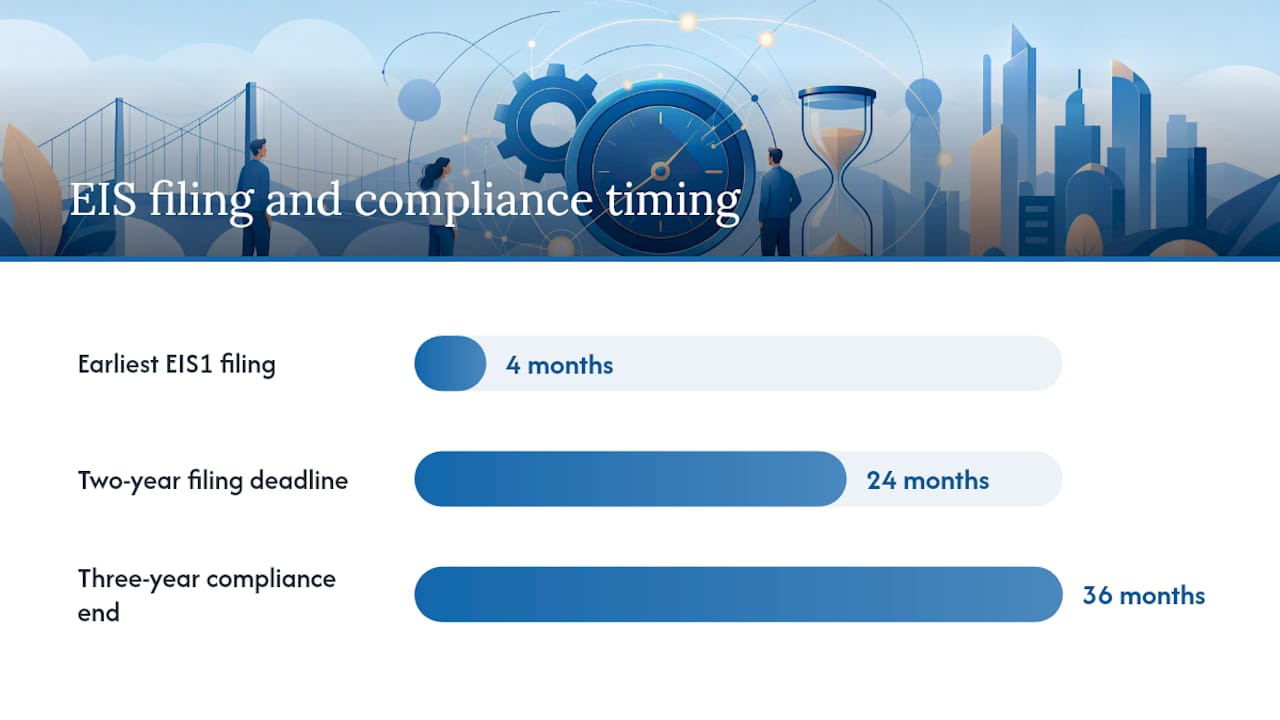
An EIS compliance statement (form EIS1) is the formal declaration you submit to HMRC confirming that your company met the conditions of the Enterprise Investment Scheme at the time of the share issue and will continue to do so. You cannot file it the moment shares are issued. HMRC requires that the company has first carried on qualifying business activity for the minimum period (four months), and the form must reach HMRC no later than two years after the end of the tax year in which the shares were issued, or two years after that qualifying period is first met, whichever is later.
Three things to check right now:
The EIS compliance statement (EIS1) is a statutory declaration with a three-year forward-looking commitment, and errors in it flow directly onto the EIS3 certificates your investors need to claim relief.
| Point | Details |
|---|---|
| Four-month trading rule | You cannot file EIS1 until the company has carried on qualifying business activity for the minimum period. |
| Two-year filing deadline | Submit no later than two years after the end of the tax year in which shares were issued, or two years after the qualifying period is met, whichever is later. |
| Three-year compliance period | Filing EIS1 commits the company to maintaining EIS conditions for three years; breaches can trigger retrospective withdrawal of investor relief. |
| £3,000 false-statement penalty | Section 207 ITA 2007 sets the maximum penalty for a false compliance statement; HMRC can also withdraw relief across the entire share issue. |
| Priceandaccountants EIS support | Priceandaccountants handles EIS1 drafting, evidence assembly, HMRC liaison, and EIS3 issuance for UK tech founders. |
Filing the EIS1 is not an administrative formality. Under the Income Tax Act 2007, the compliance statement is a statutory declaration that the company satisfied the EIS conditions for the relevant shares and that the form is submitted in the manner HMRC directs. HMRC may also require additional information beyond what the form itself requests.
The downstream effect matters to your investors. Once HMRC is satisfied with the EIS1, it issues an EIS2 (the authorisation letter, which contains the Unique Investment Reference). The company then uses that authorisation to issue EIS3 certificates to each subscriber. Investors cannot claim income tax relief, capital gains deferral, or loss relief without a valid EIS3, so the EIS1 is the single document that unlocks those reliefs. As VCM14020 makes clear, even a company that obtained advance assurance must still submit a formal EIS1 after shares are issued; advance assurance does not replace this legal requirement.
The forward-looking commitment is the part founders most often underestimate. By filing the EIS1, the company declares it will maintain EIS qualifying conditions for at least three years after the share issue. If the company breaches those conditions during that window, HMRC can withdraw investor relief retrospectively. That is a serious reputational and commercial risk, not merely a tax technicality. Maintaining ongoing company compliance throughout the three-year period is therefore as important as getting the initial filing right.
The timing rules are statutory and precise. Getting them wrong means either a premature filing HMRC will reject or a missed deadline that forfeits investor relief entirely.
Confirm the qualifying trading start date. The four-month rule requires the company to have carried on a qualifying business activity for the minimum period before EIS1 can be submitted. For most companies this means four months of genuine trading in the qualifying trade. Retain the earliest evidence of trading: the first customer invoice, the first payroll run, or the first commercial contract.
Identify the share issue date. This is the date of allotment recorded in the company’s register of members, not the date of payment or the date the subscription agreement was signed.
Calculate the earliest filing date. Add four months to the trading start date. You cannot submit before that point, even if shares were issued earlier.
Calculate the latest filing date. Take the end of the tax year (5 April) in which shares were issued. Add two years. If the four-month qualifying period was not met until after that tax year end, the two-year clock runs from when the qualifying period was first satisfied instead.
Example A: Shares issued on 10 November 2023 (tax year ending 5 April 2024). Qualifying trading began on 1 September 2023. The four-month requirement was met on 1 January 2024. The latest filing date is 5 April 2026 (two years after the end of the 2023/24 tax year).
Example B: Shares issued on 20 March 2024 (tax year ending 5 April 2024), but qualifying trading only began on 1 April 2024. The four-month requirement is met on 1 August 2024, which falls in the 2024/25 tax year. The two-year clock runs from 1 August 2024, giving a latest filing date of 1 August 2026.
VCM14030 is unambiguous: HMRC will only accept a compliance statement from a director, company secretary, or an authorised agent. Submissions from anyone else will not be processed.
If a director or company secretary signs and submits directly, no additional authority evidence is needed beyond the signatory’s role being verifiable from Companies House. The signatory’s full name, role, and the date must appear on the form.
Where an agent (such as an accountant or tax adviser) files on behalf of the company, HMRC requires a signed letter of authority. That letter must be dated within the last three months of submission; anything older and the submission is liable to be returned unread. The letter should contain:
The agent’s details should also be entered in the relevant section of the EIS1 itself so HMRC knows where to send the EIS2. If the company has an online agent authorisation through HMRC’s agent services account, note this in the covering letter but still include the signed paper authority, as HMRC’s EIS team processes compliance statements separately from the main agent authorisation system.
Pro Tip: Date the letter of authority on the same day you finalise the EIS1 package. A letter dated weeks before submission can fall outside the three-month window if the package is delayed in the post or during internal review.
VCM14060 sets out the specific information and supporting documents required, including company identifiers, evidence used for any advance assurance, explanations of the risk-to-capital condition and growth and development requirement, and records a maximum penalty for submitting a false compliance statement.
Before you open the form, assemble the following:
| EIS1 field | Typical supporting document |
|---|---|
| Company identifiers | Companies House certificate of incorporation, CT UTR from HMRC correspondence |
| Share issue date and class | Board minutes of allotment, updated register of members |
| Subscribers list | Signed subscription agreements, share certificates |
| Qualifying trade description | Business plan, customer contracts, product documentation |
| Risk-to-capital explanation | Financial forecasts, investor pitch deck, board risk register |
| Advance assurance reference | HMRC advance assurance letter with reference number |
| Knowledge-intensive status | R&D expenditure records, employee qualification evidence |
A separate EIS1 must be completed for each distinct share issue. If you ran two funding rounds in the same tax year at different prices or on different dates, those are two separate forms.
The EIS1 follows a logical sequence. Work through it in order rather than jumping between sections, as later fields reference earlier ones.
Company details. Enter the registered name exactly as it appears at Companies House, the CRN, and the corporation tax UTR. A mismatch between the CRN and the name on the form is one of the most common causes of HMRC queries.
Share issue particulars. State the date of allotment, the class of shares (ordinary shares are typical for EIS), the number of shares issued, the nominal value, and the total amount raised. Cross-check this against the board minutes and the register of members before entering anything.
Subscribers list. List every investor who subscribed in this issue: full name, address, number of shares, and amount paid. Errors here are mirrored directly onto EIS3 certificates. An investor whose name is misspelled or whose address is wrong may face delays or rejection when claiming relief.
Trade description. Write two to three sentences describing the qualifying trade. Example: “The company develops and licences proprietary software for supply-chain risk analysis, sold on a subscription basis to logistics businesses in the UK and EU. The company has traded in this capacity since [date].” Avoid generic phrases; HMRC will query anything that sounds like a holding company or an investment vehicle.
Risk-to-capital statement. This is the field founders most often underestimate. HMRC expects a genuine explanation of why there is a real risk of loss of capital, not a boilerplate disclaimer. Reference the stage of the business, the competitive market, the reliance on key personnel, and the financial runway. Two to four sentences grounded in the actual business are far more persuasive than a generic paragraph.
Advance assurance linkage. If you obtained advance assurance, enter the reference number from HMRC’s advance assurance letter. If any material facts have changed since advance assurance was granted (new investors, different share class, revised business model), note this clearly and attach a brief explanation. HMRC will compare the EIS1 against the advance assurance file.
Declarations and signatures. The signatory confirms the information is accurate and that the company meets and will continue to meet EIS conditions. Read this declaration carefully before signing; it is the basis of the statutory penalty provision.
Pro Tip: Before signing, run a line-by-line comparison between the EIS1 subscriber list and the company’s register of members. The share issue date, subscriber names, and share numbers must match exactly. Any discrepancy between the EIS1 and the EIS3 can prevent an investor from claiming relief, as the Ashley v Revenue & Customs Commissioners case demonstrated when an incorrect date on the compliance documentation blocked a valid claim.
HMRC’s Small Company Enterprise Centre processes EIS1 submissions. Typical review times run to a few weeks, though complex cases or those requiring additional information can take longer. There is no formal statutory timeframe for HMRC to respond, so build a buffer into your investor communications.
The process runs as follows. The company submits the EIS1 with supporting documents. HMRC reviews the submission and, if satisfied, issues an EIS2 authorisation letter. The EIS2 contains the Unique Investment Reference (UIR), which must be entered onto each EIS3 certificate. The company then completes the EIS3 certificates, one per investor, and issues them. Investors use the EIS3 to claim income tax relief through their Self Assessment return, or by writing to HMRC if they do not file a return.
Practical steps for coordinating with investors:
For companies using an accountant for SEIS/EIS accounting, the adviser will typically manage the EIS2 receipt and EIS3 preparation, reducing the administrative burden on the founding team.
Most HMRC queries on EIS1 submissions trace back to a small set of recurring errors. Knowing them in advance is the most efficient form of risk management.
The maximum statutory penalty for submitting a false EIS compliance statement is £3,000 under Section 207 of the Income Tax Act 2007. Beyond the financial penalty, HMRC can withdraw investor relief across the entire share issue, which creates serious investor relations consequences.
If you discover an error after submission, contact HMRC’s Small Company Enterprise Centre in writing as soon as possible. Explain the error, provide the correct information, and attach supporting evidence. Do not wait for HMRC to raise a query. Proactively correcting an error before HMRC identifies it is treated more favourably than a correction made in response to an enquiry. Notify affected investors of any delay or correction so they can hold off claiming relief until the corrected EIS3 is issued.
The Ashley v Revenue & Customs Commissioners case is a useful reminder of what precision means in practice. An error in the compliance documentation relating to the share issue date was sufficient to block the investor’s relief claim. The lesson is not that HMRC is inflexible; it is that the EIS3 is only as reliable as the EIS1 that generated it.
Use this checklist immediately before sending the EIS1 package to HMRC.
Pre-submission checklist:
Filing timeline milestones:
| Milestone | Timing |
|---|---|
| Share issue (allotment) | Day 0 |
| Earliest EIS1 filing point | Four months after qualifying trading begins |
| EIS1 submission | Between earliest filing point and two-year deadline |
| HMRC review and EIS2 issued | Typically a few weeks after submission |
| EIS3 certificates issued to investors | Immediately after EIS2 received |
| Investors claim relief | Via Self Assessment or letter to HMRC |
| Three-year compliance period ends | Three years after share issue date |
For record-keeping, retain all supporting documents for at least six years after the end of the tax year in which the shares were issued. HMRC can open an enquiry into an EIS claim within that window, and you will need the original evidence to defend the filing. Building a tax compliance workflow that captures these documents at the time of the share issue is far easier than reconstructing them later.
Most straightforward EIS1 submissions, a single share class, a clear qualifying trade, UK-based investors, and a company that obtained advance assurance, are manageable with careful preparation. Several situations tip the balance towards engaging a specialist.
Consider specialist support if:
Priceandaccountants works with UK tech and fintech founders at exactly this stage. The service covers document assembly and evidence pack preparation, precise EIS1 drafting, agent authorisation handling, direct liaison with HMRC’s Small Company Enterprise Centre, EIS3 preparation and issuance to investors, and co-ordination of investor communications throughout the process. For companies with multiple funding rounds or complex share structures, Priceandaccountants can also advise on structuring future issues to preserve EIS eligibility across the three-year compliance period.
To engage, send your share issue date, the company’s CRN and UTR, a copy of the advance assurance letter if you have one, and a brief description of the trade. Priceandaccountants typically structures EIS1 work as a fixed-fee advisory engagement, with the option to move onto a retainer for ongoing compliance monitoring.
Founders spend months preparing for a funding round: negotiating term sheets, updating the cap table, briefing investors on tax reliefs. Then the EIS1 gets delegated to whoever has a spare afternoon. That mismatch is where most EIS problems originate.
The EIS1 is not a form that summarises what already happened. It is a legal declaration with a three-year tail. The risk-to-capital explanation you write today will be compared against the company’s actual trajectory if HMRC ever opens an enquiry. The share issue date you enter will determine whether an investor’s relief claim is valid or void. Getting it right is not about being thorough for its own sake; it is about protecting the investors who backed you and the credibility you need for the next round.
My recommendation: reconcile your cap table and share issue dates before you touch the form, then book a review with an adviser who has submitted EIS1s before. The cost of that review is trivial compared to the cost of a withdrawn investor relief claim.
For founders who have just closed a funding round, the EIS1 is the next critical step, and the window to get it right is fixed. Priceandaccountants provides end-to-end EIS compliance support for UK tech and fintech companies: from assembling the evidence pack and drafting the EIS1 to liaising with HMRC and issuing EIS3 certificates to your investors.

The service is built for founders who need the job done precisely and on time, without spending weeks learning HMRC’s internal manual. Priceandaccountants handles the agent authorisation, monitors the HMRC review, and co-ordinates investor communications so your investors receive their EIS3 certificates without unnecessary delay. For companies with complex knowledge-intensive claims or multiple share issues, the strategic advisory and tax planning service covers the full scope of EIS structuring and compliance.
To get started, visit the how we work with start-up companies page or get in touch directly with your share issue date, CRN, and a brief description of your trade.
The following primary sources underpin the statutory and procedural points in this article. Consult the public GOV.UK guidance pages first; refer to the Venture Capital Schemes Manual (VCM) entries when you need the precise HMRC interpretation of a specific rule.
The VCM is an internal manual, meaning it reflects HMRC’s own interpretation of the law rather than the law itself. Where the VCM and the statutory text appear to differ, the legislation takes precedence. For complex or high-value EIS issues, always verify the current version of both the VCM entry and the underlying ITA 2007 provision, as both are updated periodically.
This article is general information, not a substitute for advice from a qualified financial advisor. Consult a qualified financial professional about your own circumstances before acting on anything here.