
Simplifying and optimising financial workflows is not a nice administrative project for a quiet quarter. It is the difference between a finance function that holds your business back and one that actively drives growth. UK SMEs that have moved from manual, spreadsheet-heavy operations to integrated, automated systems close their books significantly faster than those using manual workflows, substantially reducing close times. The gap is not talent. It is tooling.
Here is what optimising financial workflows delivers in practice:
- Faster close cycles: Month-end close benchmarks have tightened considerably, making manual processes an increasingly competitive liability.
- Reduced errors: Over 90% of spreadsheets contain critical mistakes, creating costly rework and unreliable data.
- Better cash flow visibility: Automated accounts payable and receivable give you a real-time picture of working capital, not a two-day-old snapshot.
- Compliance confidence: Embedded system controls and automatic audit trails reduce the risk of something slipping through as transaction volumes grow.
- Strategic capacity: When your finance team stops assembling data, they start analysing it. Tools like Xero and Compleat Software make that shift practical for businesses of any size.
What are the key benefits of improving financial efficiency?
The case for optimising financial workflows goes well beyond saving a few hours at month-end. The real prize is building a finance function that scales with your business rather than becoming its bottleneck.
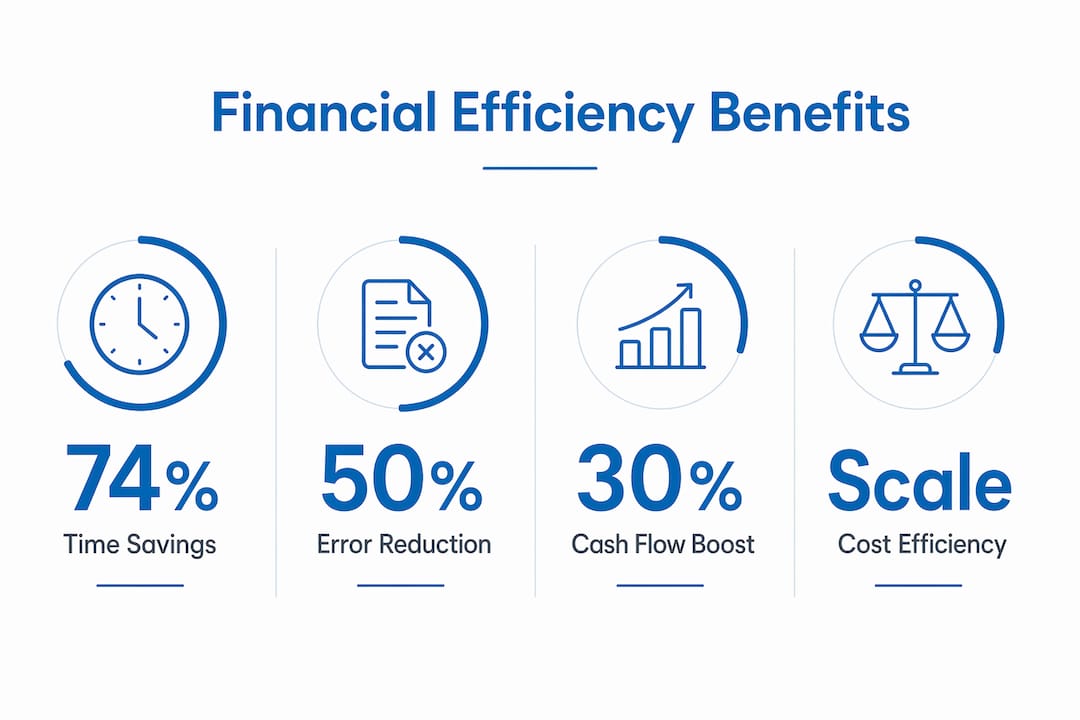
Time savings through automation. 74% of employees report that automation tools help them complete work faster. In finance, that translates directly into shorter close cycles, quicker invoice approvals, and less time spent chasing data across disconnected systems.
Fewer costly errors. Manual data entry is where mistakes breed. Automated transaction matching, three-way invoice matching, and system-enforced approval logic catch discrepancies before they become audit findings or post-close adjustments. The downstream effect on your accounts payable and accounts receivable accuracy is immediate.
Improved cash flow forecasting. When AP and AR data flows automatically into a single platform, cash flow forecasts draw from current, accurate figures rather than stale exports. That visibility supports better treasury decisions and reduces the capital tied up in conservative cash buffers.

Scalability without proportional cost. A finance function built on manual processes scales linearly: more transactions mean more headcount. Automated workflows handle higher volumes without a corresponding increase in resource. That is what allows a growing SME to add entities or product lines without rebuilding its finance operation from scratch.
Shift from data prep to strategic advisory. The goal of improving financial efficiency is not purely cost-cutting. Finance process improvement is about building capacity for the team to focus on analysis and business partnership rather than assembling and validating data. That shift is where the real competitive advantage sits.
What challenges do finance teams face, and how does automation address them?
Most finance pain points in UK SMEs trace back to the same structural problems: processes built around people rather than systems, and tools chosen for familiarity rather than fit.
Common challenges:
- Manual data entry across disconnected GL, AP, and AR systems
- Spreadsheet overreliance, with 94% of spreadsheets containing critical errors
- Slow, labour-intensive month-end close cycles
- Approval chains routed through email with no traceable audit trail
- Tribal knowledge: critical close logic living in one person’s head
- Compliance exposure as transaction volumes outgrow manual controls
How automation addresses each:
- Integrated platforms eliminate manual exports by connecting GL, AP, and AR to a single shared database
- Automated reconciliations replace spreadsheet matching, flagging genuine exceptions rather than requiring line-by-line review
- System-enforced approval workflows replace email chains, creating automatic audit trails
- Standardised close checklists with defined task ownership remove the ambiguity that slows most teams down
- Embedded controls enforce segregation of duties by design, not by manual oversight
Isolated point-automation often creates new silos rather than solving old ones. Integrated workflows with automatic data flows are what produce a genuine single source of truth.
Pro Tip: Standardise your workflows before you automate them. Automating a broken process does not fix it; it scales the errors faster. Map your current state honestly, redesign the workflow, then apply automation to the improved version.
Practical strategies to improve your financial processes
The sequence matters as much as the tools. Businesses that jump straight to automation without assessing and standardising their current workflows consistently underdeliver on ROI.
Key actions:
- Map existing financial processes end-to-end before touching any technology
- Standardise your chart of accounts and approval thresholds across all entities
- Connect your ERP or accounting platform to a cloud planning tool to automate data consolidation
- Shift reconciliations from a month-end sprint to a continuous process throughout the month
- Automate high-volume, rules-based tasks first: invoice processing, bank reconciliations, recurring journal entries
- Use AI-driven accounting automation to handle data extraction and approval routing without IT involvement
Manual data preparation consumes 60–80% of finance analyst time. Automating the data pull from your ERP is the single highest-ROI first move, because everything downstream depends on clean, current data.
StrategyPrimary benefitTools or techniquesMap and standardise workflowsRemoves broken steps before automationProcess mapping, close checklistsIntegrate GL, AP, and ARSingle source of truth, faster closeXero, integrated accounting platformsAutomate invoice processingFewer errors, faster approvalsCompleat Software, AI invoice captureContinuous reconciliationShorter month-end crunchAutomated matching, exception queuesConnect ERP to planning layerReduces analyst manual prep timeCloud FP&A platformsAutomate payroll and pensionsCompliance accuracy, time savingsPayroll automation services

For businesses exploring invoice automation specifically, AI-powered invoicing tools using platforms like n8n can handle data capture and routing without bespoke development work.
Continuous reconciliation deserves particular attention. Shifting validations from a month-end sprint to an ongoing process throughout the month is where the biggest close-speed gains tend to come from. It also gives your controllership team a cleaner picture of where things stand at any point in the cycle, rather than discovering problems under pressure at the end of the month.
How Priceandaccountants supports UK businesses in refining their financial operations
Priceandaccountants has spent over 40 years working with UK tech startups and growing SMEs, and the pattern is consistent: businesses that treat finance as a strategic function rather than an administrative one grow faster and with fewer surprises.
The firm’s cloud accounting practice is built on Xero, giving clients real-time financial visibility rather than monthly snapshots. That foundation supports faster decision-making, cleaner audit trails, and a close process that does not require the whole team to drop everything at month-end. For clients who have moved their bookkeeping to a digitised model, time savings of up to 40% in bookkeeping effort are achievable, with reporting accuracy improving alongside it.
Beyond bookkeeping, Priceandaccountants acts as an outsourced Finance Director for clients who need high-level financial oversight without the cost of a full-time hire. That role covers everything from cash flow forecasting and VAT management to strategic advisory and tax planning, ensuring that the finance function supports growth decisions rather than just recording them.
Pro Tip: If your finance team is spending more time compiling numbers than interpreting them, the problem is process design, not headcount. An outsourced FD can identify the highest-impact changes to your workflows without the overhead of a permanent hire.
Having guided over 20 startups through their early-stage processes, some now valued at well over £50m, Priceandaccountants brings sector-specific knowledge that generic accountancy practices rarely match. The 2026 focus is on helping clients adopt automation tools and integrated platforms that position their finance functions for the next stage of growth, not just the current one.

Ready to move your finance function from reactive to proactive? Priceandaccountants offers accurate bookkeeping solutions and cloud accounting services tailored to UK SMEs. Get in touch to find out how we can help you build a finance operation that scales with your ambitions.
Key takeaways
Optimising financial workflows is the most direct route from a manual, error-prone finance function to one that actively supports business growth.
PointDetailsAutomation closes the tooling gap—Spreadsheets carry hidden risk94% of spreadsheets contain critical errors, making them unreliable for high-volume operational processes.Standardise before you automateAutomating a broken workflow scales its errors; map and redesign processes first.Analyst time is recoverableManual data preparation consumes 60–80% of analyst time; automating the data pull redirects that capacity to analysis.Benchmarks have tightenedMonth-end close benchmarks have tightened considerably, making manual processes an increasingly competitive liability.
Recommended
- Why digitise finance: a practical guide for UK SMEs - Price & Accountants
- How to streamline bookkeeping in UK fintech startups: cut time 40% - Price & Accountants
- Streamline your UK year-end accounts process in 2026 - Price & Accountants
- How to scale business finances: a UK SME guide - Price & Accountants