

TL;DR:
- Treasury management involves overseeing liquidity, risk, and funding to ensure business solvency and support growth. It is a strategic function that requires clear processes, real-time cash visibility, and appropriate tools, especially as a business scales. Outsourcing treasury tasks to specialists can provide strategic guidance without the cost of a full-time role for early-stage UK startups.
Treasury management is the process of overseeing your organisation’s liquidity, funding, financial risk and capital structure to keep the business solvent today and positioned for growth tomorrow. It is not the same as bookkeeping or basic cash management — it is the function that decides where money sits, how risk is hedged, and what funding structure supports your next stage.
TL;DR — what you need to know:
- Treasury management covers cash visibility, risk management (FX, interest rate, fraud), working capital, funding and bank relationships.
- The primary goal is simple: never run out of money, and never pay more for capital than you have to.
- In most UK SMEs, the CFO or Finance Director owns treasury; early-stage startups often outsource to an FD or specialist adviser rather than hiring a dedicated treasurer.
Treasury is forward-looking, not backward-looking. Accounting records what happened; treasury plans what needs to happen next.
Pro Tip: If you can answer “exactly how much cash will we have in 30 days, and in which accounts?” without opening a spreadsheet, your treasury function is working. If you cannot, that is where to start.
Table of Contents
- What does treasury management actually cover day to day?
- Why treasury management matters more than most founders realise
- Treasury versus cash management: what is the actual difference?
- Who owns treasury, and how is it organised in practice?
- What tools and systems does treasury management actually need?
- Common risks and red flags in treasury operations
- How to start with treasury if you run a UK SME or startup
- Key takeaways
- The part most founders get wrong about treasury
- Treasury support for UK startups, without the overhead of a full hire
- Useful sources and further reading
What does treasury management actually cover day to day?
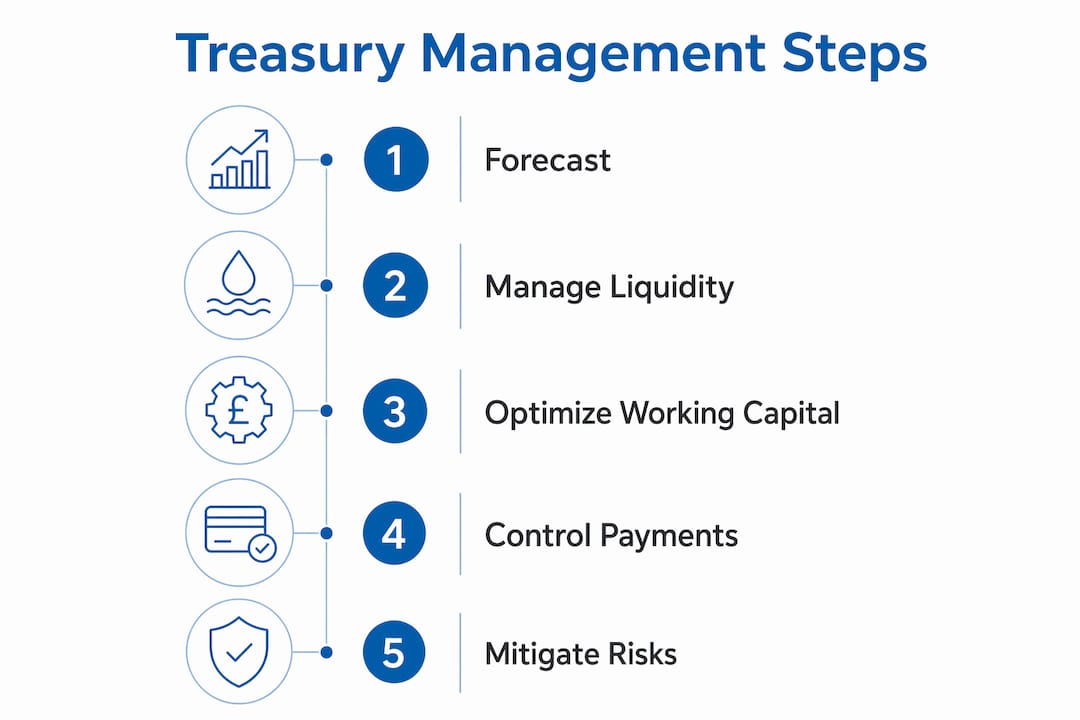
Treasury sits across two horizons at once: the operational (keeping the lights on this week) and the strategic (funding the next 18 months). The core functions span both.

Cash and liquidity management is treasury’s primary duty. The business must be able to pay employees, suppliers, lenders and HMRC as obligations fall due. This means monitoring inflows and outflows daily, managing bank account structures, and maintaining liquidity buffers.
Cash flow forecasting runs at multiple horizons. A rolling 30-day forecast covers operational cash; a 12-month forecast supports working capital planning; scenario-based forecasts inform funding decisions. Each horizon needs different data inputs and a clear owner.
Payments and collections covers how money moves in and out: payment runs, direct debits, supplier terms, and the controls that prevent fraud. Getting this wrong is expensive — both in losses and in supplier relationships.
Working capital optimisation means managing the gap between cash going out (to suppliers) and cash coming in (from customers). Extending payment terms, accelerating collections, and managing stock levels all sit here.
FX and interest-rate risk management becomes critical the moment you invoice in a currency other than sterling or take on variable-rate debt. A UK startup selling into the US or EU is carrying FX exposure from day one, whether or not it has a policy for it.
Short-term investing and debt management covers what to do with surplus cash (money market funds, short-dated gilts, notice accounts) and how to structure borrowing (revolving credit facilities, invoice finance, term loans).
Bank and counterparty relationships includes negotiating banking terms, maintaining credit lines, and managing the risk of over-reliance on a single banking partner.
“Real-time cash visibility is the foundation of every other treasury decision. Without it, you are managing by instinct rather than by data — and instinct does not scale.” — Kyriba
Pro Tip: The single highest-impact action for an SME with no formal treasury function is to pull all bank balances into one consolidated daily report. Even a simple spreadsheet that aggregates overnight balances and flags variance against forecast will cut unnecessary overdraft charges and idle cash within weeks.
Why treasury management matters more than most founders realise
The primary objectives are to ensure the company can meet its financial obligations, mitigate financial risks, and deploy capital efficiently. Those three things sound administrative. They are not.
Effective treasury directly lowers borrowing costs by demonstrating creditworthiness to lenders. It prevents fraud through payment controls. It gives leadership timely, accurate data to make decisions about hiring, investment and fundraising. Organisations that integrate treasury into strategy tend to access capital faster and on better terms.
What goes wrong without it:
- Liquidity crises that force emergency borrowing at punishing rates, or worse, missed payroll.
- Material FX losses on unhedged receivables — a startup with £500k of USD revenue and no hedge can lose tens of thousands of pounds in a bad quarter.
- Missed investment opportunities because surplus cash sits idle in a current account earning nothing.
- Fraud losses from manual payment processes with no dual-authorisation controls.
- Poor fundraising outcomes because investors find inconsistent cash records during due diligence.
Treasury management is a strategic necessity, not an administrative luxury. The businesses that treat it as such tend to lower their funding costs and gain faster access to capital when they need it.
Treasury versus cash management: what is the actual difference?
The terms are often used interchangeably, particularly in banking. In practice, the scope differs significantly.

DimensionCash managementTreasury managementScopeCollections, disbursements, account balancesAll of cash management plus funding, risk and capital structureTime horizonDaily to weeklyDaily operational through multi-year strategicTypical activitiesPayment runs, bank reconciliation, overdraft monitoringFX hedging, debt structuring, investment policy, capital allocationDecision ownerFinance manager, controllerCFO, Finance Director, TreasurerWhen it mattersAlways — from day oneGrows in importance with scale, multi-currency ops, or external funding
A practical example: a cash management problem is discovering on a Thursday that the payment run will exceed the current account balance. A treasury problem is realising in Q3 that your revolving credit facility matures in six months, your USD receivables are unhedged, and your Series A runway assumptions were built on a sterling rate that no longer exists.
Which should a UK SME prioritise first?
- Start with cash management basics: consolidated bank view, weekly cash position, payment controls.
- Add treasury disciplines as complexity grows: when you take on debt, operate in multiple currencies, or raise external investment.
- The trigger for formal treasury is usually the first external funding round or the first overseas customer contract.
Who owns treasury, and how is it organised in practice?
In most organisations, the CFO or Finance Director oversees treasury, with day-to-day work handled by a treasurer or delegated to accounting staff. In larger firms, a dedicated treasury team sits under the CFO. For UK SMEs and startups, the picture is more varied.
Typical roles:
- CFO / Finance Director: sets treasury policy, owns funding decisions, manages board-level reporting on liquidity and risk.
- Treasurer: executes policy, manages bank relationships, runs forecasting and hedging programmes.
- Treasury analyst: handles daily cash positioning, bank reconciliations and reporting.
- FP&A team: provides the forecast inputs that treasury uses for liquidity planning.
- External adviser / outsourced FD: common in SMEs that need strategic treasury guidance without the cost of a full-time hire.
Organisational models compared:
ModelCostControlScalabilityBest forIn-house (dedicated team)HighFullHighSeries B+ or complex multi-currency opsShared service / finance teamMediumGoodModerateGrowing SMEs with a finance functionOutsourced FD / adviserLowerSharedFlexiblePre-seed to Series A startups
Smaller or high-growth firms commonly outsource treasury tasks to an FD or specialist advisory firm to scale without the cost of a full treasury hire. The trade-off is response time and depth of daily oversight, which is why clear SLAs and reporting cadences matter when outsourcing.
Skills and qualifications for treasury personnel in SMEs: the Association of Corporate Treasurers (ACT) Certificate in Treasury Fundamentals is the standard entry-level qualification in the UK. For an outsourced or part-time FD covering treasury, ICAEW or ACCA membership combined with corporate finance experience is the practical baseline.
Pro Tip: Before hiring a treasurer, check whether your current finance team can cover the function with better tooling and a clear policy document. Many SMEs at the £2m–£10m revenue stage need process and technology more than headcount.
What tools and systems does treasury management actually need?
Technology does not replace treasury judgement, but it does make real-time cash visibility achievable without a large team. The building blocks are straightforward.
What a Treasury Management System (TMS) does:
- Aggregates bank balances across multiple accounts and currencies in real time.
- Automates bank statement import and reconciliation.
- Orchestrates payment runs with approval workflows and audit trails.
- Provides cash forecasting templates and variance reporting.
- Supports FX exposure tracking and hedging documentation.
Bank connectivity options for UK firms: most UK banks support BACS, Faster Payments and CHAPS natively. For multi-bank or multi-currency operations, open banking APIs (under the UK’s Open Banking framework) allow third-party platforms to pull balances and initiate payments without manual log-ins. Host-to-host connectivity is available from major clearing banks for higher-volume payment environments.
Process requirements that technology cannot replace:
- A defined forecasting cadence (daily cash position, weekly 4-week rolling, monthly 12-month).
- Documented approval workflows: who can authorise payments, at what value thresholds, and with what dual-authorisation requirements.
- Regular reconciliations: bank to ledger, forecast to actual.
- Audit trails for every payment and every bank account change.
Typical implementation steps for a UK SME:
- Consolidate all bank accounts into a single platform or reporting view (Xero, for example, connects to most UK banks via open banking).
- Set up automated bank feeds and daily balance reports.
- Define and document payment approval workflows.
- Build a 13-week rolling cash forecast template.
- Review and tighten bank signatory controls.
- Add FX tracking if you operate in multiple currencies.
Pro Tip: Cloud accounting platforms like Xero give you the bank connectivity and reporting foundation of a basic TMS at a fraction of the cost. For most UK startups under £5m revenue, Xero plus a disciplined forecasting process covers 80% of treasury needs. You can layer specialist TMS tools on top as complexity grows.
Common risks and red flags in treasury operations
Most treasury failures are not dramatic. They are the result of small process gaps compounding over time until a cash shortfall or fraud event makes them visible.
Typical risks to monitor:
- FX volatility: unhedged foreign currency receivables or payables can swing materially in a short period. Startups that neglect FX management until losses appear are exposing themselves to material currency risk.
- Interest-rate exposure: variable-rate debt becomes expensive quickly when rates rise, as UK businesses discovered from 2022 onwards.
- Payment fraud: manual payment processes are a common vulnerability. Authorisation controls and anomaly detection reduce exposure significantly.
- Concentration risk: relying on a single banking relationship creates operational risk if that bank has a service outage or restricts access.
- Poor cash visibility: operating without a consolidated cash position means decisions are made on stale or incomplete data.
- Stale forecasts: a forecast that is not updated weekly is not a forecast — it is a historical document.
Operational red flags to watch for:
- Payment approvals handled by a single person with no secondary check.
- Bank reconciliations completed monthly rather than weekly.
- Unexplained cash movements that sit unresolved for more than 48 hours.
- Bank signatories that have not been reviewed since the company was founded.
- No documented treasury policy or cash management procedure.
When a red flag appears: stop, escalate to the CFO or board immediately, freeze the relevant payment or account access, and investigate before resuming. Speed of escalation matters more than having a perfect process.
How to start with treasury if you run a UK SME or startup
The good news: you do not need a treasury department to have good treasury practices. You need a clear process, the right tools, and someone accountable.
Step-by-step for the first 90 days:
- Audit your current cash position. List every bank account, the balance in each, and who has access. This alone surfaces surprises in most early-stage businesses.
- Consolidate bank accounts. Close dormant accounts; reduce the number of active accounts to what you actually need. Fewer accounts means simpler visibility.
- Set a forecasting cadence. Build a 13-week rolling cash forecast. Update it weekly. Assign ownership to a named person.
- Define payment controls. Document who can authorise payments, at what value, and with what dual-authorisation requirement. Implement this in your banking platform.
- Establish KPIs. Track: days sales outstanding (DSO), days payable outstanding (DPO), cash conversion cycle, forecast accuracy (actual vs forecast variance), and available liquidity headroom.
- Separate operational cash from reserves. UK tech startups should keep investment reserves and operational cash in separate accounts, and establish formal banking relationships early — both improve fundraising readiness.
- Review bank signatories. Confirm that only current, authorised employees have payment access.
In-house versus outsourced: how to decide:
- Outsource if: you are pre-Series A, your finance team is one or two people, or you need strategic treasury guidance (FX policy, debt structuring, investor-ready cash reporting) that exceeds your current team’s expertise.
- Keep in-house if: you have a Finance Director with treasury experience, your operations are single-currency and low-complexity, or you are at a stage where daily oversight requires someone embedded in the business.
Checklist when evaluating an outsourced treasury adviser:
- What is the reporting frequency and format? (Weekly cash position? Monthly board pack?)
- What bank connectivity do they support? Can they connect to your existing UK banking relationships?
- How are payment approvals handled, and what is the separation of duties?
- What are the SLAs for responding to urgent cash or fraud issues?
- Can they provide references from UK SMEs at a similar stage?
- How do fees scale as the business grows?
Six-month milestones:
- Month 1: consolidated cash position live, forecasting cadence set, payment controls documented.
- Month 3: 13-week forecast running with weekly variance review, KPIs tracked and reported to board.
- Month 6: FX policy in place (if applicable), bank relationships reviewed, treasury policy document signed off by the board.
Pro Tip: Bookkeeping accuracy is the foundation of cash forecasting. If your books are two weeks behind, your forecast will be wrong by definition. Fix the bookkeeping cadence before you invest in treasury tools.
Key takeaways
Effective treasury management is the difference between a business that runs out of cash at the worst possible moment and one that enters every funding conversation from a position of strength.
PointDetailsTreasury is forward-lookingIt plans future cash needs and risk, not just records past transactions.Start with visibilityA consolidated daily cash position is the single highest-impact first step for any SME.Scale the function with the businessAdd FX, debt and investment disciplines as complexity grows, not before.Outsourcing is a legitimate modelPre-Series A startups commonly outsource to an FD or adviser to access expertise without a full-time hire.Priceandaccountants offers outsourced treasury advisoryAs part of its outsourced Finance Director service, Priceandaccountants provides treasury support, cash forecasting and strategic financial guidance for UK tech and fintech businesses.
The part most founders get wrong about treasury
Treasury gets neglected in early-stage businesses for a predictable reason: it feels like a problem for later. You are focused on product, customers and fundraising. The bank balance is positive. Why spend time on cash policies and FX hedges?
The answer is that treasury problems do not announce themselves in advance. They arrive as a missed payroll, a fraud loss, or a Series A due diligence process that stalls because your cash records are inconsistent. By the time the problem is visible, the damage is already done.
What I see consistently is that founders conflate treasury with accounting. They assume that because the books are tidy, the cash position is understood. It is not. Accounting tells you what happened last month. Treasury tells you whether you can make payroll next month, whether your USD receivables are exposed to a sterling rally, and whether your revolving credit facility is structured correctly for your growth trajectory.
The other mistake is treating treasury as a binary: either you have a treasury team or you do not. The reality for most UK SMEs is that good treasury is 80% process and 20% technology. A clear forecasting cadence, documented payment controls, and a single consolidated cash view will outperform a sophisticated TMS with no governance behind it.
For bootstrapped startups, the priority is cash visibility and fraud controls. For venture-backed firms, add FX policy and investor-ready reporting from the moment you close your first round. The function should grow with the business, not lag behind it.
Treasury support for UK startups, without the overhead of a full hire
For founders who want strategic treasury guidance without adding a full-time Finance Director to the payroll, Priceandaccountants offers exactly that. As part of its outsourced accounting services, the firm provides cash flow forecasting, payment controls, bank relationship support and treasury advisory for UK tech and fintech businesses from pre-seed through Series A.

The practical difference: rather than hiring a senior finance professional at a substantial annual salary, you get the same strategic capability on a flexible basis, scaled to what your business actually needs right now. Priceandaccountants has supported over 20 UK startups through their early growth stages, several of which are now valued at over £50m. If you want to understand what a structured treasury function would look like for your business, get in touch for an initial conversation.
Useful sources and further reading
- Treasury management — Wikipedia: A solid structural overview of treasury functions, organisational models and the distinction between treasury and cash management. Good starting point for understanding scope.
- Association of Corporate Treasurers (ACT): The UK’s professional body for treasury. Publishes guidance on treasury policy, qualifications (including the Certificate in Treasury Fundamentals) and best practice standards for UK organisations.
- ICAEW — Finance and treasury guidance: The Institute of Chartered Accountants in England and Wales publishes practical guidance on financial risk management and treasury governance relevant to UK finance directors and CFOs.
- Bank of England — Financial stability and markets: Authoritative source for UK interest rate decisions, monetary policy and financial stability reports — all of which directly affect treasury planning assumptions for UK businesses.
- What is treasury support: a guide for UK businesses — Priceandaccountants: Practical guidance on how treasury support works in practice for UK SMEs, including what to expect from an outsourced advisory arrangement.
- Financial reporting best practices for UK SMEs — Priceandaccountants: Covers the reporting discipline and governance that underpins effective treasury transparency, particularly relevant for businesses preparing for external investment.
Recommended
- Bookkeeping best practices for UK tech startups: 2026 guide - Price & Accountants
- Essential accounting tips for UK tech startups scaling to Series A - Price & Accountants
- Expert bookkeeping essentials for UK tech startups in 2026 - Price & Accountants
- How to streamline bookkeeping in UK fintech startups: cut time 40% - Price & Accountants