

TL;DR:
- Seed round accounting records seed investments as equity, not income, protecting tax relief and compliance.
- Proper documentation, correct share valuation, and HMRC approvals are essential to avoid costly errors.
What is seed round accounting?
Seed round accounting is the practice of recording, classifying, and reporting the financial transactions that arise when a startup raises its first significant equity investment. The core principle is straightforward: seed investment is equity, not income. That distinction shapes everything from your balance sheet to your tax position.
When investors put money into your company in exchange for shares, those funds do not appear on your profit and loss account. They sit in the equity section of your balance sheet, split between share capital and share premium. Getting this right from day one matters because HMRC, future investors, and your own board will all scrutinise these records.
Key principles to understand from the outset:
- Seed funding is equity financing, not taxable income, so it does not trigger corporation tax on receipt
- Under UK GAAP (FRS 102) or IFRS, share issuances must be recognised at fair value on the date of issue
- Accurate bookkeeping from the first investment protects SEIS and EIS eligibility for your investors
- VAT registration thresholds require monitoring once seed capital starts funding operational expenditure
- Investor confidence depends heavily on clean, auditable financial records from the earliest stage
Table of Contents
- How do you record seed investment in your company accounts?
- What happens to VAT and tax after you receive seed funding?
- How Priceandaccountants supports UK startups through seed round accounting
- Key takeaways
- Seed round accounting done properly, from day one
How do you record seed investment in your company accounts?
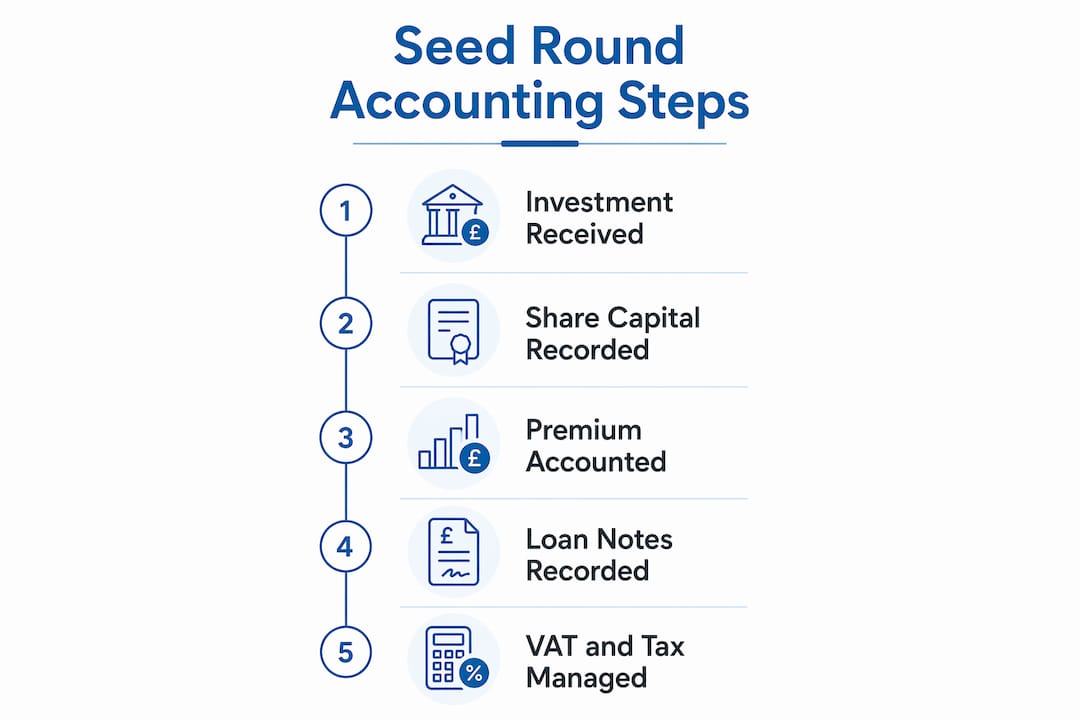
The mechanics of seed funding bookkeeping follow a clear structure under UK company law. When shares are issued to investors, the nominal value of those shares goes to share capital, and anything above that nominal value goes to the share premium account. Both sit within equity on your balance sheet.

Say an investor pays £500,000 for shares with a nominal value of £1,000. The £1,000 goes to share capital; the remaining £499,000 goes to share premium. Neither figure touches your revenue or expenses.
Pro Tip: Always issue shares at a formally agreed valuation, documented in a board resolution and shareholder agreement. An undocumented or inconsistent valuation creates problems when you apply for SEIS or EIS compliance certificates later.
Practical steps for recording seed round investments accurately:
- Prepare a board resolution authorising the share issue before any funds are received
- Update the statutory register of members and file a confirmation statement with Companies House promptly
- Record the cash receipt as a debit to your bank account and a credit split between share capital and share premium
- Disclose share transactions in the notes to your annual financial statements, as required under FRS 102 Section 22
- Obtain HMRC Advance Assurance before the round closes — skipping this step risks disqualifying the entire investment if a structural error surfaces after the money is spent
- File form SEIS1 or EIS1 compliance statements with HMRC once qualifying conditions are met, so investors can claim their tax relief
- Track dilution carefully: the valuation set at seed stage affects Business Asset Disposal Relief eligibility and future round mechanics
The distinction between equity and convertible loan notes matters here too. A convertible loan sits as a liability until conversion, not equity, which changes your balance sheet ratios and can affect covenant positions with lenders. Choosing the wrong instrument and misclassifying it is one of the most common and costly errors in early-stage accounting.
What happens to VAT and tax after you receive seed funding?
Seed funding does not attract VAT on receipt, but the spending it enables can push you over the VAT registration threshold quickly. Once your taxable turnover exceeds the current threshold, registration becomes mandatory, and missing that trigger point carries financial penalties.
The practical risks founders face post-investment:
- Increased operational expenditure funded by seed capital can breach the VAT threshold even before meaningful revenue arrives
- Misclassifying seed investment as income inflates your reported revenue and distorts your tax position
- Corporation tax planning becomes more complex once you have significant cash on the balance sheet, particularly around deferred taxation on timing differences
- Convertible loan notes carry different tax treatment from equity: interest accruing on a loan note may be deductible, but the conversion event itself can trigger tax consequences for both company and investor
- SEIS and EIS relief eligibility depends on how the money is spent, not just how it is raised — spending on non-qualifying activities within three years of issue can result in clawbacks for investors
HMRC Advance Assurance is not legally mandatory, but lead investors almost universally require it before committing. Founders who bypass it sometimes discover after the round closes that an improperly issued share class disqualifies the entire investment. Managing investor anger during a clawback event is considerably harder than getting the structure right beforehand.
How Priceandaccountants supports UK startups through seed round accounting
Priceandaccountants works specifically with UK tech and fintech startups, which means the team understands the pressures founders face between closing a round and keeping HMRC satisfied. The firm’s accounting services cover the full seed round lifecycle, from pre-investment structuring through to year-end filing.
What that looks like in practice:
- SEIS and EIS compliance management, including Advance Assurance applications and compliance certificate filings with HMRC
- Preparation of financial statements under FRS 102 or IFRS, with full disclosure of share transactions and equity movements
- VAT registration monitoring and management as post-investment expenditure scales
- Strategic tax planning covering corporation tax, R&D tax credits, and director-level tax efficiency
- Cloud accounting via Xero, giving founders real-time visibility of cash position and burn rate
- Virtual Finance Director support for board reporting, investor updates, and treasury management
Priceandaccountants has supported over 20 startups through the full funding journey, with several now valued at over £50 million. That track record matters when you are preparing accounts that sophisticated investors will scrutinise before committing to a Series A.
Key takeaways
Seed round accounting is not a back-office formality. Getting it right from the first investment protects your investors’ tax relief, your own compliance position, and your credibility with every future funder.
PointDetailsEquity, not incomeSeed investment sits on the balance sheet as share capital and share premium, never as revenue.SEIS/EIS compliance is criticalAdvance Assurance and correct compliance filings protect investors’ tax relief and prevent costly clawbacks.VAT thresholds need monitoringPost-investment spending can trigger mandatory VAT registration even before significant revenue arrives.Instrument choice affects taxConvertible loan notes carry different tax and accounting treatment from equity shares — classify them correctly from day one.PriceandaccountantsSpecialist support for UK tech and fintech startups across SEIS/EIS compliance, VAT, and seed round bookkeeping.
Seed round accounting done properly, from day one
Founders who get their seed round accounting right from the start spend less time firefighting HMRC queries and more time building their product. Priceandaccountants offers exactly the kind of specialist support that makes that possible: deep SEIS/EIS expertise, hands-on VAT and corporation tax management, and the strategic financial oversight that growing tech businesses actually need.

With over 40 years of expertise and a client base that includes high-growth startups now valued well above £50 million, Priceandaccountants acts as a genuine financial growth partner, not just a compliance box-ticker. Whether you are preparing for your first seed round or cleaning up accounts ahead of a Series A, the team handles the complexity so you do not have to. Get in touch with Priceandaccountants today to see how the firm’s accounting and tax services can support your next funding round.
Recommended
- Essential accounting tips for UK tech startups scaling to Series A - Price & Accountants
- Corporate accounting for UK tech founders: compliance and growth - Price & Accountants
- Corporate accounting for UK tech founders: compliance and growth - Price & Accountants
- UK startup funding process: a step-by-step guide - Price & Accountants