

TL;DR:
- Fintech accounting extends beyond traditional bookkeeping by utilizing cloud platforms and AI automation to enhance compliance and operational efficiency. It delivers significant benefits, including faster processing times, improved accuracy, and strategic insights, especially for regulated UK businesses. Early adoption and proper integration of these tools enable better decision-making and competitive advantages in the evolving financial technology landscape.
Most UK business owners assume they understand accounting well enough. Then they encounter a fintech business model, multi-currency transactions, FCA licensing obligations, and real-time investor reporting, and the cracks appear fast. What is fintech accounting, exactly, and why does it look so different from the spreadsheet-and-spreadsheet routine you may be used to? The answer matters more than you might expect: only 18% of SMEs combine cloud accounting with AI automation, yet those that do report returns more than three times higher than cloud-only users.
Table of Contents
- Key takeaways
- What fintech accounting actually means
- The real benefits of fintech accounting
- Compliance and regulation you cannot ignore
- Integrating fintech accounting software into your business
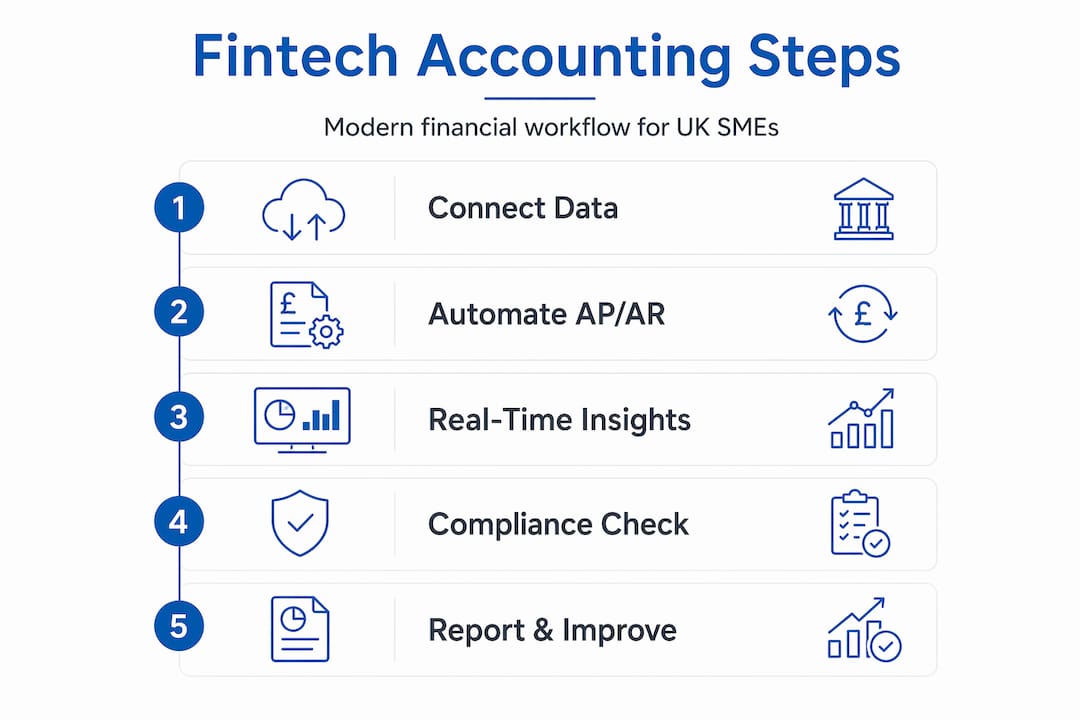
- How to get started with fintech accounting
- My honest perspective on fintech accounting adoption
- How Priceandaccountants can help your business
- FAQ
Key takeaways
PointDetailsFintech accounting is specialisedIt goes far beyond bookkeeping, covering regulatory capital, client fund segregation, and multi-jurisdiction compliance.Cloud and AI work togetherCloud accounting stores and reports; AI automation handles workflows, cutting processing time by up to 75%.Compliance is non-negotiableFCA rules, AML obligations, and data privacy requirements demand purpose-built accounting systems, not generic tools.ROI is measurableBusinesses combining cloud and AI tools report 3.2x higher ROI than those using cloud accounting alone.Start with an auditAssess your current workflows before selecting tools or providers to avoid expensive retrofitting later.
What fintech accounting actually means
Fintech accounting is the practice of managing the financial records, compliance obligations, and reporting requirements of businesses that operate within or adjacent to the financial technology sector. That covers payment processors, digital lenders, crypto platforms, insurtech firms, and software companies regulated by the FCA. It also increasingly applies to any UK SME using advanced financial technology to run its own finance function.
The term has two distinct applications, and confusing them creates problems. First, there is accounting for fintech businesses: specialist work required by regulated entities with complex revenue models, client money rules, and capital adequacy requirements. Second, there is fintech-enabled accounting: using technology, cloud platforms, and AI tools to modernise how any business manages its finances. Both fall under the fintech accounting umbrella, and both are reshaping how UK businesses operate.
What separates fintech accounting from traditional bookkeeping comes down to three things:
- Cloud accounting as the system of record. Platforms like Xero replace desktop ledgers and give your finance team real-time access to accurate data from anywhere.
- AI automation as the workflow engine. As the research confirms, cloud and AI are complementary layers: cloud manages reporting while AI handles process execution, including invoice matching, payment approvals, and reconciliation.
- Fintech-specific accounting services. These include regulatory capital monitoring, client fund segregation, AML transaction reporting, and revenue recognition for subscription or usage-based models.
Pro Tip: If your accountant cannot explain the difference between a cloud accounting system and an AI automation layer, you are likely paying for a traditional service dressed up in modern language.
Traditional bookkeeping records what happened. Fintech accounting tells you what is happening, flags what might go wrong, and automates the routine so your team can focus on decisions that actually move the business forward.
The real benefits of fintech accounting
The efficiency gains from fintech accounting are not theoretical. Businesses that integrate AI automation into their accounting workflows report a 60 to 75% reduction in accounts payable and receivable processing time, alongside improvements in Days Sales Outstanding of 12 to 20 days. For a growing UK business managing dozens of invoices weekly, that is a material operational shift.
Here are the core benefits, in order of impact for most UK SMEs:
- Reduced manual workload. Automated invoice capture, bank reconciliation, and expense categorisation free up hours every week. AI-powered accounting removes administrative burdens so that finance professionals can focus on forecasting and risk management rather than data entry.
- Greater accuracy. Human error in data entry is one of the most common sources of financial reporting mistakes. Automated systems do not fatigue, mistype, or misread bank statements.
- Faster month-end close. Businesses using fintech accounting tools typically close their books days faster than those relying on manual processes. That speed matters when investors, lenders, or the HMRC are waiting.
- Investor-grade financial data from day one. Programmes like Techstars have mandated blended human-AI accounting models using tools like Xero precisely because investor-grade financial data from the outset prevents expensive retrofitting as startups scale.
- Strategic finance capacity. When your finance team is not buried in reconciliations, they become genuine business advisors. That shift from data entry to strategic input is one of the most underappreciated benefits of fintech accounting.
“AI accounting fosters operational resilience by shifting finance professionals from data entry to strategic roles.” — AI-powered accounting is reshaping finance operations
Pro Tip: Track your current hours spent on AP, AR, and month-end manually before adopting any new tool. You will need that baseline to calculate your actual ROI, which typically arrives within 4 to 8 months of implementation.
Compliance and regulation you cannot ignore
For fintech businesses operating in the UK, compliance is not a formality. It is the condition on which your licence to operate depends. Fintech accounting compliance is a survival mechanism: complex revenue models and multi-jurisdiction regulations require sophisticated systems that traditional accounting software simply was not built to handle.
The regulatory environment for UK fintechs includes:
- FCA authorisation and ongoing reporting. Firms holding payment institution or e-money licences must maintain specific capital requirements and submit regular regulatory returns.
- Anti-money laundering (AML) obligations. Transaction monitoring, customer due diligence records, and suspicious activity reporting all require audit trails that generic accounting tools struggle to produce reliably.
- Client money segregation. FCA-regulated businesses holding client funds must account for them separately, with daily reconciliations that meet specific standards.
- Data privacy compliance. Under UK GDPR, financial data must be processed, stored, and audited according to strict rules. Your accounting systems must support this.
- Revenue recognition standards. Fintech businesses with subscription fees, usage-based pricing, or multi-component contracts must apply IFRS 15 correctly, which often requires purpose-built configuration.
The table below summarises the key compliance areas and their accounting implications:
Compliance areaAccounting implicationFCA capital adequacyRegular calculation and reporting of regulatory capital ratiosAML transaction monitoringAutomated audit trails and flagging within accounting workflowsClient money segregationSeparate ledger accounts with daily reconciliationUK GDPRData retention policies and access controls within accounting systemsIFRS 15 revenue recognitionDeferred revenue tracking and milestone-based recognition
For businesses that need a stronger grounding in the rules underpinning these requirements, the UK trust law compliance checklist from BLACKBOOK PROTOCOL provides a useful reference for audit trail and governance obligations.
Integrating fintech accounting software into your business
The technology stack question trips up many business owners. The most common mistake is treating cloud accounting and AI automation as the same thing, or assuming one replaces the other. They do not. Cloud accounting systems do not replace workflow execution. AI automation layers provide intelligent data extraction and process efficiency on top of your accounting platform.

In practice, a well-structured fintech accounting stack looks like this: Xero or QuickBooks sits at the centre as your system of record, holding your chart of accounts, tax configurations, and financial reports. AI automation tools, whether that is a platform like Peakflo or a purpose-built AP tool, sit on top and handle the execution layer: reading invoices, routing approvals, matching payments, and flagging exceptions.
The benefits of this layered approach only materialise when integration is clean. Poorly connected systems create exactly the data silos and manual bottlenecks you were trying to eliminate. Common integration challenges include:
- Duplicate data entry caused by systems that do not communicate directly
- Inconsistent chart of accounts between your accounting platform and your automation tools
- Staff reverting to manual workarounds when new tools feel unfamiliar or unreliable
The evidence is clear that organisational barriers often outweigh technical ones. Change management is the differentiator between a fintech accounting upgrade that delivers results and one that stalls after three months. You can read more about how these tools are reshaping finance functions in the Priceandaccountants guide to accounting trends in 2026.
Pro Tip: Before committing to any AI automation tool, map every manual step in your current AP and AR workflows. The tool you need is the one that removes the most friction from your specific process, not the one with the most features.
How to get started with fintech accounting
The practical path forward does not require a complete system overhaul from day one. A phased approach reduces risk, builds internal confidence, and delivers quick wins that make further investment easier to justify.
- Audit your current finance workflows. Map where time is being spent, where errors occur most often, and which processes are still entirely manual. This audit becomes your benchmark.
- Assess your transaction volumes. AI automation delivers the most obvious returns at higher transaction volumes. If you are processing fewer than 50 invoices a month, the priority may be cloud accounting first. If you are above 200, AI tools will pay for themselves quickly.
- Choose your cloud accounting platform. For UK businesses, Xero is the most widely used and most extensively supported option, with strong integrations and HMRC-compatible VAT filing. Ensure it is configured correctly for your specific business model, particularly for revenue recognition.
- Layer in AI automation selectively. Start with one workflow, typically accounts payable, where the time savings are easiest to measure. Once that is bedded in, extend to accounts receivable and bank reconciliation.
- Engage a specialist fintech accounting service provider. If you operate in a regulated space or are scaling toward Series A, specialist fintech accounting services are available at fixed monthly retainers from around €350. Getting expert support for compliance reporting and regulatory capital calculations is significantly cheaper than the consequences of getting them wrong.
For more on what this looks like in practice for UK tech companies, the Priceandaccountants article on UK tech accounting strategies covers the ground in detail.
My honest perspective on fintech accounting adoption
I have worked with UK fintech startups and SMEs at various stages, and the pattern I keep seeing is the same: founders are enthusiastic about the technology and far too slow to act on it. The numbers make the case clearly. AI in finance is an operational necessity in 2026, improving risk modelling and enabling faster, more accurate transactions. Yet most SME finance functions are still running on a combination of spreadsheets, PDFs, and a cloud accounting subscription they are underusing.
What I have found is that the hesitation is rarely about cost. It is about internal change. Nobody wants to admit their current process is inefficient, and nobody wants to manage the disruption of switching systems mid-quarter. The irony is that the longer you wait, the more technical debt you accumulate.
The businesses I have seen scale well share one characteristic: they treat their accounting infrastructure as a strategic asset, not an administrative afterthought. When your finance data is clean, real-time, and auditable, every decision you make is better informed. That is the real value of fintech accounting. Not the automation itself, but the quality of decision-making it enables.
If you are a UK founder still relying on quarterly management accounts produced two weeks after the period ends, you are flying blind. The tools to fix that exist, they are affordable, and the competitive advantage of moving early is real.
— Rahamut
How Priceandaccountants can help your business
If you have read this far, you understand that fintech accounting is more than a technology upgrade. It is a structural shift in how your business manages money, meets its obligations, and makes decisions.

Priceandaccountants works with UK tech startups, growing SMEs, and international founders who need more than a generalist accountant. Our team provides expert accounting services tailored specifically to the needs of fintech and tech businesses, including cloud accounting setup on Xero, AI workflow integration, FCA compliance support, R&D tax credits, and outsourced finance director services. We also offer reliable bookkeeping solutions that integrate directly with your fintech accounting stack, keeping your records audit-ready at all times. With over 40 years of experience and a track record of supporting businesses from pre-seed to valuations above £50m, we provide the practical expertise your business needs to scale with confidence.
FAQ
What is fintech accounting, in simple terms?
Fintech accounting combines cloud accounting platforms and AI automation tools to manage financial records, compliance obligations, and reporting for businesses operating in or with financial technology. It goes significantly beyond traditional bookkeeping by handling regulatory requirements, real-time data, and automated workflows.
How does fintech accounting differ from traditional accounting?
Traditional accounting records transactions after the fact, typically using manual processes and periodic reporting. Fintech accounting uses connected, automated systems to capture, process, and report financial data in real time, with built-in compliance controls for regulated businesses.
What are the main benefits of fintech accounting for UK SMEs?
The core benefits include a 60 to 75% reduction in AP and AR processing time, significantly faster month-end close, reduced human error, and the ability to redirect finance staff toward strategic planning rather than data entry.
Do I need specialist fintech accounting if I am not an FCA-regulated business?
Not necessarily for regulatory compliance purposes. However, fintech accounting tools and methodologies benefit any business with significant transaction volumes, multiple revenue streams, or investor reporting obligations, regardless of regulatory status.
What fintech accounting software should UK businesses consider first?
Xero is the most practical starting point for most UK businesses, given its HMRC compatibility, strong ecosystem of integrations, and widespread accountant support. AI automation tools can be layered on top once the core platform is correctly configured.
Recommended
- What is cloud accounting? A guide for UK tech startups - Price & Accountants
- Top bookkeeping tips for UK tech and fintech businesses - Price & Accountants
- Cloud accounting implementation guide for UK tech startups - Price & Accountants
- The role of technology in accounting for UK startup growth - Price & Accountants