
Business scaling is the process of increasing revenue faster than operational costs, so the business expands without needing proportional increases in resources. That distinction sounds simple, but it changes everything about how you plan, hire, and invest.
Think of it this way. A consultancy that wins a new client and immediately hires a new consultant to serve them is growing. A SaaS company that signs ten new customers on the same server infrastructure, with the same support team, is scaling. One adds cost in lockstep with revenue; the other does not.
The core elements that make scaling possible:
Professional services firms find scaling genuinely hard because every new client typically requires a new person. Software businesses, particularly SaaS, are structurally built for it. Understanding where your model sits on that spectrum is the first honest question to answer.

Growth and scaling are not the same thing, and confusing them is an expensive mistake.
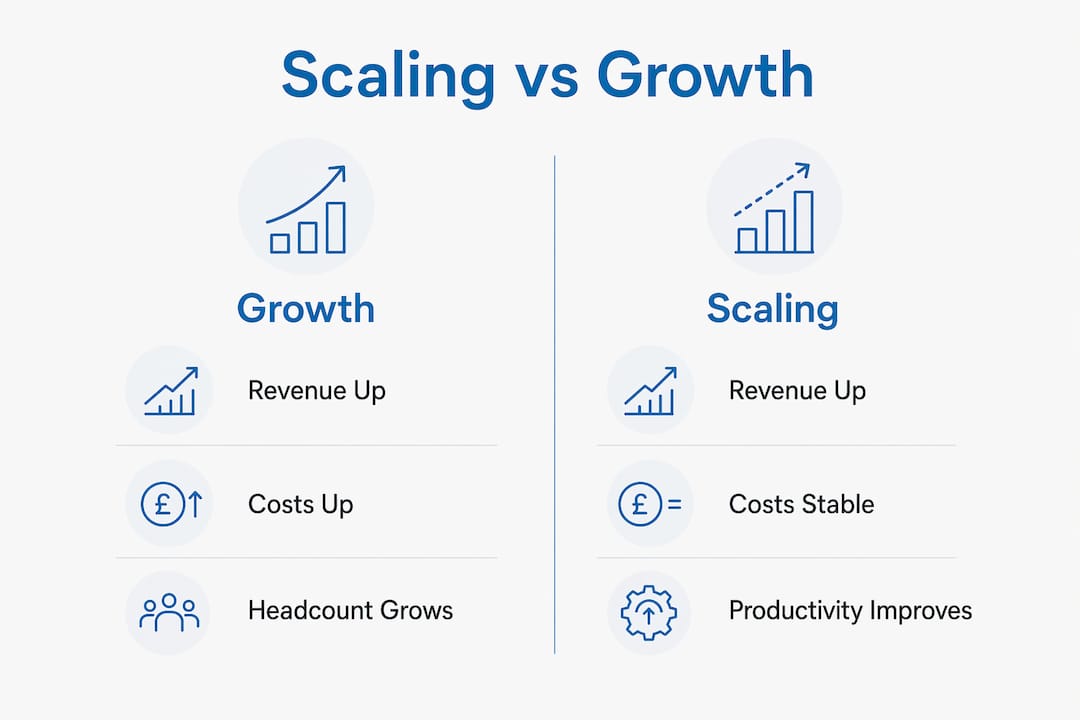
When a business grows, revenue and costs rise together. You win £50,000 in new contracts and spend £50,000 hiring the staff to deliver them. The business is bigger, but the margin has not moved. Scaling is when that £50,000 in new revenue costs you £5,000 in marketing automation to acquire. The gap between revenue and cost widens, and that gap is where profit lives.
Key distinctions at a glance:
Pro Tip: The most common trap is believing you are scaling when you are actually growing. If every new customer requires a new hire, you are growing. Track revenue per employee quarterly. If it is flat, you are adding cost as fast as you are adding revenue.
As Harvard Business School Professor Felix Oberholzer-Gee argues, growth strategies must be driven by clear value creation, not expansion alone. Disciplined management and genuine efficiency gains separate scaling from simply getting bigger.
Scaling without preparation tends to amplify whatever is already broken. The businesses that do it well treat readiness as a prerequisite, not an afterthought.
Step-by-step approach:
Scaling readiness checklist:
Most scaling failures are not market failures. They are operational ones.
The single most common problem is premature scaling: expanding before the underlying systems can support it. Every inefficiency in a small business gets amplified under growth pressure. Unclear roles, reactive decisions, and disorganised workflows become extraordinarily expensive once volume increases.
Common pitfalls to watch for:
McKinsey’s research on growth outperformance highlights a counterintuitive point: sometimes the right move is to prune non-scalable parts of the portfolio to free resources for the areas that genuinely can scale. “Shrink to grow” is not failure; it is focus.
Scaling a UK business involves financial and regulatory complexity that generic advice does not cover. SEIS and EIS schemes, R&D tax credits, corporation tax planning, and real-time financial reporting all require specific expertise, and getting them wrong at the point of scaling is costly.
Priceandaccountants works with tech startups, fintech founders, and growing SMEs across the UK, acting as a financial growth partner rather than a compliance-only firm. Having supported over 20 clients through the startup process, some now valued at well over £50m, the firm brings direct experience of what scaling actually requires at each stage.
Key areas of support for scaling businesses:
Pro Tip: Invest in financial infrastructure before you need it. The businesses that scale without breaking are the ones that set up proper financial reporting and compliance processes at the growth stage, not after the first crisis.
The UK has produced some of the clearest examples of what disciplined scaling looks like in practice.
Monzo grew from a prepaid card into a fully licensed bank serving millions of customers by building technology infrastructure first and expanding products only once the core platform was stable. The decision to delay certain features rather than ship them prematurely is a textbook example of avoiding operational drag.
Gymshark, founded in Birmingham, scaled from a screen-printing operation to a global fitness brand by investing heavily in digital marketing and fulfilment systems before expanding internationally. The founder has spoken publicly about the near-collapse caused by a website failure during a peak sales period, which forced an infrastructure overhaul that ultimately enabled the next phase of growth.
Deliveroo scaled city by city rather than launching nationally at once, a deliberate “slow and deep” approach that allowed the team to understand local demand patterns and build operational redundancies before moving to the next market. That discipline in sequencing is what allowed the model to hold under pressure.
The pattern across all three is consistent: technology and process investment preceded expansion, not followed it.
There is no single path to scaling, but the approaches that work tend to share a common logic: increase revenue capacity without a proportional increase in cost.
Productisation converts service delivery into a repeatable product. A consultancy that packages its methodology into a fixed-scope engagement can serve more clients with the same team.

Technology-led growth uses software to absorb workload. BCG’s 2026 CEO guide identifies AI integration as a material lever for reducing the cost of growth, particularly in managing complexity as organisations expand.
Channel expansion adds revenue streams without adding proportional cost. An e-commerce brand moving from direct-to-consumer to wholesale, or a SaaS business adding a reseller programme, can multiply revenue with limited incremental overhead.
Geographic expansion works best when the core model is proven and documented. Scaling into a new market with an untested process is growth, not scaling.
Partnerships and distribution let you reach new customers through existing infrastructure rather than building your own. For UK businesses, this might mean white-labelling, referral agreements, or joining established platforms.
McKinsey also notes that combining core innovation with selective adjacencies, and occasionally portfolio pruning, produces sustained outperformance over time.
Tracking the right numbers is how you distinguish genuine scaling from expensive growth.
| Metric | What it tells you |
|---|---|
| Revenue per employee | Whether productivity is rising as headcount grows |
| Customer acquisition cost (CAC) | Whether you are acquiring customers efficiently |
| Customer lifetime value (LTV) | Whether revenue per customer justifies acquisition spend |
| Gross margin | Whether revenue growth is outpacing cost of goods |
| Churn rate | Whether retained revenue compounds or erodes |
| Operating leverage | Whether fixed costs are becoming a smaller share of revenue |
Revenue per employee is particularly useful for UK SMEs. A business banker or accountant can benchmark it against industry averages using tools like Dun & Bradstreet First Research Reports. If you are already at or above the industry average, scaling may not be the priority. If you are below it, the gap usually points to a process or technology problem worth solving before expanding.
The LTV to CAC ratio deserves specific attention. A ratio below 3:1 typically means the unit economics do not support scaling. Above it, and the model can usually absorb the investment required to grow.
Technology does not scale a business by itself, but the absence of the right tools reliably prevents it.
Cloud accounting platforms such as Xero give founders real-time visibility into cash flow, margins, and tax positions. Without that, decisions get made on outdated information, which is expensive at scale.
CRM systems like Salesforce or HubSpot track the full customer pipeline, automate follow-up, and give sales teams the data to prioritise correctly. As volume increases, manual tracking fails.
Project management tools such as Asana or Monday.com create the workflow clarity that prevents the operational drag described earlier. When everyone can see what is happening and what is blocked, reactive firefighting decreases.
Payroll and HR platforms handle the administrative complexity of a growing team without requiring proportional back-office headcount.
AI tools are increasingly relevant for reducing operational costs in areas like customer support, content production, and data analysis. The BCG research cited earlier identifies AI adoption as one of the clearest levers for managing scaling complexity in 2026.
The principle is straightforward: if a task is repeatable and rule-based, technology should handle it. Your team’s time is the scarcest resource you have.
Business scaling requires revenue to grow faster than costs, and that only happens when processes, technology, and financial infrastructure are in place before expansion begins.
| Point | Details |
|---|---|
| Scaling differs from growth | Scaling widens the gap between revenue and cost; growth adds both in proportion. |
| Readiness comes first | Consistent revenue and documented processes must precede any scaling move. |
| Operational drag compounds | 62% of workday time spent on routine tasks scales with the business if automation is not built in early. |
| UK tax incentives matter | SEIS, EIS, and R&D tax credits provide material funding for scaling UK tech businesses. |
| Metrics drive decisions | LTV to CAC ratio, revenue per employee, and gross margin are the numbers that reveal whether scaling is actually working. |