
An advisory board gives your leadership team something no internal meeting can replicate: genuinely independent thinking from people with no stake in the politics. The role of strategic advisory is to provide non-binding, expert guidance that sharpens decision-making, surfaces blind spots, and supports long-term strategy without the legal weight of a formal board of directors.
Here is the core distinction that matters most. An advisory board consists of external experts who provide non-binding strategic advice to management. They carry no fiduciary duties, hold no voting rights, and bear no legal liability for company decisions. A board of directors governs. An advisory board thinks. Both serve the organisation, but they serve it differently.
Key characteristics of strategic advisory and advisory boards:
- Non-binding advice: Guidance and recommendations carry no decision-making authority.
- No fiduciary duties: Members face no legal liability for the outcomes of their counsel.
- Flexible structure: Composition and focus adapt to the organisation’s evolving priorities.
- Expertise-driven: Members bring specialised knowledge unavailable inside the company.
- Supportive role: Advisory boards complement, not replace, formal governance structures.
- Safe environment: Executives can test ideas and challenge assumptions without political pressure.
Advisory boards typically meet quarterly or biannually to provide strategic guidance, making them a low-friction, high-value governance tool for businesses at any stage.
Why do organisations actually need strategic advisory?
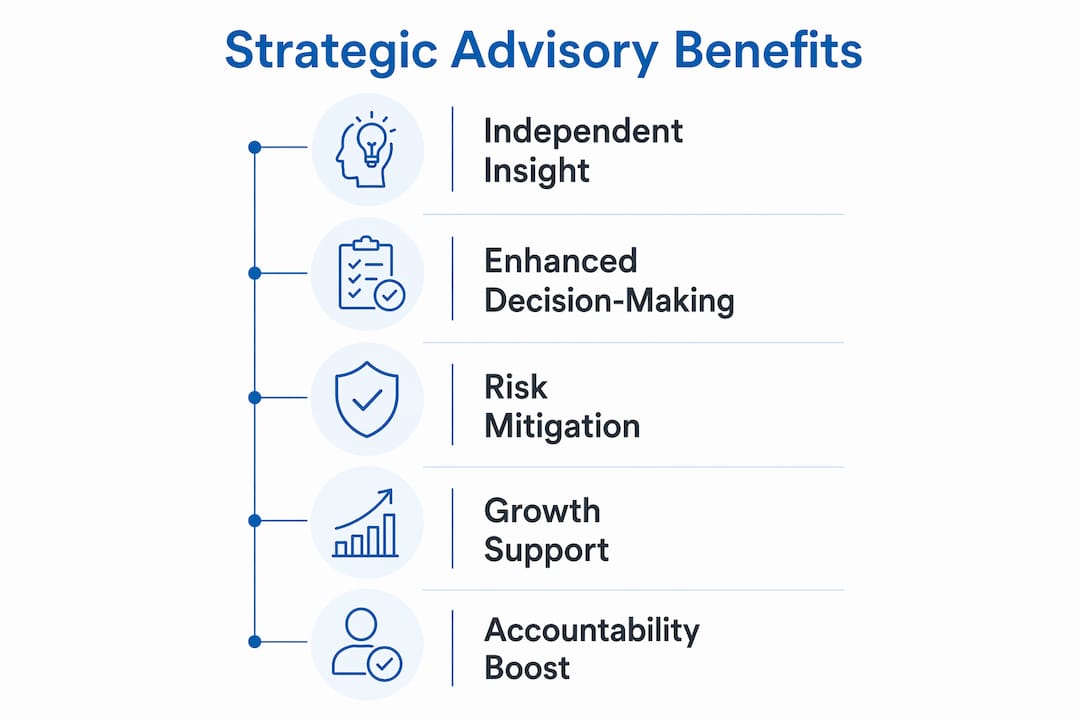
The honest answer is that internal teams, however talented, develop blind spots. Groupthink is a genuine organisational risk, and advisory boards combat it by introducing external, objective perspectives that challenge assumptions internal teams may overlook.
The benefits go well beyond avoiding bad decisions. A well-structured advisory board:
- Expands expertise: Brings in knowledge across digital transformation, finance, regulation, and customer behaviour that no single leadership team can hold.
- Accelerates growth: Advisors with relevant experience help leaders move faster on market entry, fundraising, and operational scaling.
- Strengthens governance: Independent perspectives improve risk identification and compliance awareness without adding bureaucratic overhead.
- Provides mentorship: Senior advisors act as trusted counsellors during leadership transitions, mergers, or periods of rapid change.
- Builds credibility: A respected advisory board signals to investors, partners, and clients that the organisation values external scrutiny.
- Sharpens focus: Effective strategic advisors help leaders move beyond data-gathering and focus on the decisions that actually drive growth.
The strategic consulting benefits here are cumulative. Each advantage reinforces the others. Better thinking leads to better decisions, which builds stakeholder confidence, which attracts stronger advisors.
What do advisory board members and chairs actually do?
The chair sets the tone for everything. Their job is to build the agenda, facilitate productive discussion, and act as the primary liaison between the advisory board and the executive team. A weak chair produces unfocused meetings where advisors drift into operational detail rather than strategic challenge.

Advisory board members carry three core responsibilities. First, they contribute independent perspectives on strategy, markets, and technical areas. Second, they challenge assumptions, share knowledge, and expand networks for executive teams. Third, they bring pattern recognition from experience that internal leaders often lack, particularly around risks that are not yet visible.
Internal representatives, typically the CEO, founder, or a senior director, provide organisational context and ensure recommendations translate into action. Without this role, advisory input risks becoming disconnected from operational reality.
One legal point worth being clear on for UK businesses: advisory board members hold no fiduciary duties under English law. They cannot be held liable for company decisions, and their advice carries no binding authority. This distinction matters when setting expectations with prospective members and when communicating the board’s role to investors or regulators.
How to build a strategic advisory board that actually works
Start with a clear mandate. Before approaching any prospective member, define what the advisory board is for. Is it to support a market expansion? Navigate a regulatory environment? Prepare for a fundraising round? Vague mandates attract generalist advisors who add little specific value.
When selecting members, the criteria that matter most are:
- Relevant expertise: Deep knowledge in areas where your leadership team has genuine gaps.
- Cultural fit: Advisors who align with your values and can challenge constructively without ego.
- Diversity of thought: Different industries, operational backgrounds, and strategic disciplines produce better collective thinking.
- Availability: An advisor who cannot commit to quarterly engagement is not an advisor in practice.
- Network value: Access to investors, partners, or regulators relevant to your growth stage.
Structure meetings with discipline. Set a fixed agenda in advance, circulate briefing materials at least a week before each session, and assign a note-taker who tracks agreed actions. Advisory boards that meet without structure quickly become social events.
Pro Tip: Onboard new members properly. Share your business plan, financial position, and strategic priorities before their first meeting. An advisor who arrives without context cannot challenge effectively. Treat onboarding as seriously as you would for a senior hire.
Compensation varies widely. Equity, a modest retainer, or a combination of both are all common in the UK market. The key is that compensation signals commitment. An unpaid advisory role often produces unprepared advisors.
How advisory boards must evolve as your business grows
An advisory board built for a pre-seed startup looks nothing like one suited to a Series B company. The composition, focus, and meeting cadence that served you at one stage can actively hold you back at the next.

Early-stage businesses typically need advisors with hands-on experience of the founding journey: fundraising, product-market fit, and early hiring. As the business scales, the priorities shift toward market expansion, governance, and operational depth. The most effective advisory engagement happens at key inflection points, such as scale-up, leadership transition, or exit preparation, rather than as a crisis response.
Practices that keep an advisory board relevant over time:
- Review composition annually: Ask whether each member’s expertise still matches your current priorities.
- Rotate members deliberately: A three-year term with an option to renew prevents complacency and keeps the board fresh.
- Expand focus areas proactively: If your business is entering a new sector or geography, recruit ahead of the need.
- Address disengagement early: An advisor who misses meetings or arrives unprepared should be replaced, not tolerated.
- Align the board to your strategy cycle: Revisit the advisory board’s mandate whenever you update your three-year plan.
The risk of inaction is real. An advisory board that has not evolved in three years is almost certainly advising on yesterday’s business.
Strategic advisory in the UK context: practical insights from Priceandaccountants
UK tech founders and SME leaders face a specific set of pressures that generic advisory frameworks rarely address: SEIS and EIS compliance, R&D tax credit eligibility, Companies House obligations, and the particular dynamics of raising capital in the London market. Generic advice from advisors without UK market experience can be worse than no advice at all.
Priceandaccountants works with UK tech start-ups and growing businesses as an outsourced Finance Director, providing the kind of forward-looking advisory that goes well beyond historical reporting. The distinction matters. Most accountants tell you what happened last quarter. A strategic advisor tells you what your numbers mean for the decisions you are making right now.
Practical insights for UK business leaders selecting advisors:
- Prioritise advisors with direct experience of the UK funding environment, including SEIS/EIS scheme mechanics and investor expectations.
- Seek advisors who understand HMRC’s approach to R&D tax credits, particularly for software and fintech businesses where eligibility boundaries are contested.
- Look for advisors who have navigated Companies House compliance and UK corporate governance requirements at your growth stage.
- Avoid advisors whose experience is entirely US-based. The regulatory and investor landscape differs materially.
Priceandaccountants has supported over 20 start-up clients through the full growth cycle, with several now valued at well over £50m. That track record reflects the compounding value of strategic advisory services applied consistently across funding rounds, tax planning, and governance.
The forward-looking dimension of advisory is where the real value sits. Knowing your current tax position is table stakes. Understanding how your share structure affects your Series A terms, or how your R&D claim affects your cash runway, is where an experienced advisor earns their place.
How do you measure whether your advisory board is working?
Measuring advisory board effectiveness is genuinely difficult, and most organisations do not do it well. The absence of a formal metric does not mean the question should be ignored.
Start with outputs, not inputs. The number of meetings held is irrelevant. What matters is whether the board’s input changed a decision, surfaced a risk before it became a problem, or opened a relationship that created tangible value. Track these moments explicitly.
Useful measures include:
- Decision quality: Can you point to specific decisions that improved because of advisory input?
- Risk identification: Did the board flag issues that internal teams had missed?
- Network outcomes: Have advisors made introductions that led to partnerships, hires, or investment?
- Leadership development: Have senior executives grown in their thinking as a result of advisory challenge?
Review effectiveness formally at least once a year. Ask each member to self-assess their contribution and ask the executive team to rate the board’s overall impact. The conversation itself is often more valuable than the scores.
Common challenges advisory boards face and how to fix them
The most common failure mode is a board that exists on paper but delivers nothing in practice. Members are busy, meetings drift, and the executive team stops preparing properly. Within eighteen months, the advisory board has become a line on the website rather than a source of genuine input.
Other challenges and their practical fixes:
- Misaligned expectations: Solve this at the outset with a written mandate that defines scope, meeting frequency, and what “good” looks like.
- Advisor disengagement: Caused almost always by poor meeting preparation or a sense that advice is not being acted upon. Share updates between meetings and close the loop on previous recommendations.
- Groupthink within the advisory board itself: Avoid it by recruiting members from genuinely different backgrounds. An advisory board of five former investment bankers will produce the same blind spots as the leadership team it is meant to challenge.
- Confidentiality concerns: Address these with a simple non-disclosure agreement before onboarding. Most experienced advisors expect it.
- Lack of accountability: Strategic advisory relationships function as ongoing partnerships, not one-off projects. Build in regular check-ins between formal meetings to maintain momentum.
The fix for almost every advisory board problem is the same: treat it with the same operational discipline you apply to your leadership team. Prepare properly, follow through on actions, and replace members who are not contributing.
Key takeaways
A well-structured advisory board is one of the most cost-effective governance tools available to UK business leaders, provided it is built with clear purpose, the right people, and genuine operational discipline.
PointDetailsAdvisory boards are non-bindingMembers provide expert guidance with no fiduciary duties or legal liability under English law.Best engaged at inflection pointsAdvisory support is most effective at scale-up, leadership transition, or exit preparation, not in crisis.Composition must evolveReview member expertise annually and rotate deliberately to keep the board aligned with current priorities.Measure outputs, not inputsTrack decisions improved, risks surfaced, and network outcomes rather than meeting attendance.UK-specific expertise mattersAdvisors must understand SEIS/EIS, R&D tax credits, and UK corporate governance to add real value.