
TL;DR:
- Board advisors are external specialists who provide non-binding strategic advice with minimal time commitment. They enhance decision quality, governance credibility, and investor confidence, especially during key growth phases. Advisors differ from directors and fractional executives by offering guidance without legal or operational authority.
Board advisors are defined as experienced external specialists who provide non-binding strategic guidance to business leaders without holding formal governance authority or legal fiduciary duties. For UK founders and SME leaders, understanding the role of board advisors is the difference between making critical decisions in isolation and making them with the benefit of seasoned, independent counsel. Advisory boards are not a luxury reserved for large corporations. They are one of the most cost-effective tools available to growing businesses, and the evidence for their impact on revenue growth, governance credibility, and decision quality is compelling.
What do board advisors actually do?
Board advisors provide strategic guidance and feedback on business plans, market positioning, and key decisions, typically committing 2–5 hours per month to a company. That time commitment is deliberately light. It keeps advisors focused on high-level thinking rather than day-to-day operations.
The functions of board advisors fall into three broad categories:
- Strategic input. Advisors review plans, challenge assumptions, and offer perspectives shaped by experience in markets, sectors, or functions the founder may not have direct access to.
- Introductions and networks. A well-chosen advisor opens doors to investors, partners, customers, and talent that would otherwise take years to reach.
- Mentoring and reflection. Advisors act as critical friends who challenge groupthink and help leadership teams see blind spots before they become costly mistakes.
What advisors do not do is equally important. They do not manage staff, execute projects, or hold operational accountability. That distinction separates them from fractional executives, who typically contribute 10–30 hours weekly and carry direct management responsibility.
Pro Tip: Brief your advisors before every meeting with a short written summary of the decisions you are facing. Advisors who arrive prepared give sharper, more relevant input.
The best advisory relationships feel less like consultancy and more like a trusted sounding board. The advisor’s job is to ask the questions a founder might be too close to the business to ask themselves.

How do advisory boards benefit SME growth and governance?
The benefits of board advisors extend well beyond occasional good advice. Companies with advisory boards show higher revenue growth and improved EBITDA through operational efficiencies. That finding reflects a consistent pattern: structured external input leads to better decisions, and better decisions compound over time.
The governance benefits are equally significant. Investors view companies with advisory boards as having higher valuation and creditworthiness. For a UK SME seeking seed funding, a Series A round, or a bank facility, an advisory board signals that the business is run with discipline and external accountability. That signal can materially improve terms.
The importance of advisory boards also shows up in leadership quality. The Institute of Directors and IMD research identify advisory boards as critical for leadership insight and avoiding the groupthink that afflicts many founder-led businesses. When every voice in the room reports to the CEO, honest challenge becomes rare. An advisory board creates a structured space where candid, independent perspectives are not just welcomed but expected.
Specific benefits UK SME founders consistently report include:
- Faster identification of market risks before they escalate.
- Access to sector expertise the founding team lacks internally.
- Improved credibility with lenders, investors, and strategic partners.
- A confidential space to test ideas before committing resources.
The board advisor role in startups is particularly valuable during inflection points: entering a new market, raising capital, hiring a first senior team, or preparing for exit. These are precisely the moments when founder isolation is most dangerous and external experience is most valuable.
For founders concerned about losing control, advisory boards present no threat. Advisors offer counsel. The CEO retains full authority over every decision. You can take the advice, adapt it, or set it aside entirely.
How are board advisors different from directors and fractional executives?
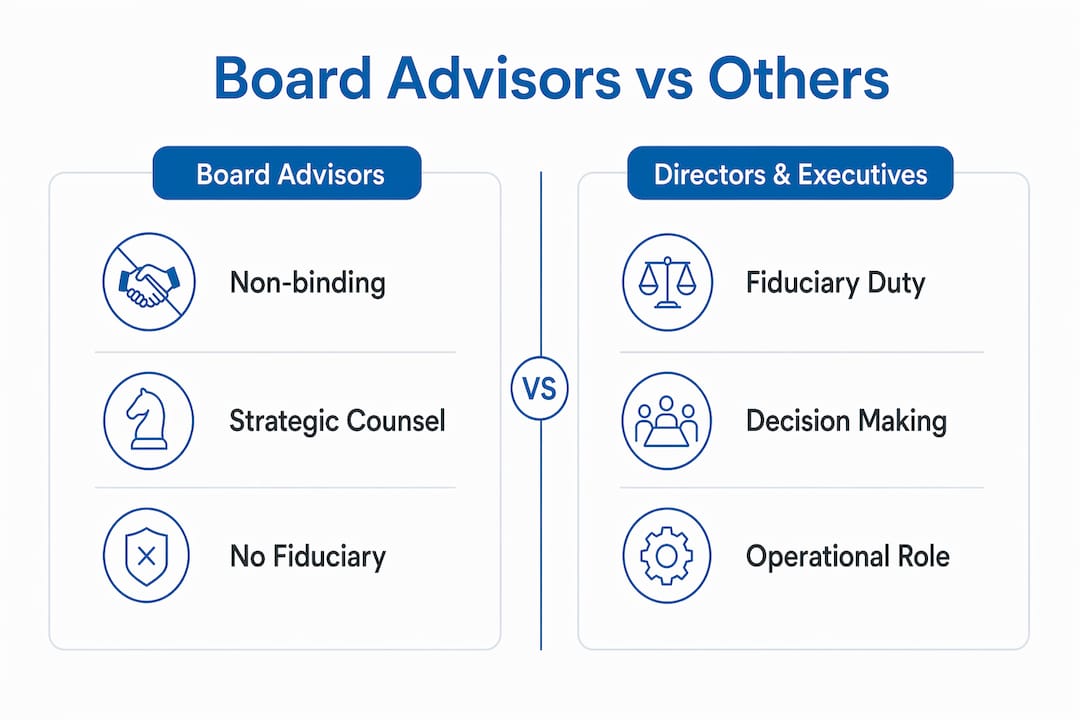
The distinction matters legally and practically. Board advisors have no fiduciary duties and no formal decision-making authority. A company director, by contrast, carries legal obligations under the Companies Act 2006, including duties of care, loyalty, and compliance. Directors can be held personally liable for governance failures. Advisors cannot.
Understanding limited liability and the boundaries of legal responsibility is worth reviewing before you formalise any advisory arrangement, because the language used in agreements can inadvertently blur these lines.
The table below summarises the key differences across the three roles:
DimensionBoard advisorCompany directorFractional executiveLegal fiduciary dutyNoneYes, under Companies Act 2006Varies by contractDecision-making authorityNoneYes, formal governance roleYes, within operational remitTime commitment2–5 hours per monthVariable, ongoing10–30 hours per weekAccountabilityNon-binding counsel onlyLegal and regulatoryOperational outcomesCompensationEquity, fee, or honorarySalary or feeDay or monthly rate
Confusing advisors with fractional executives leads to role conflicts that damage both the relationship and the business. An advisor asked to manage a project has crossed into fractional executive territory. That shift changes expectations, accountability, and potentially legal exposure.
Pro Tip: Always document the advisory relationship in a written agreement that explicitly states the role is non-binding, carries no representation rights, and grants no authority to commit the company to any obligation.
Formalising advisory relationships in writing prevents misunderstanding and role creep. A clear written scope protects both the founder and the advisor, and it sets the professional tone that makes the relationship productive from the outset.
What are best practices for forming an effective advisory board?
Advisory board effectiveness depends almost entirely on structure. An informal group of well-connected contacts who meet occasionally delivers little. A properly constituted advisory board with clear purpose, disciplined meetings, and defined expectations delivers measurable value.
Follow these steps to build an advisory board that works:
- Define the mandate in writing. State what the advisory board is for, what decisions it will inform, and what it will not do. Ambiguity is the enemy of advisory board effectiveness.
- Select for complementary skills. Choose advisors who fill specific gaps: a commercial expert if you lack sales experience, a technical specialist if your product is complex, a finance professional if capital allocation is a weakness.
- Limit the group to 3–5 advisors. Larger groups produce conflicting counsel and diluted engagement. Smaller groups maintain focus and accountability.
- Run agenda-driven meetings. Effective advisory boards require formal structure: clear agendas, consistent meetings, and prepared materials shared in advance. Quarterly meetings with disciplined protocols maximise the value advisors can provide.
- Appoint a skilled chair. A good chair keeps meetings focused, ensures every advisor contributes, and prevents any single voice from dominating.
Beyond structure, the quality of follow-through determines whether advisory input translates into business outcomes. Capture the key insights from every meeting, assign ownership, and report back at the next session on what was acted upon and why. Advisors who see their input taken seriously stay engaged. Those who feel ignored disengage quickly.
Diversity of perspective matters as much as depth of experience. An advisory board composed entirely of people with similar backgrounds will reproduce the same blind spots the founder already has. Seek advisors who have operated in different sectors, geographies, or business models. The friction that comes from genuinely different viewpoints is precisely what makes advisory boards valuable.
For founders exploring startup advisory for the first time, the most common mistake is selecting advisors based on prestige rather than relevance. A well-known name who cannot engage with your specific challenges is less useful than a less prominent expert who has solved exactly the problem you are facing.
Advisory boards also carry legal risk management considerations worth addressing early, particularly around confidentiality, intellectual property, and the boundaries of the advisory remit. Address these in the written agreement before the first meeting.
Key takeaways
Board advisors deliver the most value when their role is clearly defined, their engagement is structured, and their input is consistently acted upon.
PointDetailsAdvisors are non-bindingBoard advisors hold no legal authority or fiduciary duty; all decisions remain with the CEO.Time commitment is lightAdvisors typically contribute 2–5 hours per month, focused on strategic counsel only.Advisory boards signal governance maturityInvestors view advisory boards as markers of credibility, improving valuation and fundraising prospects.Written agreements prevent role creepFormalise every advisory relationship in writing to define scope, compensation, and non-binding status.Structure determines effectivenessAgenda-driven quarterly meetings with 3–5 advisors and advance materials produce the best outcomes.
Why founders underestimate advisory boards until it is too late
I have worked with enough UK founders to recognise a consistent pattern. The businesses that struggle most during fundraising rounds or market pivots are almost always the ones where the founding team has been making decisions in a closed loop for too long. Advisory boards break that loop. They are not a governance formality. They are a deliberate mechanism for introducing experienced, independent thinking into a business that might otherwise only hear its own echo.
The pitfall I see most often is not a lack of advisors. It is a lack of clarity about what those advisors are there to do. Founders recruit impressive names, hold occasional dinners, and then wonder why the relationship produces nothing concrete. The problem is almost always structural. Without a written mandate, a regular meeting cadence, and a clear set of questions the advisory board is meant to help answer, even the best advisors drift into irrelevance.
The other mistake is expecting advisors to execute. When a founder starts asking an advisor to make calls, manage relationships, or own a workstream, the advisory relationship has broken down. That is a fractional executive role, and it should be contracted and compensated accordingly. Keeping these roles distinct is not bureaucratic pedantry. It protects the quality of the advisory relationship and the integrity of your governance.
My honest recommendation: treat your advisory board with the same discipline you would apply to a board of directors. Prepare materials. Set agendas. Follow through. The founders who do this consistently are the ones who tell me, two years later, that their advisory board was one of the best decisions they made.
— Rahamut
How Priceandaccountants supports your advisory and governance needs
Building an advisory board is one part of the picture. Ensuring your financial governance keeps pace with your growth is the other.

Priceandaccountants works with UK tech founders and SME leaders to provide the financial infrastructure that makes advisory boards more effective. From strategic advisory and tax planning to outsourced finance director support, we give your leadership team the financial clarity advisors need to give you their best counsel. Our accounting services are built for growing businesses that need more than compliance. They need a financial partner who understands where the business is going and what it takes to get there. If you are ready to build a governance structure that supports serious growth, speak to the Priceandaccountants team today.
FAQ
What is the role of board advisors in a startup?
Board advisors provide non-binding strategic guidance to founders, typically committing 2–5 hours per month. They offer sector expertise, challenge assumptions, and open networks without holding any operational or legal authority.
Do board advisors have legal responsibilities?
Board advisors have no fiduciary duties and no formal decision-making authority. Unlike company directors, they carry no legal liability for governance decisions under the Companies Act 2006.
How many advisors should an advisory board have?
An advisory board of 3–5 advisors is the recommended size. Smaller groups maintain focus and engagement; larger groups tend to produce conflicting counsel and diluted commitment.
How are board advisors different from fractional executives?
Board advisors provide strategic counsel for 2–5 hours per month with no operational accountability. Fractional executives contribute 10–30 hours per week and carry direct management responsibility for outcomes.
How do advisory boards help with fundraising?
Investors view advisory boards as signals of governance maturity, which can improve company valuation and creditworthiness. A well-constituted advisory board demonstrates that the business benefits from experienced, independent oversight.