

TL;DR:
- Treasury support involves managing cash, banking relationships, and financial risks to ensure business stability. It includes activities like cash forecasting, bank account administration, risk hedging, and regulatory compliance, supported by automation tools. Modern treasury functions act as strategic partners, using technology to optimize cash flow and inform long-term financial decisions.
Treasury support is defined as the set of operational and strategic activities that assist a corporate treasury function in managing cash, banking relationships, liquidity, and financial risk. For UK business owners and financial managers, understanding what is treasury support means understanding the engine behind day-to-day financial stability. It covers everything from cash forecasting and bank account administration to regulatory compliance and risk hedging. The primary mission of treasury is ensuring cash is available for operations and that any surplus is properly invested. Treasury support makes that mission executable at the operational level.
What are the primary functions performed by treasury support?
Treasury support functions span a wide range of activities, all of which connect directly to a business’s financial health. These functions do not operate in isolation. Each one feeds into the others, creating a system that keeps cash moving efficiently and risk contained.
The core responsibilities in treasury support include:
- Cash forecasting. Treasury support teams build short and medium-term cash forecasts to predict inflows and outflows. Accurate forecasting prevents both cash shortfalls and idle surplus.
- Bank account administration. This covers opening, maintaining, and closing accounts across multiple banks and jurisdictions. Poor administration creates compliance exposure and unnecessary fees.
- Banking relationship management. Treasury support negotiates terms, monitors service quality, and ensures the business has access to credit when needed.
- Risk management. This includes hedging against currency fluctuations, interest rate movements, and commodity price changes. Proactive management of FX and interest rate volatility is now central to protecting shareholder value.
- Investment of surplus cash. When cash exceeds operational needs, treasury support places it in short-term instruments that balance return against liquidity risk.
- Treasury Management Systems (TMS). A TMS automates cash positioning, payment execution, bank account management, risk analytics, and compliance reporting. Automation reduces manual error and frees the team for higher-value analysis.
The role of treasury support is therefore both administrative and analytical. It keeps the business solvent on a daily basis while also providing the data that informs longer-term financial decisions.
Pro Tip: Review your banking panel at least once every two years. Banks should be periodically rebid to maintain competitiveness and to confirm your business has adequate operational redundancy across providers.

How does treasury support optimise cash flow and financial efficiency?
Treasury support improves cash flow through a combination of process discipline and negotiation. The goal is to reduce the cost of holding and moving money while keeping the business liquid at all times.
The main techniques used are:
- Cash pooling. Multiple accounts across subsidiaries or business units are consolidated into a single notional or physical pool. This reduces the need for external borrowing by using internal surpluses to cover internal deficits.
- Working capital management. Treasury support works with accounts receivable and accounts payable teams to shorten collection cycles and extend payment terms where possible. Tighter working capital cycles free up cash without increasing debt.
- Automated cash positioning. Rather than manually checking balances each morning, a TMS pulls real-time data from all bank accounts and produces a consolidated position. This removes human error and speeds up decision-making.
- Negotiating banking fees. Treasury support reviews bank charges regularly and uses competitive tension between providers to reduce transaction costs, custody fees, and credit facility margins.
- Closing dormant accounts. Leaving unused accounts open is a common and costly oversight. Failure to close dormant accounts can trigger state unclaimed-property laws with dormancy periods of 3–5 years, creating both financial and legal risk.
The table below shows how each technique connects to a measurable financial outcome.
TechniquePrimary benefitCash poolingReduces external borrowing costsWorking capital managementFrees up internal cash without new debtAutomated cash positioningCuts manual error and speeds decisionsNegotiating banking feesLowers transaction and facility costsClosing dormant accountsAvoids compliance penalties and fees
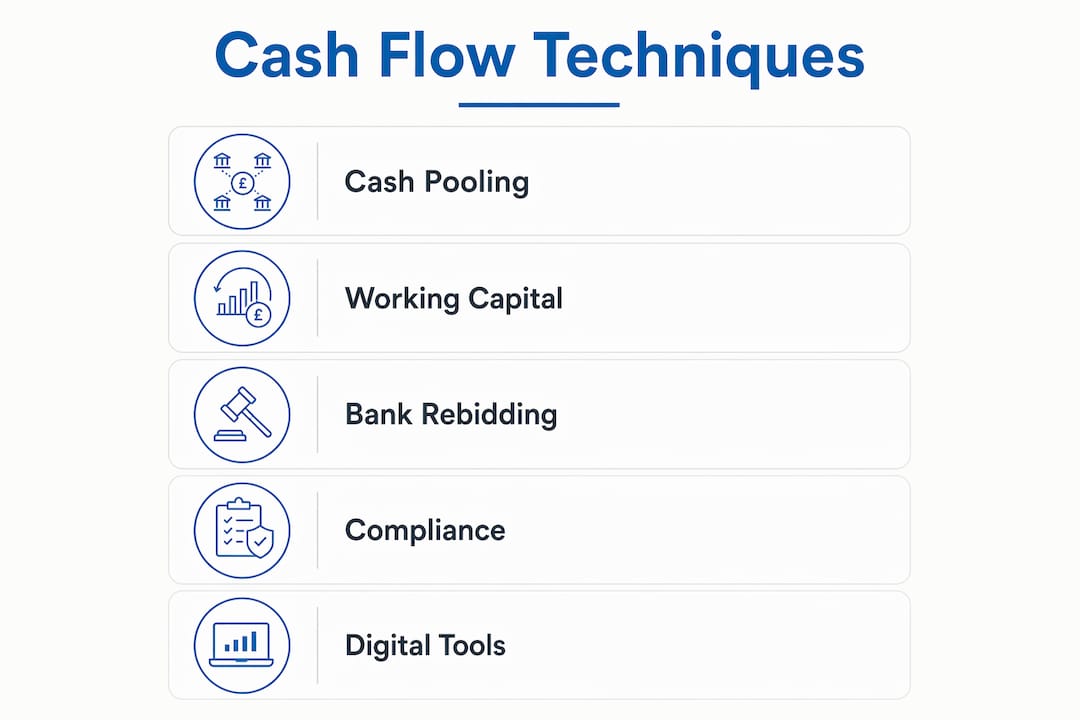
The importance of treasury support to cash flow efficiency cannot be overstated. A business that manages its cash position actively will consistently outperform one that treats banking as a passive administrative task.
What role does treasury support play in regulatory compliance and financial risk?
Treasury support sits at the intersection of financial risk and regulatory obligation. Compliance failures in this area carry direct financial penalties and reputational damage, making this one of the most consequential parts of the treasury support team’s remit.
Key compliance and risk responsibilities include:
- Beneficial ownership disclosure. Regulations require businesses to disclose individuals who hold 25% or more of equity interests when opening or maintaining bank accounts. Treasury support tracks ownership changes and updates disclosures accordingly. Managing banking relationships across jurisdictions adds significant complexity to this obligation.
- Unclaimed property compliance. Dormant accounts and unclaimed balances must be reported and remitted to the relevant authority within statutory timeframes. Treasury support maintains registers and monitors dormancy periods.
- Hedging programmes. Currency, interest rate, and commodity risks are managed through derivative instruments such as forward contracts, interest rate swaps, and options. These instruments require ongoing monitoring and documentation to remain effective and compliant.
- Governance and audit support. Treasury support collaborates with legal and finance teams to produce documentation for internal audit, external audit, and board reporting.
- Real-time risk monitoring. Analytics tools within a TMS provide live exposure data, allowing the team to respond to market movements before they become losses.
Pro Tip: Build a compliance calendar that maps every regulatory deadline across all jurisdictions where your business holds bank accounts. Missing a single beneficial ownership filing can freeze an account at the worst possible moment.
Treasury support teams that treat compliance as a routine process rather than a reactive one consistently avoid the penalties that catch less organised businesses off guard.
How is treasury support evolving with technology and business strategy?
The treasury support function has shifted from a back-office operation to a genuine strategic partner within the business. Treasurers have evolved from operational guardians to strategic navigators who influence corporate strategy and risk management at the highest level. Technology is the primary driver of this change.
Treasury Management Systems now handle tasks that once required entire teams. AI-driven analytics take this further by moving treasury from reactive historical reporting to predictive liquidity and risk management. A treasurer who can model three cash scenarios simultaneously, stress-test a credit facility, and report to the board in real time is delivering a fundamentally different service than one working from spreadsheets.
“The modern treasurer role requires skills in data science, technology architecture, geopolitical analysis, and strategic communication. Treasury is no longer just about managing cash. It is about managing uncertainty at scale.”
The Global Treasurer, 2025
Cross-department collaboration is equally important. Treasury effectiveness depends on breaking silos with procurement, IT, sales, and operations to build a comprehensive financial view. A treasury team that works in isolation will always have incomplete data.
ESG-aligned financing and digital transformation have also entered the treasury support remit. Green bonds, sustainability-linked loans, and supply chain finance programmes all require treasury expertise to structure and monitor. This positions treasury support as a strategic nexus in corporate decision-making, not merely a cash management function.
For UK businesses, particularly those in the tech and fintech sectors, this evolution means treasury support is no longer optional at scale. It is a competitive requirement.
Key takeaways
Treasury support is the operational and strategic backbone that enables a business to manage cash, control risk, and meet regulatory obligations consistently.
PointDetailsCore definitionTreasury support covers cash forecasting, banking administration, risk management, and compliance.Cash flow efficiencyTechniques like cash pooling and automated positioning reduce borrowing costs and manual error.Regulatory complianceBeneficial ownership disclosure and dormant account management carry direct legal and financial risk.Technology shiftTMS and AI tools move treasury from reactive reporting to predictive financial management.Strategic roleModern treasury support collaborates across departments and influences corporate financial strategy.
Why treasury support deserves more attention than most UK businesses give it
Most business owners I speak with treat treasury as something large corporates worry about. That view is wrong, and it costs them money. A growing tech business with £2m in the bank and three banking relationships already has a treasury problem. It just does not know it yet.
The businesses I have seen manage cash most effectively are not necessarily the ones with the biggest finance teams. They are the ones that have built simple, disciplined processes around cash positioning, banking fees, and account management. They close dormant accounts. They review their banking panel. They know their FX exposure before it becomes a loss.
Technology has made this accessible. A well-configured TMS or even a well-structured cloud accounting setup in Xero can give a small business the same visibility that a corporate treasury team had a decade ago. The barrier is not cost. It is awareness.
The skills gap is real too. The data science and geopolitical analysis skills now expected of senior treasury professionals reflect how much the function has changed. For smaller businesses, this means the person managing your cash needs to think strategically, not just administratively. If your finance function is not asking forward-looking questions about liquidity, you have a gap worth addressing.
— Rahamut
How Priceandaccountants supports your treasury and financial management needs

Priceandaccountants works with UK tech businesses, fintech founders, and growing SMEs to bring structure and clarity to financial management. Our advisory and tax planning service acts as an outsourced Finance Director, covering treasury oversight, cash flow planning, and regulatory compliance alongside your core accounting needs. We also help businesses understand their accounting period obligations and how they connect to cash reporting cycles. With over 40 years of expertise and a track record of supporting businesses from pre-seed to Series A, Priceandaccountants gives you the financial rigour that treasury support demands, without the cost of a full in-house team.
FAQ
What is treasury support in simple terms?
Treasury support is the set of activities that help a business manage its cash, banking relationships, and financial risk on a day-to-day basis. It covers cash forecasting, bank account administration, compliance, and risk hedging.
What does a treasury support team do?
A treasury support team manages cash positioning, executes payments, monitors bank accounts, maintains compliance with regulations such as beneficial ownership rules, and supports hedging programmes to control financial risk.
How does treasury support differ from general accounting?
Accounting records what has happened financially. Treasury support manages what is happening with cash right now and plans for future liquidity needs, making it forward-looking rather than historical.
Why is treasury support important for small and medium-sized businesses?
Growing businesses face the same cash flow risks and banking compliance obligations as large corporates, but with fewer resources to manage them. Treasury support processes reduce the risk of cash shortfalls, compliance penalties, and unnecessary banking costs.
What technology does treasury support use?
Treasury support relies on Treasury Management Systems, which automate cash positioning, bank account management, and compliance reporting. AI-driven analytics tools are increasingly used for scenario modelling and predictive liquidity management.
Recommended
- Navigating the UK’s Complex VAT Landscape: A Comprehensive Guide - Price & Accountants
- What is financial reporting: a guide for UK businesses - Price & Accountants
- Bookkeeping best practices for UK tech startups: 2026 guide - Price & Accountants
- Small business tax planning guide 2026 for UK tech - Price & Accountants