

TL;DR:
- UK employers must enroll all eligible workers in a qualifying pension scheme from their first day at work. Setting up and maintaining this process is essential to avoid fines and ensure proper retirement savings.
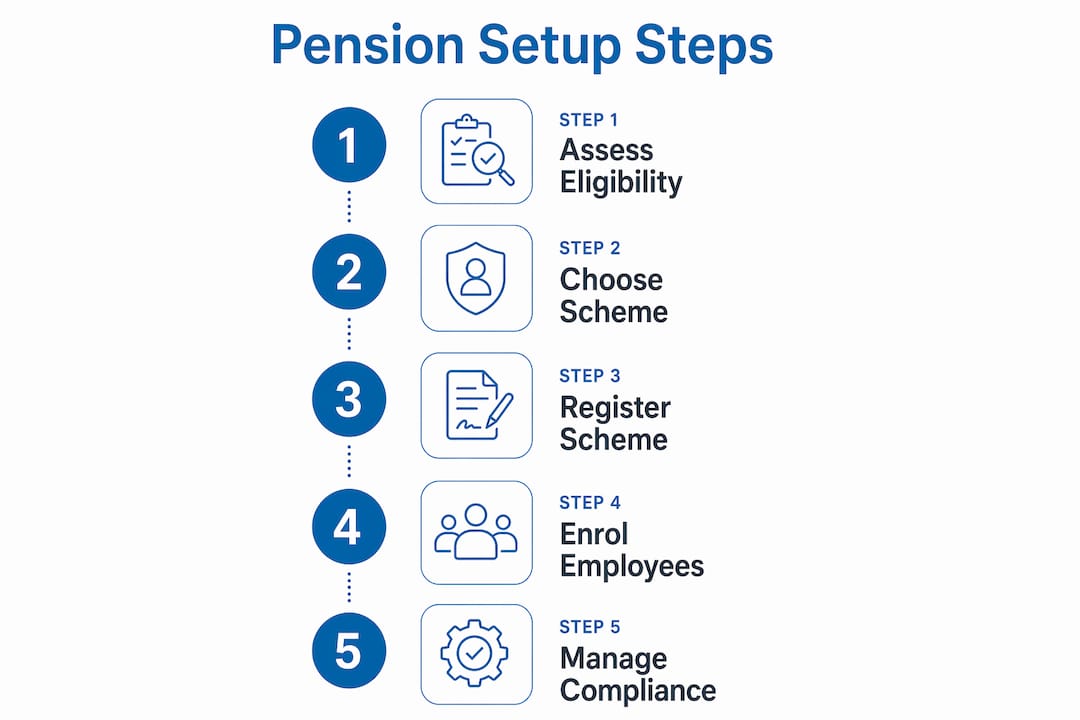
Automatic enrolment is the legal duty requiring every UK employer to enrol eligible workers into a qualifying workplace pension scheme from the first day they begin work. The Pensions Act 2008 established this obligation, and The Pensions Regulator enforces it across all business sizes. For the step by step pension setup for UK SMEs, the process covers five core stages: preparing your payroll, selecting a compliant scheme, assessing employees, communicating enrolment, and managing ongoing compliance. Getting each stage right from the start protects you from fines and keeps your team’s retirement savings on track.
What do UK SMEs need before setting up a pension?
Your duties start on the day your first employee begins work. That date is called your duties start date, and everything flows from it. Setting up your pension scheme before that date is the only way to avoid backdating contributions and the penalties that come with it. Assessing employees from day one is a legal requirement, not a best practice.
Before you register a scheme, you need three things in place:
- Payroll software that supports pension integration. Connecting your pension platform with payroll software prevents manual calculation errors and automates contribution submissions. Xero, for example, integrates directly with several pension providers.
- Employee data. You need each worker’s date of birth, National Insurance number, earnings figure, and UK work status to assess eligibility correctly.
- A clear record of your duties start date. This date anchors every subsequent deadline, including your Declaration of Compliance submission.
Eligibility under the auto-enrolment rules applies to workers aged 22 to State Pension age who earn over £10,000 per year and work in the UK. Workers outside those parameters are not eligible for automatic enrolment, though they may have the right to opt in.
Pro Tip: Set a calendar reminder for your duties start date the moment you hire your first employee. Missing it by even one pay period can trigger a backdating obligation that is time-consuming and costly to correct.

Good recordkeeping is non-negotiable. The Pensions Regulator can request evidence of your assessment process, your communications to employees, and your contribution records at any time. Keep digital copies of all correspondence and payroll outputs.
How do you choose and register a qualifying pension scheme?
A qualifying pension scheme must meet the standards set out in the Pensions Act 2008. The scheme must accept all eligible workers, meet minimum contribution thresholds, and be registered with HMRC. Not every pension product on the market meets these criteria, so you cannot simply pick any provider.
For most SMEs, the practical options fall into two broad categories:
- Government-backed schemes. NEST (National Employment Savings Trust) is free to set up, must accept every employer regardless of size, and integrates with most payroll software. It carries no setup fees and manages online enrolment and contribution collection directly.
- Commercial master trusts and group personal pensions. These are offered by insurance providers and pension specialists. They often provide more flexibility in investment options but may carry setup or administration charges.
FeatureGovernment-backed (e.g. NEST)Commercial master trustSetup feeNoneVaries by providerMust accept all employersYesNot alwaysPayroll integrationStandardVariesInvestment flexibilityLimitedHigherBest suited forSMEs needing simplicityBusinesses with specific investment needs
Once you select a scheme, register it with The Pensions Regulator through your online account. You will need your PAYE reference number and your duties start date. Registration is separate from your Declaration of Compliance, which comes later.
Pro Tip: NEST is the default choice for most SMEs starting out. Its zero setup cost and universal acceptance remove two of the biggest barriers to getting a scheme in place quickly.
Check that your chosen scheme’s contribution structure aligns with the legal minimums before you finalise registration. The minimum total contribution is 8%, split as at least 3% from the employer and 5% from the employee.
How do you assess and enrol your employees?
Employee assessment is the process of categorising every worker by age and earnings to determine what pension rights they hold. You must run this assessment on the first day of employment and repeat it every pay period, because a worker’s status can change as their earnings fluctuate.
The three categories are:
- Eligible jobholders. Aged 22 to State Pension age, earning over £10,000 per year, working in the UK. You must automatically enrol these workers without waiting for them to ask.
- Non-eligible jobholders. Aged 16–21 or State Pension age to 74, or earning between £6,240 and £10,000 per year. They can opt in and receive employer contributions if they do.
- Entitled workers. Aged 16–74, earning under £6,240 per year. They can join a pension scheme but are not entitled to employer contributions.
Once you identify eligible jobholders, enrolment must happen promptly. The legal process runs as follows:
- Enrol the worker into your qualifying scheme from their first eligible pay period.
- Notify the worker of their enrolment status within 6 weeks of their start date or the date they become eligible.
- Allow a one-month opt-out window from the date of enrolment or the date they receive their enrolment letter, whichever is later.
- Process any opt-out requests promptly. If a worker opts out within the window, you must refund all contributions deducted from their pay.
- Re-enrol any opted-out workers every three years at your re-enrolment date.
Pro Tip: Do not rely on employees to tell you when their earnings cross the £10,000 threshold. Your payroll software should flag eligibility changes automatically each pay period. If it does not, that is a gap in your compliance process.
Workers who opt out must be re-enrolled at the three-year cycle regardless of their wishes. They can opt out again, but you cannot simply leave them out permanently.
How do you manage contributions, submissions, and ongoing compliance?
Contribution management is where many SMEs slip up. The minimum total contribution is 8% of qualifying earnings, with at least 3% coming from the employer. Qualifying earnings currently sit between £6,240 and £50,270 per year. Contributions above those thresholds are at the employer’s discretion.
The ongoing compliance cycle works as follows:
- Calculate contributions each pay period. Your payroll software should do this automatically once integrated with your pension provider.
- Submit contributions to your pension provider by the payment deadline. Most providers require payment within a set number of days after each pay period closes. Late payments attract compliance notices and interest charges.
- File your Declaration of Compliance. This must be submitted to The Pensions Regulator within 5 calendar months of your duties start date. Critically, you must file even if you have no eligible workers at that point.
- Manage statutory communications. Every enrolled worker must receive a written enrolment notice. Opted-out workers must receive re-enrolment notices at the three-year cycle.
- Complete re-enrolment every three years. Re-enrol eligible workers who have previously opted out, then submit a new Declaration of Compliance within five months of your re-enrolment date.
Compliance taskDeadlineEmployee assessmentFirst day of employment and every pay periodEnrolment notification to workerWithin 6 weeks of eligibilityOpt-out window closes1 month from enrolment or letter dateDeclaration of ComplianceWithin 5 months of duties start dateRe-enrolment cycleEvery 3 years from duties start date
The Pensions Regulator issues fixed penalty notices starting at £400 for missed declarations. Persistent non-compliance escalates to daily fines. The declaration of compliance is a recurring duty, not a one-off task. It repeats at every three-year re-enrolment cycle for the lifetime of your business.
For a broader view of your payroll obligations alongside pension duties, the payroll compliance checklist from Priceandaccountants covers both areas in detail.
Key takeaways
Setting up a compliant workplace pension for a UK SME requires acting from day one, selecting a qualifying scheme, and maintaining a structured three-year compliance cycle.
PointDetailsAct from day oneYour pension duties begin the moment your first employee starts work.Choose a qualifying schemeNEST is free, universal, and integrates with payroll software, making it the practical default for most SMEs.Assess every pay periodEmployee eligibility can change as earnings fluctuate, so assessment must run with every payroll cycle.File the Declaration of ComplianceSubmit to The Pensions Regulator within 5 months of your duties start date, even with no eligible workers.Re-enrol every three yearsOpted-out workers must be re-enrolled at the three-year cycle, followed by a new Declaration of Compliance.
Why I think most SMEs get pension setup wrong from the start
The most common mistake I see is treating pension setup as a task to complete after the first payroll has already run. By that point, you are already behind. The legal duty starts on day one, and backdating contributions is a genuinely painful process that eats into time and cash you cannot afford to lose.
The second mistake is the “set and forget” attitude. Proactive management of pension duties is what separates compliant businesses from those receiving penalty notices. A worker’s earnings can cross the £10,000 threshold mid-year. A new hire can join at 22 and immediately trigger enrolment. These events happen quietly, and if your payroll software is not flagging them, you will miss them.
My honest advice: integrate your pension platform with your payroll software before your first employee starts. Manual contribution calculations are error-prone and unnecessary when automation handles it reliably. Diary your Declaration of Compliance deadline and your three-year re-enrolment date the moment you know your duties start date. Treat those dates with the same seriousness as a tax filing deadline, because the penalties are just as real.
Pension compliance is not complex once the system is in place. The difficulty is getting the system in place before the clock starts. That is where most small business owners lose ground.
— Rahamut
How Priceandaccountants supports UK SMEs with pension compliance
Pension setup sits inside a wider set of payroll and compliance obligations that grow quickly as your team grows. Priceandaccountants handles auto-enrolment duties, contribution management, and Declaration of Compliance filings as part of its payroll and pension services for UK SMEs.

With over 40 years of expertise and a track record supporting businesses from pre-seed to Series A, Priceandaccountants acts as your finance partner rather than just a filing service. If you want pension compliance handled correctly from day one, the accounting services team is ready to take it off your plate. Reach out today to discuss your specific situation.
FAQ
What is automatic enrolment for UK employers?
Automatic enrolment is the legal duty to enrol eligible workers into a qualifying workplace pension scheme without waiting for them to ask. It applies from the first day an employee begins work.
Who qualifies for automatic enrolment?
Workers aged 22 to State Pension age who earn over £10,000 per year and work in the UK must be automatically enrolled. Workers outside those parameters have opt-in rights but are not enrolled automatically.
What is the minimum pension contribution for UK SMEs?
The minimum total contribution is 8% of qualifying earnings, with at least 3% paid by the employer and 5% by the employee. Qualifying earnings are currently banded between £6,240 and £50,270 per year.
When must the Declaration of Compliance be filed?
The Declaration of Compliance must be submitted to The Pensions Regulator within 5 calendar months of your duties start date. You must file even if you have no eligible workers at that time.
How often do employers need to re-enrol workers?
Employers must re-enrol eligible workers who have opted out every three years from the original duties start date. A new Declaration of Compliance must be submitted within five months of each re-enrolment date.