

TL;DR:
- Management accounts are internal reports that provide current insights into a business’s performance for decision-making. They include key components like profit and loss, balance sheet, cash flow, variance analysis, and tailored KPIs, helping owners track progress and identify risks. Unlike statutory accounts, management accounts are flexible, timely, and used monthly or quarterly to prevent financial drift and support strategic actions.
Management accounts are internal financial reports that give business owners a current, accurate picture of how their company is performing. Unlike statutory accounts, which look backwards and satisfy legal obligations, management accounts are built for decision-making right now. With 23,938 registered company insolvencies recorded in England and Wales in 2025, the cost of ignoring timely financial data is not abstract. Management accounts sit between daily bookkeeping and annual compliance, turning raw numbers into the kind of insight that helps you act before problems become crises.
What are management accounts and what do they contain?
Management accounts are flexible, customised internal reports tailored specifically to help business owners and managers make decisions. They are not regulated by the Companies Act or FRS 102. That means you choose the format, the frequency, and the level of detail that suits your business.
The core components of management accounts typically include:
- Profit and loss (P&L) statement. This tracks income, expenses, and profitability over a set period. A well-prepared profit and loss account shows whether your business is generating surplus or burning through margin.
- Balance sheet. A snapshot of assets, liabilities, and equity at a point in time. It tells you what the business owns, what it owes, and what is left for shareholders.
- Cash flow statement. This tracks the movement of cash in and out of the business. Understanding your cash flow position is the difference between a profitable business that survives and one that collapses despite strong sales.
- Variance analysis. This compares actual results against your budget or forecast. The gap between what you planned and what happened is where the real management insight lives.
- Key performance indicators (KPIs). These are metrics tailored to your goals, such as gross profit margin, customer acquisition cost, debtor days, or stock turnover.
Core management account componentsCore management account components include P&L statements, balance sheets, cash flow statements, variance analysis, and customised KPIs. Each component answers a different question, and together they give you a complete view of business health.
Pro Tip: Choose no more than five to seven KPIs for your management accounts. Too many metrics dilute focus. Pick the ones that directly reflect your biggest risks and opportunities.

How do management accounts differ from statutory financial accounts?
The clearest way to understand the difference is through an analogy. Financial statements are like a car’s MOT, proving compliance after the fact, while management accounts are the dashboard gauges giving you real-time readings as you drive. Both matter, but they serve entirely different purposes.
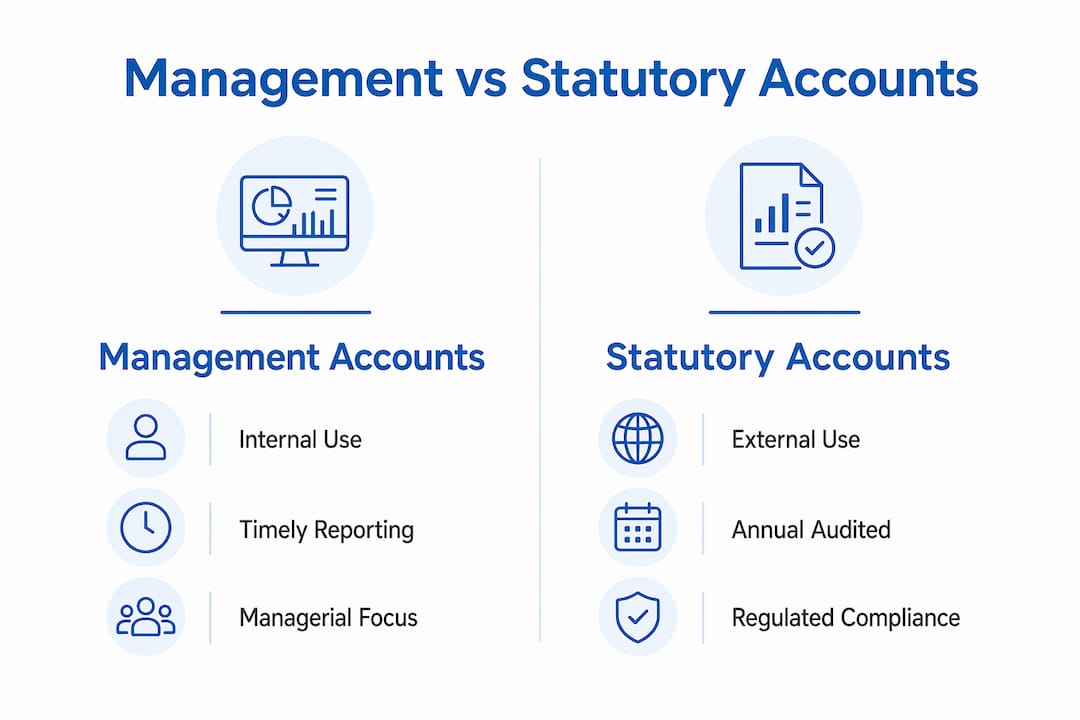
Here is how the two compare directly:
FeatureManagement accountsStatutory accountsAudienceInternal: owners, managers, investorsExternal: HMRC, Companies House, lendersFrequencyMonthly or quarterlyAnnuallyRegulationNone: fully flexibleCompanies Act, FRS 102FocusDecision-making and performanceLegal compliance and historical recordPrecisionEstimates and accruals acceptableAudited accuracy requiredClassificationBy department, project, or productBy statutory headings
Management accounts classify data by managerial needs, such as department, project, or product line, rather than the statutory headings mandated by the Companies Act. That flexibility is precisely what makes them useful. You can drill into the profitability of a single product line or a specific client, something a statutory set of accounts would never show you.
Management accounts rely on accruals and estimates so they can be produced quickly. Statutory accounts must follow the Companies Act 2006 and UK accounting standards, and are audited only if the company does not qualify for audit exemption — most small private companies do (see GOV.UK on audit exemption). Annual accounts are due at Companies House 9 months after the financial year-end, or 21 months after incorporation for a company's first accounts (GOV.UK filing deadlines).
Pro Tip: Do not wait until your management accounts are perfectly reconciled before sharing them with your leadership team. A 95% accurate report delivered promptly beats a perfect one that arrives too late to act on.
For a deeper look at how annual accounts fit alongside management reporting, the distinction becomes clearer when you see both in practice.
Why are management accounts important for UK SMEs?
Management accounts protect UK business owners from financial drift. Drift happens when gradual margin erosion or rising costs go unnoticed until they become critical problems. Without monthly or quarterly reporting, you are steering by memory rather than by data.
The practical benefits for small and medium businesses are significant:
- Early warning signals. Spotting a drop in gross margin in month three is recoverable. Discovering it at year-end is often not.
- Tax planning. Knowing your profit position mid-year lets you make decisions about pension contributions, capital expenditure, or director salary structuring before the tax year closes.
- Pricing confidence. If your management accounts show that a particular service line is running at a loss, you can reprice or exit it. Without that data, you may keep selling at a loss for months.
- Stakeholder confidence. Investors and lenders expect management accounts. A business that cannot produce them on request signals poor financial control, which raises the cost of borrowing or makes funding harder to secure.
- Cash flow visibility. Many profitable businesses fail because they run out of cash. Regular cash flow reporting within your management pack prevents that surprise. Understanding processing fees and cash timing is one area where small businesses often lose money without realising it.
The 2025 insolvency figure of 23,938 companies in England and Wales is not a statistic about bad luck. It reflects what happens when business owners lose sight of their financial position until it is too late to correct course.
How to create and use management accounts effectively
Producing management accounts that actually drive decisions requires more than assembling numbers. The process needs structure, consistency, and the right level of detail for your business.
- Decide your reporting frequency. Monthly reporting suits most growing businesses. Quarterly may work for very small or stable operations. The key is consistency. Irregular reporting breaks the trend data you need for variance analysis.
- Select your KPIs. Choose metrics that reflect your specific business model. A SaaS business tracks monthly recurring revenue and churn. A retailer tracks stock turnover and average transaction value. Generic KPIs produce generic insight.
- Use estimates and accruals. Do not wait for every invoice to be processed before closing your management pack. Accrue for known costs and prepay income where appropriate. This is standard practice and keeps your reports timely.
- Run variance analysis every period. Compare actuals to budget line by line. The variances are the conversation starters. A 15% overspend on marketing or a 10% shortfall in revenue needs an explanation and a response.
- Involve your accountant as a strategic partner. Management accounts transform the accountant’s role from a compliance clerk to a strategic adviser who helps plan for future business needs. Your accountant should be interpreting the numbers with you, not just producing them.
- Integrate cloud accounting tools. Platforms like Xero connect your bookkeeping to your management reporting in near real time. That reduces the manual effort of producing reports and improves accuracy.
Pro Tip: Build your management accounts review into a fixed monthly meeting with your accountant or finance lead. Treat it like a board meeting, even if it is just the two of you. The discipline of a regular review is what turns data into decisions.
Management accountingManagement accounting is a profession focused on partnering in management decision-making and performance management systems. That framing matters. It positions the function not as a back-office task but as a core part of running a business well.
Key takeaways
Management accounts are the most practical financial tool available to UK SME owners, providing timely, decision-ready insight that statutory accounts simply cannot deliver.
- Definition: management accounts are internal reports built for decisions, not legal compliance.
- Contents: P&L, balance sheet, cash flow, budget vs actual and a handful of KPIs.
- Difference from statutory accounts: management accounts use estimates for speed; statutory accounts follow the Companies Act and accounting standards and are filed once a year.
- Why it matters: regular reporting prevents financial drift and supports tax planning, pricing and investor confidence.
- Practical use: a monthly review of variances turns the report into decisions.
Why I think most SMEs are using management accounts wrong
Most business owners I speak with treat management accounts as something their accountant produces and emails over. They glance at the P&L, check whether profit is up or down, and move on. That is a missed opportunity of the first order.
The real value of management accounts is not in the numbers themselves. It is in the conversation the numbers force you to have. When your gross margin drops two percentage points in a single month, that is not just a figure on a page. It is a question that demands an answer: did your costs rise, did your pricing slip, or did your sales mix shift towards lower-margin products? Each answer points to a different action.
Experienced practitioners emphasise that management accounts move the conversation from reporting old news to planning future actions. That shift only happens if you sit down with your accountant and interrogate the variances together. A PDF sent by email does not do that.
The other mistake I see regularly is waiting until the business is in trouble before taking management accounts seriously. By that point, the data confirms what you already feared rather than giving you time to act. The businesses that use management accounts well treat them as a monthly health check, not an emergency diagnostic.
My honest advice: if your management accounts are not changing at least one decision per month, they are not being used properly. Ask your accountant to walk you through the variances. Push for explanations, not just numbers. That is when management accounting becomes genuinely useful.
— Rahamut
How Priceandaccountants supports your management reporting
Producing management accounts consistently takes time, structure, and financial expertise that most SME owners simply do not have spare. Priceandaccountants works with growing UK businesses to produce timely, accurate management packs that go beyond compliance and into genuine business insight.

From bookkeeping to acting as your outsourced finance director, Price & Accountants builds the reporting your business needs to make confident decisions every month. We prepare monthly management packs from your Xero data as part of our virtual finance director service and our Black package (see pricing). If your books aren't up to date yet, start with bookkeeping. Understanding your accounting period and how it shapes your reporting cycle is one of the first things we will clarify with you. Ask us for a sample management pack.
FAQ
What is management accounts in simple terms?
Management accounts are regular internal financial reports that show how a business is performing. They include a P&L, balance sheet, cash flow statement, and KPIs, produced monthly or quarterly to support decisions.
How do management accounts differ from statutory accounts?
Statutory accounts are annual, regulated by the Companies Act and FRS 102, and filed with Companies House. Management accounts are internal, flexible, and produced as often as the business needs them.
Are management accounts a legal requirement in the UK?
Management accounts are not a legal requirement for UK companies. Statutory accounts are the legal obligation, but management accounts are widely recommended as best practice for any business that wants to stay in control of its finances.
How often should a business produce management accounts?
Most growing businesses produce management accounts monthly. Quarterly reporting suits smaller or more stable operations. Consistency matters more than frequency: irregular reporting breaks the trend data needed for variance analysis.
What should management accounts include?
A standard management pack includes a profit and loss statement, balance sheet, cash flow statement, variance analysis against budget, and a set of KPIs tailored to the business and its goals.