

TL;DR:
- Compliance in UK startups involves ongoing adherence to legal, regulatory, and governance obligations from the start of trading.
- Embedding compliance early helps avoid penalties, builds investor trust, and supports sustainable growth.
Compliance in UK startups is defined as the ongoing process of meeting legal, regulatory, and governance obligations that apply from the moment a business begins trading. The role of compliance in UK startups extends well beyond paperwork. It covers frameworks such as the Money Laundering Regulations 2017, the UK GDPR, and Financial Conduct Authority (FCA) expectations under the Senior Managers and Certification Regime (SM&CR). Founders who treat compliance as a foundational business function avoid penalties, protect their reputation, and build the investor trust needed to scale. Those who treat it as an afterthought pay for that decision in enforcement actions, failed due diligence, and lost deals.
What are the core compliance requirements UK startups must fulfil?
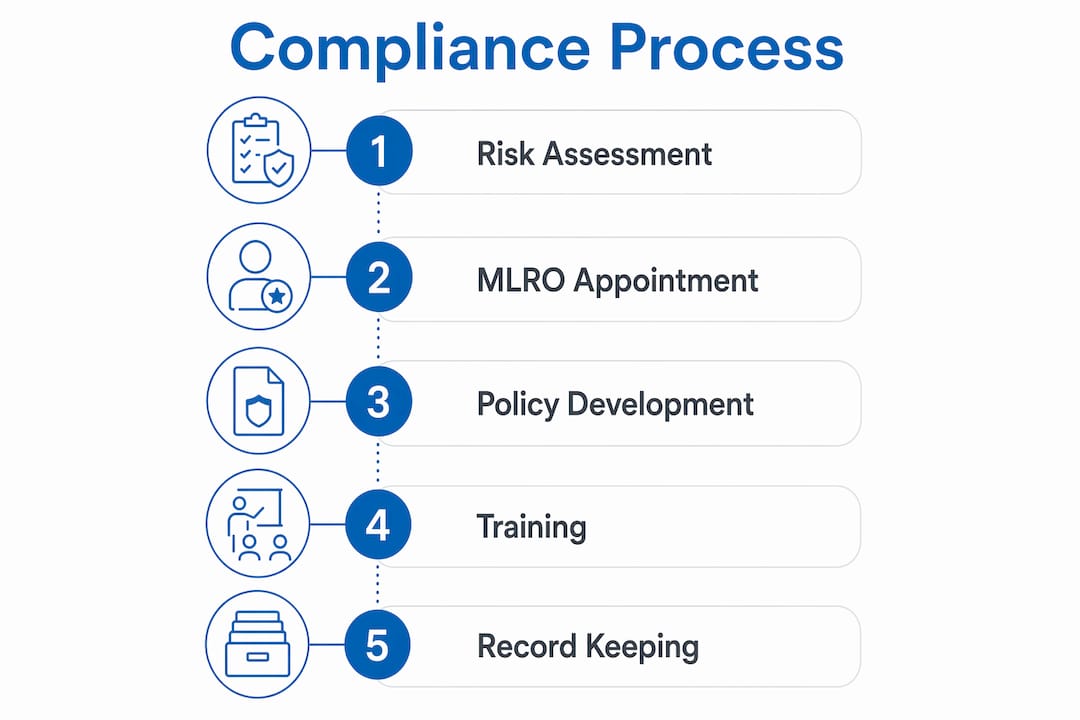
Every UK startup operating in a regulated sector must complete four foundational steps before regulated activity begins. Fintech startups must establish a documented risk assessment, written Anti-Money Laundering (AML) policies, an appointed Money Laundering Reporting Officer (MLRO), and active transaction monitoring capabilities. These are not optional extras. They are minimum requirements under the Money Laundering Regulations 2017 and FCA regulatory expectations.

The MLRO role carries particular weight. The FCA classifies the MLRO as Senior Management Function 17 (SMF17) under SM&CR, requiring a documented appointment with clear operational authority before any regulated activity commences. Delaying this appointment signals governance weakness to regulators and can stall authorisation.
UK GDPR adds a second layer of obligation. GDPR compliance requires thorough documentation, data mapping, lawful processing bases, and subject rights workflows. There is no formal certification, but the documentation itself is the proof. Startups must also define staff roles, run training, and record all data processing activities.
Compliance elementRegulatory basisPurposeFirm-wide risk assessmentMoney Laundering Regulations 2017Identifies and documents AML exposureWritten AML policiesFCA SM&CR expectationsSets internal rules for detecting financial crimeAppointed MLRO (SMF17)FCA Senior Management Function 17Provides accountable oversight of AML obligationsData mapping and processing recordsUK GDPRDemonstrates lawful handling of personal dataSubject rights workflowsUK GDPREnables timely responses to data access requests
For tech founders, the UK business compliance essentials page from Priceandaccountants covers these obligations in detail, including sector-specific requirements.
Pro Tip: Build your compliance framework before you write your first line of product code. Retrofitting AML policies and data workflows into a live product costs far more in time and money than designing them in from day one.
How does compliance governance and culture affect startup success?
Compliance culture is the difference between a policy that exists and a policy that works. A strong compliance culture requires board oversight, tone at the top, and active involvement across every team. When founders treat compliance as a box-ticking exercise, staff follow that lead. The result is a set of documents that satisfy no one during an audit.
Integrating compliance strategically as part of company culture signals maturity and transparency to investors and regulators alike. Startups that embed governance early avoid the growth-compliance tension that derails many Series A candidates. A founder who can demonstrate active compliance oversight during due diligence closes funding rounds faster.
Leadership actions that build a genuine compliance culture include:
- Appointing a dedicated compliance officer or MLRO with real authority, not just a title
- Including compliance as a standing agenda item at board meetings
- Running quarterly staff training on AML, data protection, and relevant sector regulations
- Creating a clear escalation path so staff can raise concerns without fear of retaliation
- Reviewing and updating policies annually or after any material regulatory change
- Documenting every compliance decision, including the reasoning behind it
Pro Tip: Create a named, confidential channel for staff to report compliance concerns. Regulators view the presence of a speak-up culture as evidence of genuine governance, not just paper compliance.
What are the risks of inadequate compliance and how do they impact startups?
Poor compliance management produces three categories of harm: regulatory enforcement, financial loss, and reputational damage. Ineffective compliance management risks litigation, enforcement actions, and financial penalties. Regulators do not treat all breaches equally. The quality and active implementation of a compliance programme directly influences penalty severity.
Regulators assess the quality of a compliance programme when determining enforcement outcomes. A startup with documented policies, active monitoring, and a named MLRO will receive materially different treatment from one with no programme at all. The difference is not just financial. It is existential.
The investor impact is equally serious. Poor record keeping and a lack of compliance evidence can delay or derail customer contracts and investment deals through failed due diligence. A Series A investor conducting legal due diligence expects to see data processing agreements, AML policies, and evidence of staff training. If those records do not exist, the deal stalls or collapses.
Compliance records are not administrative overhead. Compliance records are evidence of lawful handling of privacy, security, and supplier risks. They are the documents that close deals and satisfy regulators. Founders who understand this treat record keeping as a commercial asset, not a legal obligation to be minimised.
For a broader view of how startup tax compliance intersects with these risks, Priceandaccountants has published a dedicated guide for UK founders.
How can startups practically integrate compliance into daily operations?
Practical compliance integration follows a clear sequence. Start with a firm-wide risk assessment that maps your business model, customer types, and transaction flows against known regulatory risks. Document the findings. Then write your AML policies and data protection procedures based on what the risk assessment reveals, not on a generic template downloaded from the internet.
The next step is appointing your MLRO before regulated activity begins. This person needs documented authority, a clear reporting line to the board, and the time to do the job properly. A compliance officer who also runs sales and operations cannot fulfil the role effectively. The FCA will notice.
Technology reduces the manual burden significantly. Automating GDPR workflows improves compliance readiness and closes the hidden gaps that cause regulatory issues or lost deals. Startups relying on manual processes face the greatest risk during audits and customer security questionnaires. Know Your Customer (KYC) checks, transaction monitoring, and data subject access request workflows are all candidates for automation from day one.
Practice areaManual approachTechnology-assisted approachKYC checksPaper forms, manual ID verificationAutomated identity verification platformsTransaction monitoringSpreadsheet-based reviewReal-time monitoring software with alert rulesGDPR subject rightsEmail-based, tracked manuallyAutomated request management workflowsStaff training recordsPaper sign-off sheetsLearning management system with audit trailPolicy version controlShared drive foldersDocument management system with access logs
Record keeping standards matter as much as the policies themselves. Every training session, policy review, risk assessment update, and compliance decision needs a dated record. For data protection guidance relevant to your customer data handling, the practical steps covered at Kipmion Tecnología offer a useful reference point for founders building their first data protection framework.
Pro Tip: Schedule a compliance review into your quarterly board calendar from your first month of trading. Founders who wait until they face an FCA inquiry or a due diligence request to organise their compliance records spend weeks recovering ground they should never have lost.
Key takeaways
Compliance in UK startups is a foundational business function that protects against enforcement, builds investor confidence, and enables sustainable growth when embedded from the outset.
PointDetailsStart before regulated activityAppoint your MLRO and complete your risk assessment before trading begins.Culture beats paperworkPolicies only work when leadership actively enforces and models them.Records close dealsDocumented compliance evidence is what investors and customers check during due diligence.Automate earlyTechnology-assisted KYC and GDPR workflows reduce audit risk and manual error.Compliance is a growth assetEarly governance signals maturity to investors and accelerates funding rounds.
Compliance as a growth lever, not a legal burden
I have worked with founders across the UK tech and fintech space for years, and the pattern is consistent. The startups that struggle most with compliance are not the ones that lack resources. They are the ones whose founders decided, early on, that compliance was something to sort out later.
The uncomfortable truth is that “later” usually arrives at the worst possible moment. It arrives when a Series A investor’s legal team sends a due diligence questionnaire. It arrives when the FCA requests documentation of your AML programme. It arrives when a B2B customer asks for your data processing agreement before signing a contract worth six figures.
What I have seen work is treating compliance the same way you treat product development. You build it iteratively, you document your decisions, and you assign clear ownership. A founder who appoints an MLRO in month one and runs quarterly training is not being bureaucratic. They are building a business that can actually scale without hitting a regulatory wall at the worst possible time.
The startups I have seen reach Series A and beyond share one characteristic. They can open a folder and show an investor exactly how they handle customer data, financial crime risk, and regulatory obligations. That folder is worth more than most founders realise.
— Rahamut
How Priceandaccountants supports UK startups with compliance
Priceandaccountants works with UK tech and fintech startups from pre-seed through to Series A, providing compliance advisory, risk management guidance, and financial planning support tailored to regulated businesses.

The team at Priceandaccountants understands that founders need practical advice, not generic checklists. Whether you need help structuring your AML framework, preparing for FCA authorisation, or ensuring your financial governance is investor-ready, the strategic advisory and tax planning service provides the expert support to get there. With over 40 years of experience and a track record of supporting startups now valued at over £50m, Priceandaccountants acts as your financial growth partner at every stage.
FAQ
What does compliance mean for a UK startup?
Compliance means meeting all legal and regulatory obligations that apply to your business, including AML requirements under the Money Laundering Regulations 2017, UK GDPR, and FCA rules where relevant. It covers policies, records, appointed officers, and active monitoring.
When should a UK startup appoint an MLRO?
The FCA requires an appointed MLRO with documented authority before any regulated activity begins. Delaying this appointment signals governance weakness and can stall FCA authorisation under SM&CR.
How does compliance affect investor due diligence?
Investors and their legal teams check for documented AML policies, data processing records, and evidence of staff training during due diligence. Poor or missing records can delay or collapse a funding round.
What is the biggest compliance mistake UK startups make?
The most common mistake is treating compliance as a bolt-on after the product is built. Compliance failure most often results from treating governance as an afterthought rather than embedding it as a core business function from day one.
Does a UK startup need to be GDPR certified?
UK GDPR does not require formal certification. Compliance is demonstrated through documentation, data mapping, lawful processing records, and subject rights workflows, all of which must be maintained and kept current.
Recommended
- UK business compliance essentials for tech founders - Price & Accountants
- How to set up a UK company: a guide for startup founders - Price & Accountants
- What is startup tax compliance? A UK founders’ guide for 2026 - Price & Accountants
- Why tax compliance fuels startup growth and funding - Price & Accountants