
Your choice of legal business structure shapes how much tax you pay, how much personal risk you carry, and whether investors can back you. In the UK, most entrepreneurs choose between four options: sole trader, general partnership, limited liability partnership (LLP), or private limited company (Ltd). Each sits at a different point on the spectrum between simplicity and protection, and picking the right one from the outset saves you from expensive restructuring later.

What are the main UK business structures?
The four primary structures differ most sharply on two axes: liability and tax.
- Sole trader: You and the business are legally the same. No registration fee, just a Self Assessment sign-up with HMRC. All profits taxed as personal income.
- General partnership: Two or more people share ownership, profits, and unlimited personal liability. Each partner files their own tax return; one files a Partnership Tax Return for the business.
- Limited liability partnership (LLP): Partners gain limited liability protection while retaining the tax transparency of a partnership. Must register with Companies House.
- Private limited company (Ltd): A separate legal entity. Shareholders risk only what they invest. Pays Corporation Tax on profits; directors take salary and dividends.
The administrative burden rises as you move down that list. So does the protection. A sole trader can be trading within days; a limited company carries annual filing obligations that typically cost £1,000–£3,000 per year in accountancy fees alone.
Operating as a sole trader: what you gain and what you risk

The sole trader structure is the simplest way to start a business in the UK. You register for Self Assessment with HMRC, there is no fee, and you keep every decision to yourself. For freelancers, consultants, and early-stage service businesses, that simplicity is genuinely attractive.
The trade-off is unlimited personal liability. If the business runs into debt, your savings, car, and home are all fair game. Profits are taxed as personal income at varying rates depending on income band, plus Class 4 National Insurance Contributions on profits above the lower threshold.
- No registration fee; just HMRC Self Assessment sign-up
- Unlimited personal liability for all business debts
- Income Tax at 20%, 40%, or 45% plus National Insurance on profits
- No requirement to file accounts publicly
- Full control over all decisions and profit retention
- VAT registration required once taxable turnover exceeds £90,000
One common mistake is skipping a separate business bank account. Mixing personal and business finances creates real headaches at tax time and complicates HMRC audits. It is not a legal requirement, but treating it as one protects your bookkeeping clarity from day one.
Pro Tip: Even as a sole trader, open a dedicated business current account immediately. The discipline of keeping finances separate pays dividends when your Self Assessment deadline arrives.
How do general partnerships and LLPs actually differ?
A general partnership is the default structure when two or more people go into business together without incorporating. Setup is straightforward: register with HMRC, nominate one partner to handle the Partnership Tax Return, and each partner files their own Self Assessment. Profits are split according to whatever arrangement the partners agree, and each partner pays Income Tax on their share.
The liability position is the critical weakness. Every partner carries unlimited joint and several liability, meaning one partner’s bad decision can leave all the others personally exposed. There is no legal separation between the partners and the business.
- Each partner registers individually for Self Assessment
- One nominated partner files the Partnership Tax Return
- Profits taxed as personal income for each partner
- Unlimited joint and several personal liability for all partners
- One partner’s actions legally bind the others
- A written partnership agreement is not legally required but strongly advisable
An LLP changes that liability picture entirely. Members of an LLP have limited liability, protecting personal assets from the partnership’s debts. Tax treatment remains transparent, with each member paying Income Tax on their allocated profits. LLPs must register with Companies House and file accounts annually, which adds administrative overhead compared to a general partnership.
LLPs are particularly well suited to professional services firms: solicitors, architects, and accountants frequently use them because they combine the flexibility of a partnership with meaningful personal asset protection. For a two-person tech startup, though, a limited company usually offers better access to investor funding and formal equity structures.
What does running a private limited company actually involve?
A private limited company is a separate legal entity. It can own assets, enter contracts, and incur debts in its own name. Shareholders are liable only for the value of their unpaid shares, which in practice is often minimal. That separation of personal and business finances is the structure’s defining feature.
Corporation Tax applies to company profits at 19% for profits up to £50,000, rising to 25% above £250,000, with marginal relief in between. Directors typically draw a modest salary (often set at the National Insurance threshold) and take additional income as dividends, which are taxed at lower rates than employment income. That combination can produce meaningful tax savings once profits are healthy.
- Register with Companies House (small fee applies) and with HMRC for Corporation Tax within three months of starting
- Appoint at least one director and one shareholder (can be the same person)
- File annual accounts, a confirmation statement, and a Corporation Tax return each year
- Maintain a registered office address
- Keep personal and company finances entirely separate
- Compliance costs typically run £1,000–£3,000 per year for accounting and filing
The company’s financial information is publicly visible at Companies House, which some founders find uncomfortable. On the other hand, that transparency often builds credibility with clients and suppliers. Directors also contribute to National Insurance through PAYE on their salary, which feeds into state pension entitlement in a way that dividend income does not.
VAT registration is compulsory for any business, regardless of structure, once taxable turnover crosses £90,000. Below that threshold, registration is voluntary but sometimes worth doing for the credibility it signals to larger clients.
Intellectual property owned by the company belongs to the company, not to any individual director or shareholder. That distinction matters if a founder exits. Under a sole trader or general partnership, IP typically sits with the individual, creating complications when the business changes hands or brings in new partners. Incorporating transfers that ownership cleanly to the entity, making it easier to license, sell, or protect IP as the business grows.
How to choose the right business structure for your situation
The right legal structure depends on four practical questions: how much personal risk you can absorb, what your profit expectations look like, whether you need external investment, and how much administrative work you are willing to take on.
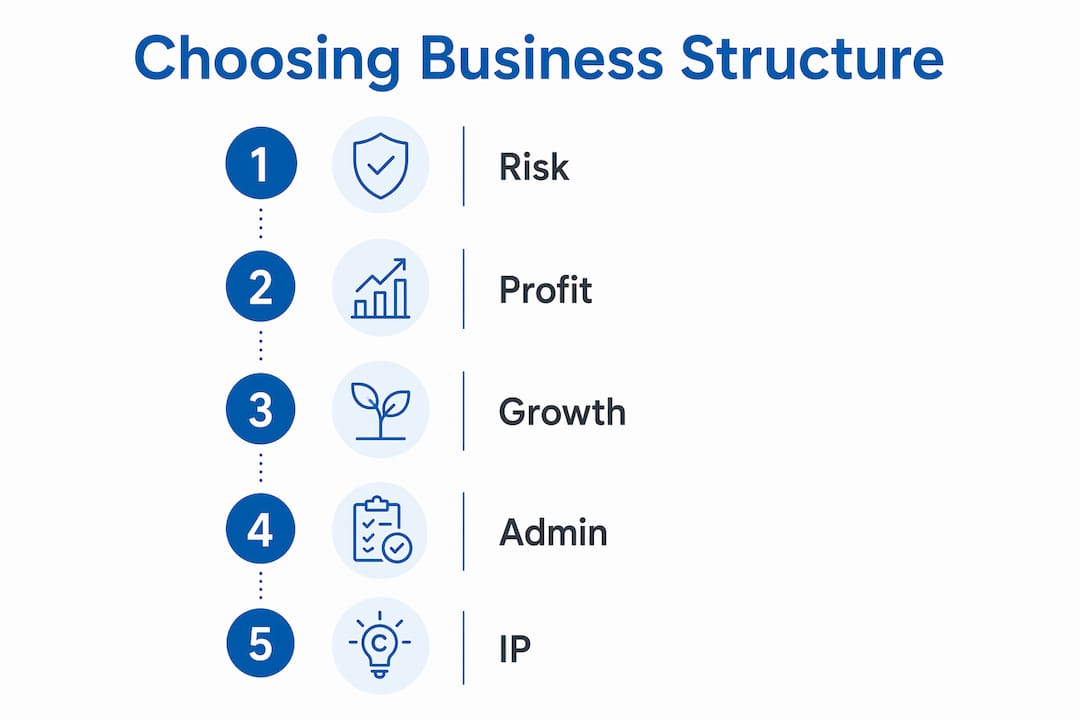
Liability tolerance. If your business involves significant financial risk, client contracts with large potential liabilities, or physical assets, limited liability protection is worth the extra compliance burden. High-risk ventures should treat incorporation or an LLP as close to mandatory. Low-risk solo services can often manage with professional indemnity insurance instead.
Tax efficiency thresholds. Sole traders and partners pay Income Tax on all profits from the first pound. Once annual profits reach roughly £30,000–£50,000, the corporate tax structure of a limited company typically produces better after-tax outcomes. Below that level, the compliance costs of a limited company can outweigh the tax savings.
Funding and ownership. If you plan to raise external investment, incorporation is not optional. Schemes like SEIS and EIS, which reduce risk for early investors, are accessible only through private limited companies. Equity splits, vesting schedules, and shareholder agreements are also far cleaner in a limited company than in a general partnership.
Administrative capacity. Be honest about how much time and money you can devote to compliance. A sole trader’s obligations are genuinely light. A limited company’s are not. If you are a one-person operation in the early stages, starting as a sole trader and incorporating later is a well-trodden path.
- Assess your personal liability exposure before choosing
- Model your expected profits against the tax cost of each structure
- Consider whether you need SEIS or EIS access for investor funding
- Factor in the annual cost of accountancy and Companies House filings
- Check grant eligibility: some government funding programmes favour incorporated businesses
- Changing structure later is possible but carries costs and administrative complexity
- Seek professional advice before committing, particularly if co-founders are involved
Pro Tip: Review your business structure every time you hit a significant milestone: first £50,000 in profit, first external investor conversation, or first employee. What worked at launch may not serve you at scale.
Strategic pitfalls that catch founders off guard
“Business structure is not a mere formality. It is a foundational decision that shapes your growth trajectory, your risk exposure, and your ability to raise capital. Getting it wrong at the start is far more expensive than getting professional advice before you begin.” — Johnson & Boon Solicitors
The most common mistake is treating structure as a one-off administrative tick-box. Founders who choose a sole trader setup for convenience and then try to bring in investors two years later face a full incorporation process mid-stride, with all the legal and tax complexity that entails.
Co-founder disputes are another area where structure choice bites hard. General partnerships offer almost no formal mechanisms for managing exits or disagreements. A limited company, by contrast, can use shareholders’ agreements and vesting conditions to protect all parties if someone leaves. That legal scaffolding is worth building from day one if there are multiple founders.
Mixing personal and business finances is a persistent problem across all structures, but it is most damaging for sole traders. Without a clear boundary, HMRC investigations become harder to navigate and bookkeeping accuracy suffers. Keeping finances separate is not just good practice; it is the baseline for any credible business.
Finally, do not underestimate the pension implications of your structure choice. Sole traders and partners pay Class 4 National Insurance but do not build entitlement to employer pension contributions. Directors of limited companies can make employer pension contributions through the company, which are deductible against Corporation Tax and do not count as a personal benefit in kind. Over a career, that difference compounds considerably.
Pro Tip: If you are incorporating, set up your company accounts and accounting policies from day one rather than retrofitting them later. Clean records from the start make every subsequent filing faster and cheaper.
Who owns your intellectual property under each structure?
IP ownership follows the legal entity, not the individual behind it. As a sole trader, you personally own all intellectual property your business creates: trademarks, copyrights, software, and trade secrets. That is clean and simple while you are the only person involved, but it creates complications if you want to sell the business or bring in a partner, because the IP transfer has to be handled separately from any business sale.
In a general partnership, IP ownership depends on what the partnership agreement says. Without a written agreement, disputes over who owns jointly created work can become genuinely messy. An LLP or limited company removes that ambiguity: IP belongs to the entity, which continues to exist regardless of changes in membership or shareholding.
For tech founders and anyone building a product, this point is not abstract. Investors conducting due diligence will ask who owns the IP. If the answer is “the founder personally, not the company,” that is a red flag that delays or kills funding rounds. Incorporating early, and assigning any pre-incorporation IP to the company formally, is standard practice for startups seeking external capital.
Key takeaways
The right UK business structure depends on your liability tolerance, profit level, and growth ambitions, not just administrative convenience.
PointDetailsLiability is the first filterSole traders and general partners carry unlimited personal liability; LLP members and Ltd shareholders do not.Tax efficiency shifts at scaleA limited company’s Corporation Tax rates typically outperform Income Tax once profits reach a certain threshold.Investors require incorporationSEIS and EIS tax relief schemes are only accessible through private limited companies, making a Ltd essential for fundraising.Compliance costs are realLimited companies typically spend £1,000–£3,000 per year on accounting and filing obligations.IP belongs to the legal entityUnder a limited company, intellectual property sits with the business, not the founder, which simplifies future investment and sale.
How Priceandaccountants can help you decide

Choosing the wrong structure costs more to fix than getting it right first time. At Priceandaccountants, we work with tech founders, growing SMEs, and international entrepreneurs to match their legal structure to their actual growth plans, not just their immediate situation. From strategic tax planning to full incorporation support and ongoing compliance, we handle the complexity so you can focus on building. If you are at the point of choosing or reconsidering your structure, speak to our team before you commit.