

TL;DR:
- Financial runway indicates how many months a business can operate before running out of cash, calculated by dividing cash on hand by net burn rate.
- Founders should frequently update their runway through weekly bank reconciliations and monthly forecasts, incorporating scenario planning to respond to changing conditions.
Financial runway is the number of months your business can keep operating before it runs out of cash. The core formula is simple: cash on hand ÷ monthly net burn rate = months of runway. For example, if you have a certain cash balance and your net monthly spending rate is known, dividing these gives your months of runway.
- Act now: run the calculation today using your latest bank balance and last month’s net cash outflow.
- Caution: a single snapshot can mislead you — one-off expenses or delayed receipts distort the number, so treat it as a starting point, not a verdict.
- Next step: build a 90-day rolling cash forecast to turn a static figure into a live decision tool.
Table of Contents
- How do you calculate financial runway step by step?
- Net burn versus gross burn: why the distinction matters
- Worked examples you can copy into a spreadsheet
- What counts as a ‘good’ runway for your startup?
- How to extend your runway: practical levers
- How often should you update your runway forecast?
- Common mistakes and red flags investors notice
- Your pre-meeting checklist for your accountant or FD
- Key takeaways
- The metric that tells you everything else
- How Priceandaccountants helps founders take control of their cash
- Useful sources and further reading
How do you calculate financial runway step by step?
The calculation has three inputs: cash on hand, gross burn, and net burn. Get these right and the rest follows.
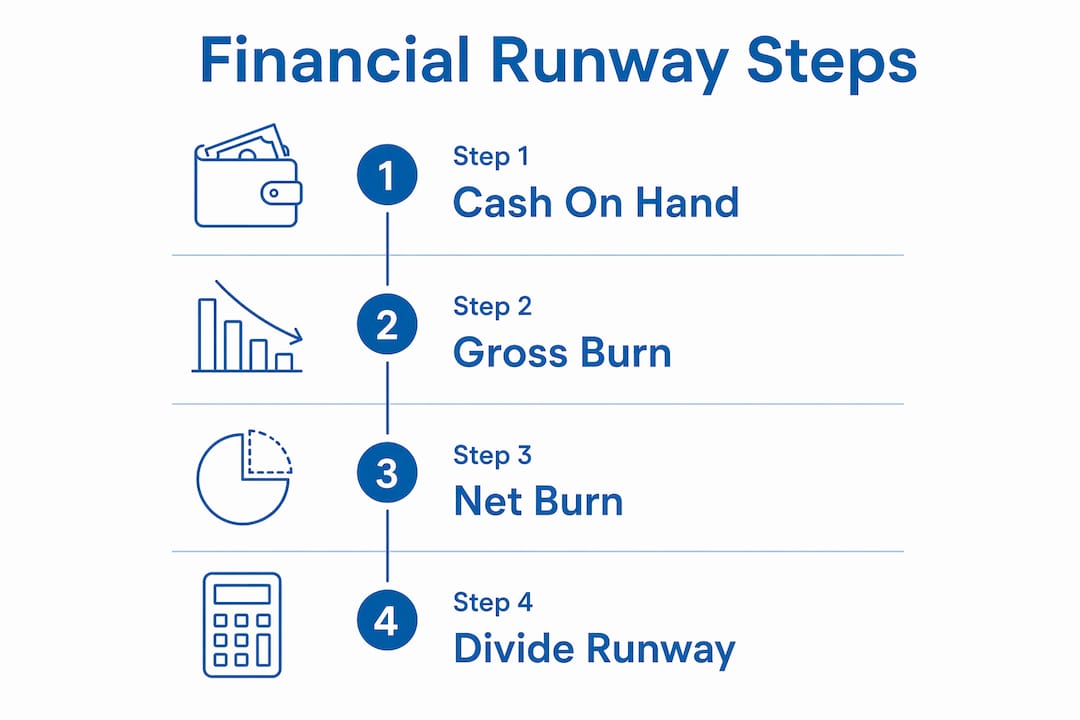
Step 1 — Establish cash on hand. Count only money that is immediately accessible: current account balances, instant-access savings, and liquid short-term deposits. Exclude anything not yet received, including anticipated fundraising rounds that have not yet closed. A term sheet is not cash.
Step 2 — Calculate gross burn. Add up every cash payment leaving the business in a typical month: salaries, rent, software subscriptions, supplier invoices, loan repayments. This is your total monthly cash outflow before any income arrives.

Step 3 — Calculate net burn. Subtract your monthly cash receipts (actual payments received from customers, not invoices raised) from gross burn. Net burn = gross burn − cash inflows. This is the figure that goes into the runway formula.

Step 4 — Divide. Cash on hand ÷ monthly net burn = months of runway.
Two edge cases are worth knowing. If net burn is negative, you are cash-flow positive that month and runway is theoretically infinite — but do not bank on that continuing. If net burn is zero, the same logic applies: treat it as a temporary state and model what happens when it shifts.
Pro Tip: Reconcile your bank statement to your accounting ledger before you run the calculation. Unreconciled transactions are the single most common reason founders end up with a runway figure that is weeks off.
Net burn versus gross burn: why the distinction matters
Gross burn is the total cash leaving the business each month. Net burn is what remains after subtracting cash actually received. For a pre-revenue startup, the two figures are identical. For any business with customers paying, they diverge — and using gross burn instead of net burn overstates how fast you are depleting cash.
The practical difference is significant. A startup spending a given amount per month but collecting some cash from early customers will have a net burn that reflects the difference. This net burn, when compared to cash balance, determines months of runway, which can be significantly longer than if gross burn were used. The decision to raise now versus in three months could hinge on that gap.
Three common miscounts that distort the figure:
- Timing of receipts: an invoice raised in March but paid in May is not March income. Count cash when it lands in your account.
- One-off expenses: a one-time legal fee or equipment purchase inflates a single month’s gross burn. Strip it out when calculating a representative monthly figure, then model it separately.
- Capital purchases: buying a laptop or server is a cash outflow but not an operating expense. Misclassifying it as burn inflates your monthly rate.
Never include fundraising you expect but have not yet received as part of your available cash. Investors and advisers consistently flag this as the most dangerous calculation error founders make — it produces a runway figure that looks safe while the real clock is ticking faster.
Worked examples you can copy into a spreadsheet
Three scenarios cover most founder situations.
Example A: pre-revenue startup
ItemAmountCash on handa certain amountGross burn (monthly)a certain amountCash inflows (monthly)noneNet burnequals gross burnMonths of runwaya relatively low number
No revenue means gross and net burn are the same. Six months is tight — this founder needs to act.
Example B: revenue-generating startup
ItemAmountCash on handa certain amountGross burn (monthly)a certain amountCash inflows (monthly)a certain amountNet burngross burn minus cash inflowsMonths of runwaydepends on net burn and cash on hand
The worked example confirms the formula: £200,000 ÷ £18,000 = 11.1 months. Enough breathing room to plan a raise without panic.
Example C: seasonal business
A business with fluctuating monthly receipts (say, £5,000 in January but £20,000 in April) should average inflows over the last three to six months rather than using a single month. Calculate a representative net burn, then model a downside scenario using the lowest recent monthly inflow.
To adapt these templates for weekly tracking, divide monthly net burn by 4.3 to get a weekly burn figure. For quarterly planning, multiply monthly net burn by 3 and compare against your current cash balance.
What-if testing: change one input at a time. Reduce gross burn by £3,000 and see how many months you gain. Add a new revenue stream of £5,000 per month and recalculate. This is scenario planning in its simplest form.
What counts as a ‘good’ runway for your startup?
The raw number only makes sense in context. Stage, industry, and your next planned milestone all shift what “enough” looks like.
RunwaySituationTypical founder actionShort runwayCriticalImmediate cost cuts and emergency fundraisingModerate runwayTight but manageableBegin fundraising now; cut non-essential spendLonger runwayHealthyPrepare materials; start investor conversationsExtended runwayStrongFocus on milestones; raise from a position of strength
Investors and CFOs use months of runway to judge fundraising timing and negotiating power. Fewer than six months and you are raising under duress — terms will reflect that. Twelve to eighteen months is where most advisers suggest starting a formal process, giving you enough time to run a proper round without the clock forcing your hand.
A hardware startup with significant tooling expenses needs more buffer than a SaaS business with low marginal costs. A founder targeting an early funding round in a tight market should carry more runway than one in a buoyant funding environment. These qualitative benchmarks are a starting point; your financial metrics and milestone plan determine the right number for your situation.
How to extend your runway: practical levers
When the number is too low, you have three categories of lever: cut costs, accelerate revenue, or bring in capital. The fastest wins usually come from fixed costs.
Immediate actions (this week):
- Audit every recurring subscription and cancel anything not directly tied to revenue.
- Pause or delay any planned hires that are not blocking current revenue.
- Renegotiate payment terms with key suppliers — 30 days to 60 days on payables adds meaningful float.
- Chase outstanding receivables personally; a phone call recovers cash faster than a reminder email.
30-day priorities:
- Review your largest fixed cost lines (rent, payroll, software licences) and identify which can be renegotiated or restructured.
- Launch a quick monetisation move: an annual prepay discount, a small pilot contract, or a new pricing tier.
- Explore bridge financing or a convertible note with existing investors before approaching new ones.
90-day priorities:
- Model three scenarios (best, base, downside) and identify the fundraising trigger point for each.
- Investigate UK-specific options: R&D tax credits can return meaningful cash to innovative businesses, and SEIS/EIS structuring can make your raise more attractive to early investors.
- Review grant eligibility via Innovate UK and sector-specific programmes.
Operational focus on fixed versus variable costs determines how quickly you can move the needle. Fixed costs — rent, salaries, annual contracts — are harder to cut but deliver the largest immediate impact when you do. Variable costs give you flexibility but rarely shift the runway figure dramatically on their own.
Pro Tip: Before cutting headcount, model the revenue impact of losing that person. Cutting a sales hire to save £4,000 per month is a poor trade if they were generating £10,000 in pipeline.
How often should you update your runway forecast?
A single monthly calculation is not enough. A rolling 90-day cash forecast with weekly updates gives far better operational control than a snapshot taken once a month.
A practical cadence looks like this: reconcile your bank account weekly, reforecast monthly using actual receipts and payments, and run strategic scenario planning quarterly. The weekly reconciliation catches timing surprises — a large invoice paid late, a direct debit pulled early — before they become a crisis.
Model at least three scenarios: a base case using current trends, a downside case (a key customer delays payment, a contract falls through), and a fundraising timing scenario that maps when you need to close a round against your runway thresholds. For fundraising timing, build scenario-based runways and start the process at 9–12 months runway so you can close before you drop below 3–6 months.
Cloud accounting tools like Xero, connected to a simple cash-flow spreadsheet, make this modelling faster. Real-time bank feeds reduce reconciliation time and mean your runway figure reflects this week’s balance, not last month’s. For more on setting this up, the guide on why financial forecasting matters for UK businesses covers the practical workflow.
Common mistakes and red flags investors notice
The most dangerous runway errors are not arithmetic mistakes. They are classification errors and wishful thinking.
Common founder mistakes:
- Counting a signed term sheet or verbal commitment as available cash.
- Using P&L profit figures instead of actual cash movements — your P&L may look fine while your bank balance is shrinking because receipts lag payables.
- Forgetting a large near-term capital spend (a server upgrade, a trade show deposit) that will hit in the next 60 days.
- Calculating burn from a month with unusual one-off costs and treating it as representative.
Investor red flags:
- Fewer than six months of runway at the start of a fundraising conversation.
- A pattern of last-minute emergency rounds that suggests poor cash visibility.
- Burn increasing without a clear milestone plan that justifies the spend.
Cleaning checklist before you present runway to an investor: reconcile your bank statement, remove one-off items from your burn calculation, reclassify any capital purchases, and maintain a simple 13-week cash calendar showing expected inflows and outflows. Understanding financial risk at this level of granularity is what separates founders who raise confidently from those who scramble.
Your pre-meeting checklist for your accountant or FD
Arriving prepared turns a 90-minute meeting into a 45-minute one. Bring these documents:
- Latest three months of bank statements (all accounts, including any reserve accounts).
- Your cashbook or bookkeeping ledger, reconciled to the bank.
- Aged receivables and aged payables reports.
- A payroll summary showing total monthly employer cost (salaries plus National Insurance and pension contributions).
- A list of any planned capital expenditure in the next 90 days.
Questions worth asking in the meeting:
- What assumptions are you using for my runway calculation, and how sensitive is it to a 20% drop in receipts?
- Which cost lines can realistically be reduced in the next 30 days?
- Am I eligible for R&D tax credits, and what cash timing should I expect from a claim?
- Is my current share structure ready for SEIS or EIS investment?
- Are there any Innovate UK or sector grants I should be applying for now?
Services you may want to request: a bookkeeping clean-up before the calculation, monthly management accounts, a 13-week cash forecast, R&D tax credit work, or SEIS/EIS setup. For founders just getting their books in order, the guide on accounting for start-ups is a useful starting point before the meeting.
Pro Tip: Bring a one-page summary of your last three months of actual cash movements. An adviser who can see the pattern immediately gives you sharper advice in half the time.
For broader small business financial planning context, including cash management frameworks that apply beyond runway, that resource covers the fundamentals clearly.
Key takeaways
Financial runway is cash on hand divided by monthly net burn, and every founder should know their number today and update it at least monthly.
PointDetailsCore formulaCash on hand ÷ monthly net burn = months of runway; use net burn, not gross.Update cadenceReconcile weekly, reforecast monthly, run scenario planning quarterly.Healthy benchmark12–18 months is the recommended range to begin a fundraising process with leverage.Extend runway fastRenegotiate fixed costs and chase receivables first; these move the number quickest.PriceandaccountantsPriceandaccountants provides bookkeeping clean-up, management accounts, R&D tax credit claims, and SEIS/EIS setup to help UK founders calculate and extend runway accurately.
The metric that tells you everything else
Runway is the one number that forces honesty. You can argue about growth rates, market size, and product-market fit, but the cash clock does not negotiate. What I find founders consistently underestimate is how much the rhythm of tracking runway matters, not just the calculation itself.
Running the number once a quarter is like checking your fuel gauge only at motorway junctions. The founders who manage cash well treat runway as a weekly discipline, not a fundraising-season exercise. They know their burn to within a few thousand pounds at any given moment, and that knowledge changes how they make decisions about hiring, pricing, and when to start investor conversations.
There is also a subtler point about what runway signals to investors. A founder who walks into a meeting and says “we have 14 months of runway, here is our base and downside scenario, and we plan to start raising at month 9” is demonstrating financial maturity. That is not just reassuring — it shifts the entire tone of the negotiation. Investors price risk into terms, and a founder with clear cash visibility is a lower-risk bet.
The UK context adds one more layer. R&D tax credits, SEIS/EIS structuring, and Innovate UK grants are all legitimate runway-extension tools that many founders either overlook or pursue too late. Getting the right advice early — before the runway gets short — is where the real leverage sits.
How Priceandaccountants helps founders take control of their cash
Knowing your runway number is one thing. Having the clean books, accurate forecasts, and tax-efficient structure to act on it is another.

Priceandaccountants works with UK tech and fintech founders from pre-seed through Series A, providing the financial infrastructure that makes runway management practical rather than theoretical. That means bookkeeping clean-up so your burn figure is trustworthy, monthly management accounts that track cash movements in real time, and outsourced FD support when you need a sharper strategic view. For founders looking to extend runway through the tax system, the team handles R&D tax credit claims and SEIS/EIS structuring, two of the most underused levers available to UK startups.
Having supported over 20 startups through their early-stage processes, some now valued at well over £50m, Priceandaccountants understands what investors expect and what founders actually need. To discuss your runway position and what can be done about it, get in touch with the team for an initial conversation.
Useful sources and further reading
The following resources are worth bookmarking for ongoing runway management:
- Cash runway explained (Corporate Finance Institute) — clear definitions of net and gross burn with formula walkthroughs.
- Cash runway (Wall Street Prep) — worked examples and fundraising timing frameworks.
- Creating a cash runway for your startup (J.P. Morgan) — practical founder guidance on forecasting and scenario planning.
- Cash runway (First Round Review) — investor perspective on benchmarks and negotiating leverage.
- Cash runway (BDC glossary) — concise reference definition.
- Finance guide: cash runway (Rho) — includes a free calculator and downloadable template.
For cloud accounting setup that feeds directly into your runway model, the Priceandaccountants guide on cloud accounting for SMEs explains how a Xero workflow reduces reconciliation time and keeps your cash figures current.
Recommended
- Financial KPIs for startups: the founder’s guide - Price & Accountants
- Financial metrics for tech startups: 2026 investor guide - Price & Accountants
- Essential startup expenses: A founder’s guide to smart budgeting - Price & Accountants
- Securing Seed Funding: Financial Statements that Attract Investors - Price & Accountants