
Yes, you can include R&D subcontractor costs and externally provided worker (EPW) payments in a UK R&D tax relief claim, but the rules differ sharply depending on how the engagement is structured. For SME scheme claimants, unconnected subcontractor payments qualify at 65% of the attributable amount, subject to a “lower of payment and subcontractor relevant expenditure” test under CIRD84200. EPW costs follow a separate route governed by CIRD84100 and CIRD137000, with PAYE status as the critical first test. Get the classification wrong and HMRC will disallow the cost entirely.
Three immediate actions to take now:
Pro Tip: Ask your staff provider in writing: “Do you operate PAYE for this individual, and are charges calculated on a time basis?” A written confirmation of both points is your fastest route to establishing EPW eligibility and will satisfy most HMRC queries at the first stage.
| Point | Details |
|---|---|
| Confirm PAYE status first | Ask your staff provider in writing whether it operates PAYE before treating any payment as an EPW cost. |
| Apply the 65% rule and lower-of test | For unconnected subcontractors, qualifying expenditure is the lower of 65% of your payment and the subcontractor’s own relevant expenditure. |
| Request subcontractor accounts within 12 months | GAAP accounts must reflect the payment within 12 months of your period end for the lower-of test to apply. |
| Keep contemporaneous records | Timesheets, time-based invoices, and project reports assembled at the time of work are far stronger than retrospective reconstructions. |
| Priceandaccountants | Provides full R&D subcontractor cost review, calculation workbooks, and compliance packs for UK SMEs and tech startups. |
HMRC recognises several qualifying cost categories for R&D tax relief. The two most commonly misunderstood are EPWs and subcontracted R&D, and conflating them is one of the most frequent errors in claims.
Externally provided workers are individuals who provide their services personally to your company under a contract between the worker and a staff provider (an agency or umbrella). The key is that the arrangement supplies staff, not a finished output. CIRD137000 makes clear that qualifying EPW expenditure covers the provision of staff time directly engaged on R&D, not recruitment fees or other ancillary services.
Subcontracted R&D is where you pay a third party to carry out R&D activities on your behalf. The subcontractor delivers a result or service, not simply their time.
Other qualifying categories include:
A payment to a self-employed consultant who invoices through their own limited company is generally neither an EPW nor a subcontracted R&D cost in the traditional sense. It falls outside the EPW definition because there is no staff-provider contract, and it may not meet the subcontracted R&D tests either. Mischaracterising these payments is a leading cause of HMRC enquiries.
The HMRC definition of an EPW rests on three conditions, all drawn from CIRD84100:
The practical first check is PAYE. HMRC accepts that a written confirmation from the staff provider that it operates PAYE for the worker is normally sufficient to establish EPW status, without requiring you to inspect the underlying worker contract in detail. Where the provider has no UK permanent establishment, more detailed checks are needed before relying on this shortcut.
Evidence HMRC expects for EPW costs:
Pro Tip: Time-allocated daily logs, rather than weekly summaries, are the single most useful non-obvious evidence item. They demonstrate active supervision and make apportionment straightforward if the worker split time between R&D and non-R&D tasks.
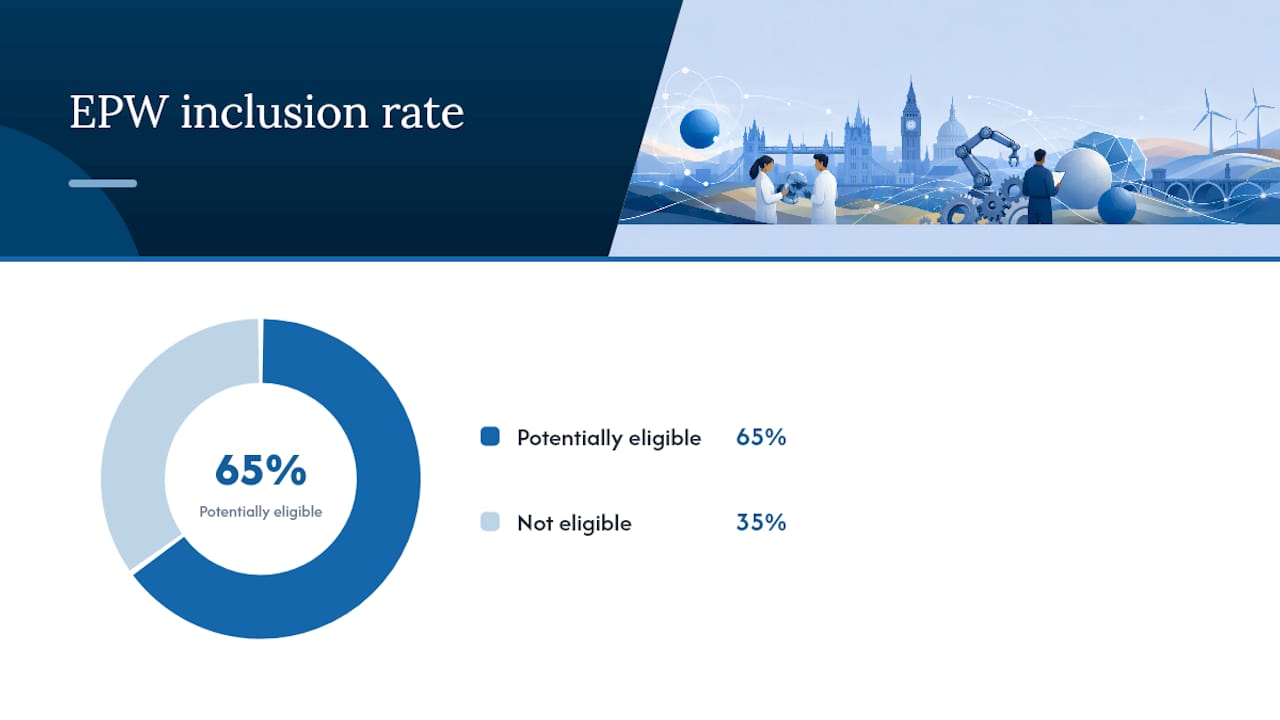
Once EPW status is confirmed, CIRD84000 sets the 65% inclusion rate for unconnected arrangements: only 65% of the payment attributable to qualifying earnings is potentially eligible as qualifying expenditure.
The rules for subcontracted R&D differ between the SME scheme and RDEC, and connected-party status changes the calculation significantly.
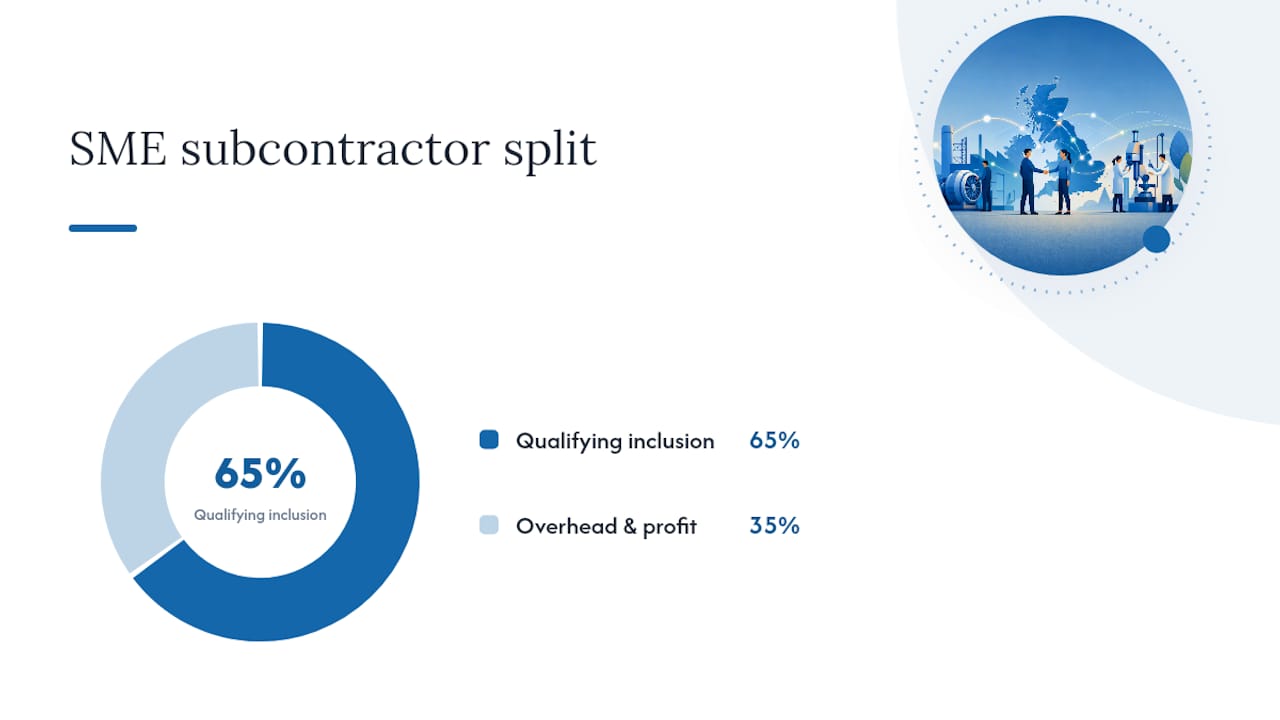
SME scheme (unconnected subcontractor): Under CIRD84200, you may include 65% of the payment attributable to qualifying R&D activities, but only up to the lower of:
The subcontractor must bring the payment into account in its GAAP-compliant accounts within 12 months of your accounting period end.
The 65% rate conceptually strips out the subcontractor’s overhead and profit margin. Practitioners should focus on demonstrating which portion of the invoice relates to qualifying R&D tasks, because that attribution drives both the numerator and the cap.
RDEC (large companies and connected parties): Large companies claiming under RDEC can include subcontractor costs only where the subcontractor is a qualifying body (a university, charity, or similar), an individual, or a partnership. Payments to connected companies follow different rules and may require the connected party to make its own claim rather than the costs passing up the chain.
The connected party’s actual qualifying expenditure becomes the operative figure.
Statistic callout: For SME claimants, the 65% inclusion rule means a £100,000 subcontractor invoice can generate at most £65,000 of qualifying expenditure before the lower-of test is applied.
Scenario: A tech startup pays an unconnected software development agency £80,000 for a project. The agency’s own qualifying expenditure on the project was £45,000.
Step-by-step calculation:
| Step | Amount |
|---|---|
| Invoice total | £80,000 |
| R&D-attributable portion | £60,000 |
| After 65% inclusion rule | £39,000 |
| Subcontractor relevant expenditure | £45,000 |
| Qualifying amount (lower of) | £39,000 |
For an SME with an enhanced deduction, £39,000 of qualifying expenditure generates a meaningful uplift in the R&D addition. For context on current credit rates, see UK R&D claims 2026.
Good recordkeeping is not about volume; it is about having the right document for each test HMRC will apply. Practitioner commentary from LexisNexis confirms that contemporaneous documentation and careful classification are the two factors that most determine whether a claim survives enquiry.
Mandatory records:
Practical recordkeeping habits:
[Supplier]_[Project]_[Period]_[DocType] so any document can be located in under 30 seconds during an enquiry.Pro Tip: Request the subcontractor’s draft accounts before your own filing deadline. Waiting until after you file means you may need to amend the claim if their figures differ from your estimate.
HMRC’s compliance activity on R&D claims has intensified, and subcontractor costs are a frequent focus. The most common errors are not obscure technicalities; they are classification failures that a brief pre-claim review would catch.
Top red flags:
Vague invoices are not just an administrative nuisance. HMRC can disallow the entire cost if it cannot verify what proportion relates to qualifying R&D. A single line reading “development services — £50,000” gives an inspector every reason to ask for more, and if you cannot produce it, the cost goes.
If you discover an issue before submission, the corrective path is straightforward: obtain a revised invoice with a time breakdown, request PAYE confirmation in writing, and document your apportionment methodology. If the issue surfaces after submission, consider whether an amendment is warranted before HMRC opens a formal enquiry. For a broader view of claim compliance risks, see why report R&D to HMRC.
Pro Tip: Before signing any subcontractor contract, add a clause requiring the supplier to provide a breakdown of R&D-attributable hours on each invoice and to share relevant accounts on request. This costs nothing to negotiate and saves significant effort at claim time.
Structuring subcontractor spend well before the claim is prepared is far more effective than trying to reconstruct evidence afterwards.
Contract drafting:
Operational steps:
Accounting steps:
For overseas-supplied workers, immigration and employment status add a further layer. Where a staff provider supplies workers on skilled-worker visas, understanding UK sponsorship duties is relevant to confirming the employment relationship and PAYE position.
Pro Tip: Include a standard R&D data-capture clause in your supplier onboarding pack. A one-page template asking for PAYE status, time-recording method, and willingness to share accounts takes minutes to complete and eliminates the most common documentation gaps.
Most finance teams can handle straightforward R&D claims internally. Subcontractor and EPW costs are where specialist input pays for itself.
Engage a specialist when:
Questions to ask a prospective adviser:
Priceandaccountants supports clients through the full review process: classifying payments, building the calculation workbook, preparing the compliance pack, and handling HMRC correspondence. See maximising R&D tax credits for a broader overview of the claim process.
Pro Tip: Ask any prospective adviser to walk you through a worked example using your actual subcontractor invoices before you engage them. An adviser who cannot explain the lower-of test with your numbers in front of them is not the right fit for a complex claim.
The conventional wisdom is that subcontractor costs are straightforward to include. They are not.
The other underestimated risk is the EPW/subcontractor boundary. A contractor who delivers a finished module is almost certainly a subcontractor, not an EPW. A developer who sits in your office under your team’s daily direction, invoiced by an agency at a day rate, is almost certainly an EPW. The distinction matters because the evidence requirements, the calculation method, and the audit risk profile are entirely different. Getting it right from the start, rather than reclassifying at enquiry stage, is the only approach that holds up.
R&D subcontractor and EPW claims are where the difference between a well-prepared claim and a disallowed one is most visible.

The service covers the full claim cycle: initial payment review, calculation workbook, technical narrative, and submission support. For businesses with connected-party arrangements or cross-border subcontractors, the advisory team can also structure future contracts to maximise the eligible proportion of spend. To start a review of your subcontractor arrangements, visit the R&D tax credits service page or speak to the team about a tailored engagement through the advisory and tax planning service.
The primary HMRC guidance pages for subcontractor and EPW costs in R&D claims:
The HMRC CIRD manual is the authoritative source for all R&D tax relief rules in the UK. Where practitioner commentary and HMRC guidance conflict, always follow the HMRC manual and seek specialist advice before filing.
This article provides general information about UK R&D tax relief rules and is not a substitute for professional tax advice. Confirm current rules with HMRC guidance or a qualified tax adviser before submitting a claim.