
TL;DR:
- Missed expense claims can cost UK small businesses thousands of pounds annually, but simple processes and tools can recover these funds.
- Strategic expense management involves understanding allowable costs, implementing clear policies, and automating workflows with platforms like Xero and Dext.
Missed expense claims are not a minor accounting inconvenience. For many UK small businesses and tech start-ups, they represent thousands of pounds walked out the door every year. Research suggests that SMEs lose £2,000 to £4,500 annually through unclaimed business expenses alone. The good news is that fixing this does not require a finance team or a complicated system. It requires clarity on what you can claim, a sensible process, the right tools, and regular reviews. This guide covers all four in practical, actionable detail.
Table of Contents
- Know what you can claim: Business expense basics
- Set your policy and systems: Laying the groundwork
- Automate and streamline: Tools that save hours (and money)
- Avoiding pitfalls: Compliance, edge cases and best practices
- Why most businesses overcomplicate expenses—and what actually works
- How Price & Accountants can help you save time, stress and money
- Frequently asked questions
Key Takeaways
PointDetailsKnow allowable expensesYou can only claim business expenses that are wholly for work, not for personal or capital purposes.Set clear expense policiesDefining categories, limits, and approval processes ensures consistency and enables automation.Leverage automation toolsSoftware like Xero and Dext reduce admin, save time, and can prevent missed claims worth thousands each year.Stay compliantKeep records for six years and apportion costs correctly to avoid HMRC penalties.Simplify for better resultsA straightforward system with regular reviews is more effective than overcomplicated manual tracking.
Know what you can claim: Business expense basics
Before you can manage expenses well, you need to know what actually qualifies. The core HMRC principle is straightforward: costs must be wholly and exclusively for business to be deductible against your profits. That phrase “wholly and exclusively” does real work. A business lunch you enjoyed as much for personal reasons as professional ones may not qualify. A laptop used for both personal and work tasks requires apportionment.
For limited companies, the expenses reduce your corporation tax bill. For sole traders, they reduce your taxable profit. Either way, the categories are broadly the same, and most business expense categories follow a recognisable pattern once you know where to look.
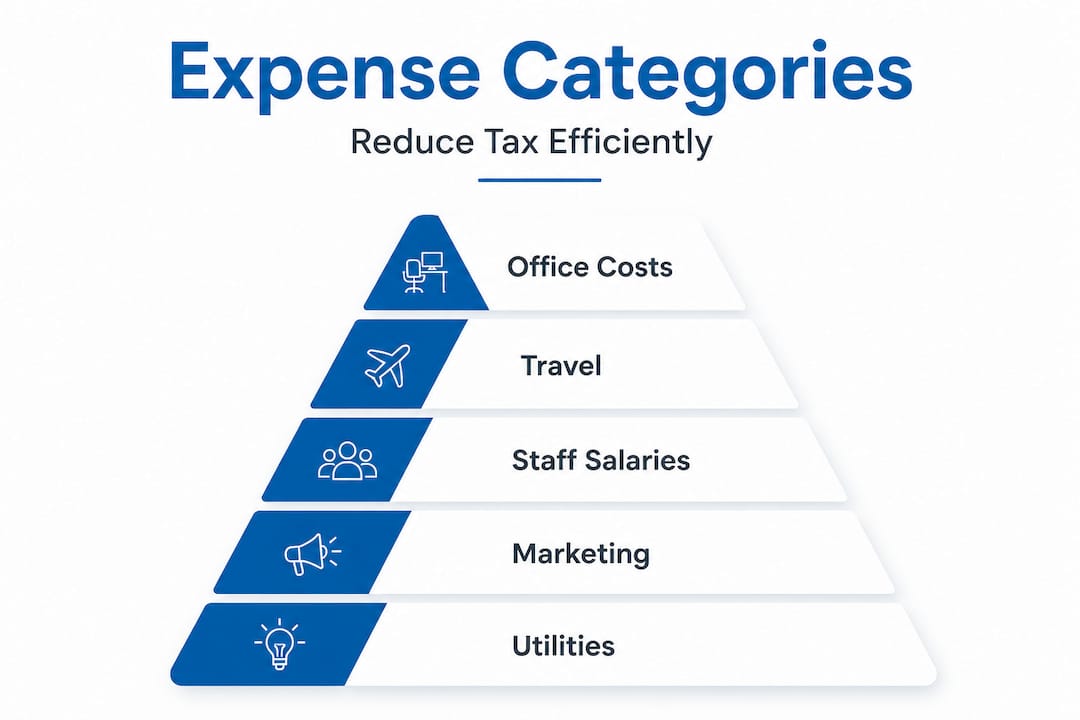
The main allowable categories include office costs, travel and subsistence, staff costs and salaries, marketing and advertising, premises and utilities, professional subscriptions, and software licences. Many founders also overlook top tax deductions that sit right in front of them, such as bank charges, training costs directly related to the business, and even certain home office costs.
Here is a quick comparison of commonly confused allowable and non-allowable expenses:
ExpenseAllowable?NotesBroadband used for workYes (partial)Apportion if shared with personal useClient entertainmentNoHMRC explicitly excludes thisWork travel (not commute)YesTrain, taxi, flights for business tripsDaily commuteNoTravel to a permanent workplace is personalHome office (use of home)YesFixed rate or calculated apportionmentStaff training on current roleYesMust relate to existing dutiesNew skills training (career change)NoNot allowable if it opens a new tradeSoftware subscriptions for workYesTools like Xero, Slack, NotionPersonal mobile contractPartialOnly business proportion claimable
HMRC on entertainment and mixed use: Client entertainment, including meals with clients or hospitality at events, is specifically excluded from allowable business expenses under HMRC rules, regardless of the commercial intent behind the meeting. If an expense has a dual personal and business purpose, only the business portion may be claimed, and you must be able to demonstrate and document that apportionment clearly.
The most overlooked deductions tend to be the unglamorous ones: annual software renewals, professional body memberships, mileage for client site visits, and small equipment purchases. Start a habit of reviewing receipts weekly rather than monthly. You will catch far more.
Set your policy and systems: Laying the groundwork
Knowing what you can claim is only half the battle. The other half is building a repeatable process that captures everything consistently and keeps you HMRC-ready. That starts with an expense policy, even if you are a small team of three.
An expense policy sets the rules of the game. Without one, team members make judgement calls that vary wildly. One person submits receipts for every coffee; another thinks client meals come out of their own pocket. Both scenarios are wrong in different ways, and both cost you money or compliance risk. A well-structured policy should define categories, limits, approvals, and VAT rules aligned with HMRC requirements.
Here is a basic policy framework that works well for small businesses and start-ups:
Policy elementWhat to defineExpense categoriesList all allowable types and any excluded itemsSpend limits per categoryE.g. meals capped at £25 per personApproval workflowWho approves what, and within what timeframeVAT recordingWhether VAT receipts are required for reclaimSubmission frequencyWeekly or monthly? Define the cycleRecord retentionDigital copies kept for minimum six years
To get your system up and running, follow these steps in order:
- Draft your expense policy covering all the elements above. Keep it to one page if possible. Founders read one-page documents.
- Choose your accounting platform. Xero is particularly well-suited for tech businesses and integrates directly with expense tools and bank feeds.
- Add a receipt capture tool such as Dext or Xero Expenses, so team members can photograph receipts on their phones in real time.
- Set up a dedicated business bank account and card. Mixing personal and business transactions is one of the most common and costly mistakes you can make.
- Create approval workflows within your tool so expenses above a defined threshold require sign-off before reimbursement.
- Schedule a monthly review of expense categories and flags. Do not let it slip to quarterly.
Pro Tip: If you are working on an R&D claim or preparing for SEIS investment, your expense policy needs to do double duty. Costs that qualify for R&D relief, such as staff time, contractor costs, and software used in qualifying projects, need to be coded and documented separately from day-to-day business expenses. Build this into your tax planning checklist from day one rather than trying to reconstruct it at year end. Your startup workflow guide can help you structure this sensibly.
Automate and streamline: Tools that save hours (and money)
Once your policy and system are in place, automation is where the real efficiency gains happen. The combination of Xero and a tool like Dext can transform a painful monthly chore into something that practically runs itself. Xero and Dext together can save 6 to 8 hours per month and enable SMEs to reclaim £3,200 to £5,800 in additional expenses per year that would otherwise have been missed or incorrectly processed.

That is not a trivial number. For an early-stage tech start-up watching cash flow closely, recovering an extra £4,000 or more annually is the equivalent of a meaningful cash injection, without raising a single pound from investors.
The core benefits of automating your expense management process include:
- OCR receipt scanning with up to 95% accuracy, meaning receipts are read and categorised automatically rather than typed in manually
- Real-time bank feed integration, so transactions appear in Xero the moment they occur and can be matched to receipts instantly
- Mobile receipt capture, allowing employees to photograph and submit receipts at the point of purchase rather than accumulating a paper pile
- Automated approval workflows, which route expense submissions to the right approver based on category or amount
- VAT extraction, identifying the VAT component on each receipt so you are not manually calculating reclaim amounts
- Mileage tracking, often via GPS or manual entry in-app, with automatic application of HMRC-approved rates
The cost of not automating is also measurable. Disorganised expense management costs SMEs an average of £742 per month, and businesses that adopt automation tools typically see a 10x return on investment through time savings and additional VAT and tax reclaims. Multiply £742 by twelve months and you have nearly £9,000 in annual losses from poor process alone.
Beyond Xero and Dext, tools like Soldo, Pleo, and Spendesk offer pre-loaded business cards with built-in expense policies and automatic receipt matching. These can be especially useful for companies with multiple team members incurring expenses regularly. Explore your small business tax guide for more on how these tools integrate with your broader tax strategy.
Pro Tip: Automation does not mean set-and-forget. Even with 95% OCR accuracy, the remaining 5% contains edge cases that can cause problems: receipts with unusual formats, mixed-use purchases, or items that look like business expenses but are not. Build a monthly 30-minute review into your calendar to check flagged items, review categories, and catch anything that slipped through incorrectly. Good bookkeeping best practices always include human oversight, even in a heavily automated system.
Avoiding pitfalls: Compliance, edge cases and best practices
Good tools and a solid policy will prevent most problems. But tech founders and small business owners frequently encounter edge cases that require careful handling. Getting these wrong can mean a rejected claim, a clawback from HMRC, or a penalty during an inspection.
The most common mistakes, in order of frequency and impact, are:
- Mixing personal and business accounts. This creates audit nightmares and makes it nearly impossible to demonstrate the business purpose of individual transactions.
- Poor or missing records. HMRC expects receipts, invoices, or digital evidence for every claim. A bank statement alone is not sufficient.
- Ignoring dual-purpose rules. If an item has any personal benefit, it may require apportionment or may not be claimable at all. “It was mostly for work” is not a compliant position.
- Missing home office claims. Many founders working from home fail to claim the allowable portion of broadband, heating, or electricity, or use the simplified flat rate when a calculated apportionment would yield a larger deduction.
- Overlooking subsistence scale rates. HMRC publishes approved rates for meals and overnight stays when travelling for work. Using actual cost rather than scale rates can sometimes result in unnecessary complexity.
For complex situations, the principle is apportionment of the business element only. Entertainment of clients is simply not claimable, regardless of the commercial rationale. Records must be kept for a minimum of six years to satisfy HMRC.
On temporary workplaces and the 24-month rule: If you or an employee works at a location for less than 24 months and it is not expected to become a permanent workplace, travel costs to that location are deductible. Once a workplace is expected to last beyond 24 months, it becomes a permanent workplace and the daily commute is no longer claimable. This catches many growing businesses off guard when contractors or staff move to longer-term client sites. Document expected duration at the outset to avoid retrospective issues.
For home office rules and subsistence rates in 2026, HMRC sets approved flat rates for travel and meals. Use these as your baseline and only deviate with clear documentation.
Your annual compliance checklist should include: reviewing all expense categories against current HMRC rules, confirming records are stored securely for the required six years, checking that your VAT reclaim submissions are accurate, reconciling mileage logs against fuel card or personal mileage claims, and verifying that any dual-purpose expenses have been appropriately apportioned. Bringing in a specialist tax consultant for an annual review is often the most cost-effective single investment you can make in compliance.
Why most businesses overcomplicate expenses—and what actually works
Here is a perspective that runs counter to most expense management advice: the founders who stress least about expenses are not the ones with the most elaborate coding systems. They are the ones who kept it simple.
We regularly see early-stage tech businesses building multi-level expense hierarchies, colour-coded categories, and weekly reconciliation rituals that consume more founder time than they save. The intent is admirable, but the execution misses the point. HMRC does not reward complexity. It rewards documentation, consistency, and clear business purpose.
What actually works is this: clean category structure, a receipt at the time of purchase, automated bank matching, and a monthly review. That is genuinely it. The businesses that capture the most expenses are not the ones doing the most admin. They are the ones who made submission so frictionless that it became a habit.
The more important insight, particularly for tech founders, is that critical tax planning is not about expense management in isolation. It connects directly to your R&D claims, your SEIS eligibility, and your year-end position. When you document with an audit and potential R&D claim in mind, you are building a financial record that supports multiple objectives simultaneously, not just routine bookkeeping.
Fast-moving businesses often treat expenses as an afterthought. The ones that scale efficiently treat them as a live financial signal. When you know exactly what you are spending, where it is going, and what you are claiming, you make better decisions about headcount, tooling, and cash deployment. That clarity is the real return on a good expense process.
How Price & Accountants can help you save time, stress and money
Managing expenses efficiently and claiming every allowable deduction requires more than a good app. It requires a consistent process, expert guidance on HMRC rules, and a sharp eye for opportunities that generic tools simply miss.

At Price & Accountants, we work with tech start-ups and small businesses to build end-to-end expense and bookkeeping systems using bookkeeping solutions that integrate Xero, Dext, and smart category policies tailored to your business model. We also identify opportunities to connect your expense data with R&D tax credits support, SEIS compliance, and proactive tax planning. If you suspect you are leaving money on the table, or simply want your process to stop costing you hours every month, get in touch with our team for a no-obligation conversation about what efficient expense management could look like for your business.
Frequently asked questions
What if an expense is partly personal and partly business?
You may only claim the proportion that relates strictly to business use; appropriate apportionment of mixed-use items is required and must be clearly documented.
How long must I keep my expense records for HMRC?
Business expense records must be kept for at least six years to comply with HMRC requirements for companies.
What are the HMRC-approved mileage rates for 2026?
For 2026/27, the approved mileage rates are 45p per mile for the first 10,000 business miles in cars and vans, 25p per mile thereafter, 24p for motorcycles, and 20p for bicycles.
Can I claim subsistence or daily meals as expenses?
Subsistence can be claimed using HMRC scale rates for travel (£5 for 5 hours, £10 for 10 hours, £25 for 15 hours or overnight), but daily non-business meals are not allowable.
Are there benefits to automating expense management for small businesses?
Automation tools such as Xero and Dext can save 6 to 8 hours per month and help SMEs reclaim £3,200 to £5,800 in additional expenses per year that would otherwise be missed.
Recommended
- Master UK business expense categories for smarter tax savings - Price & Accountants
- 10 Tax Deductions Every UK Business Owner Should Know in 2024 - Price & Accountants
- Bookkeeping Tips for Busy Business Owners - Price & Accountants
- Efficient VAT Management and Compliance - Price & Accountants
- Optimaliseer je belastingvoordeel met zakelijke verzekeringen
- Fiscale spreiding: zo verlaagt u uw belastingdruk slim | Ambition Valley