

TL;DR:
- Modern accounting technology enables real-time insights and automation, significantly improving startup scalability and compliance.
- Adopting cloud and AI-driven platforms transforms manual processes into strategic tools that enhance funding opportunities and investor confidence.
Accounting used to be the slowest part of running a startup. Now it can be one of the fastest levers for growth. Firms with advanced AI adoption are 3.1x more likely to achieve measurable ROI from their finance functions, yet most early-stage UK tech founders are still wrestling with disconnected spreadsheets and quarterly surprises. This guide walks you through how modern accounting technology reshapes compliance, funding readiness, and strategic decision-making, so you can stop firefighting and start scaling with confidence.
Table of Contents
- From spreadsheets to real-time insight: How technology changes accounting
- Making Tax Digital and regulatory tech: What UK startups must know
- AI and automation: Moving from manual tasks to strategic growth
- Tech-enabled funding: R&D claims, reporting, and the metrics that matter
- Why the right balance of tech and human expertise drives real startup growth
- How Price & Accountants can help your tech startup thrive
- Frequently asked questions
Key Takeaways
PointDetailsAutomation fuels ROIAI and digital platforms automate 80 percent of routine work and boost startup efficiency several times over.Compliance is digitalUK founders must adopt digital-first accounting to meet new MTD and funding requirements securely from 2026.Unlock funding and reliefTechnology simplifies R&D tax claims and keeps key growth metrics investor-ready at all times.Hybrid beats pure automationBalancing tech with expert judgement ensures founders stay agile, compliant, and ready for audit scrutiny.
From spreadsheets to real-time insight: How technology changes accounting
Manual accounting processes are not just slow. They are actively dangerous for a fast-growth startup. When your financial data lives in a patchwork of Excel files, you cannot see your runway clearly, you miss VAT deadlines, and you hand investors a reason to hesitate. The shift to cloud and AI-powered platforms changes this completely.
Modern cloud accounting tools connect directly to your bank feeds, payment processors, and payroll systems. The result is a live financial picture updated throughout the day, not a stale snapshot prepared once a quarter. For a seed-stage fintech managing multiple revenue streams, this is transformative. You can spot a cash flow gap three weeks out and act on it, rather than discovering it on the day invoices are due.
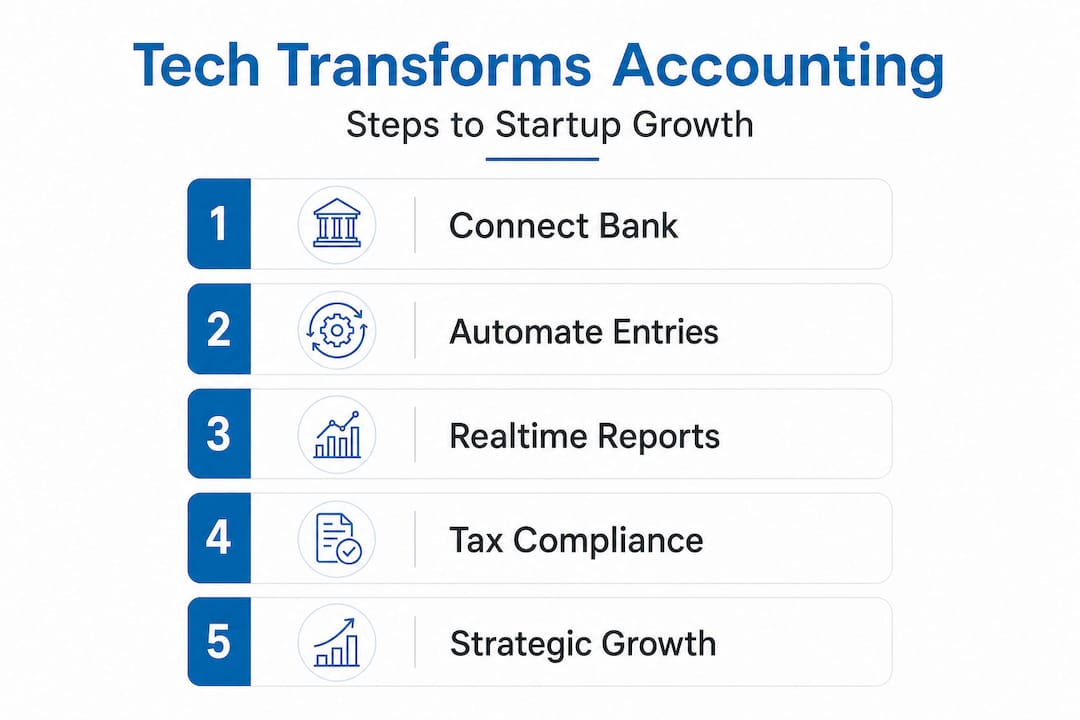
The efficiency gains are not theoretical. AI and automation savings from real UK deployments show a 360-person firm achieving 80% automation of routine accounting tasks with a 3 to 4 times improvement in efficiency, a manufacturing business saving 25 hours per week, and accounts payable teams recovering more than 30 hours per week. For a lean startup team, those hours translate directly into product development, sales, and fundraising.
Key features every tech startup should look for in a modern accounting platform include:
- Automatic bank feeds that pull transactions in real time without manual imports
- Mobile access so founders can approve payments and review dashboards from anywhere
- Digital document storage that keeps receipts, invoices, and contracts audit-ready
- Automated VAT calculations that reduce the risk of submission errors
- Multi-currency support for startups operating across borders or serving international clients
The contrast with legacy approaches is stark:
FeatureManual/spreadsheet approachModern digital accountingSpeed of data entryHours per weekNear real-time via bank feedsAccuracyProne to human errorAutomated reconciliationScalabilityBreaks down as transaction volume growsScales with business growthInvestor readinessRequires significant preparationDashboards available on demandComplianceReactive and often lateAutomated reminders and submissions
“The question is no longer whether startups should use cloud accounting. It is how quickly they can migrate, and whether their setup is optimised for growth rather than just compliance.”
Understanding the tax filing procedure for your specific business structure is the first step. But the technology you choose to manage that process will determine how much time and money you save doing it.
Making Tax Digital and regulatory tech: What UK startups must know
Compliance is not optional, but it does not have to be painful. The UK government’s Making Tax Digital (MTD) programme is the single biggest driver of technology adoption in startup accounting right now, and many founders are still underestimating its scope.
From April 2026, MTD for Income Tax Self Assessment (ITSA) mandates that all businesses and sole traders with income above £50,000 keep fully digital records and submit quarterly updates to HMRC using approved software. From April 2027, this threshold drops to £30,000. If you are a founder drawing income from your startup alongside other sources, you are likely already in scope.
MTD milestoneDateWho is affectedMTD for VATAlready liveVAT-registered businessesMTD for ITSA (phase 1)April 2026Income over £50,000MTD for ITSA (phase 2)April 2027Income over £30,000MTD for Corporation TaxTBC (post-2026)All limited companies
The platforms that qualify for MTD submissions include Xero, QuickBooks, FreeAgent, and Sage. Crucially, these are the same platforms that give you the real-time dashboards and integrations discussed earlier. Choosing the right tool now means you are compliant and operationally efficient from day one.
For fintech startups specifically, the regulatory burden goes further. UK fintechs must integrate KYC (Know Your Customer), AML (Anti-Money Laundering) monitoring, and compliance dashboards from the very beginning of operations. Investors and regulators alike will examine these systems closely, and non-compliance risks not just fines but the withdrawal of funding entirely.
100% of digital records and quarterly submissions will be mandatory for most tech founders by 2026. Building your systems now, rather than scrambling in the final weeks before a deadline, gives you a material advantage in investor conversations and audit preparedness.
Pro Tip: Do not treat MTD as a one-off compliance task. The startups that benefit most are those that use MTD-compliant software to build a continuous, investor-grade financial record from the earliest stages of trading. It makes due diligence faster and your numbers harder to challenge.
Reviewing SME tax compliance tips specific to UK tech businesses can help you identify reliefs and obligations that generic compliance checklists tend to miss.
AI and automation: Moving from manual tasks to strategic growth
Time is the scarcest resource a founder has. Accounting automation returns it. But the real opportunity is not just saving hours. It is redirecting human attention toward the decisions that actually move the needle.
AI automates routine tasks including transaction categorisation, bank reconciliation, and anomaly detection, freeing your finance team to focus on strategy. The same research confirms that firms with advanced AI in their finance function are 3.1x more likely to achieve ROI from their accounting operations.
“Automation via AI and cloud handles roughly 80% of routine accounting tasks. The critical 20% that requires judgement, such as regulatory interpretation, dispute resolution, and complex tax structuring, still demands human expertise.”
This 80/20 split is not a reason to rely entirely on software. It is a framework for deciding where your attention and your accountant’s attention should go. Human oversight remains essential for the judgment-heavy cases that software cannot reliably handle alone.
The five accounting tasks UK tech startups can automate immediately are:
- Bank reconciliation using direct feeds from current accounts and credit cards
- Invoice generation and chasing via accounts receivable automation
- Expense categorisation through AI-powered receipt scanning and classification
- Payroll calculations including PAYE, National Insurance, and pension contributions
- VAT return preparation using MTD-compliant software that pulls live transaction data
Building a hybrid system, where AI handles volume and humans handle judgement, also dramatically improves your standing in audits and investor due diligence. A VC conducting financial diligence wants to see clean, consistent records. They become deeply uncomfortable when they find manual spreadsheets and unexplained categorisation inconsistencies.
Pro Tip: When building your accounting tech stack, document every automation rule you configure. Knowing exactly why each transaction is categorised a certain way gives you confidence in your numbers and makes audits significantly smoother.
Your tax planning checklist should include a specific review of which manual processes are still running in your business and a target date for automating each one.
Tech-enabled funding: R&D claims, reporting, and the metrics that matter
The most financially impactful application of accounting technology for UK tech startups is not compliance. It is funding. Specifically, it is the ability to maximise R&D tax credits and present investor-grade metrics without weeks of preparation.

The UK’s R&D tax relief scheme is one of the most generous in the world. Up to 27% relief is available for R&D-intensive SMEs, with loss-making companies able to claim up to 18.6% cash back on qualifying expenditure. HMRC paid out £7.6 billion in R&D relief in 2023/24, with the average SME claim sitting at £54,000. Claims can be backdated up to two years, meaning startups that have been operating without claiming are leaving significant cash on the table.
Cloud accounting makes R&D claims substantially easier. When every expense is correctly categorised in real time, identifying qualifying R&D expenditure, such as staff costs, software licences, contractor fees, and prototyping costs, becomes a structured data exercise rather than a forensic reconstruction of the past year.
Technology shifts accounting from a backward-looking compliance function into a forward-looking strategic tool. The metrics investors care about most, including Customer Acquisition Cost (CAC), Lifetime Value (LTV), monthly recurring revenue (MRR), churn rate, and cash runway, can all be automated through your accounting and CRM integrations.
Metrics every founder should automate for investor reporting:
- Monthly recurring revenue (MRR) and growth rate month on month
- Customer Acquisition Cost (CAC) by channel
- Gross margin by product or service line
- Cash runway calculated dynamically from current burn rate
- Churn rate segmented by cohort or subscription tier
- Burn multiple to show capital efficiency
Average R&D tax claims for UK SMEs stand at £54,000, with relief backdatable up to two years. If your startup has been developing software, algorithms, or novel technical processes, there is a strong probability you are eligible and have been missing this cash.
Detailed guidance on R&D claims for tech startups covers the eligibility criteria most founders are unaware of. And understanding the process of reporting R&D to HMRC correctly is equally important, since claim rejections often come down to documentation failures rather than genuinely ineligible expenditure.
Why the right balance of tech and human expertise drives real startup growth
Here is an uncomfortable truth: the startups that automate everything and then step back from their finance function are the ones that get caught out. Not by HMRC. By their own blind spots.
Full automation is genuinely powerful for volume tasks. But the 2026 regulatory landscape is tightening in ways that software cannot anticipate alone. The FRC is raising audit quality requirements, Consumer Duty is creating new accountability structures for fintechs, and AI-generated financial outputs are coming under closer regulatory scrutiny. These are not problems you can solve by upgrading your software subscription.
What we consistently see with high-growth startups is that the founders who architect their own financial systems, who understand why the automation rules are set up the way they are, who ask hard questions about their metrics, gain a strategic advantage that peers relying entirely on automated outputs simply do not have. They catch anomalies faster. They spot funding opportunities earlier. They walk into investor meetings with genuine confidence rather than hoping the numbers hold up under questioning.
There is also the concept of “invisible ROI” to consider. The returns from compliance, fraud prevention, and clean audit trails do not show up on a growth dashboard. But they absolutely show up in the speed of due diligence, the cost of your next funding round, and your ability to expand into regulated markets. Treating these as afterthoughts because they are not as exciting as CAC or MRR is a strategic error we see founders make repeatedly.
Pro Tip: Keep your technology team, finance team, and compliance function communicating monthly, not just at year end. The most expensive compliance failures we see come from product changes that nobody told the finance team about until a tax event made it impossible to ignore.
How Price & Accountants can help your tech startup thrive
Building a tech-enabled accounting function is genuinely achievable for any UK startup, but the setup choices you make early will shape your funding readiness and compliance standing for years.

At Price & Accountants, we work specifically with tech and fintech founders at every stage, from pre-seed through Series A, helping you choose the right tools, structure your R&D claims correctly, and stay ahead of MTD and regulatory requirements. Our bookkeeping solutions are built on Xero and modern cloud platforms, giving you real-time insight without the manual overhead. Our R&D tax advice service has helped clients reclaim significant capital that was sitting unclaimed in plain sight. And our strategic advisory and tax planning function acts as your outsourced Finance Director, ensuring your numbers tell the right story when it matters most. Get in touch today to see how we can build a finance function that keeps pace with your ambitions.
Frequently asked questions
What are the key deadlines for Making Tax Digital in 2026?
From April 2026, all UK businesses with income over £50,000 must keep digital records and submit updates quarterly using HMRC-approved software. The threshold drops to £30,000 from April 2027.
How does AI free up time for founders?
AI automates routine tasks including transaction categorisation, bank reconciliation, and anomaly detection, allowing founders to focus their attention on strategy, fundraising, and growth decisions.
What is the average R&D tax claim for UK startups?
The average R&D tax credit claim for UK SMEs is £54,000, and qualifying expenditure can be backdated up to two years, meaning many startups have unclaimed cash available right now.
Do investors require tech-enabled compliance?
Yes. UK fintechs must integrate KYC, AML, and real-time compliance dashboards from day one, and most VCs expect to see robust digital financial systems before committing capital.
Recommended
- Role of accountants for UK tech startups in 2026 - Price & Accountants
- Essential accounting tips for UK tech startups scaling to Series A - Price & Accountants
- Why startups need accountants for UK tech founders - Price & Accountants
- The Future of Tech Startup Companies in the UK - Price & Accountants
- Drive innovation in small business with cloud accounting | Ready Accounting