

TL;DR:
- AI adoption in UK accounting boosts efficiency, reduces costs, and provides real-time business insights.
- R&D tax incentives offer significant relief; proper documentation is crucial for claims in tech startups.
- Compliance with Making Tax Digital enables real-time reporting, improving decision-making and investor confidence.
Accounting in the UK tech sector is changing faster than most founders realise. AI adoption among UK accountants has already reached 36% weekly use, with 24% using it daily, and the ripple effects on compliance, forecasting, and operational efficiency are profound. If you are building a start-up or scaling a tech business in 2026, understanding where accounting is heading is not an optional extra. It is a competitive advantage. This guide breaks down the trends reshaping the numbers behind UK tech, and what they mean for your growth, your next funding round, and your obligations to HMRC.
Table of Contents
- AI automation is redefining financial operations
- How R&D tax incentives drive tech sector growth
- Complying with Making Tax Digital and real-time reporting
- Funding and scale: accounting’s role in fast growth pitches
- The overlooked reality: human insight is still vital
- Taking the next step with expert accounting support
- Frequently asked questions
Key Takeaways
PointDetailsAI transforms accountingAutomation speeds up reporting, lowers costs, and lets founders focus on growth.R&D tax credits matterProper claims and documentation unlock substantial funds for innovation.Digital compliance is essentialMaking Tax Digital affects every tech start-up’s systems and strategy from 2026 onwards.Data quality still countsHuman expertise remains vital to complement rapid, AI-powered accounting tools.
AI automation is redefining financial operations
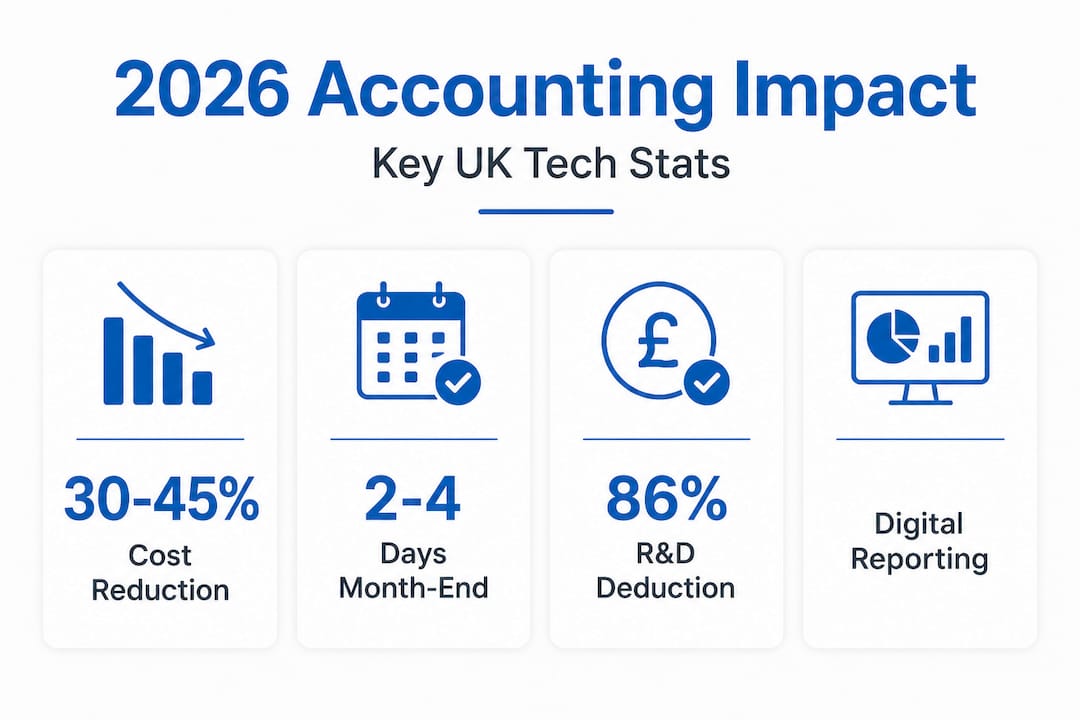
Artificial intelligence is not a future promise for UK accounting. It is already embedded in the day-to-day workflow of forward-thinking finance teams. The productivity gains are striking and well-documented. According to independent analysis, AI tools reduce month-end close from the traditional eight to ten days down to two to four days. That is a transformation, not an incremental improvement. For a lean tech start-up where the founder is often wearing multiple hats, cutting five to eight days from a monthly financial cycle frees up significant time for strategic thinking.
The cost impact is equally compelling. Firms that have embedded AI into their accounting workflows are reporting 30 to 45% lower cost per transaction. For a scaling business watching every pound of runway, that is a meaningful operational saving that compounds over time.
Here is what AI-driven accounting looks like in practice for a tech start-up:
TaskTraditional approachAI-assisted approachMonth-end close8 to 10 days2 to 4 daysInvoice reconciliationManual, error-proneAutomated matchingExpense categorisationSpreadsheet-basedReal-time classificationCash flow forecastingMonthly snapshotContinuous, live modelsTransaction costBaseline30 to 45% reduction
The strategic gains are just as important as the operational ones. When month-end closes in three days instead of ten, founders get earlier access to accurate data. That means better decisions on hiring, product investment, and burn rate management. Real-time forecasting, once reserved for businesses with full finance departments, is now accessible to pre-Series A teams.
However, there are cautions worth noting. AI amplifies whatever data quality you feed into it. Garbage in, garbage out is never more true than when an algorithm is making automated categorisations across hundreds of transactions. Founders should be vigilant about maintaining clean, structured financial records as the foundation for any AI-assisted system.
Pro Tip: Before adopting any AI accounting tool, audit your existing data quality. Messy historical records will create inaccurate forecasts that feel authoritative but mislead you at the worst possible moments.
The future of tech startups in the UK will increasingly be shaped by those who use automated financial systems not just to save time, but to gain genuine strategic foresight. The founders who treat AI accounting as a core operational function rather than a back-office cost will have a measurable edge.
How R&D tax incentives drive tech sector growth
The UK’s R&D tax credit scheme remains one of the most powerful yet underutilised levers available to tech founders. In 2026, eligible SMEs can claim an 86% enhanced deduction on qualifying R&D expenditure. For a profitable company, that translates into a 16.3% saving on corporation tax. For a loss-making start-up, it means an 18.6% cash credit, which means HMRC can effectively become a source of early-stage funding.
The scale of the opportunity is substantial. The average SME R&D claim sits at around £54,000, and across the UK, total relief paid out reached £7.6 billion in 2023/24. Yet many tech founders either do not claim at all or significantly undervalue what they are entitled to.
Here is a quick comparison of what the two main scenarios look like:
Company statusRate of reliefBenefit typeProfitable SME86% enhanced deduction16.3% corporation tax savingLoss-making SME86% enhanced deduction18.6% cash credit from HMRCLarge company (RDEC)Separate scheme appliesCredit against tax liability
Qualifying is more straightforward than many founders assume. If you are building software, developing AI models, creating new algorithms, or solving technical problems that do not have obvious off-the-shelf solutions, you are almost certainly doing qualifying R&D activity. The key is documentation.
To protect and maximise your claim, follow these steps:
- Define the scientific or technological uncertainty. HMRC requires evidence that you were trying to resolve a genuine technical challenge, not simply applying known methods.
- Record your development activity in real time. Meeting notes, sprint logs, Git commits, and design documents all serve as contemporaneous evidence.
- Identify qualifying expenditure. This includes staff costs, subcontractor costs (with limits), consumables, and cloud computing costs directly tied to R&D.
- Separate R&D costs from general development. Not all software development qualifies. Time spent on routine updates or maintenance does not count.
- Work with a specialist. HMRC scrutiny on R&D claims has increased markedly. An experienced adviser will identify opportunities you miss and protect you from errors that trigger enquiries.
Pro Tip: Start building your R&D documentation at the beginning of each project sprint, not at year-end. Retrospective reconstruction of evidence is both time-consuming and unconvincing to HMRC.
Our guide to R&D tax credits explains the qualifying criteria in detail. For practical strategies specific to this year, our 2026 R&D claim tips article covers the current compliance landscape. You can also review our SME tax compliance tips for a broader picture of reliefs available alongside R&D.
Complying with Making Tax Digital and real-time reporting
Making Tax Digital, commonly known as MTD, is HMRC’s programme for modernising the UK tax system. For tech start-ups, it is not a distant regulatory concern. It is an active compliance requirement that demands the right systems, habits, and infrastructure.
MTD for VAT has been in force for several years, but the regime is expanding. In 2026, the expectation from HMRC is that businesses maintain digital records, submit data through compatible software, and align their reporting with increasingly real-time standards. The digital compatibility requirements are tightening, and firms that rely on spreadsheets or disconnected systems will find compliance increasingly difficult.
For tech start-ups specifically, MTD compliance creates several practical demands:
- You must use HMRC-compatible software that links directly to their systems for VAT submissions.
- All VAT records must be kept digitally, with a clear digital audit trail between source data and the final submission.
- Any bridging software used to transfer data between systems must be properly integrated and documented.
- Bank feeds, invoicing platforms, and expense management tools should be fully connected to your core accounting software.
“Real-time financial reporting is no longer just a competitive advantage. For UK tech start-ups navigating MTD and investor scrutiny simultaneously, it is the baseline expectation.”
The benefits of proper MTD compliance go well beyond avoiding penalties. When your accounting systems are fully digital and integrated, you gain access to something more valuable: real-time financial insight. Live bank feeds, automated reconciliation, and up-to-date P&L data mean you are always looking at current reality rather than a report that is six weeks old.
Cloud platforms such as Xero sit at the heart of most MTD-ready tech start-up stacks. They connect seamlessly with payroll tools, CRMs, and invoicing platforms, giving founders a single pane of glass for financial visibility. This matters enormously when you are trying to make fast decisions in a high-growth environment.

Our tax planning checklist gives practical guidance on integrating your compliance obligations with your broader financial strategy. And if you want a deeper understanding of the strategic case for preparation, our piece on why tax planning matters lays out the full picture.
Funding and scale: accounting’s role in fast growth pitches
The UK tech sector is growing at a remarkable rate, and competition for investment is intensifying sharply. UK tech incorporations surged 39% year-on-year to 16,887 in Q1 2026 alone, and fintech sector revenue is forecast to reach £34.7 billion. Scale-ups are averaging £1.46 million in R&D spend, representing a 12% intensity ratio. In this environment, every founder pitching for investment is competing against well-funded, professionally advised peers.
Investors at the seed to Series A stage are increasingly sophisticated about what they expect from founders’ financial data. Clean accounts, detailed R&D documentation, and credible forecasting models are no longer signs of exceptional preparation. They are the minimum standard. The following missteps can derail a promising pitch:
- Inconsistent revenue recognition. Mixing cash accounting with accruals creates confusion and undermines your reported growth metrics.
- Undocumented R&D spend. Investors know about R&D tax credits. If you cannot show what you spent and why it qualifies, they will discount your cash efficiency claims.
- Missing cap table clarity. Share structures that are not clearly documented create immediate due diligence delays.
- No management accounts. Monthly or quarterly management accounts signal operational maturity. Founders who present year-end accounts only signal that finance is not a priority.
- Unreconciled bank statements. A surprisingly common issue in early-stage businesses, this immediately raises questions about control and governance.
“Investors do not just fund your product. They fund their confidence in your ability to manage capital responsibly and report accurately under pressure.”
Making your R&D and tax data investor-ready starts earlier than most founders think. If you intend to raise in the next twelve to eighteen months, your accounting processes need to be institutional-grade today. Our SEIS/EIS tax guidance is particularly relevant here, as the share structures underpinning early-stage investment must be correctly set up from the beginning to preserve investor eligibility. Working with a specialist tax consultant early in your funding journey prevents costly restructuring later.
The overlooked reality: human insight is still vital
There is a temptation, especially among tech founders who trust systems and automation instinctively, to assume that AI and digital compliance tools have largely replaced the need for expert financial advisers. This assumption is worth challenging directly.
AI accelerates processes and surfaces patterns with impressive speed. But it also magnifies whatever errors or blind spots exist in the underlying data. Research shows that data quality concerns are cited by 46% of finance professionals as a top risk associated with AI adoption, even as the same tools deliver productivity gains of up to 70% faster month-end processing. Speed without accuracy is not a benefit.
The experienced human adviser brings something automation cannot replicate: judgement built from pattern recognition across many different businesses, market cycles, and regulatory environments. When HMRC changes its interpretation of qualifying R&D activity, or when a funding round introduces complicated share class structures, or when your business model shifts in a way that affects VAT treatment, you need someone who has navigated those exact situations before.
The most effective finance function for a UK tech start-up in 2026 is a hybrid one. Automated systems handle the volume, speed, and routine classification work. Human advisers focus on interpretation, strategy, risk assessment, and the kind of forward planning that keeps you ahead of compliance obligations rather than scrambling to catch up. This is not a tension between old and new. It is a deliberate combination that unlocks maximum benefit from both.
We have worked with founders who over-relied on automated tools and discovered material errors only during due diligence, at the worst possible time. We have also worked with founders who avoided automation entirely and spent excessive time on manual processes that crowded out strategic thinking. The middle path, well-configured systems supported by expert oversight, is consistently the superior model.
Taking the next step with expert accounting support
The trends shaping UK tech accounting in 2026 are not abstract. They translate directly into how much capital you retain, how attractive your business is to investors, and how confidently you can navigate HMRC’s evolving requirements. The founders who act on these trends early will have cleaner books, stronger R&D claims, and more credible pitches than those who treat accounting as an afterthought.

At Price & Accountants, we specialise in exactly the intersection where these trends meet your day-to-day decisions. From maximising your R&D claims through our specialist R&D advisory service, to building MTD-compliant cloud accounting systems, to acting as your outsourced Finance Director for investor-ready reporting, we work as your financial growth partner rather than just your compliance team. If you are scaling a UK tech business or preparing for your next funding round, we would welcome the conversation.
Frequently asked questions
What makes AI essential in UK tech accounting for 2026?
AI reduces month-end close to two to four days and cuts transaction costs by 30 to 45%, making it critical for meeting MTD requirements and delivering the real-time forecasting that investors and founders increasingly depend on.
How can start-ups ensure they maximise R&D tax credits?
Maintain detailed, contemporaneous records of all software and AI development activity, and work with a specialist who can identify the full scope of qualifying expenditure. With the average SME claim reaching £54,000, under-claiming is a costly oversight.
What is Making Tax Digital and why does it matter for tech founders?
MTD is HMRC’s framework requiring digital record-keeping and software-based submissions, and it is already mandatory for VAT-registered businesses. Founders who build MTD-compliant systems gain real-time financial visibility as an additional benefit, beyond simply meeting the legal requirement.
Why do investors care about robust financial processes in tech scale-ups?
With UK tech incorporations up 39% year-on-year, investors can afford to be selective. Transparent, well-documented accounts signal operational maturity and reduce due diligence risk, making a funded outcome significantly more likely.
Recommended
- Role of accountants for UK tech startups in 2026 - Price & Accountants
- How accountants drive global growth for tech and fintech firms - Price & Accountants
- Corporate accounting for UK tech founders: compliance and growth - Price & Accountants
- Corporate accounting for UK tech founders: compliance and growth - Price & Accountants