

TL;DR:
- Strategic financial planning connects company decisions with long-term goals, beyond basic compliance.
- UK incentive schemes require precise timing and consideration of policy risks to maximize benefits.
- Founders should continuously model and review their full tax stack, including extraction, reliefs, and policy changes.
Most UK tech and fintech founders treat financial planning as a compliance exercise. File the returns, claim the reliefs, move on. But that mindset leaves serious money on the table and, increasingly, exposes founders to risks they never anticipated. The UK’s incentive landscape is genuinely powerful, but it is also shifting. Some sector voices warn that scheme complexity and limits can make the UK harder to scale in, not just less tax-efficient. Strategic financial planning is the tool that turns this complexity into competitive advantage rather than a liability.
Table of Contents
- What defines strategic financial planning for tech founders
- Navigating UK complexities: Tax incentives, risks, and compliance
- Building your holistic financial framework: From funding to extraction
- Applying strategic planning: Turning insights into competitive advantage
- The uncomfortable truth most founders miss about UK tax planning
- Connect with expert support for strategic planning
- Frequently asked questions
Key Takeaways
PointDetailsStrategic planning goes beyond complianceIt enables founders to optimise incentives and structure for real growth, not just box-ticking.Full tax stack is essentialIntegrating company taxes with extraction methods gives founders a clearer path to maximising value.UK complexity requires smart navigationFounders must actively manage regulatory changes, incentive limits, and hidden risks.Process turns insight into advantageApplying these principles moves your startup from confusion to confident, competitive financial planning.
What defines strategic financial planning for tech founders
Most founders understand basic financial management: keep the books tidy, submit VAT returns on time, make sure payroll runs. That is necessary, but it is not strategy. Strategic financial planning means aligning your financial decisions with your business goals across a multi-year horizon, accounting for funding rounds, headcount growth, product development cycles, and eventual exit.
For a tech or fintech startup, the distinction matters enormously. Basic planning is reactive. Strategic planning is forward-looking and integrative. It asks: how does today’s share structure affect our Series A eligibility? How does the timing of an R&D claim interact with our next funding round? What does a salary-versus-dividend decision today cost us in five years?
The most important concept here is what specialists call the “full tax stack.” As one expert framework explains, planning must integrate company-level taxation alongside how founders extract funds personally, because the marginal impact of extraction decisions can dominate the practical benefit of any relief you claim. In other words, you can optimise your corporation tax position perfectly and still walk away with far less cash than you expected if you have not planned the extraction side.
“Strategic planning is not about finding clever loopholes. It is about making sure every financial decision you take at company level connects logically to what you actually receive as a founder.”
Here is what strategic financial planning actually covers for a UK tech founder:
- Funding structure design: Deciding between equity, convertible instruments, and debt before you approach investors, not after.
- Share scheme architecture: Setting up EMI options, growth shares, or SEIS-compatible structures at the right moment.
- Tax relief sequencing: Knowing when to trigger R&D claims, SEIS/EIS advance assurance, and capital allowances.
- Extraction planning: Mapping out salary, dividends, and eventual capital gains treatment across the full founder lifecycle.
- Personal tax integration: Connecting company decisions to your personal tax position, including pension contributions and director loan accounts.
Good director tax planning strategies sit at the intersection of all of these. Miss any one element and the whole picture distorts.
Navigating UK complexities: Tax incentives, risks, and compliance
The UK offers some of the most generous innovation incentives in the world. The challenge is that accessing them requires precision, and the rules are not static.
R&D tax credits remain a cornerstone for tech and fintech founders. Under the merged R&D scheme introduced in April 2024, most companies claim an enhanced deduction on qualifying expenditure, with loss-making companies able to claim a payable credit. The rates and eligibility criteria have shifted multiple times in recent years, which means a claim strategy that worked in 2022 may not be optimal today.
SEIS and EIS are equally powerful. SEIS offers investors up to 50% income tax relief on investments up to £200,000 per company, making early-stage fundraising significantly more attractive. EIS extends that to larger raises with 30% relief. But the compliance requirements around advance assurance, share structure, and trading conditions are detailed. One wrong move and your investors lose their relief, which can destroy relationships and future fundraising prospects.
Here is a direct comparison of the two schemes:
FeatureSEISEISMaximum company raise£250,000£12 million (lifetime)Investor income tax relief50%30%CGT disposal relief100% after 3 years100% after 3 yearsCompany age limitUnder 3 years tradingUnder 7 years tradingGross assets limitUnder £350,000Under £15 millionEmployee limitUnder 25Under 250
Beyond the mechanics, there is a layer that most planning conversations skip: tax policy risk. The UK has repeatedly adjusted incentive schemes in ways that caught founders off guard, and sector voices increasingly argue that this instability, not just headline tax rates, is what makes scaling in the UK harder. Your strategic plan needs to account for the possibility that the rules you are relying on today will change before you exit.
Compliance itself is also a strategic lever, not just a box to tick. Strong compliance records reduce HMRC enquiry risk, improve due diligence outcomes during fundraising, and signal credibility to institutional investors. Our step-by-step tax planning guide covers how to build compliance into your planning rhythm rather than treating it as a separate administrative burden.

For founders operating in regulated fintech sectors, compliance extends beyond HMRC. Forensics compliance guidance shows how robust internal controls and audit trails strengthen your position with both regulators and investors. And our top tax planning strategies resource covers the specific moves that high-growth tech companies use to stay ahead.
The key risks to build into your planning:
- Scheme eligibility drift: Your company grows and accidentally exits SEIS or EIS eligibility mid-raise.
- R&D claim scrutiny: HMRC has significantly increased enquiry rates on R&D claims since 2023.
- Policy change exposure: Reliefs are reduced or restructured between your planning date and your exit.
- Cross-border complexity: Hiring internationally or receiving overseas investment introduces transfer pricing and permanent establishment risks.
Building your holistic financial framework: From funding to extraction
With the risks and incentives mapped, the next step is building the actual framework. Think of this as a four-layer structure, each layer feeding into the next.
Layer one: Funding structure. Before you raise, decide whether equity or convertible instruments (such as ASAs or convertible loan notes) best serve your cap table and investor tax position. Equity is straightforward for SEIS/EIS but dilutes earlier. Convertible notes preserve optionality but can complicate future round valuations. Debt is rarely appropriate at seed stage but becomes relevant post-Series A for working capital.
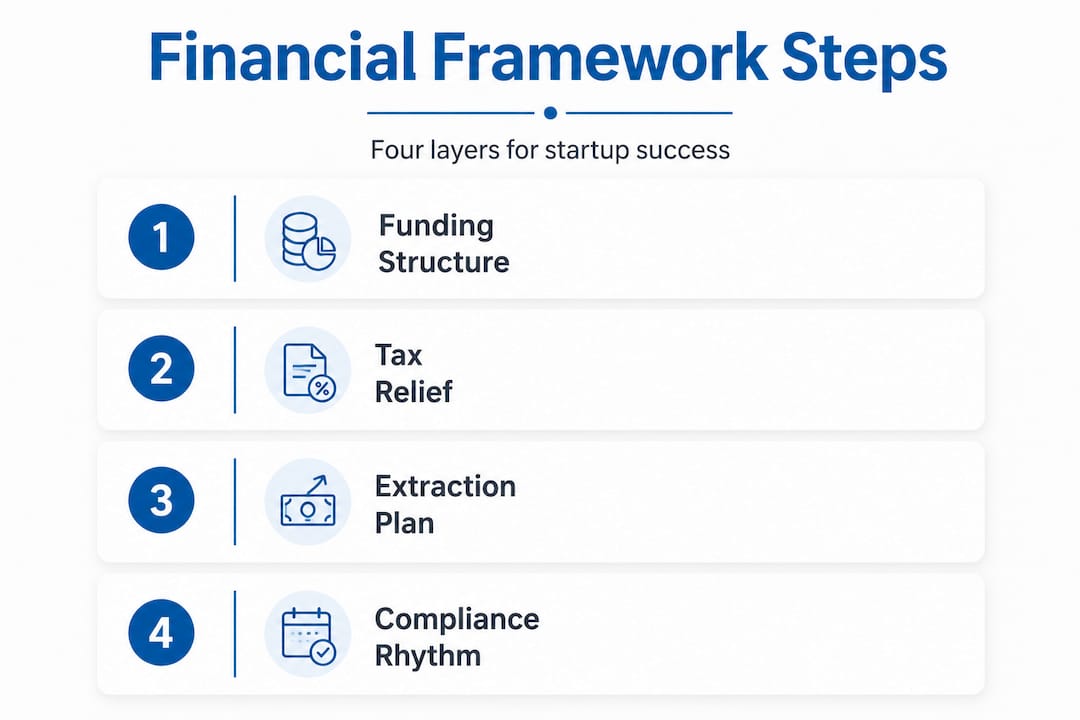
Layer two: Tax relief optimisation. Timing is everything. Triggering an R&D claim in the wrong accounting period can reduce its cash value. Applying for SEIS advance assurance too late means investors cannot rely on it before writing cheques. The table below shows how relief timing interacts with funding stages:
StageKey reliefTiming considerationPre-seedSEIS advance assuranceApply before first investmentSeedEIS advance assuranceApply as SEIS limit approachesSeries AR&D enhanced deductionAlign with year-end and cash flowGrowthEMI optionsGrant before valuation risesExitEntrepreneurs’ Relief (BADR)Confirm qualifying conditions 2 years prior
Layer three: Extraction strategy. This is where the full tax stack becomes critical. The three main extraction methods each carry different tax treatment:
- Salary: Subject to income tax and National Insurance (both employer and employee). Efficient up to the personal allowance and basic rate band. Creates a pensionable earnings base.
- Dividends: Taxed at dividend rates (8.75% basic, 33.75% higher, 39.35% additional in 2025/26). No NI. Requires distributable profits. Efficient above the salary threshold.
- Capital gains on exit: Taxed at 18% or 24% (or 10% under Business Asset Disposal Relief up to the £1 million lifetime limit). The most tax-efficient extraction method, but only available at exit.
Pro Tip: Do not optimise salary and dividends in isolation. Model the full picture across a five-year horizon, including the impact on your personal allowance, higher-rate thresholds, and pension annual allowance. A founder taking £150,000 in dividends might inadvertently trigger a personal allowance taper that costs more than the NI saving.
Layer four: Compliance rhythm. Build quarterly financial reviews into your calendar. Use these to check relief eligibility, update your extraction model, and flag any structural changes (new hires, new products, new markets) that might affect your tax position. Our tax compliance workflow resource provides a practical template for this. And our guide on how to maximise tax efficiency walks through the specific decisions at each stage.
Applying strategic planning: Turning insights into competitive advantage
Frameworks are only useful when applied. Here is how to translate everything above into a practical process for your startup.
Step one: Audit your current position. Map your existing funding structure, outstanding reliefs, and personal extraction history. Identify gaps: have you claimed all eligible R&D expenditure? Is your share structure SEIS-compatible? Are your director loan accounts clean?
Step two: Model your future funding needs. Work backwards from your next milestone. If you are raising a Series A in 18 months, what does your cap table need to look like today? What compliance obligations must be in place for institutional investors to conduct clean due diligence?
Step three: Map reliefs against your business plan. Not every relief is relevant to every company. Prioritise the ones that match your actual activities and timeline. A fintech with no qualifying R&D expenditure should not waste resources on a speculative claim. A deep-tech company ignoring R&D credits is leaving real cash on the table.
Step four: Stress-test your plan against policy risk. Ask: what happens if R&D rates are cut by 20%? What if EIS is restricted further? Does your plan still work? If not, build in contingencies. Some founders are now factoring in the possibility of relocating their HQ to a jurisdiction with more stable incentive regimes, not because they want to leave the UK, but because scheme instability makes optionality valuable.
Step five: Review extraction timing annually. Tax rates and thresholds change. Your income changes. A dividend strategy that was optimal at £80,000 profit may be suboptimal at £300,000. Build in an annual review with your accountant specifically focused on extraction.
Key actions to take right now:
- Download and complete our small business tax planning guide to benchmark your current position.
- Work through our tax planning checklist before your next financial year-end.
- Book a full tax stack review with a specialist who understands both company and personal taxation.
Pro Tip: The best time to do strategic financial planning is six months before you need it. By the time you are in a fundraising process or approaching a major tax deadline, your options narrow sharply. Build the habit of planning ahead, not reacting to events.
The uncomfortable truth most founders miss about UK tax planning
Here is what we see repeatedly at Price & Accountants, and what most generic advice misses entirely. Founders spend enormous energy optimising for the reliefs they can see: R&D credits, SEIS/EIS, EMI options. These are real and valuable. But the biggest financial risks for high-growth UK tech companies are not in the reliefs themselves. They are in the instability around them.
The UK has changed R&D rules three times in four years. SEIS limits have been adjusted. Capital gains treatment has shifted. Every time this happens, founders who built their financial models around specific assumptions face a painful recalculation. The ones who fare worst are those who treated their tax plan as a fixed document rather than a living model.
We also see founders make expensive decisions about HQ location, team structure, and even personal residency without fully modelling the tax consequences. A founder who relocates to a lower-tax jurisdiction mid-company lifecycle may inadvertently trigger exit charges, lose BADR eligibility, or complicate their EIS compliance. These are not hypothetical risks. They are patterns we observe with real clients.
The director tax extraction question is where this gets most personal. Founders often delay thinking about extraction until they are already sitting on significant retained profits. By then, the options have narrowed. The founders who build extraction strategy from day one, even when the numbers are small, are consistently better positioned at exit.
Our honest view: strategic financial planning is not a luxury for well-funded startups. It is the baseline for any founder who wants to build a genuinely valuable business in the UK. The complexity is not going away. The policy risk is real. The only rational response is to plan for it, not hope it resolves itself.
Connect with expert support for strategic planning
Ready to move from insight to action? The frameworks in this article are powerful, but implementing them correctly requires specialist knowledge of both UK tax law and the specific dynamics of high-growth tech companies.

At Price & Accountants, we work with tech and fintech founders from pre-seed through to Series A and beyond, acting as your outsourced Finance Director rather than just a filing service. Our advisory tax planning service covers the full tax stack, from company structure to personal extraction. We also manage R&D tax credits end to end, ensuring your claims are robust, timely, and optimised. If you want to understand exactly how we support founders at every stage, our page on how we work with startups sets out our approach in detail. With over 40 years of expertise and a track record of supporting companies now valued at over £50 million, we are ready to help you build a financial plan that actually works.
Frequently asked questions
What makes UK strategic financial planning different for tech founders?
UK founders face extra complexity from incentive schemes, frequent regulatory shifts, and the need to manage both company and personal taxation simultaneously. Some sector voices argue that scheme complexity can make the UK harder to scale in, which means strategic planning must include a policy risk layer that founders in simpler jurisdictions do not need.
How do R&D tax credits fit into strategic planning?
R&D tax credits are a vital incentive but need to be woven into a broader strategy that considers eligibility, timing, and compliance, particularly given that HMRC has increased scrutiny of claims significantly since 2023. Treating R&D as a standalone annual exercise, rather than integrating it into your financial model, is one of the most common and costly mistakes we see. Some founders find that scheme instability around R&D rules makes it harder to rely on credits as a predictable cash flow tool.
What is meant by the ‘full tax stack’ in startup planning?
It means planning for both company-level taxes and how founders extract cash through salary, dividends, and capital gains, because together these determine your real returns. As specialist guidance explains, extraction decisions can dominate the practical benefit of any company-level relief you claim.
Why should founders consider tax policy risk?
Tax rules and incentives can change quickly, so founders might need to revisit HQ location, timing decisions, and even residency as part of their planning. The risk of losing high-growth firms to other jurisdictions is partly driven by this instability, which means optionality should be built into any serious financial plan.
What are common mistakes in UK financial planning for startups?
The most common mistakes include neglecting the personal extraction side of the tax stack, misunderstanding incentive eligibility, and treating compliance as the only goal rather than a strategic input. As expert guidance confirms, integrating the full tax stack from the outset is what separates founders who maximise their returns from those who leave significant value unrealised.
Recommended
- Small business tax planning guide 2026 for UK tech - Price & Accountants
- How accountants unlock funding for UK tech startups - Price & Accountants
- How accountants unlock funding for UK tech startups - Price & Accountants
- Corporate accounting for UK tech founders: compliance and growth - Price & Accountants
- How legal clarity boosts business: cut risk and unlock growth | Ali Legal