
TL;DR:
- Cloud accounting offers real-time, accessible financial data that accelerates decision-making.
- It provides scalable, secure tools that reduce operational costs and enhance collaboration.
- Combining automation with human oversight ensures compliance and prevents costly errors.
Accounting doesn’t have to mean a mountain of spreadsheets, delayed financial reports, or waiting days for your bookkeeper to tell you whether you can afford that next hire. For UK tech and fintech founders moving fast, that old model is a genuine liability. The accounting software market is growing at 11.32% CAGR to $36.32 billion by 2033, and cloud adoption is the primary engine. This article explains what cloud accounting is, what features matter most, how it compares to traditional methods, and exactly how to get started in a UK startup context.
Table of Contents
- Defining cloud accounting and why it matters
- Core features of cloud accounting platforms
- Key advantages for UK tech and fintech startups
- Traditional vs. cloud accounting: A side-by-side comparison
- How to get started with cloud accounting in your startup
- The hidden edge: Why automation alone is not enough for startup accounts
- Explore expert support for your cloud accounting journey
- Frequently asked questions
Key Takeaways
PointDetailsCloud accounting definedCloud accounting allows real-time, anywhere access to financial data and streamlines UK startups’ finance management.Startup-specific advantagesTech founders benefit from agility, collaboration, compliance, and clearer decision-making with cloud software.Essential features matterChoose solutions with automation, compliance, and integration to support growth and regulation in the UK market.Traditional vs cloud valueCloud platforms offer superior speed, accessibility, and control compared to outdated desktop tools.Expert oversight requiredAutomation is powerful but must be paired with rules-based review for high-stakes compliance and complex accounting.
Defining cloud accounting and why it matters
Cloud accounting means managing your financials through software hosted on remote servers rather than installed on a single desktop machine. Instead of one person on one computer running your numbers, your entire financial picture lives online, accessible from any device with an internet connection. That is a fundamental shift in how a business operates, not merely a software upgrade.
The contrast with older approaches is stark. Traditional accounting relied on desktop applications, physical ledgers, or emailing spreadsheets back and forth. Updates were manual. Errors compounded. And if your accountant had the file, you had to wait for them to open it. The cloud accounting importance for modern businesses lies precisely in removing these friction points entirely.
For UK tech and fintech startups, the pace of growth makes this especially critical. You might be onboarding new clients, closing a funding round, and managing payroll all in the same week. Making confident decisions during that kind of velocity requires real-time financial data, not a report from three weeks ago.
Here is what makes cloud accounting genuinely different:
- Real-time data sync: Your books update automatically as transactions occur, giving you a live view of cash flow, expenses, and revenue.
- Scalability without IT costs: Adding new users, currencies, or entities is a configuration change, not an infrastructure project.
- Accessibility: You can review your profit and loss account at midnight before a board meeting, from anywhere in the world.
- Security: Reputable cloud platforms use bank-grade encryption and automated backups, often more robust than a laptop with a spreadsheet.
- Regulatory readiness: Built-in support for Making Tax Digital (MTD) and UK VAT rules reduces the risk of non-compliance as you scale.
Imagine you are a fintech founder about to accept a term sheet. Your investor wants to see your latest management accounts. With cloud accounting, you share a secure link in minutes. Without it, you wait for your accountant to compile a report, which might take days you simply do not have.
“Cloud adoption for scalability and real-time collaboration is driving explosive expansion in the accounting software market, fundamentally changing how businesses access and use financial data.”
The shift is not merely technological. It changes the relationship between founders and their finances. Instead of being a passive recipient of financial reports, you become an active participant in your own financial story.
Core features of cloud accounting platforms
With a foundation in what cloud accounting is, the next step is to break down the must-have features fuelling its value. Not all platforms are equal, and understanding what to look for helps you avoid paying for bloated tools that miss the things your startup actually needs.
The most important features to evaluate include:
- Real-time dashboards: A live view of your cash position, outstanding invoices, and burn rate at a glance.
- Automated bank feeds: Your bank transactions flow directly into the software, eliminating manual data entry and the errors that come with it.
- Bank reconciliation: The platform matches your transactions to your bank statements automatically, flagging discrepancies for human review.
- VAT management: Automated VAT calculations and direct submission to HMRC through Making Tax Digital, which is now mandatory for many UK businesses.
- Multi-user access with permissions: Your founders, finance team, and external accountant can each have tailored access, collaborating on the same live data.
- Mobile access: Full functionality from a smartphone means you are never locked out of your numbers when you are travelling or between meetings.
- Integrations: Connection to payroll tools, CRMs, payment gateways, and investment platforms keeps your tech stack coherent.
The role of AI in modern AI bookkeeping tools is growing rapidly. AI handles tasks like categorising expenses, detecting anomalies, and predicting cash flow patterns. However, as highlighted in a detailed analysis of AI in accounting, the most reliable approach is to combine AI for pattern recognition and data extraction with rules-based systems for compliance-critical decisions. VAT codes, tax classifications, and cross-border transactions all carry risks that pure AI can mishandle.

FeatureManual/desktopCloud accountingData accessSingle machineAny device, anywhereUpdatesManual entryAutomated, real-timeBank reconciliationWeekly/monthlyContinuous, automatedVAT filingManual, error-proneAutomated MTD submissionCollaborationEmail attachmentsSimultaneous multi-userSecurityLocal backupsEncrypted cloud storageScalabilityLimitedInstant, low cost
The cloud accounting benefits for startups become tangible very quickly once you experience the difference between waiting for a report and seeing your numbers live.
Pro Tip: Do not rely solely on AI automation for compliance tasks. Build rules-based checks into your workflow, particularly for VAT codes and payroll, to catch edge cases before they become HMRC problems.
Key advantages for UK tech and fintech startups
Having explored the platform capabilities, it is worth examining how these features deliver tangible, often unexpected, advantages for your startup. The benefits go beyond convenience. They change how you make decisions, how you collaborate, and how you scale.
Here are the five most significant advantages for UK tech and fintech founders:
- Faster, more confident decision-making: When your financial data updates in real time, you can assess whether to hire, spend, or raise before the opportunity closes. Waiting for month-end reports in a fast-moving startup is like navigating with a map from six months ago.
- Reduced operational overhead: No server maintenance, no version conflicts, no IT support contracts. Cloud software eliminates the hidden costs of keeping legacy systems running, freeing your budget for growth.
- Seamless investor and advisor collaboration: When your accountant, co-founder, and lead investor all view the same live data, meetings become shorter, decisions sharper, and trust stronger. There is no version confusion and no “which file did you send?” moments.
- Built-in compliance and audit readiness: UK-specific features like Making Tax Digital integration, automated VAT returns, and digital transaction records mean you are always prepared for an HMRC inquiry. This is critical as you approach Series A due diligence.
- Scalability without growing pains: Adding a new entity, a new currency, or a new team member is straightforward. The UK tech cloud implementation process is manageable with the right preparation, and the long-term gains far outweigh the short-term setup effort.
The global trend validates this direction. The accounting software market growing at 11.32% CAGR reflects a sector-wide recognition that cloud is the standard, not the exception. Founders who delay adoption risk falling behind competitors who already have real-time financial clarity baked into their operations.
How accountants drive global growth for tech and fintech firms is increasingly tied to leveraging cloud tools that give both the founder and the advisor a shared, accurate view of the business.
Pro Tip: The biggest gains from cloud accounting come when you onboard your team, your accountant, and any advisors at the same time. Staggered adoption creates data silos that undermine the very clarity you are trying to achieve.
Traditional vs. cloud accounting: A side-by-side comparison
Even with clear upsides, some startup founders hesitate. Common objections include concerns about data security, integration complexity, and the learning curve. Let us address those directly by comparing the two approaches.
DimensionTraditional accountingCloud accountingAccessOne location, one deviceAny device, any locationCost structureHigh upfront software/hardwareSubscription, scales with useSecurityLocal backups, single point of failureEncrypted, redundant cloud storageCollaborationSerial (email files back and forth)Parallel (simultaneous access)Compliance updatesManual software patchesAutomatic regulatory updatesDisaster recoveryDependent on local backup disciplineAutomatic, continuousIntegrationOften siloedOpen API ecosystem
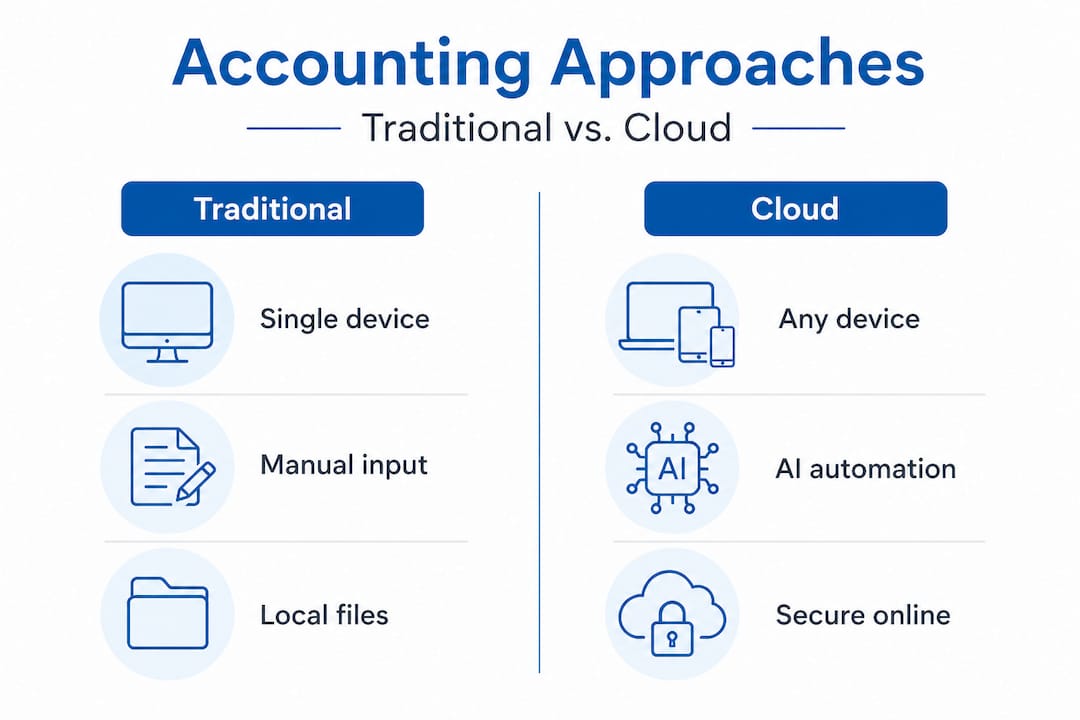
Beyond the table, the company accountant services available through cloud platforms allow specialist advisors to work directly inside your accounts rather than receiving exports. That removes a significant bottleneck at precisely the moments, such as fundraising or year-end, when speed matters most.
Several persistent myths deserve direct rebuttal:
- “Cloud accounting is less secure than desktop”: In reality, enterprise-grade cloud platforms use multi-factor authentication, end-to-end encryption, and geographic redundancy that most small businesses cannot replicate locally.
- “It is too complex to integrate with our existing tools”: Modern cloud accounting platforms offer open APIs and pre-built integrations with hundreds of tools including Stripe, Shopify, HubSpot, and most UK payroll systems.
- “We are too early-stage to need it”: Pre-revenue startups benefit enormously from having clean, organised financial records from day one. Investors notice when your data is structured and accessible. It signals operational maturity.
- “Migration will be disruptive”: With careful planning and the right support, migration from desktop or spreadsheet-based systems is typically achievable within a few weeks without disrupting operations.
The accounting software market’s rapid growth signals a clear market verdict. Founders who remain on traditional systems are swimming against a very strong current.
How to get started with cloud accounting in your startup
If you are ready to seize the benefits, here is exactly how to start the journey to cloud-based clarity and control. The process is more straightforward than most founders expect.
- Audit your current state: Map out what financial tools you currently use, what data exists, and where the gaps are. Identify your pain points: delayed reports, reconciliation errors, VAT filing stress, or investor data requests.
- Define your requirements: List what you need the system to do. Consider VAT filing, payroll integration, multi-currency support, user permissions, and Making Tax Digital compliance. Prioritise features by how much time or risk the absence of each creates.
- Evaluate and trial platforms: Xero, QuickBooks Online, and FreeAgent are the most common choices for UK startups. Each offers a free trial. Test against your actual workflows rather than feature lists.
- Plan your migration: Set a migration date, map your historical data, and decide what to import versus archive. For most startups, importing the last 12 to 24 months of transactions is sufficient for operational purposes.
- Train your team and advisors simultaneously: Assign ownership of the platform internally and ensure your accountant has full access from day one. Gaps in access create gaps in accountability.
- Establish your compliance workflows: Configure your VAT settings, bank feeds, and automated reminders before going live. Do not treat this as something to sort out later.
As detailed in AI in accounting, combining AI-assisted categorisation with rules-based compliance checks is the most reliable approach during and after migration. AI catches patterns; rules catch exceptions. You need both.
The cloud setup guide for UK tech startups outlines a practical timeline that most founders can follow without significant disruption to day-to-day operations.
Pro Tip: Treat your cloud accounting migration as a full bookkeeping process review. It is the ideal moment to clean up your chart of accounts, reclassify old transactions, and establish consistent categorisation rules that will save hours every month going forward.
The hidden edge: Why automation alone is not enough for startup accounts
Here is a perspective that most cloud accounting articles skip entirely. Automation is genuinely powerful. But the founders who extract the most value from cloud accounting are not the ones who set it up and walk away. They are the ones who pair smart automation with disciplined human oversight.
The rise of AI in accounting is real and accelerating. Routine tasks like bank reconciliation, invoice categorisation, and expense matching are now largely automated on good platforms. That is genuinely valuable time reclaimed. However, the nuance that matters for startups is this: AI combined with rules-based systems for compliance-critical decisions avoids costly errors in edge cases like VAT codes and tax classifications.
We have seen this play out with UK startups claiming R&D tax relief or managing SEIS investments. The data was in the cloud system, but the classifications needed human expertise to be correct. An AI might correctly categorise 94% of transactions. The remaining 6%, if they include a misclassified R&D expense or an incorrect VAT treatment on a cross-border SaaS sale, can create a material problem.
The stronger perspective here is that cloud accounting is not a replacement for good accounting advice. It is a force multiplier for it. When your advisor has real-time access to clean, organised data, the conversation shifts from “what happened?” to “here is what to do next.” That shift in dialogue is where real financial strategy happens.
The AI bookkeeping perspective for ambitious startups is clear: embrace automation where it handles volume and speed, but maintain expert oversight where regulatory precision is non-negotiable.
Explore expert support for your cloud accounting journey
Moving to cloud accounting is one of the most practical steps you can take to build financial clarity into your startup from the ground up. But the platform is only part of the answer.
At Price & Accountants, we work with UK tech and fintech founders to implement, optimise, and get the most from cloud accounting setups, including Xero. Our bookkeeping solutions are built for startups that need clean, investor-ready records without the overhead of a full in-house finance team. We also help founders unlock significant capital through R&D tax credits, ensuring that innovation spend is correctly classified and claimed. Understanding your accounting period is a good starting point if you are just beginning to structure your finances. We are here to help you build a financial foundation that scales with your ambitions.
Frequently asked questions
What are common risks of cloud accounting for UK startups?
Top risks include poor data migration, insufficient staff training, and over-relying on automation for complex compliance tasks. As highlighted in guidance on AI in accounting, combining AI with rules-based oversight is essential for accuracy in areas like VAT and tax codes.
How does cloud accounting improve collaboration?
All stakeholders, including founders, accountants, and investors, can securely access up-to-date financial data simultaneously, which sharpens decision-making and eliminates version confusion. The real-time collaboration capability is a primary reason the accounting software market is growing so rapidly worldwide.
Is cloud accounting suitable for pre-revenue or early-stage startups?
Absolutely. Cloud accounting helps early-stage startups manage cash carefully, maintain clean records for future investment, and stay agile as their model evolves. The scalability benefits mean the platform grows with you without switching costs.
What is the most important feature to look for in cloud accounting?
Strong automation paired with compliance oversight is the most critical combination. Look specifically for robust VAT handling and rules-based compliance checks, particularly if you are trading across borders or handling complex UK tax obligations like R&D credits or SEIS investments.
Recommended
- Cloud accounting implementation guide for UK tech startups - Price & Accountants
- Streamline company accounts in the UK: A guide for tech startups - Price & Accountants
- Role of accountants for UK tech startups in 2026 - Price & Accountants
- 5 key benefits of cloud accounting for UK startups - Price & Accountants
- Business Finance Archives - Switch&Save
- The role of cloud in business: strategies for success