

Fundraising readiness means that when an investor asks for your numbers, your cap table or your tax status, you can answer within a day, with documents that agree with each other. For a UK start-up, that usually comes down to five things: clean accounts, a share structure investors can work with, SEIS/EIS advance assurance where it applies, an organised data room, and a story backed by evidence. This guide covers each one, in the order we would tackle them.
TL;DR
- Start the groundwork months before you open a round. Investors back founders they have already watched make progress.
- Get management accounts, a clean cap table and a tidy data room in place first. Disorganisation reads as weak governance.
- If you will offer SEIS or EIS, apply for advance assurance early, so the relief is confirmed before an investor asks.
- Raise enough at seed to reach Series A. A thin round that forces a bridge is a negative signal.
- Readiness has two halves: the paperwork, and your ability to tell the story and choose the right investors.
Table of Contents
- Why readiness matters more in the current market
- Two kinds of readiness
- Step 1: Get the financial foundations in order
- Step 2: Clean up the cap table and share structure
- Step 3: Sort SEIS and EIS before you pitch
- Step 4: Check your R&D tax position
- Step 5: Build the data room
- Step 6: Prove market readiness, especially for Series A
- Perspective: what we see founders get wrong
- A 12-week readiness timeline
- How we help
- FAQ
- Sources
Why readiness matters more in the current market
Money is available, but investors are selective. The British Business Bank reported that equity investment into UK smaller businesses fell 4% to £12.3 billion in 2025, with AI companies taking a record 44% of the total. Within that, seed-stage deal volumes fell by 27% and venture-stage deals by 13%.
Fewer deals means more competition for each cheque. Founders who look organised, and whose numbers hold up under questioning, move through due diligence faster than those who are still tidying their records mid-process.
Two kinds of readiness
Advice from the Francis Crick Institute’s investor-readiness programme separates two things that founders often blur. Investment readiness is logistical: data room, legal documents, financial records. Investor readiness is the ability to tell a compelling story and to qualify which investors fit your stage and sector. Trying to build both during a frantic fundraising sprint is a common point of failure.
The same source stresses that pitching is partly about recruiting a partner, and that relationships should be built months ahead. A mentor who actively invests in your sector can sharpen your narrative before you open a round.
A practical split:
| Area | Investment readiness (paperwork) | Investor readiness (people and story) |
|---|---|---|
| Finance | Management accounts, forecast, filed statutory accounts | Clear explanation of burn, runway and use of funds |
| Legal | Cap table, articles, shareholder agreements | A round structure that suits your stage |
| Tax | SEIS/EIS advance assurance, R&D position | Honest answers on tax risk |
| Market | Customer contracts, pipeline data | Evidence of customer demand |
| Relationships | Investor target list | Warm introductions, regular updates |
Step 1: Get the financial foundations in order
Every investor will ask for the same things first: last year’s filed accounts, current-year management accounts, a monthly burn figure and a forecast that ties to them. If your bookkeeping is three months behind, you cannot produce any of these quickly.
What to have ready:
- Filed statutory accounts and your confirmation statement up to date at Companies House.
- Monthly management accounts, reconciled, no more than a month or so old.
- A 12 to 24 month forecast with stated assumptions.
- A clear record of VAT, PAYE and corporation tax filings and payments.
- Cloud-based books that an investor’s analyst can read without a phone call to you.
Most early-stage teams are better served by proper bookkeeping from the start than by a clean-up exercise the month before a raise. Investors read late filings and unreconciled accounts as a signal about how the business is run.
Step 2: Clean up the cap table and share structure
A cap table with unexplained options, informal promises of equity or missing share allotments slows diligence more than most founders expect. Before outreach, check that:
- Every share issued is recorded properly and filed.
- Founder shareholdings and any vesting arrangements are documented.
- Convertible instruments, such as advance subscription agreements or convertible notes, are listed with their terms.
- Any option pool is set up and sized for your next hires.
- The share classes work for the investor schemes you intend to use.
The last point matters because SEIS and EIS impose conditions on the shares investors receive. Getting this wrong after the money arrives is costly to fix.
Step 3: Sort SEIS and EIS before you pitch
For many UK angels, tax relief is part of the decision. If you can offer SEIS or EIS shares, say so early, and have HMRC advance assurance in hand. It is not a guarantee, but it tells an investor that HMRC has reviewed your facts and, on the information given, expects the shares to qualify.
The scale of demand is worth knowing. HMRC statistics for 2025-26 show 4,085 SEIS advance assurance applications, up 24%, with 76% approved so far, and 3,310 EIS applications, up 4%, with 72% approved. Roughly a quarter of applications are not approved in the period, so a weak application is a real risk.
Where to start:
- Work out which scheme fits your stage. Our guide to SEIS versus EIS sets out the differences.
- Test your company against the SEIS eligibility criteria or the EIS eligibility criteria before you apply.
- Check the amounts in our SEIS investment limits guide, as they affect how you size the round.
- Read what to secure in EIS advance assurance and apply well ahead of your first investor meeting.
Build in time. HMRC gives no guaranteed turnaround, so do not schedule a closing date that depends on assurance arriving by a particular day.
Step 4: Check your R&D tax position
If you build software or hardware, R&D relief can extend your runway, and investors like to see that you have a handle on it. Two points from current guidance are worth knowing.
First, the merged scheme and enhanced R&D intensive support apply to accounting periods beginning on or after 1 April 2024. For enhanced support, loss-making companies must meet an R&D intensity condition of 30%, and a PAYE cap applies: £20,000 plus 300% of the company’s relevant PAYE and National Insurance liabilities.
Second, first-time claimants can ask for full claim advance assurance, which can cover up to three accounting periods. Check the eligibility conditions on the page before you apply.
An investor will want to know whether a claim is made, planned or not applicable, and whether it is documented well enough to survive an HMRC enquiry. Our R&D tax credits guide for UK tech start-ups explains how we approach it.
Step 5: Build the data room
A data room is a shared folder, organised by topic, where an investor finds everything they need. GOV.UK’s data room checklist calls a well-prepared one one of the strongest signals of investor readiness, because it shows a company that is transparent, organised and disciplined.
The same guidance points to a standard index. Use these six folders:
- Financial: accounts, management accounts, forecast, tax filings, bank summaries.
- Legal and IP: incorporation documents, cap table, shareholder agreements, IP assignments, contracts.
- Commercial: customer data, pipeline, pricing, key contracts.
- Regulatory: licences, FCA status or applications for fintechs, data protection records.
- HR and governance: employment contracts, board minutes, option schemes.
- Technical: architecture overview, security practices, product roadmap.
Name files consistently, date them, and keep a short index at the top. Resist the urge to dump everything in. A reviewer who finds a stale forecast or a missing signature loses trust in the rest.
If you want a structured review before outreach, our investment readiness and due diligence service is built for exactly this stage.
Step 6: Prove market readiness, especially for Series A
Seed investors will often back vision and early signals. Series A investors want evidence. According to the UK Business Angels Association, they look for active customer engagement, retention, and a clear path to positive unit economics, such as customer acquisition cost against lifetime value. In regulated sectors like fintech, regulatory milestones matter as much as product milestones.
The same piece describes the “funding cliff” between seed and Series A. Founders under-raise at seed, underestimate the burn that compliance, approvals and customer acquisition demand, and then need bridge funding. Investors increasingly weigh burn multiples and payback periods over growth alone, so a lean round that forces a bridge counts against you.
The finance team’s job here is to produce honest numbers on:
- Monthly burn and runway, with scenarios.
- Gross margin and payback period by customer segment.
- Revenue quality: recurring share, churn, concentration.
- How much you need to reach the milestones a Series A investor will want, plus a buffer.
Perspective: what we see founders get wrong
We have completed start-up processes for over 20 clients, and the pattern is consistent. The founders who raise smoothly are rarely the ones with the flashiest deck. They are the ones whose finance function was boring and current long before the round.
Three habits separate them. They keep monthly books closed within a few weeks of month end, so every figure in the deck traces back to a ledger. They decide on SEIS or EIS early and sort the share structure before term sheets exist, not after. And they treat the forecast as a working tool they update, so they can explain a variance without improvising.
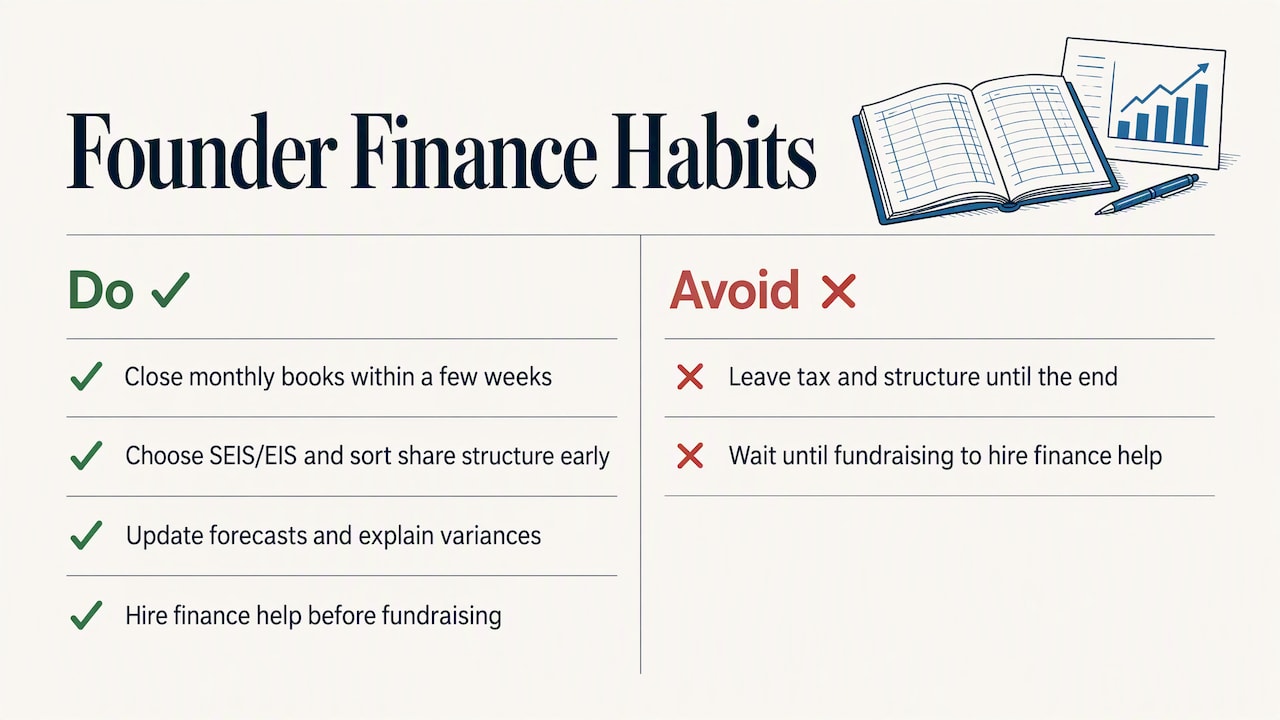
The mistake we see most often is leaving tax and structure to the end. A founder with a signed term sheet and an unresolved question about share rights or scheme eligibility is negotiating from weakness. Fix those questions while nobody is waiting for an answer.
One more point: do not wait to hire finance help until you are raising. An outsourced finance director can pressure-test your round size and runway while there is still time to change the plan.
— Rahamut
A 12-week readiness timeline
Use this as a rough guide and adjust it to your own situation.
| Weeks | Focus | Output |
|---|---|---|
| 1 to 2 | Review books, filings and cap table | List of gaps and owners |
| 3 to 4 | Catch up bookkeeping, produce management accounts | Reconciled monthly reports |
| 3 to 5 | Confirm SEIS/EIS route, submit advance assurance application | Application filed |
| 5 to 8 | Build forecast, unit economics and use-of-funds plan | Model that ties to the accounts |
| 6 to 9 | Assemble data room using the six-folder index | Indexed, dated documents |
| 8 to 12 | Refine story, shortlist investors, request warm introductions | Target list and tested pitch |
The timings overlap deliberately. Advance assurance depends on HMRC, so start it early and let the rest run alongside it.
How we help
Price & Accountants works with UK tech and fintech start-ups from pre-seed to Series A, as well as overseas founders setting up a UK company. For recurring support, our published plans start with Core Services at £249 per month and Blue Plan at £549 per month, and Black Plan starts from £1,999 per month. Finance directorship services sit on the same page, and you can see our wider accounting and tax services too.
If you are already planning a round, the most useful starting point is a conversation about your outsourced finance director options and the readiness review above.
FAQ
How early should a UK start-up begin preparing to fundraise?
Aim for at least three to six months before you want to open a round. Relationship building takes the longest, and advice on becoming investor ready stresses months of groundwork rather than a sprint. SEIS/EIS advance assurance and catching up bookkeeping also take time you cannot compress.
Do I need SEIS or EIS advance assurance before I pitch?
It is not a legal requirement, but many UK angels expect it, and it removes a point of doubt early in the conversation. Our guide to EIS advance assurance explains what to have in place. Apply well before your first meeting, because HMRC offers no fixed turnaround.
What do investors look at first in due diligence?
Typically financials, the cap table, legal documents and any regulatory position. A tidy data room speeds this up considerably, and GOV.UK guidance recommends a standard index covering financial, legal and IP, commercial, regulatory, HR and governance, and technical material.
How much should I raise at seed?
Enough to reach the milestones a Series A investor will expect, with a buffer. The UKBAA warns that under-raising at seed and then needing bridge funding is a negative signal. Build the figure from your forecast and burn, not from a round number that sounds comfortable.
Sources
- Becoming investor ready, Francis Crick Institute
- The FinTech funding cliff: how to get from Seed to Series A, UK Business Angels Association
- Data Room Essentials and Documents Checklist, GOV.UK
- Enterprise Investment Scheme and Seed Enterprise Investment Scheme: 2026, GOV.UK
- AI attracts record share of UK startup investment, National Technology
- AI takes record 44% of UK equity market, UK Startups and Innovation
- R&D tax relief: the merged scheme and enhanced R&D intensive support, GOV.UK
- Apply for full claim advance assurance on your first R&D tax relief claim, GOV.UK