

Setting up a finance function means deciding who records the money, who checks it, who files with HMRC and Companies House, and who turns the numbers into decisions. For a UK limited company, the sensible order is: clean books on cloud software, a compliance calendar, a monthly reporting pack, then forecasting and funding readiness. Add senior finance help when decisions outgrow the founder’s time, not before.
This guide is for founders of UK limited companies, from pre-seed to Series A, and for overseas founders opening a UK entity. It covers what to build, in what order, and what it costs you if you leave it late.
TL;DR
- A finance function has two jobs: control (accurate records, tax and filing on time) and advice (forecasts, pricing, funding decisions). Build control first.
- Start with a separate business bank account, cloud accounting software and a simple chart of accounts. Everything else depends on them.
- Put every statutory deadline in one calendar. Late accounts at Companies House bring automatic penalties from £150.
- If you plan to raise on SEIS or EIS, or claim R&D relief, set up your records for it from day one, because both are much harder to reconstruct later.
- Bring in an outsourced finance director when you are making funding, hiring or runway decisions that a bookkeeper cannot make for you.
Table of Contents
- What a finance function actually is
- Step 1: Lay the foundations
- Step 2: Build a compliance calendar
- Step 3: Set up payroll and bookkeeping rhythms
- Step 4: Add reporting that founders actually read
- Step 5: Make the function funding-ready
- When to hire, outsource or upgrade
- Our perspective
- How we can help
- A 30-day setup checklist
- FAQ
- Sources
What a finance function actually is
Most pages on this topic describe the finance function as everything that keeps a business financially healthy: budgeting, tracking expenses, reporting and planning. That is accurate but too broad to act on. In a young company it helps to split it into four layers.
- Transactions. Invoicing, paying suppliers, expenses, payroll, bank reconciliation.
- Compliance. Annual accounts, corporation tax, VAT, PAYE, confirmation statements.
- Reporting. Monthly management accounts, cash position, KPIs.
- Decision support. Forecasts, scenario planning, fundraising, tax-efficient structuring.
Layers one and two are control. Layers three and four are advice. Founders usually start by doing layer one on a spreadsheet and discover layer four only when an investor asks for a model they cannot produce. The aim of a setup is to build the layers in order, so each one is trustworthy before you depend on the next.
Step 1: Lay the foundations
Separate the money
If the company is not yet formed, the government’s guidance on setting up a limited company explains that you register online with Companies House, choose a name, appoint at least one director and give basic details of what the business does. Once it exists, open a business bank account in the company’s name. Paying company costs from a personal account is the single most common cause of messy first-year books, and it creates director’s loan balances you then have to untangle.
Choose cloud accounting software
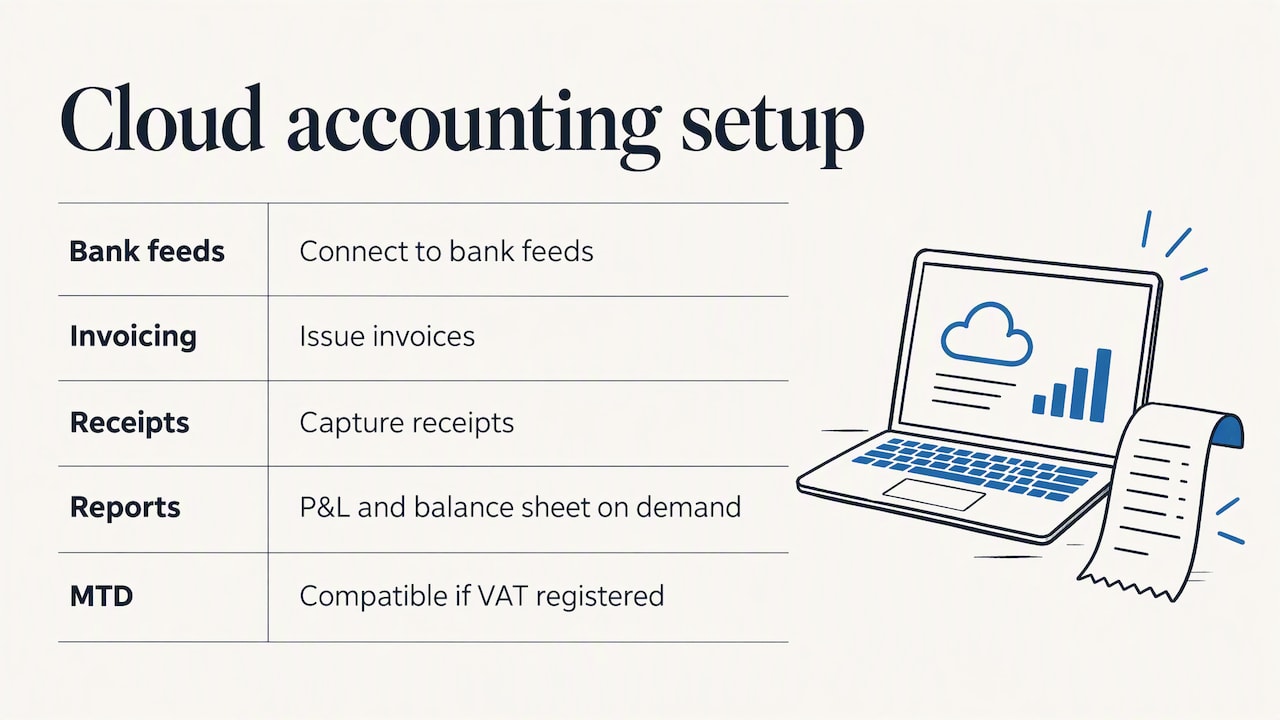
The software is the spine of the function. It should connect to your bank feeds, issue invoices, capture receipts and produce a profit and loss and balance sheet on demand. It also needs to be compatible with Making Tax Digital if you are VAT registered. HMRC’s own business accounting guidance is a good starting point on what records you need and how to set up the basics, and our glossary entry on cloud accounting software covers what to look for. We build most client set-ups on Xero because its app ecosystem lets you connect billing, expenses and payroll without re-keying data.
Design the chart of accounts before the first transaction
This is the step founders skip and regret. The chart of accounts is the list of categories every transaction lands in. If you design it around how you will want to report (revenue by product line, engineering salaries separate from sales salaries, software subscriptions separate from hosting), you will be able to answer investor questions and support tax claims without rework.
Three choices are worth making deliberately:
- Separate R&D-relevant costs. Staff time on development, cloud hosting for test environments and subcontracted engineering should each have their own codes.
- Track funding separately. Equity raised, advance subscription money and director loans should never share a code.
- Agree your accounting policies early, especially how you recognise revenue and capitalise development costs.
Step 2: Build a compliance calendar
Compliance is where a weak function costs real money, because the penalties are automatic. Put these in one shared calendar with owners and reminder dates.
| Obligation | What the rule says | Source |
|---|---|---|
| Annual accounts | Private limited companies file with Companies House within 9 months of the accounting reference date | GOV.UK |
| Late filing penalty | Starts at £150 for accounts up to a month late and rises to £1,500 if more than 6 months late | GOV.UK |
| VAT registration | Mandatory once taxable turnover passes £90,000 | House of Commons Library |
| Digital records | VAT-registered businesses keep digital records in compatible software | GOV.UK |
A few practical notes sit behind that table.
Companies House deadlines are calculated by the day, and a deadline falling on a weekend or bank holiday does not move. The same GOV.UK guidance says the requirement to file accounts using commercial software is due to be fully in effect from 1 April 2028, so choose software with that in mind.
VAT is not only about the threshold. Many tech companies register voluntarily earlier, because they buy a lot of VAT-bearing software and equipment and want to recover that input tax. Whether that suits you depends on who your customers are: a business customer can usually recover the VAT you charge, a consumer cannot. Our entry on Making Tax Digital explains the digital record-keeping side.
Corporation tax has its own timetable, separate from the Companies House one. Our glossary page on corporation tax is a quick reference, and your accountant should confirm the exact payment date for your accounting period. If you pay yourself through payroll, add PAYE reporting to the calendar as well.
Step 3: Set up payroll and bookkeeping rhythms
A function is a set of habits as much as a set of tools. Decide the rhythm now:
- Weekly: categorise bank transactions, chase unpaid invoices, upload receipts.
- Monthly: reconcile the bank, run payroll, review the profit and loss, close the month.
- Quarterly: VAT return, forecast refresh, review of the compliance calendar.
- Annually: statutory accounts, corporation tax return, confirmation statement, review of tax reliefs claimed.
Good bookkeeping is the habit that makes all the others cheap. Books closed within a few days of month end give you numbers you can act on. Books closed six months late give you a historical record and not much else.
Step 4: Add reporting that founders actually read
The monthly pack should fit on a few pages. Aim for:
- Profit and loss against last month and against budget.
- Cash balance and a rolling 12-month cash forecast.
- Runway in months, calculated from current burn.
- Revenue by customer or product, and gross margin.
- Headcount cost and the split between R&D and other staff.
- Any funding or tax relief in progress, such as an advance assurance application or an R&D claim.
The cash forecast is the most useful single page. Build it on three scenarios (base, slower sales, delayed funding), and update it monthly. When the downside case shows cash running out in under six months, that is your trigger to start fundraising or cut costs, not the day the balance gets low.
If you are thinking about team structure, this finance team structure guide sets out how finance roles tend to be sequenced over the first two years.
Step 5: Make the function funding-ready
For UK start-ups, funding readiness is mostly tax and record-keeping detail.
SEIS and EIS
The Seed Enterprise Investment Scheme and Enterprise Investment Scheme give individual investors tax relief for buying new shares in qualifying companies. GOV.UK explains how these venture capital schemes work. They are popular, with 3,735 companies raising £1,575 million under EIS in 2024 to 2025, according to HMRC statistics.
Before issuing shares, most companies ask HMRC for advance assurance that the investment is likely to qualify. Three points matter for your finance setup:
- Advance assurance is a discretionary service. The HMRC manual says it is non-statutory, so HMRC is not obliged to provide it.
- HMRC does not give it for speculative applications. A company that has not raised under these schemes before must show it expects to raise the money, for instance through a lead investor or platform.
- The company must already be formed and hold a Unique Tax Reference. In the 2025 to 2026 period, HMRC approved 72% of EIS and 76% of SEIS applications, per the same statistics release.
If you use advance subscription agreements to take money quickly, read the terms against HMRC’s guidance first. The venture capital schemes manual and the ASA guidance set out the conditions, and an ASA that allows refunds, pays interest or runs beyond a six-month longstop can put assurance at risk. Have an adviser read the agreement before anyone signs it. Our guides on SEIS eligibility and SEIS/EIS accounting for tech start-ups go further.
R&D tax relief
If you build software or engineering products, your finance function should capture R&D costs as they happen. For accounting periods beginning on or after 1 April 2024, the old SME and RDEC schemes have been replaced by a merged R&D expenditure credit scheme with a 20% credit rate. Loss-making, R&D-intensive SMEs may instead qualify for enhanced R&D intensive support, but you cannot claim under both for the same expenditure.
The practical consequence: time sheets, project codes and subcontractor invoices are evidence. Setting them up in month one is far cheaper than rebuilding them for a claim. For more detail, see our pieces on the merged scheme, RDEC versus SME relief and HMRC enquiry risks on R&D claims.
When to hire, outsource or upgrade
The common question is who does what, and when. Here is a rough sequence for a company of 2 to 50 people, based on what we see with start-up clients.
| Stage | Typical situation | Finance set-up that fits |
|---|---|---|
| Pre-seed | Founders only, few transactions | Cloud software, accountant for compliance, outsourced bookkeeping |
| Seed | First hires, funding in progress | Monthly management accounts, payroll, cash forecast, SEIS/EIS support |
| Seed to Series A | Growing headcount, investor reporting | Outsourced finance director, R&D claim process, budget and board pack |
| Series A and beyond | Multiple funding streams, more complex reporting | Senior finance lead, whether outsourced or in-house, plus bookkeeping team |
The signal to add a finance director is not size. It is the first time you face a decision with real money and several possible answers: how much to raise, whether to hire three engineers or five, whether to enter a new market. A bookkeeper records what happened. An FD helps you choose what happens next.
Our perspective
We have spent over 40 years in accounting and tax, and we have completed start-up processes for more than 20 clients. The pattern repeats. Founders rarely fail at finance because the work is hard. They fail because it is done in the wrong order, or not at all until an investor, HMRC or Companies House asks.
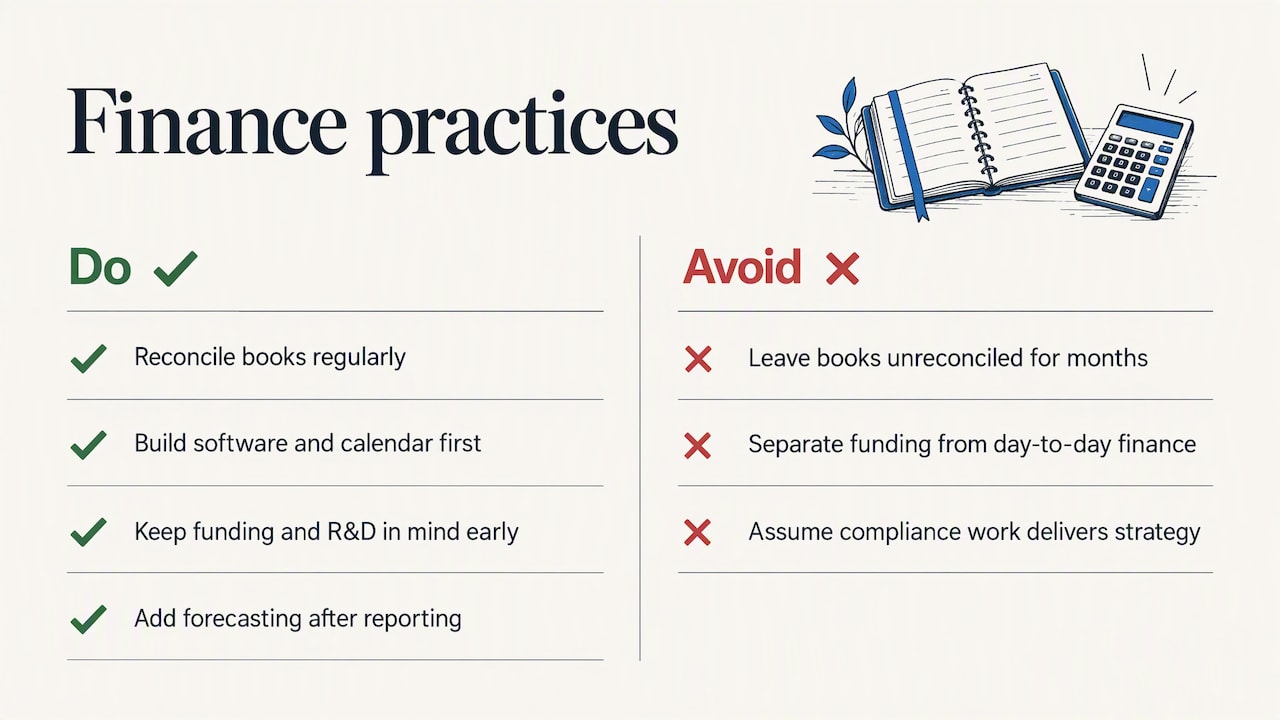
The three mistakes we see most are these. First, books are left unreconciled for months, so the first set of accounts becomes a reconstruction exercise. Second, funding and tax relief are treated as separate from day-to-day finance, when in fact SEIS, EIS and R&D claims all depend on how the shares were issued and how costs were coded. Third, founders hire a generalist accountant for compliance and assume strategy will follow, when it usually does not.
Our advice is to start small and build in layers. Get the software and the calendar right, then reporting, then forecasting. Keep funding and R&D in mind from the first day, because that is where the biggest sums are at stake. And bring in finance director support the moment your decisions get bigger than your spreadsheet.
— Rahamut
How we can help
If you would rather have this built for you, our plans are published. Core Services is £249 per month, the Blue Plan is £549 per month, and the Black Plan starts from £1,999 per month. Finance directorship services are listed on the same page. If you want to see what each service covers first, our services page lists bookkeeping, company accounts, VAT, payroll and pensions, R&D tax credits and advisory work. We work with UK tech and fintech start-ups and with overseas founders setting up a UK entity.
A 30-day setup checklist
- Week 1: open the business bank account, choose and connect accounting software, set up the chart of accounts.
- Week 2: list every statutory deadline in a shared calendar, confirm your accounting reference date and check whether VAT registration makes sense.
- Week 3: set up payroll if you will employ anyone including yourself, and agree the weekly and monthly bookkeeping routine.
- Week 4: build the first monthly pack and a 12-month cash forecast, and record the funding and R&D evidence you will need later.
After that, review the setup every quarter. A function that fitted five people rarely fits fifteen.
FAQ
What is the first thing to set up in a finance function?
A business bank account and cloud accounting software connected to it. Everything else, from VAT returns to investor reporting, relies on clean, current transaction records. Add the chart of accounts straight away so every transaction is coded correctly from the start.
When should a start-up hire a finance director?
When you are making decisions that carry real financial risk, such as raising a round, planning headcount against runway, or choosing between funding routes. Most early companies do not need a full-time FD. An outsourced or part-time finance director gives you the judgement without the full salary.
Can I run my own finance function in the first year?
You can handle day-to-day bookkeeping yourself if you stay disciplined, but compliance and tax are where mistakes cost money. Late accounts bring automatic penalties from £150, and incorrect SEIS, EIS or R&D claims can be expensive to unwind. Most founders are better off having an accountant check the work from the start.
Do I need to be VAT registered from the start?
Not necessarily. Registration is compulsory once taxable turnover exceeds £90,000, but you may register earlier on a voluntary basis. Whether that helps depends on how much VAT you pay on costs and whether your customers can recover the VAT you charge. Ask your accountant to model it before you decide.
Sources
- Preparing and filing Companies House accounts, GOV.UK
- VAT Registration, House of Commons Library
- How to set up a limited company, Tax Confident
- Setting up business accounting and finance, Business.gov.uk
- Use a venture capital scheme to raise money for your company, GOV.UK
- EIS and SEIS statistics 2026, GOV.UK
- VCM60210 SEIS advance assurance, HMRC manual
- VCM60130 no speculative applications, HMRC manual
- VCM12025 advance subscription agreements, HMRC manual
- R&D tax relief: the merged scheme and ERIS, GOV.UK