
For freelancers and sole traders, Pandle is the strongest free alternative; for growing limited companies, Xero or a managed service like Price & Accountants will serve you better; and for budget-conscious small businesses wanting more than a spreadsheet, Zoho Books or QuickBooks Online hit the sweet spot between price and capability.
The three picks at a glance:
The strongest Crunch alternative depends entirely on your business type: software-first platforms suit confident, low-complexity users; a managed service like Priceandaccountants suits founders who need advisory depth alongside compliance.
| Point | Details |
|---|---|
| Best for freelancers and sole traders | Pandle (free) or Zoho Books (free tier under £35k turnover) cover core UK compliance without a monthly fee. |
| Best for limited companies and growing startups | Xero with a qualified adviser, or Priceandaccountants for a fully managed, advisory-led service. |
| MTD VAT is non-negotiable | Any VAT-registered business must use MTD-compatible software; confirm this before switching platforms. |
| Migration takes 4–8 weeks | Export data, reconcile balances, run a parallel period, and notify HMRC of any agent changes. |
| Priceandaccountants as managed alternative | Covers bookkeeping, payroll, VAT, R&D and SEIS/EIS in one Xero-based retainer with 40+ years of expertise. |
The table below maps the eight most-compared alternatives across the dimensions that matter most to UK small businesses. Published pricing changes frequently, so treat starting tiers as a guide and verify directly with each provider.
| Provider | Starting price (approx.) | Best for | MTD & HMRC | Payroll | Invoicing & time tracking | Support type | Scalability |
|---|---|---|---|---|---|---|---|
| Price & Accountants | Monthly retainer (quote) | Tech startups, limited companies, founders needing R&D/SEIS/EIS | Full — VAT, Self Assessment, year-end | Included in managed packages | Via Xero | Xero integrations + outsourced FD | High |
| Xero | From £5/mo | Growing SMEs, limited companies | Full MTD VAT; Self Assessment add-on | Add-on (Xero Payroll) | Strong | Xero adviser network | Very high |
| QuickBooks Online | From — | Small businesses, sole traders | Full MTD VAT | Add-on | Strong | Chat, phone, community | High |
| Zoho Books | Free tier; paid from £5/mo | Budget-conscious SMEs | MTD VAT supported | Via Zoho Payroll (separate) | Good | Email, chat | Medium–high |
| FreshBooks | From — | Freelancers, service businesses | MTD VAT | Limited | Excellent | Chat, email | Medium |
| Pandle | Free; premium ~£5/mo | Sole traders, micro-businesses | MTD VAT (premium) | Add-on | Good | Low–medium | |
| Wave | Free (invoicing/accounting) | Micro-businesses, freelancers | Limited UK compliance | Not included | Good | Community/paid support | Low |
| Manager.io | Free (desktop); cloud paid | Tech-savvy sole traders | Manual only | Manual | Basic | Community forums | Low |
ITQlick’s 2026 comparison lists QuickBooks Online, Wave and Zoho Books among the most frequently cited Crunch alternatives, with pricing deltas and feature notes. AccountingReviews focuses specifically on QuickBooks, Pandle and Zoho Books for UK users and explains where each suits different business types.
Practical trade-offs in brief:
Pro Tip: Published prices almost always exclude payroll fees, registered office services and Self Assessment filings. When comparing total cost, add those line items before deciding.
The decision usually comes down to three questions: how much accounting do you want to do yourself, what are your HMRC obligations, and how fast are you growing?
A practical checklist:
Red flags to watch for:
For a deeper look at bookkeeping best practices before you commit to a new platform, that guide covers MTD obligations and what to set up from day one.
Crunch built its reputation on combining proprietary software with in-house accountant support at a modular price point. That model works well for contractors and freelancers who want a single provider handling both the software and the compliance, without paying for a full-service accountancy firm.
CB Insights notes Crunch’s position as part of the broader UK fintech and SME financial tools space, where the competition ranges from pure-software platforms to fully managed services.
Where Crunch’s model is preferable:
Where software-first alternatives are better:
The core trade-off, repeated across independent comparisons, is predictable monthly fee versus price flexibility: bundled services cost more upfront but remove the surprise of add-on charges at year-end.
Most migrations take four to eight weeks if the books are reasonably tidy. Complex payrolls or incomplete historical records add time and cost.
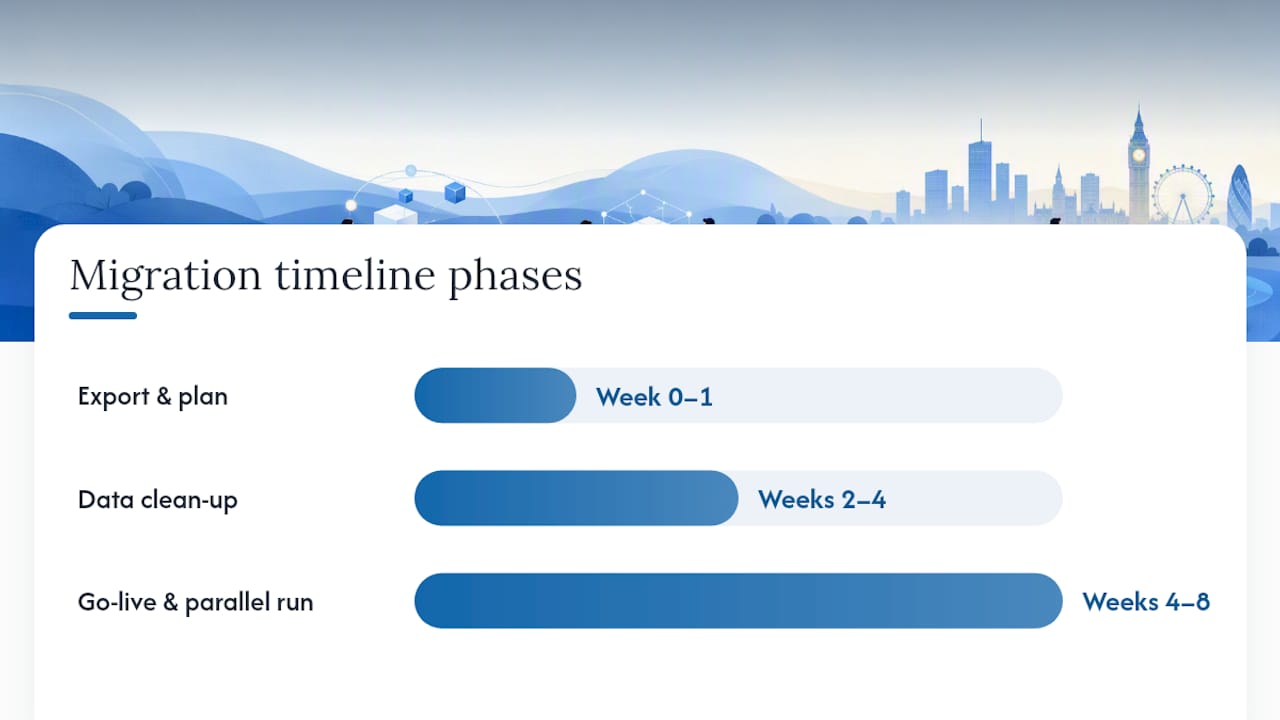
Timeline guide: Week 0–1: export and plan. Weeks 2–4: data clean-up and opening balances. Weeks 4–8: go-live with parallel run.
Pro Tip: The biggest cost driver in a migration is incomplete bookkeeping. If your Crunch records have unreconciled transactions, budget for a bookkeeper to clean them up before you import — it is far cheaper than fixing errors after go-live.
For a full checklist of what to prepare, the UK tech startup bookkeeping essentials guide covers HMRC compliance steps and what to set up from the start.
Pandle is the most practical free option for UK users. Bank feeds, stock control and project tracking are all available on the free plan, and the import path from Crunch is documented. MTD VAT filing requires the premium tier at around £5 per month.
Wave covers invoicing and basic bookkeeping at no cost. UK payroll is not supported, and HMRC filing requires manual workarounds — fine for a micro-business with very low transaction volume, less so once you are VAT-registered.
Zoho Books offers a free tier for businesses under £35,000 annual turnover and includes MTD VAT filing, which puts it ahead of Wave for UK compliance. Payroll sits in a separate Zoho product.
Manager.io suits technically confident sole traders who want a desktop-first tool with no subscription cost. HMRC filing is entirely manual, so it is not a realistic option for VAT-registered businesses without additional software.
Key limitations across all free tiers:
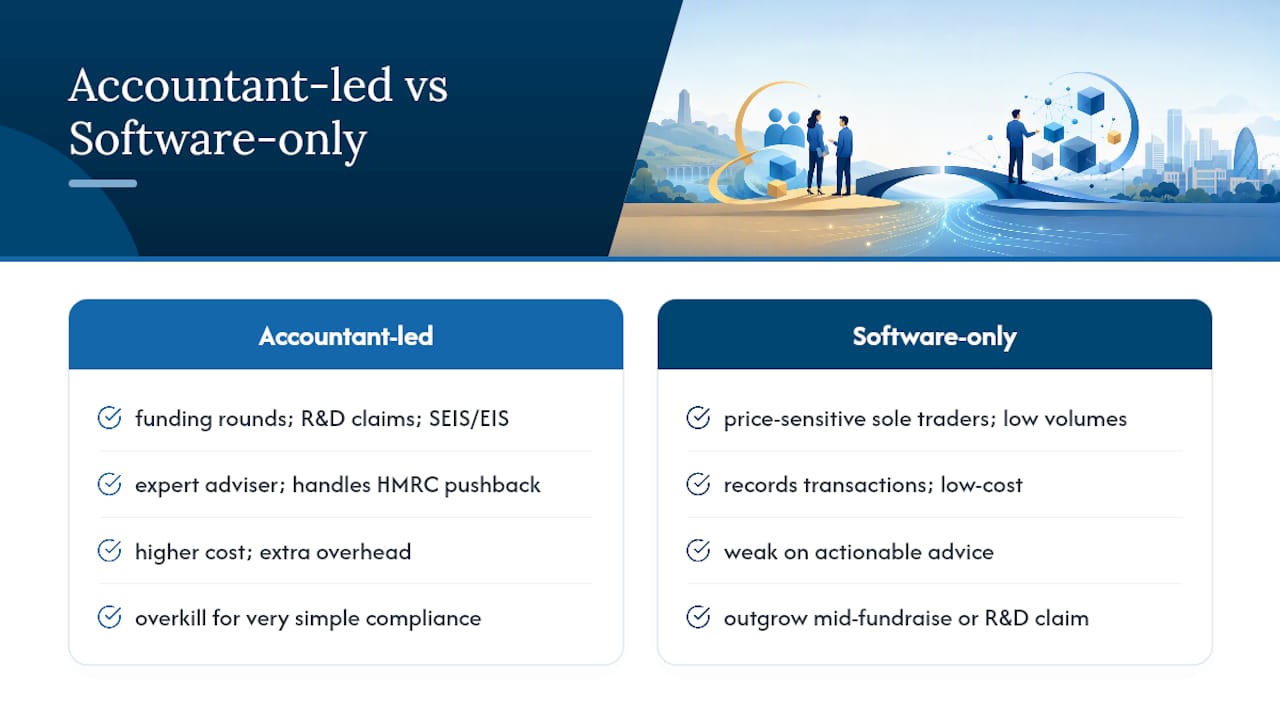
Software-first platforms are excellent at recording what happened. They are much weaker at telling you what to do next.
The businesses I see benefit most from a managed service are those approaching a funding round, filing an R&D tax credit claim, or structuring SEIS/EIS for early investors. In those situations, the software is almost irrelevant — what matters is having an adviser who has done it before and knows where HMRC pushes back. A Xero dashboard will not tell you whether your R&D expenditure qualifies or how to structure a share option scheme for your first hire.
That said, software-first is genuinely the right call for price-sensitive sole traders with low transaction volumes and the confidence to manage their own books. If your compliance needs are straightforward — a handful of invoices a month, no payroll, no VAT — paying for a managed service is overhead you do not need. Pandle or Zoho Books will handle it cleanly.
The mistake I see most often is founders starting on a free tool, outgrowing it at exactly the wrong moment (mid-fundraise, mid-R&D claim), and then paying a premium for emergency clean-up work. Switching platforms when your books are already under scrutiny is avoidable. The time saved by moving to a managed service earlier is rarely appreciated until the alternative has already cost you.
If you have outgrown Crunch’s modular model and need more than a software subscription, Priceandaccountants offers a fully managed alternative: bookkeeping, payroll, VAT, and year-end compliance handled by a dedicated team, all running on Xero so your data is portable and your accountant has real-time visibility.

Beyond compliance, Priceandaccountants specialises in the areas that matter most to growing UK tech businesses: R&D tax credit claims, SEIS/EIS scheme management, outsourced finance director support, and UK entity setup for overseas founders. With 40+ years of combined expertise and a track record of supporting startups now valued at over £50m, the firm goes well past filing returns.
Onboarding is straightforward: a discovery call to scope your needs, a fixed monthly retainer, and a clean migration from your current platform. To find out what a managed service costs for your business, book a discovery call with the team today.
The sources below were selected for independence, UK-market relevance and practical detail. Independent review sites and vendor comparison pages provide pricing context; the Priceandaccountants resources offer deeper guidance on HMRC compliance and migration steps.