
TL;DR:
- AI accounting automation uses artificial intelligence to streamline financial processes, reduce manual work, and improve accuracy for SMBs. It significantly cuts month-end close times and enhances compliance, but human oversight remains essential for high-stakes tasks. Selecting the right platform and implementing phased processes with governance ensures effective and trustworthy automation.
AI accounting automation is the use of artificial intelligence to automatically process, categorise, reconcile, and report financial data, replacing manual bookkeeping tasks and sharpening decision-making accuracy. For small and medium businesses, this shift is already measurable. Nearly 98% of accounting professionals now use AI tools, with 76% applying them specifically to accounting tasks. Tools like QuickBooks Online with Intuit Assist, DualEntry, FloQast, and Xero are at the centre of this change, and the productivity gains they deliver are no longer theoretical. Understanding what these platforms actually do, and where human judgement still matters, is the practical starting point for any SMB owner considering this path.
What does AI accounting automation actually do?
AI accounting automation covers a specific set of finance functions that have traditionally consumed disproportionate staff time. These include data entry, transaction coding, invoice capture, bank reconciliation, expense categorisation, and financial reporting. The technology behind these functions combines optical character recognition (OCR), machine learning models, and real-time data processing to handle volume that would otherwise require hours of manual work.

The efficiency gains from these capabilities are documented and significant. FloQast case studies show month-end close reduced from 15 days to 3, and cash reconciliation cut from 6 to 8 hours down to 5 to 10 minutes. That is not a marginal improvement. It represents a structural change in how finance teams spend their working week.
The specific tasks that AI handles most effectively include:
- Receipt and invoice capture: OCR extracts data from scanned documents and PDFs, eliminating manual re-keying.
- Bank transaction coding: Machine learning models learn from historical categorisation patterns and apply them automatically to new transactions.
- Reconciliation: AI matches transactions across accounts continuously rather than in monthly batches, catching discrepancies earlier.
- Financial reporting: Automated consolidation of general ledger data produces draft reports without manual assembly.
- Anomaly detection: AI flags unusual transactions in real time, reducing the window for errors or fraud to go unnoticed.
AI tools enable accountants to support 55% more clients weekly. For an SMB owner, this means your finance function scales without proportional headcount growth. Platforms like DualEntry integrate with thousands of bank connections and automate document capture with OCR, reducing manual data entry by up to 90% for SMBs. That figure matters because data entry errors are the most common source of reconciliation problems downstream.
How accurate is AI accounting automation vs traditional methods?
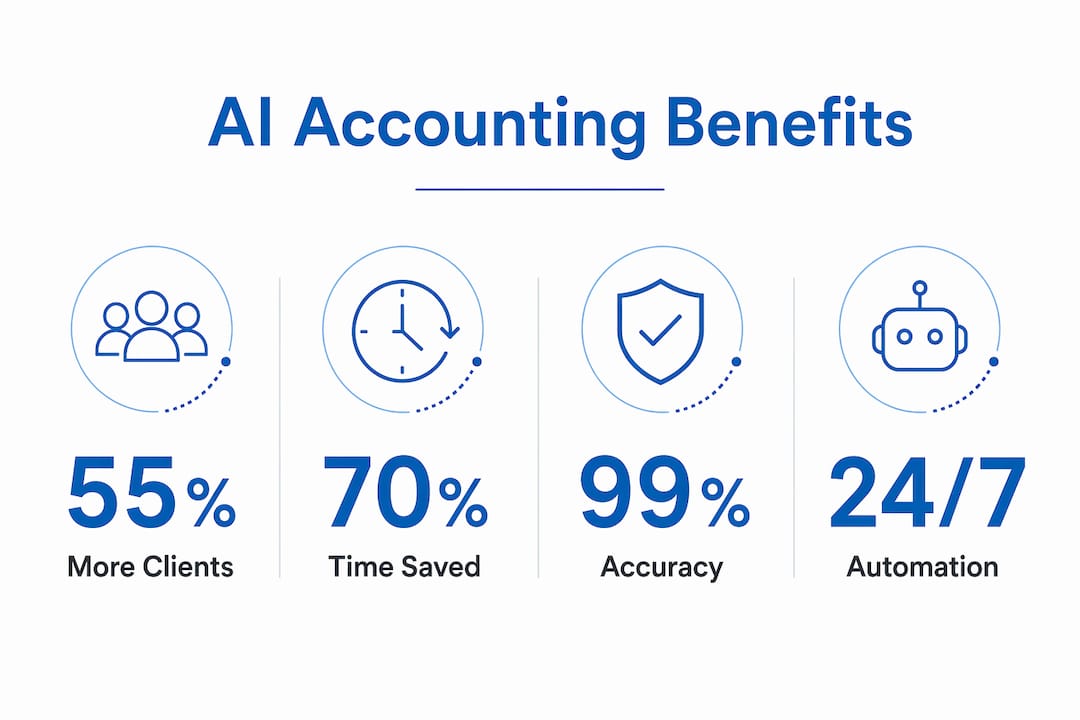
Accuracy is where AI accounting tools make their strongest case against traditional manual processes. AI improves accuracy through early anomaly detection and supports continuous reconciliation rather than batch processing. This means errors surface within hours rather than at month end, when they are far more costly to unwind.
That said, accuracy is not unconditional. The quality of AI outputs depends directly on the quality of inputs. Poorly structured chart of accounts, inconsistent supplier naming, or incomplete transaction descriptions will produce unreliable categorisation regardless of how sophisticated the model is. Garbage in, garbage out remains the governing principle.
“Successful small businesses treat AI as a copilot rather than a full replacement, using AI to handle volume while humans ensure compliance and interpretation.” — AI in accounting 2026
Human oversight is not optional for high-stakes tasks. Tax filings, audit preparation, and statutory accounts all require a qualified professional to review and certify AI outputs. Effective AI deployments require human-in-the-loop designs that enable users to certify rules and maintain audit trails. Without this governance layer, the speed advantage of automation can become a liability if errors propagate unchecked into official filings.
Compliance monitoring is another area where AI adds genuine value. Automated systems can flag VAT coding inconsistencies, identify transactions that breach expense policies, and alert finance teams to unusual payment patterns before they become regulatory problems. This proactive posture is a meaningful upgrade over the reactive approach most SMBs currently use.
Pro Tip: Set a weekly review cadence where a finance lead or accountant spot-checks a sample of AI-coded transactions. This builds confidence in the system, catches edge cases the model has not yet learned, and satisfies audit trail requirements without consuming significant time.
Which AI accounting platforms suit SMBs best?
The market for automated accounting software has matured considerably. The platforms below represent the most widely adopted options for SMBs in 2026, each with distinct strengths.
PlatformCore strengthBest suited forQuickBooks Online (Intuit Assist)AI-assisted categorisation and cash flow forecastingSMBs wanting an all-in-one solution with broad integrationsXeroCloud-native bookkeeping with strong UK VAT complianceUK-based SMBs and those working with Xero-certified advisersDualEntryAI-native ERP automating up to 90% of finance workflowsMid-market businesses with multi-entity or complex consolidation needsFloQastClose management and reconciliation automationFinance teams focused on accelerating month-end closeBotkeeperAI bookkeeping with human accountant review layerSMBs outsourcing bookkeeping who want AI speed with human sign-offZoho BooksAffordable automation with invoicing and compliance toolsEarly-stage businesses needing cost-effective financial automation
Selecting between these platforms requires honest assessment of three factors. First, integration depth: does the platform connect natively with your existing payroll, CRM, and banking systems? Second, compliance coverage: does it handle UK-specific requirements such as Making Tax Digital (MTD) and VAT returns? Third, scalability: will the platform still serve you at twice your current transaction volume?
Xero deserves particular mention for UK SMBs because its MTD compliance is built in rather than bolted on, and its ecosystem of certified advisers, including the team at Priceandaccountants, means you can get professional support that is already fluent in the platform. For businesses with more complex multi-entity structures, DualEntry’s AI-native architecture handles general ledger management and consolidation at a depth that traditional cloud accounting tools do not match.
How to implement AI accounting automation in your SME
Implementation is where most SMBs either realise the full benefit of intelligent accounting tools or waste their investment. The difference almost always comes down to sequencing and governance, not the choice of platform.
- Start with upstream manual tasks. Automating receipt capture and invoice extraction first produces cleaner books and more accurate downstream reporting. Do not begin with financial reporting automation if your input data is still messy.
- Audit your chart of accounts before onboarding. AI categorisation models learn from your existing structure. If your account codes are inconsistent or overly granular, clean them up before the AI ingests historical data.
- Define human oversight roles explicitly. Assign a named person responsible for reviewing AI outputs weekly. This is not bureaucracy. It is the governance layer that keeps your books auditable and your compliance intact.
- Integrate tools deliberately, not opportunistically. Only a third of businesses have fully scaled accounting AI, largely because siloed tools and disconnected systems prevent automation from flowing end to end. Choose platforms that connect natively rather than patching together incompatible solutions.
- Train your finance staff on AI limitations, not just features. Staff who understand where the model is likely to make mistakes, such as split transactions, foreign currency invoices, or unusual supplier names, will catch errors before they compound.
- Use AI-generated insights for strategic decisions. Once your books are clean and reconciled in near real time, you have cash flow visibility that most SMBs lack. Use that data to inform hiring decisions, supplier negotiations, and growth planning rather than simply filing it away.
Pro Tip: Before committing to any platform, run a 30-day parallel test where AI-coded transactions are reviewed against your existing manual process. This reveals the model’s accuracy on your specific transaction types and builds internal confidence before you remove the manual fallback.
For a broader view of where AI bookkeeping tools are heading, the practical guidance for SMBs has expanded considerably in 2026.
Key takeaways
AI accounting automation delivers the greatest returns when clean data inputs, phased implementation, and human oversight are combined from the outset.
PointDetailsAutomation scopeAI handles data entry, reconciliation, invoice capture, and reporting, freeing staff for higher-value work.Efficiency gainsMonth-end close can fall from 15 days to 3, and cash reconciliation from hours to minutes with the right platform.Human oversight is non-negotiableTax, audit, and compliance tasks require human certification of AI outputs to maintain accuracy and auditability.Platform selectionMatch tools to UK compliance needs, integration depth, and transaction volume rather than choosing on price alone.Implementation orderAutomate upstream tasks first. Clean inputs produce reliable reporting; fixing downstream errors costs more than preventing them.
Why AI will not replace your accountant, but will change what they do
I have worked with enough SMB finance teams to say this plainly: the businesses that get the most from AI accounting tools are not the ones that use them to cut headcount. They are the ones that use them to redirect skilled people toward work that actually requires judgement.
The CPA talent shortage is real, and AI is partly a response to it. But the response that works is not removing accountants from the process. It is removing the parts of the process that do not need an accountant. Reconciling 800 bank transactions a month does not need a qualified professional. Deciding how to structure a director’s loan account ahead of a funding round absolutely does.
What I find most telling is the trust gap. Building trust in AI outputs through human verification and accountability frameworks is the critical challenge, not the technology itself. Most SMB owners I speak with are not sceptical of AI in principle. They are sceptical of specific outputs they cannot verify. That scepticism is healthy, and the answer is not blind faith in the model. It is a governance structure that makes verification fast and systematic.
The businesses I have seen struggle with AI adoption share a common pattern: they treated implementation as a technology project rather than a process change. They bought the software, connected the bank feeds, and expected the books to look after themselves. They did not. The businesses that succeeded treated AI as a capable junior colleague who needs clear instructions, regular review, and a senior person to sign off on anything that matters. That framing is not a limitation. It is the correct mental model for getting real value from financial automation technologies in 2026.
For context on where accounting trends in 2026 are heading more broadly, the shift toward advisory-led finance is accelerating across the UK market.
— Rahamut
How Priceandaccountants supports your AI accounting transition
At Priceandaccountants, we work with UK tech businesses and SMBs that are ready to move beyond manual bookkeeping but want professional oversight built into the process from day one. Our bookkeeping services are built around Xero and modern automation tools, giving you real-time financial visibility without the administrative burden. For businesses that need more than clean books, our strategic advisory and tax planning service acts as an outsourced Finance Director, helping you interpret AI-generated insights and make decisions that support growth. If you are evaluating AI accounting platforms or want a second opinion on your current setup, speak with our team directly.
FAQ
What is AI accounting automation?
AI accounting automation is the application of artificial intelligence, including machine learning and OCR, to automatically process, categorise, reconcile, and report financial data. It replaces manual bookkeeping tasks and reduces the time finance teams spend on repetitive data work.
How much time can AI accounting tools save an SMB?
Real-world implementations show month-end close reduced from 15 days to 3 days, and cash reconciliation cut from several hours to under 10 minutes. The scale of saving depends on transaction volume and how thoroughly automation is applied across the finance function.
Does AI accounting automation replace accountants?
AI handles volume and repetition; accountants handle judgement, compliance, and strategy. The most effective deployments treat AI as a copilot that processes data while qualified professionals review outputs, certify rules, and advise on decisions that carry financial or legal consequence.
Which AI accounting platform is best for UK SMBs?
Xero is the strongest choice for most UK SMBs because of its native Making Tax Digital compliance and wide adviser network. Businesses with more complex multi-entity structures may find DualEntry’s AI-native architecture better suited to their consolidation needs.
What is the biggest risk of implementing AI accounting automation?
The primary risk is deploying automation without governance. Automation without human-in-the-loop verification can allow miscoded transactions and compliance errors to propagate undetected through your books, creating problems that are costly to correct at year end or during an audit.
Recommended
- AI-powered Bookkeeping Tools: A Guide for Small Businesses - Price & Accountants
- Accounting trends in 2026: what leaders must know - Price & Accountants
- UK tech accounting trends: key strategies for 2026 growth - Price & Accountants
- Why Cloud Accounting Matters: Fuelling Growth for SMEs and Start-ups - Price & Accountants