

TL;DR:
- UK tech startups face costly penalties and reputational damage from missed or inaccurate filings, which can hinder investment and growth. Maintaining digital, evidence-based compliance and proactive disclosure streamlines operations, minimizes risks, and enhances funding prospects. Building compliance infrastructure early enables scaling, improves investor confidence, and transforms tax obligations into growth enablers.
For UK tech founders, missed or inaccurate filings trigger penalties and charges that can escalate far beyond the original oversight, draining cash reserves at exactly the moment you need them most for growth. Yet the bigger risk is not the fine itself. It is the ripple effect: investor due diligence stalling, grant applications failing, and HMRC enquiries eating up months of your time. This article maps out the full compliance landscape for UK tech startups, explains the real costs of getting it wrong, and shows you how treating compliance as a strategic priority rather than a legal chore can actively accelerate your path to funding and scale.
Table of Contents
- What does tax compliance mean for UK startups?
- The real costs of non-compliance: penalties and lost opportunities
- Why small businesses are under the HMRC spotlight
- Behaviour matters: how intent, disclosure and advice impact penalties
- How robust tax compliance unlocks growth and funding
- Why compliance is a growth enabler, not just a box-ticking burden
- How Price & Accountants helps you stay compliant and unlock growth
- Frequently asked questions
Key Takeaways
PointDetailsNon-compliance is costlyPenalties and lost opportunities can severely impact startup growth and funding eligibility.Small businesses face greater scrutinyStartups are more likely to be checked by HMRC due to their contribution to the UK tax gap.Compliance enables investmentRobust compliance paves the way for grants, VC investment, and faster growth.Digital workflows are vitalAutomated systems and good records help avoid mistakes and support rapid scaling.
What does tax compliance mean for UK startups?
Tax compliance is not simply about filing a return once a year and hoping for the best. For a UK tech startup, it means meeting every required obligation on time, with accurate information, and with the right digital evidence to back it up. Understanding startup tax compliance explained in full is the foundation for everything else that follows.
In practical terms, your obligations typically include corporation tax returns, VAT returns, PAYE for employees, and potentially R&D tax credit claims. Each of these has its own submission window, its own evidence requirements, and its own penalty regime.
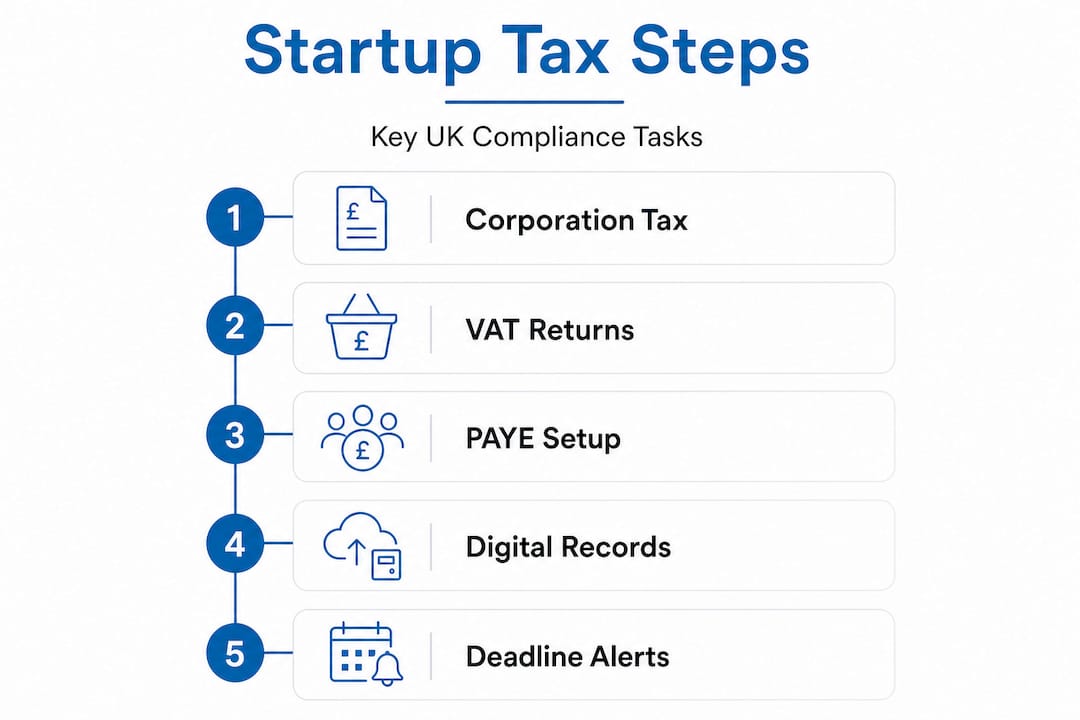
HMRC’s penalty points for late VAT returns work on an accumulation model: miss enough deadlines and you cross a threshold that triggers financial penalties. This reformed system replaced the old surcharge regime and demands that founders treat every filing as a discrete, time-sensitive task rather than an administrative afterthought.
Recent reforms also introduced stricter digital evidence requirements under Making Tax Digital (MTD). This means your bookkeeping software must generate records in a format HMRC can audit, not just a spreadsheet you assembled the night before the deadline.
Here is a summary of the core obligations most tech startups will face:
ObligationFrequencyKey deadlinePenalty triggerCorporation tax returnAnnual12 months after year endDay one if lateVAT returnQuarterlyOne month + 7 days after periodPoints-based systemPAYE and NIC submissionsMonthly19th of following monthImmediate daily chargeR&D tax credit claimAnnualTwo years after year endMissed reliefSelf-assessment (director)Annual31 January£100 immediate penalty
Common startup obligations at a glance:
- Submit all filings on time, even if the tax owed is nil
- Maintain digital records that meet MTD standards
- Keep supporting evidence for every transaction, especially R&D expenditure
- Notify HMRC promptly when your circumstances change, such as crossing the VAT threshold
Pro Tip: Set calendar reminders 30 days before every filing deadline and assign a named owner internally. Automated reminders inside cloud accounting tools like Xero can eliminate the human error element entirely before it becomes a penalty point.
The real costs of non-compliance: penalties and lost opportunities
Understanding compliance basics sets the stage for grasping just how costly non-compliance can be for founders and their ventures.
A £200 fixed penalty applies the moment a company tax return is filed late, and this escalates rapidly. If the return is six months late, another £200 is added automatically. Beyond twelve months, HMRC can charge a percentage of the unpaid tax based on potential lost revenue (PLR), which is their estimate of what you owe rather than what you have declared. For a startup with complex R&D claims or share-based remuneration, PLR assessments can be eye-wateringly large.
Statistical callout: Small businesses account for 60% of the UK’s estimated £39.8 billion annual tax gap. That concentration of risk means HMRC directs a disproportionate share of its compliance resource toward exactly the kind of company you are building.
The comparison below shows how penalties stack up across the most common compliance failures:
Failure typeInitial penaltyEscalationBehaviour-based upliftFunding riskLate corporation tax return£200 (day one)£200 at 3 months; % of tax at 6 and 12 monthsUp to 100% of PLR if deliberateDue diligence failureLate VAT returnPoints-based£200 per point threshold breachSurcharge % on unpaid VATGrant eligibility at riskInaccurate return15 to 30% of PLR30 to 70% if careless; up to 100% if deliberateDisclosure reduces penaltyInvestor confidence underminedFailure to notify30% of PLR minimumUp to 100% if deliberate concealmentUnprompted disclosure reduces to 10 to 30%Loss of SEIS/EIS advance assurance
Beyond the direct financial hit, the hidden costs are often worse for a growth-stage business. Here are the most damaging non-financial consequences:
- Increased HMRC scrutiny. One late filing puts you on a risk register. Two or three and you face a full compliance check, which can take six to eighteen months to resolve and consumes enormous management time.
- Damaged investor trust. VCs and angel investors run thorough due diligence. A history of late filings or HMRC disputes signals poor governance, which is a red flag that can kill a deal at term sheet stage.
- Missed grant rounds. Innovate UK and other grant bodies check tax compliance status before releasing funds. An outstanding liability or an open HMRC enquiry can disqualify your application entirely.
- Loss of R&D credit eligibility. R&D claims must be filed within two years of the accounting period end. Miss that window and the relief is gone permanently, often representing tens of thousands of pounds.
- Reputational risk. In the UK’s tight-knit tech ecosystem, word travels. A publicised tax dispute or CCJ arising from unpaid tax can affect your ability to hire, partner, and raise.
Investing in seamless tax compliance workflows early in your company’s life is far cheaper than recovering from the cascade of penalties and lost opportunities that non-compliance creates.
Why small businesses are under the HMRC spotlight

Once the risks and penalties are clear, it is crucial to understand why small and medium businesses are at the centre of HMRC’s compliance initiatives.
The numbers are stark. Small businesses drive 60% of the UK’s annual tax gap, which means HMRC cannot afford to ignore this segment. Their response has been to intensify digital controls, deploy data analytics to spot anomalies, and run targeted audit programmes aimed squarely at the sectors and company profiles where risk is highest. Tech startups, with their complex share structures, R&D claims, and international contractor relationships, sit firmly in that high-risk category.
“HMRC is increasingly using third-party data, banking records, and Companies House filings to cross-reference what businesses declare. If your numbers do not add up, you will hear about it.”
Understanding the importance of tax planning before HMRC comes knocking is far better than scrambling to explain discrepancies after the fact. Good corporate accounting for growth practices create an audit trail that answers HMRC’s questions before they are even asked.
The most common triggers for an HMRC enquiry include:
- Inconsistencies between your VAT returns and corporation tax return
- Large or unusual R&D credit claims without supporting documentation
- Payroll records that do not match bank transactions
- Director loan accounts that are not properly documented or repaid
- Sudden changes in profit margins without a clear explanation
- Missing or incomplete MTD-compliant digital records
- Late filings in two or more consecutive periods
Avoiding these triggers is not complicated. It requires discipline, good software, and the right adviser.
Behaviour matters: how intent, disclosure and advice impact penalties
Besides technical correctness, founders need to know that how they behave, and even who advises them, directly impacts penalties and relationships with HMRC.
HMRC operates a behaviour-linked penalty regime that distinguishes between careless errors, deliberate inaccuracies, and deliberate concealment. The gap in outcomes is significant. A careless mistake with unprompted disclosure might attract a penalty of as little as 15% of the PLR. A deliberate inaccuracy with concealment can trigger a 100% penalty. HMRC takes stronger action when failures are deliberate, involve non-disclosure, or result from poor professional advice, with penalties frequently calculated as a percentage of the potential lost revenue.
What does this mean in practice? Follow these steps:
- Document every decision. Keep written records of why you took specific tax positions, including board minutes, adviser emails, and supporting calculations.
- Disclose proactively. If you discover an error, tell HMRC before they find it. Unprompted disclosure dramatically reduces penalties compared to a disclosed error during an enquiry.
- Act on specialist advice. Relying on a general-purpose accountant for complex R&D claims or SEIS/EIS structuring is one of the most common ways startups end up with inaccurate returns. The wrong advice is not a defence; it can still attract penalties.
- Review filings before submission. Do not sign off a return you have not read. The director is legally responsible for the accuracy of the company’s tax filings, regardless of who prepared them.
- Maintain a compliance calendar. A visible, shared schedule of all upcoming deadlines ensures that no one on your team can claim ignorance of an approaching obligation.
Pro Tip: When working with specialist tax advisors, always request written confirmation of the advice given and the basis for it. This creates a contemporaneous record that HMRC will accept as evidence of reasonable care, which can reduce a penalty significantly.
How robust tax compliance unlocks growth and funding
With penalties and risks mapped out, founders should focus on how compliance actually enables faster funding and overall business growth.
The connection between clean tax records and investment success is not abstract. When a VC runs due diligence on your startup, one of the first documents they request is your HMRC compliance history, corporation tax computations, and VAT records. A tidy, well-documented set of accounts signals professional management. Gaps or anomalies trigger red flags that can delay or derail a round entirely.
Digital and evidence-based compliance is now operationalised by HMRC, and the same readiness that keeps you compliant also makes your business more efficient and investment-ready. A startup running on real-time cloud accounting data can answer investor questions instantly, model scenarios accurately, and close funding rounds faster.
The strategic benefits of proactive compliance include:
- R&D tax credits. Claims can return 33p for every £1 spent on qualifying innovation for loss-making startups. Clean records are essential to maximise and defend these claims.
- SEIS and EIS advance assurance. Investors backing your pre-seed or seed round expect SEIS or EIS relief. HMRC will not grant advance assurance to companies with compliance issues.
- Innovate UK grants. Grant applications require evidence of financial probity. Outstanding liabilities or HMRC disputes can disqualify your application.
- Smoother Series A due diligence. Investors at Series A typically spend more time on financial and legal due diligence. A clean three-year compliance record halves that process.
- Better borrowing terms. Banks and alternative lenders check HMRC compliance status. Good standing supports lower rates and faster approvals.
Using a tax planning checklist tailored to your growth stage, combined with an understanding of HMRC digital tax processes, positions your startup to capture every legitimate advantage the UK tax system offers.
Why compliance is a growth enabler, not just a box-ticking burden
There is a persistent myth in the UK startup ecosystem that tax compliance is a drag on growth, a cost centre that diverts energy from product and sales. We see the reality every day with our clients, and the evidence points the other way.
Some founders view compliance as a growth constraint due to complexity, but reforms are steadily building toward automation and simplification. Making Tax Digital, combined with modern cloud accounting platforms, means the marginal cost of staying compliant is falling. What used to require days of manual work can now be handled in hours with the right setup.
The founders who treat compliance as a strategic function rather than an annual panic tend to raise faster, scale further, and exit on better terms. Why? Because their financial house is always in order. They can answer questions in investor meetings with confidence. They can respond to HMRC queries quickly and without drama. They spend their energy on growth, not on firefighting.
The contrarian truth is this: compliance complexity is highest for businesses that leave it too late. Invest in optimising compliance workflows from day one, bring in specialist advisers before you file your first R&D claim or issue your first SEIS-eligible shares, and the ongoing burden becomes genuinely manageable. The startups we have worked with that reached valuations of £50m and beyond all shared one characteristic: they built compliance infrastructure alongside their product, not after it.
How Price & Accountants helps you stay compliant and unlock growth
At Price & Accountants, we have spent over 40 years helping UK businesses navigate exactly the complexity described in this article. We work specifically with tech startups, fintech founders, and scale-ups who need more than a once-a-year accountant.

Whether you need support claiming R&D tax credit support to reclaim capital tied up in innovation, a dedicated team handling your day-to-day bookkeeping specialists to keep your records MTD-ready, or a full-service partner providing expert accounting services from incorporation through Series A, we act as your outsourced Finance Director rather than just a filing service. Our clients have raised millions in investment on the strength of clean, well-structured financials, and we are ready to help you do the same. Get in touch today to explore how we can make compliance a genuine growth lever for your startup.
Frequently asked questions
What are the main penalties for late tax filing in the UK?
Late company filings start with a fixed £200 penalty from day one and escalate with further delays, potentially reaching a percentage of the tax owed based on HMRC’s potential lost revenue assessment.
Why does HMRC target small businesses for compliance checks?
Small businesses account for 60% of the UK tax gap, so HMRC directs a significant portion of its compliance and audit resource toward this segment to recover lost revenue.
Does digital compliance software help avoid penalties?
Yes. Digital compliance readiness supports timely, accurate submissions and provides the evidence base HMRC requires under Making Tax Digital, reducing the risk of both late filing penalties and inaccuracy charges.
Can using the wrong tax adviser result in extra penalties?
HMRC links penalties to the quality of advice received, and deliberate or careless failures resulting from poor adviser guidance can attract penalties calculated as a percentage of the potential lost revenue.
How does good tax compliance help when raising investment?
Investors and grant agencies review compliance records during due diligence, and a clean history of accurate, on-time filings signals strong governance and substantially increases the likelihood of a successful funding round.
Recommended
- What is startup tax compliance? A UK founders’ guide for 2026 - Price & Accountants
- Build a seamless tax compliance workflow for UK startups - Price & Accountants
- Corporate accounting for UK tech founders: compliance and growth - Price & Accountants
- Corporate accounting for UK tech founders: compliance and growth - Price & Accountants