

TL;DR:
- Getting payroll wrong can lead to costly penalties, legal disputes, and damage to employee trust for small and medium-sized UK businesses. Proper payroll management involves accurate calculations, timely RTI submissions, lawful deductions, and comprehensive record-keeping to ensure compliance and smooth operations. Outsourcing or using reliable software can help mitigate errors and streamline the process, ultimately strengthening business reliability and financial accuracy.
Getting payroll wrong is expensive. Whether it is a missed RTI submission, an unlawful deduction, or a late payment to HMRC, the consequences for small and medium business owners in the UK can range from financial penalties to employment tribunals. Payroll management is the end-to-end process of calculating, processing, and recording employee pay while meeting every legal obligation your business carries as an employer. This guide cuts through the complexity and gives you a clear picture of what payroll management actually involves, why it matters, and how to get it right.
Table of Contents
- Key takeaways
- Core components of UK payroll management
- Legal requirements and compliance risks
- Benefits of effective payroll management
- Choosing payroll software or services
- Practical steps to manage payroll accurately
- My honest take on payroll complexity
- How Priceandaccountants can help with payroll
- FAQ
Key takeaways
PointDetailsPayroll management definedIt covers calculating pay, deducting tax and NIC, submitting RTI reports, and paying HMRC on time.RTI is non-negotiableAll UK employers must report payroll to HMRC in real time on or before every payday.Legal compliance goes beyond taxEmployment law requires timely pay, lawful deductions, and correctly formatted payslips.Software reduces error riskGood payroll software automates RTI submissions and flags compliance issues before they become costly.Outsourcing is a legitimate optionMany UK SMEs benefit from outsourcing payroll entirely, freeing time and reducing compliance risk.
Core components of UK payroll management
Payroll management is more than issuing a payslip once a month. At its core, it is the mechanism by which employee tax and NIC contributions are calculated, deducted, and handed over to HMRC accurately and on time. For UK employers, that means operating PAYE (Pay As You Earn), the system through which Income Tax and National Insurance Contributions are deducted at source from every employee’s wages before they receive a penny.
There are four main moving parts to understand:
- PAYE calculations. You calculate each employee’s gross pay, apply tax codes issued by HMRC, deduct Income Tax and employee National Insurance, and arrive at a net pay figure. Errors at this stage cascade through everything else.
- Employer’s National Insurance. On top of what you deduct from employees, you also pay Employer’s NIC. The current employer NIC rate is 15% on earnings above £96 per week. This is a direct payroll cost many new employers underestimate when budgeting for headcount.
- RTI submissions. Since 2014, all UK employers report PAYE payroll information to HMRC in real time. A Full Payment Submission (FPS) must reach HMRC on or before every payday. There are no exceptions and no grace periods for missing this window.
- Payslips and records. Every employee is legally entitled to a written payslip showing gross pay, deductions, and net pay. Keeping clean records of these is not optional; it protects you if a dispute arises.
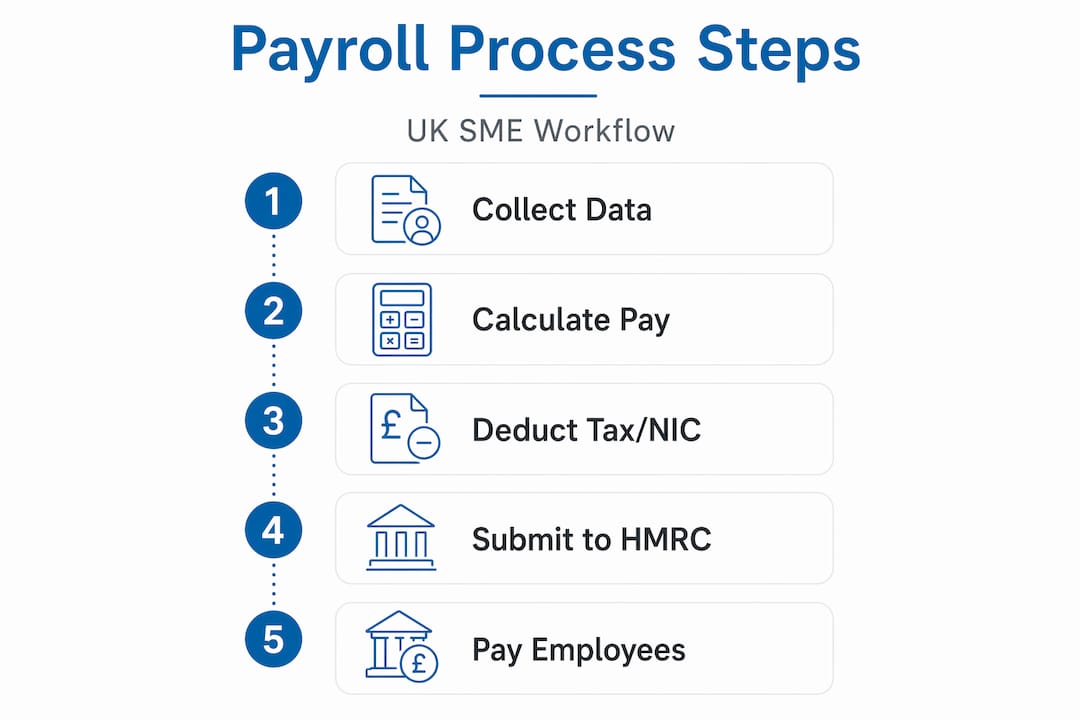
The payroll management process for most UK SMEs follows a clear rhythm: collect and verify employee data, calculate pay, run the payroll software, submit the FPS to HMRC, pay employees, and retain records. Repeating that cycle with precision each pay period is what separates a well-run payroll from a liability.
Pro Tip: Process discipline matters more than software choice. Before you select any payroll tool, write down who is responsible for each step in your pay cycle. Ambiguity about ownership is the most common reason errors slip through.
Legal requirements and compliance risks
UK payroll law is not limited to tax. The Employment Rights Act 1996 requires employers to pay wages on the agreed payday. Delay, even by a day, can give employees grounds for a formal complaint or legal action. That legal dimension is something many SME owners discover only after a dispute surfaces.
Here is what you need to stay on the right side of:
- Lawful deductions only. Deductions must be authorised in writing, either in the employment contract or with a separate signed agreement. You cannot deduct for breakages, errors, or shortfalls without meeting strict conditions, and any deduction must be shown clearly on the payslip.
- Payslip requirements. Since April 2019, all workers (not just employees) are entitled to a payslip. It must show hours worked where pay varies by hours.
- Starter and leaver obligations. When someone joins, you need their P45 or starter checklist to assign the correct tax code. When someone leaves, final pay calculations must account for outstanding holiday pay, and you must issue a P45. Mistakes here often trigger HMRC queries and employee complaints simultaneously.
- P60 at year end. Every employee still on your books at 5 April must receive a P60 by 31 May.
The table below summarises the key compliance obligations and their consequences if missed:
ObligationDeadlineRisk of non-complianceRTI Full Payment SubmissionOn or before paydayHMRC penalties and interestEmployer NIC payment22nd of following monthSurcharges and late payment interestPayslip issuanceOn or before paydayEmployment tribunal claimP45 for leaversAt point of leavingHMRC query and employee disputeP60 for current employeesBy 31 May each yearEmployee complaint and regulatory risk
Pro Tip: Document who owns each compliance task in your payroll process. If your payroll administrator is off sick, someone else needs to know exactly what to do and when. This single step has saved many SMEs from missed deadlines.
Benefits of effective payroll management
The benefits of payroll management extend well beyond avoiding fines. Done well, payroll actively strengthens your business in ways that are easy to overlook when you are focused on day-to-day operations.

The most direct benefit is employee trust. When staff are paid accurately and on time, every single month, it signals that the business is well-run. Conversely, a single payroll error, even an innocent one, creates anxiety and erodes confidence in leadership. For SMEs where culture and retention matter more than at large corporates, that is a real business risk.
Good payroll management also produces cleaner financial data. When payroll runs correctly, your labour costs are accurately recorded in your accounts, giving you reliable numbers for cash flow planning, budgeting, and salary reviews. Bad payroll creates reconciliation headaches that cost your finance team time every quarter.
Here are the practical benefits that well-managed payroll consistently delivers for UK SMEs:
- Reduced risk of HMRC penalties and interest charges
- Fewer employment disputes related to pay and deductions
- Accurate employer NIC calculations that feed into budgeting
- Better visibility of total employment costs including pension contributions
- A clear audit trail that protects the business in disputes
- Faster, more confident onboarding when new starters are processed correctly from day one
Payroll also connects directly to your pension auto-enrolment obligations. If pay is calculated incorrectly, pension contributions will be wrong too, creating a secondary compliance issue with The Pensions Regulator. Managing both together through an integrated process is far safer than treating them as separate workstreams.
Choosing payroll software or services
The question of how to manage payroll in your business comes down to three models: do it yourself using software, outsource it to a specialist, or use a hybrid where you handle data entry but someone else manages submissions and compliance.
If you are running payroll in-house, software is non-negotiable. The key features to look for when evaluating options:
- RTI compliance. The software must generate and submit FPS and EPS (Employer Payment Summary) reports directly to HMRC. If it cannot do this, it is not fit for purpose in the UK.
- Auto-enrolment integration. Pension contribution calculations should be automated based on qualifying earnings, with submissions to your pension provider handled within the same workflow.
- Payslip generation. Employees should be able to access payslips digitally. Paper-only systems create distribution delays and record-keeping risks.
- Starter and leaver processing. The software should handle new starter declarations, P45 imports, and leaver workflows including P45 generation.
- Reporting. You need to see total payroll costs, employer NIC liabilities, and net pay summaries at a glance.
Outsourcing is worth serious consideration if your team lacks payroll expertise or if your headcount is growing quickly. You can read more about whether outsourcing payroll makes sense for your stage of business before committing either way.
For UK startups and growing businesses especially, working with a specialist accountancy firm that handles payroll as part of a broader service often proves more cost-effective than hiring a dedicated payroll administrator. The payroll setup steps for UK businesses differ depending on whether you are registering as an employer for the first time or migrating from one system to another, so getting specialist input early avoids expensive corrections later.
Practical steps to manage payroll accurately
The importance of payroll management is most visible in the workflow. Here is how the process runs for a typical UK SME doing monthly payroll:
- Register as an employer with HMRC. You must do this before your first payday. HMRC issues you a PAYE reference and an Accounts Office reference, both of which you will need for every submission. Allow up to five working days for registration.
- Collect and verify employee data. Before running payroll, confirm each employee’s name, National Insurance number, tax code, contracted hours, salary, and pension status. Errors in employee data are the most common cause of RTI corrections.
- Calculate gross and net pay. Apply the correct tax codes, run NIC calculations, deduct pension contributions, and process any other authorised deductions. Check each figure before proceeding.
- Submit the Full Payment Submission. The FPS must reach HMRC on or before payday. A practical payroll workflow involves submitting the FPS first, then releasing payment to employees. Not the other way around.
- Pay employees. Transfer net pay by BACS or faster payments. Issue payslips at the same time, whether electronically or in print.
- Pay HMRC. Income Tax and NIC collected during the month must be paid to HMRC by the 22nd of the following month if paying electronically. Missing this deadline triggers automatic interest charges.
- Handle starters and leavers. Process any new starters on the next available pay run using their P45 or starter checklist. For leavers, calculate final pay including accrued holiday, generate the P45, and update your records.
Repeating this sequence reliably, every pay period, is what payroll management actually looks like in practice.
My honest take on payroll complexity
I have worked with enough UK small business owners to know that payroll is routinely underestimated. Not because owners are careless, but because the process looks simpler from the outside than it is from the inside.
The RTI system in particular catches businesses off guard. Many assume that if they pay employees correctly, the HMRC reporting takes care of itself. It does not. RTI requires continuous reporting and errors must be corrected promptly, ideally before the next pay cycle. I have seen businesses accumulate RTI discrepancies over months because no one realised a correction was needed until HMRC raised a query.
The other area I see go wrong consistently is the handover between people. When the person who runs payroll changes, whether through resignation or role expansion, the new person often inherits an undocumented process and makes errors simply because no one wrote down the steps. Documenting payroll responsibilities and workflows is the single best risk-reduction measure available to an SME, and it costs nothing except an afternoon.
My honest advice: treat payroll as a legal obligation with operational consequences, not as an admin task. The businesses that get it right invest in clear processes, decent software, and either trained people or a reliable external partner. The ones that struggle tend to treat it as something anyone can pick up and run with minimal preparation. That assumption is where the problems start.
— Rahamut
How Priceandaccountants can help with payroll
Payroll compliance is one of those areas where good intentions are not enough. You need the right processes, the right software, and ideally someone who has seen every edge case that UK employment law can throw at a growing business.

At Priceandaccountants, we handle payroll and pension administration as part of a broader suite of services that includes bookkeeping and HMRC reporting for UK SMEs. Whether you need a complete managed payroll service, help migrating to a new system, or simply want your existing payroll reviewed for compliance gaps, our team brings over 40 years of expertise to your specific situation. We also offer tax advisory support to make sure your employer NIC planning and payroll cost management feed into your broader financial strategy. Get in touch to find out how we can take this off your plate.
FAQ
What is the payroll management definition in simple terms?
Payroll management is the process of calculating employee pay, deducting the correct Income Tax and National Insurance, submitting reports to HMRC, and paying staff on time. It covers every step from data collection to year-end reporting.
What does payroll management do for UK employers?
It keeps your business compliant with PAYE, RTI, and employment law obligations while making sure every employee is paid accurately and on time. It also produces the financial records you need for budgeting and HMRC reporting.
How often must UK employers submit RTI reports?
Employers must submit a Full Payment Submission to HMRC on or before every payday. This applies whether you pay weekly, fortnightly, or monthly, with no exceptions for small businesses.
What are the risks of poor payroll management?
Poor payroll management can result in HMRC penalties, interest charges on late payments, employment tribunal claims for unlawful deductions or late wages, and damage to employee trust and retention.
What is the best payroll software for UK small businesses?
The best payroll software for UK SMEs integrates RTI submissions directly with HMRC, handles auto-enrolment pension calculations, and generates compliant payslips. Choosing a solution that fits your team size and level of in-house expertise matters more than choosing the most feature-rich option available.
Recommended
- How to manage small business payroll for UK tech teams - Price & Accountants
- UK startup payroll obligations: a clear founder’s guide - Price & Accountants
- Best practices for payroll: a tech startup founder’s guide - Price & Accountants
- Why outsource payroll: Efficient solutions for UK tech startups - Price & Accountants