

If you want your investors to claim EIS relief, do not raise the money on a convertible loan note. HMRC treats a convertible note as debt, and shares issued when a loan converts do not count as new money raised. The route founders use instead is an advance subscription agreement (ASA), kept simple and short, with the terms HMRC expects.
This guide explains the rule, the reasoning behind it, what a compliant bridge looks like and how to avoid the mistakes that cost investors their relief.
TL;DR
- A convertible loan note is debt until it converts. HMRC’s guidance says that shares issued to liquidate a loan or convert loan stock do not count as a qualifying raising of money.
- An advance subscription agreement can work for EIS, but only if it is non-refundable, carries no interest, cannot be varied, cancelled or assigned, and has a longstop date for issuing shares.
- HMRC expects the longstop date to be no more than six months from the agreement date, and it is likely to refuse relief if you go beyond that.
- Anything that shields the investor from loss, such as security or priority repayment, can fail the risk-to-capital condition.
- Apply for Advance Assurance before you take the money, and disclose the ASA terms in full.
Table of Contents
- Why a convertible note and EIS pull in opposite directions
- The risk-to-capital condition: the second trap
- Advance subscription agreements: the bridge HMRC accepts
- How to structure the round step by step
- Perspective: what we see with founders
- When a convertible note is still the right call
- Related tax point: what happens if a loan is released
- How we help
- FAQ
- Sources
Why a convertible note and EIS pull in opposite directions
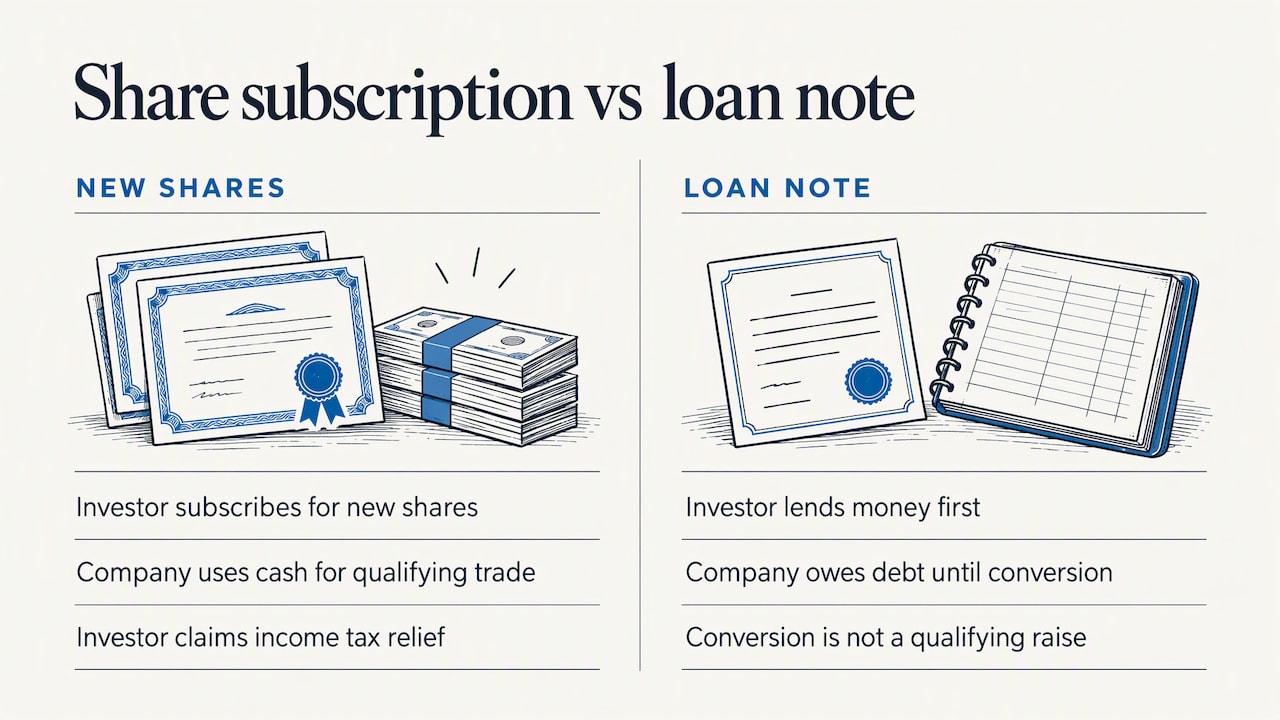
EIS exists to reward investors for putting capital genuinely at risk in a young company. The investor subscribes for new shares, the company uses the cash for a qualifying trade, and the investor claims income tax relief. As of 6 April 2026, EIS offers 30% income tax relief on subscriptions for new shares, with an annual company limit of £10 million and a lifetime limit of £24 million.
A convertible loan note works the other way round. The investor lends money first and decides later, or the terms decide later, whether it becomes shares. Until conversion it is a debt owed by the company, usually with interest and a repayment date. That is exactly what EIS is designed to exclude.
The SEIS manual is blunt on the mechanics. Shares issued in consideration for the liquidation of a loan, or by the conversion of loan stock, do not raise money for the purpose of a qualifying business activity. The EIS manual takes the same line on its general requirements. For that reason the loan-to-equity conversion is the point where the relief fails, not the point where it is claimed.
What this means for your seed round
In practice, three situations catch founders out:
- An angel offers to lend you £100,000 now on a convertible note and says the EIS paperwork can be sorted when the round closes. It cannot be sorted retrospectively: the conversion shares are not a qualifying issue.
- A UK investor wants the same note your US investors signed. US-style convertible notes and SAFEs are built around a different tax system. They do not map onto EIS.
- You already issued a note and now want to bring EIS investors into the priced round. The note holders will probably not get relief on conversion, though new investors who subscribe for shares directly can still be eligible if the company qualifies.
None of this makes convertible notes illegal or foolish. For investors who do not need EIS or SEIS, such as overseas funds or some corporate investors, they can be a perfectly sensible instrument. The problem arises only when you mix them with investors who expect tax relief.
The risk-to-capital condition: the second trap
Even if you avoid a loan note, the structure of the deal can still fail. HMRC applies a risk-to-capital condition with two parts. The first asks whether the company intends to grow and develop its trade. The second asks whether the investor faces a real risk of losing their capital.
This matters for any bridge instrument because most of the features that make a note attractive to a cautious lender are exactly the features that remove risk:
- security over company assets
- priority repayment ahead of other creditors or shareholders
- guaranteed returns or a fixed redemption amount
- intercompany loan arrangements that route money in a way that protects the investor
We tell founders to run one test on every term sheet: is the investor’s only route to a return the success of the business? If a clause gives them another route, take it out or expect questions from HMRC.
Advance subscription agreements: the bridge HMRC accepts
An ASA lets an investor pay subscription money into the company before the shares are issued, typically because the company’s value cannot yet be agreed. HMRC’s manual says ASAs are sometimes used to raise funds quickly when share value cannot easily be ascertained. It also sets the bar for EIS. HMRC will not consider an ASA suitable unless it:
- does not permit the subscription payment to be refunded under any circumstances
- cannot be varied, cancelled or assigned
- bears no interest charge
- has a longstop date by which the shares must be issued
The manual adds that the more complex the agreement, or the longer the gap between payment and share issue, the higher the risk that the EIS rules will not be met. HMRC also expects the company to show how the timing and terms fit its business plan and planned spending on growth.
The six-month longstop
HMRC strongly advises a longstop date of no more than six months from the agreement date, and it is usually a condition of advance assurance. Go beyond that and it becomes highly likely that EIS eligibility will be refused. If your next priced round is unlikely to close within six months, an ASA is the wrong tool, and you should talk to an adviser before you sign anything.
Convertible note versus ASA at a glance
| Feature | Convertible loan note | ASA built for EIS |
|---|---|---|
| Legal nature | Debt that may convert | Advance payment for shares |
| Interest | Usually accrues | None allowed |
| Refundable | Repayable at maturity | Not refundable in any circumstances |
| Maturity or longstop | Often 12 to 24 months | Six months or less is the norm HMRC expects |
| EIS relief on conversion shares | Not available | Possible if all conditions are met |
| Can be varied or assigned | Often yes | No |
The table is a summary, not a drafting guide. Your solicitor drafts the agreement, and your accountant checks that the tax position holds.
How to structure the round step by step
- Decide who is investing. List which investors want EIS or SEIS relief and which do not. Mixed rounds are common, so you may need two instruments or one clean priced round.
- Check the company qualifies. Gross asset limits are £30 million before the share issue and £35 million immediately after, according to the April 2026 government announcement. Age, trade and employee tests apply too. Our EIS eligibility guide walks through them.
- Apply for Advance Assurance with the ASA terms included. HMRC is clear that assurance is not an automated approval. It expects full disclosure of your capital structure and a clear business plan with intended use of funds. See our guides to EIS advance assurance and SEIS advance assurance.
- Draft the ASA against HMRC’s conditions. No interest, no refund, no variation, a longstop of six months or less. Our overview of the advance subscription agreement covers what founders and investors should see in the document.
- Issue ordinary shares on or before the longstop date. Keep the share issue clean: new, fully paid ordinary shares with no preferential rights that would erode the investor’s risk.
- File the compliance statement. After the shares are issued and trading conditions are met, the company submits its EIS compliance statement so investors can claim relief.
Perspective: what we see with founders
Most of the convertible note questions we get arrive late. A founder has a friendly angel, a handshake on a number and a template found online, and only then asks whether it works for EIS. By that point the cheapest fix is a redraft, and the most expensive is a note already signed and funded.
We work with tech and fintech companies from pre-seed to Series A, and the pattern is consistent. The founders who raise smoothly decide the investor mix first, then pick the instrument. They treat Advance Assurance as a checkpoint rather than a formality, and they keep their cap table simple enough that an HMRC caseworker can follow it in one sitting.
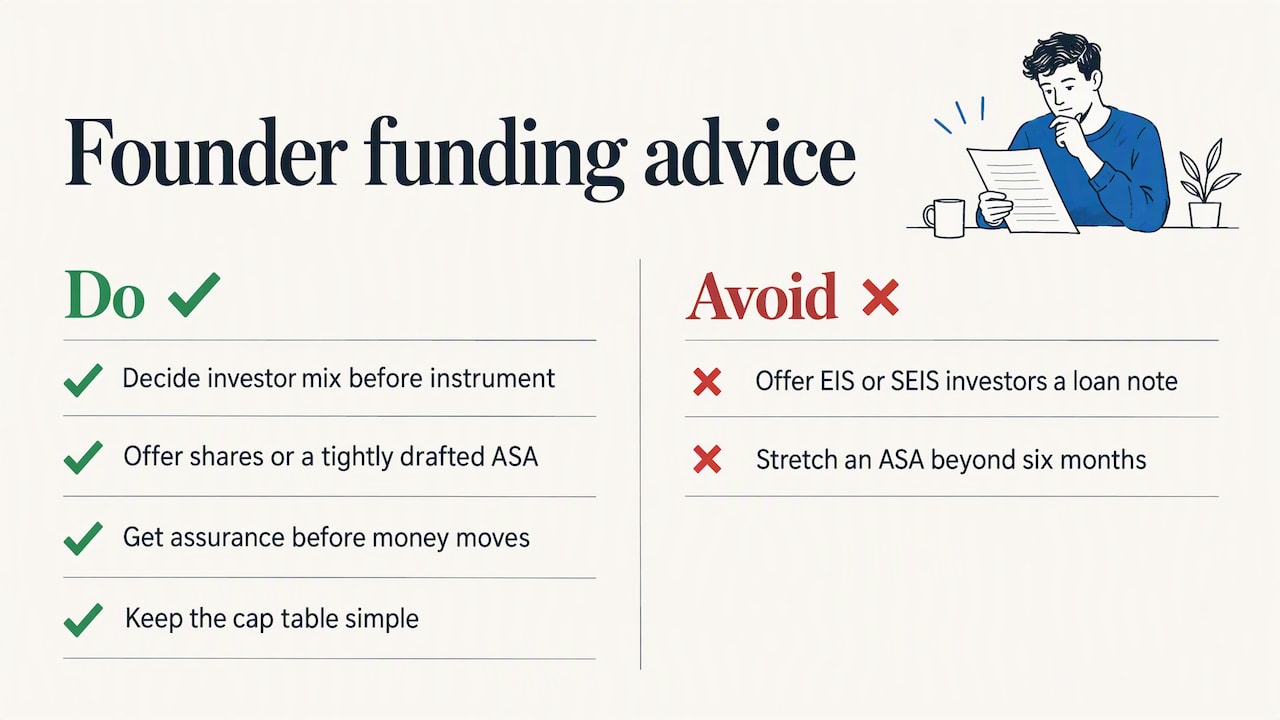
Our advice is plain. If any investor in your round expects EIS or SEIS relief, do not offer them a loan note. Offer them shares, or a tightly drafted ASA with a short longstop, and get the assurance before the money moves. If the round slips beyond six months, go back to the investors and agree a priced round rather than stretching the ASA.
Having completed start-up processes for over 20 clients, we have seen how much easier a later Series A is when the early investors’ relief is intact. Investors who keep their relief tend to be investors who come back.
— Rahamut
When a convertible note is still the right call
It would be wrong to say notes are always a mistake. They suit some situations:
- Overseas or institutional investors who have no use for UK income tax relief and want the speed and familiarity of a note.
- Bridge money from existing shareholders who have already had their EIS relief and are not seeking more.
- Rounds where no investor wants EIS or SEIS and the company would rather keep terms flexible.
If you do mix, keep the instruments separate and say so in the documents. An EIS investor should never sit in the same convertible instrument as a lender who has security or a repayment right. Better still, close a single priced round for everyone.
Related tax point: what happens if a loan is released
Founders sometimes ask what happens to an existing loan that is written off rather than converted, for example between group companies. HMRC’s corporate finance manual explains that where the creditor and debtor are connected companies, a release of a trade debt is generally tax-neutral under the loan relationship rules. Between unconnected parties, the outcome typically differs: the debtor can have a taxable credit and the creditor an allowable loss. That is a corporation tax question, separate from EIS, and it deserves proper advice before you write anything off.
How we help
We handle SEIS and EIS work for UK tech and fintech start-ups: share structure, Advance Assurance applications, compliance statements and the accounting that sits behind them. Our Strategic Advisory and Tax Planning service covers funding structure questions like the ones in this article, and our virtual finance director service supports founders through a raise.
Our published plans start at £249 per month for Core Services and £549 per month for the Blue Plan, with the Black Plan from £1,999 per month. You can compare them on our pricing page, or see the full list of services. Funding structure advice does not have a published price, so we scope it with you first.
FAQ
Can I use a convertible loan note and still offer EIS to investors?
Not for the money lent under the note. HMRC says that shares issued by converting loan stock do not count as a qualifying raising of money, so note holders cannot rely on EIS relief on conversion. Other investors who subscribe directly for new shares may still qualify.
Is an ASA the same as a convertible note?
No. An ASA is an advance payment for shares, not a loan. It must carry no interest, allow no refund and not be capable of variation, cancellation or assignment, and it needs a longstop date for issuing the shares.
How long can an ASA run for EIS purposes?
HMRC strongly advises a longstop date of no more than six months from the agreement date, and it typically expects this for advance assurance. A longer period makes it highly likely that relief will be refused.
Do I need Advance Assurance before raising on an ASA?
It is not mandatory for investors to claim EIS relief, but HMRC will review the ASA terms if you apply, which gives you and your investors comfort before money moves. HMRC may refuse speculative applications, so have your business plan and use of funds ready.
Sources
- VCM12025: EIS advance subscription agreements, HMRC internal manual
- VCM33030: SEIS purpose of the issue requirement, HMRC internal manual
- VCM8540: risk-to-capital condition, HMRC internal manual
- VCM60110: advance assurance, HMRC internal manual
- Britain’s innovators backed with around £100m of new investment, GOV.UK
- CFM41070: releases of trade debts between connected companies, HMRC internal manual